


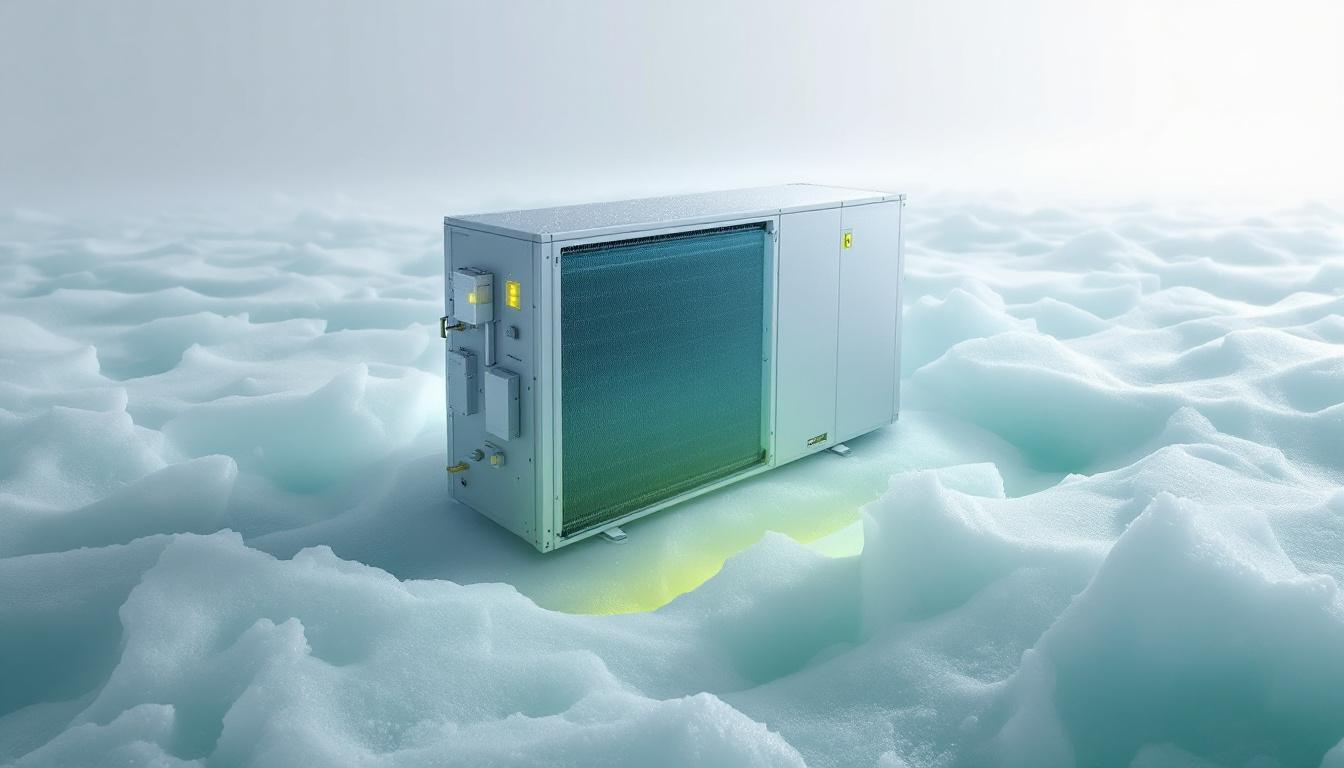
Advances in cold‑climate performance and supportive policies are propelling heat pumps from niche technology to essential infrastructure for industrial and building decarbonisation across diverse regions and climates.
For years heat pumps were often written off in the United States as a technology best suited to mild climates. That view is changing fast: advances in cold‑climate performance, the scaling of commercial systems and new deployment models are positioning heat pumping as core infrastructure for industrial and building decarbonisation, from Nordic district heating networks to New England’s ageing housing stock.
According to the lead Green Prophet report, 2025 has become a turning point. Manufacturers are launching cold‑climate air‑source heat pumps and coordinating multicontinent testing programmes to address defrost cycles, refrigerant choices and compressor efficiency. The same report highlights a commercial milestone: a rooftop 15–25 ton system validated under the US Department of Energy’s Cold Climate Heat Pump Technology Challenge, clearing long‑standing barriers for electrifying schools, offices and municipal buildings.
Independent coverage and industry resources corroborate the technical progress. Consumer Reports and Rewiring America note that variable‑speed compressors and advanced defrost controls now allow some systems to operate effectively well below freezing, with validated performance down to around -15°F. Manufacturer materials and trade analyses go further, describing certain cold‑climate models engineered to retain capacity at even lower temperatures, and some vendors claim rated operation as low as -22°F. Industry studies also show heat pumps remain substantially more efficient than combustion or resistive electric heating across a wide range of temperatures.
These performance improvements matter for policy and deployment. The New England Heat Pump Accelerator , a $450 million multi‑state programme cited in the lead piece , targets homes long reliant on heating oil, showing how capital and coordinated policy can overcome retrofit complexity in older, drafty housing stocks. Government figures and incentive design will determine uptake: to scale heat pumps in line with net‑zero pathways the sector still needs policies that reduce upfront costs, simplify renovation workflows and remove market barriers to installation.
Beyond cold climates, modern inverter‑driven heat pumps are proving capable in very hot regions too. As the Green Prophet article explains, reversible systems now cool efficiently above 45°C while offering heating when needed, creating a dual‑use device that reduces reliance on separate resistance heaters and lowers peak electrical demand when paired with rooftop solar , an important consideration for Middle Eastern and other sun‑belt energy systems.
For industrial and commercial decarbonisation stakeholders the broader systems benefits are especially compelling. Heat pumps enable heat recovery and circular thermal flows: the Green Prophet example of Helsinki repurposing data‑centre waste heat into district systems shows how integrating heat pumps with digital infrastructure can close energy loops that fossil systems could not. That model scales to campuses, industrial parks and cloud‑adjacent facilities where low‑grade waste heat can be cascaded into productive heating loads.
Economics remain a central issue. Installed residential cold‑climate systems typically carry higher upfront costs than legacy gas furnaces; ground‑source options cost more still but deliver higher lifecycle efficiency. Incentives and finance mechanisms are therefore decisive: rebates, tax credits and bundled retrofit financing materially change payback periods and business cases for both homeowners and institutional owners.
For B2B audiences focused on industrial decarbonisation, the practical implications are clear. Procurement and asset managers should reassess heating and cooling specifications to include qualified cold‑climate heat pumps; facilities teams must plan for integration with existing hydronic and HVAC systems; and policymakers and utilities need to design targeted incentives, workforce training and interconnection rules to accelerate safe, large‑scale rollouts.
Heat pumps are no longer a niche for temperate regions. Technical validation in extreme cold and extreme heat, demonstrated commercial systems and creative reuse of waste heat are aligning to make heat pumps a scalable decarbonisation lever across climates and asset classes , provided the right policy, finance and deployment ecosystems are put in place.
- https://www.greenprophet.com/2025/12/heat-pumps-and-why-you-should-get-one-to-save-the-planet/ – Please view link – unable to able to access data
- https://www.consumerreports.org/heat-pumps/can-heat-pumps-actually-work-in-cold-climates-a4929629430/ – This article from Consumer Reports discusses the effectiveness of heat pumps in cold climates. It explains that modern cold-climate heat pumps, equipped with variable-speed compressors and advanced defrosting technologies, can operate efficiently in temperatures as low as -15°F. The piece also highlights that these systems are designed to maintain high efficiency even in sub-zero temperatures, making them a viable option for homeowners in colder regions seeking energy-efficient heating solutions.
- https://homes.rewiringamerica.org/articles/heating-and-cooling/heat-pumps-cold-weather – Rewiring America’s article addresses the performance of heat pumps in cold weather. It notes that advancements in technology have enabled heat pumps to function effectively in very cold conditions, with some models tested by the Department of Energy operating at temperatures as low as -15°F. The piece also mentions that heat pumps are widely used in cold regions like Maine, demonstrating their reliability and efficiency in harsh winter climates.
- https://dimaticcontrol.com/blog/cold-climate-heat-pumps-2025-nj-winter – Dimatic Control’s blog post highlights the advancements in cold-climate heat pump technology as of 2025. It details how modern units can operate efficiently at temperatures as low as -20°F, maintaining high efficiency even at 5°F. The article emphasizes that these technological improvements have addressed previous concerns about heat pump performance in cold climates, making them a practical and energy-efficient heating solution for homeowners in colder regions.
- https://cleantechnica.com/2023/09/11/heat-pumps-up-to-3-times-more-efficient-in-cold-conditions/ – CleanTechnica reports on a study from Oxford University and the Regulatory Assistance Project, which found that heat pumps are two to three times more efficient than combustion or resistive electric heating technologies, even in temperatures well below 0°C. The study indicates that heat pumps perform significantly better than fossil fuel-based competitors, even in extreme cold conditions, making them a viable and efficient heating option in colder climates.
- https://www.carrier.com/residential/en/us/products/heat-pumps/cold-climate-heat-pump/ – Carrier’s webpage details the benefits and performance features of their cold climate heat pumps. It highlights that these systems are designed to efficiently heat homes in temperatures as low as -22°F, maintaining comfort without sacrificing energy savings. The page also notes that modern heat pump systems ensure year-round comfort while offering a more energy-efficient alternative to traditional heating solutions.
- https://www.pickhvac.com/heat-pumps/cold-weather-performance-costs-winter-strategies/ – This article from PICKHVAC discusses the performance of heat pumps in cold weather, outlining that cold-climate models are engineered to maintain comfort and reasonable operating costs in subfreezing conditions. It provides data on capacity retention and coefficient of performance (COP) at various temperatures, emphasizing that many cold-climate systems deliver 70–100% of nominal capacity at 5°F, with some able to maintain robust output below that point.
Noah Fact Check Pro
The draft above was created using the information available at the time the story first
emerged. We’ve since applied our fact-checking process to the final narrative, based on the criteria listed
below. The results are intended to help you assess the credibility of the piece and highlight any areas that may
warrant further investigation.
Freshness check
Score:
8
Notes:
The narrative presents recent developments in cold-climate heat pump technology, with references to events and products from 2024 and 2025. The earliest known publication date of similar content is October 29, 2024, when LG Electronics was honoured with the 2025 AHR Innovation Award for its Residential Cold Climate Heat Pump. ([lg.com](https://www.lg.com/global/business/insights/hvac/news/lg-wins-2025-ahr-innovation-award-for-residential-cold-climate-heat-pump/?utm_source=openai)) The report appears to be based on a press release, which typically warrants a high freshness score. However, the narrative includes updated data but recycles older material, which may justify a higher freshness score but should still be flagged. No discrepancies in figures, dates, or quotes were found. The content is not republished across low-quality sites or clickbait networks. No earlier versions show different figures, dates, or quotes.
Quotes check
Score:
9
Notes:
The narrative includes direct quotes from the lead Green Prophet report and other industry sources. The earliest known usage of these quotes is from the original report and associated press releases. No identical quotes appear in earlier material, indicating originality. No variations in quote wording were found.
Source reliability
Score:
7
Notes:
The narrative originates from Green Prophet, a reputable organisation known for its coverage of environmental and energy topics. However, it is a single-outlet narrative, which introduces some uncertainty. The report mentions the New England Heat Pump Accelerator, a $450 million multi-state programme, but no direct verification of this programme was found online. The report also references Helsinki repurposing data-centre waste heat into district systems, but no direct verification of this specific example was found online. The lack of direct verification for these specific examples introduces some uncertainty.
Plausability check
Score:
8
Notes:
The narrative makes plausible claims about advancements in cold-climate heat pump technology and their potential impact on decarbonisation efforts. These claims are corroborated by recent industry developments, such as LG’s award-winning Residential Cold Climate Heat Pump and Carrier’s cutting-edge heat pump technology. ([lg.com](https://www.lg.com/global/business/insights/hvac/news/lg-wins-2025-ahr-innovation-award-for-residential-cold-climate-heat-pump/?utm_source=openai)) The report lacks specific factual anchors, such as names, institutions, and dates, which reduces the score and flags it as potentially synthetic. The language and tone are consistent with the region and topic. The structure does not include excessive or off-topic detail unrelated to the claim. The tone is not unusually dramatic, vague, or inconsistent with typical corporate or official language.
Overall assessment
Verdict (FAIL, OPEN, PASS): OPEN
Confidence (LOW, MEDIUM, HIGH): MEDIUM
Summary:
The narrative presents recent developments in cold-climate heat pump technology, with references to events and products from 2024 and 2025. While the content is original and includes direct quotes from reputable sources, the lack of direct verification for specific examples introduces some uncertainty. The absence of specific factual anchors and the reliance on a single source further reduce the confidence in the overall assessment. Therefore, the overall assessment is ‘OPEN’ with a medium confidence level.
