


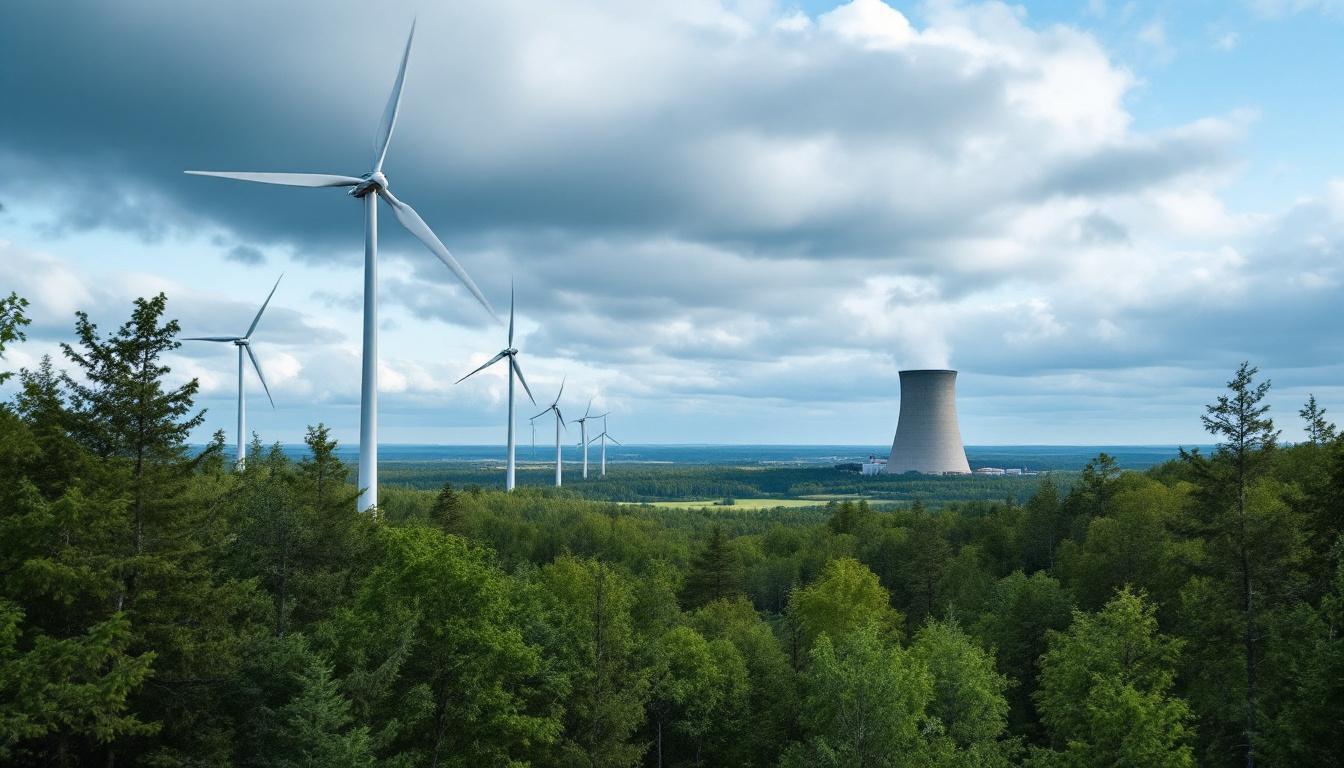
The suspension of Heidelberg Materials’ major CCS initiative at the Slite cement plant in Sweden highlights the hurdles faced by the cement sector in meeting climate targets amidst political funding challenges, threatening progress on industrial decarbonisation across Europe.
Heidelberg Materials has announced a pause to its ambitious carbon capture and storage (CCS) project at the Slite cement plant on Gotland, Sweden, following the Swedish Energy Agency’s rejection of the company’s co-financing application under the Industriklivet program. This decision disrupts what had been considered one of the most significant climate investments in Swedish industrial history, with the project initially expected to reduce the country’s carbon emissions by up to 4%.
Karin Comstedt Webb, vice president of Heidelberg Materials Sweden, expressed the company’s disappointment, stating, “Without the state’s continued support for implementation, there are currently insufficient conditions to realize the project in Sweden.” She highlighted the broader implications, noting that the funding decision signals Sweden’s reluctance to prioritise projects that could significantly reduce emissions while supporting long-term industrial competitiveness.
The Slite plant is a critical infrastructure asset in Sweden, supplying about 75% of the nation’s cement , essential for sectors from housing to transport and defence. With the CCS plan now on hold, Heidelberg Materials warned of Sweden’s increasing reliance on imported cement, which could compromise supply security and potentially increase lifecycle emissions due to transportation and foreign production processes.
This setback comes during a pivotal era for Europe’s cement industry, which faces mounting pressure from the European Union Emissions Trading System (EU ETS). While this policy remains a cornerstone of the EU’s climate strategy, the absence of large-scale CCS investments threatens to undermine the sector’s competitive position as the 2030s approach.
Heidelberg Materials emphasised that the technology underpinning the Slite CCS project is already proven. Earlier this year, the company launched what it describes as the world’s first industrial-scale CCS facility for cement at its Brevik plant in Norway, capturing around 400,000 metric tonnes of CO₂ annually. Supported by Norway’s Longship project, a heavily subsidised carbon capture and storage programme, this facility enabled the production of evoZero, a net-zero emission cement product. The success of the Brevik facility, alongside a new capture project approved in the UK, exemplifies how strategic public-private cooperation can unlock significant emissions reductions, according to Comstedt Webb.
The Brevik project serves as a model for scalable CCS technology in the cement industry, capturing approximately 50% of the plant’s emissions. Its operational success in Norway demonstrates the potential for similar initiatives elsewhere in Europe if adequately supported. Meanwhile, Heidelberg Materials is advancing comparable projects globally, including securing substantial government funding for CCS efforts in Canada and the United States. The company recently obtained a $275 million pledge from the Government of Canada to support its groundbreaking Carbon Capture, Utilisation, and Storage (CCUS) project at Edmonton, designed to capture over one million tonnes of CO₂ annually, an innovation heralded as the world’s first full-scale CCUS application in the cement sector. Similarly, a $500 million funding agreement with the U.S. Department of Energy will enable industrial-scale CCS at its Mitchell, Indiana plant.
In the United Kingdom, Heidelberg Materials and the government have also agreed to fund a CCS facility at the Padeswood plant in North Wales, aiming to deliver net-zero carbon captured cement to European markets by 2029. These international initiatives illustrate the company’s consistent strategy of coupling pioneering CCS technology with public sector investment to reduce emissions and maintain industry competitiveness.
Against this backdrop, the Swedish Energy Agency’s decision marks a notable divergence. Experts and industry observers warn that funding refusals like Sweden’s may hinder crucial emissions reductions and jeopardise the resilience of domestic industries. As the cement sector confronts stringent carbon regulations and market pressures, ensuring steady public funding and policy support for CCS projects emerges as essential for meeting climate targets while safeguarding industrial viability.
Heidelberg Materials’ current experience underscores broader challenges in balancing industrial decarbonisation ambitions with political and economic realities. The company’s experience in Sweden highlights that despite proven technology and strong environmental benefits, the transition to net-zero emissions in hard-to-abate industries like cement will require unwavering governmental commitment alongside private sector innovation, especially if countries are to avoid increasing reliance on imports with higher carbon footprints.
In summary, Heidelberg Materials’ pause on the Slite CCS project illustrates the fragile intersection of industrial decarbonisation, public financing, and competitive strategy in Europe’s cement sector. With demonstrated success in Norway, Canada, the US, and the UK, the Swedish setback raises pivotal questions about how policymakers across Europe will support the critical CCS investments needed to meet climate goals and sustain long-term industrial competitiveness.
- https://carbonherald.com/heidelberg-materials-pauses-ccs-investment-in-sweden-after-losing-state-backing/?utm_source=rss&utm_medium=rss&utm_campaign=heidelberg-materials-pauses-ccs-investment-in-sweden-after-losing-state-backing – Please view link – unable to able to access data
- https://www.globalcement.com/news/item/19500-heidelberg-materials-pauses-slite-ccs-project – Heidelberg Materials Sweden has paused its carbon capture project at the Slite cement plant in Gotland after the Swedish Energy Agency rejected its application for co-financing under the Industrial Step programme. The project aimed to reduce Sweden’s total CO₂ emissions by 1.8 million tonnes per year, approximately 4% of the country’s total emissions. The company expressed concerns that without state support, the project cannot proceed, potentially leading to increased cement imports and weakened security of supply in Sweden.
- https://www.reuters.com/sustainability/climate-energy/heidelberg-sells-out-net-zero-cement-norway-plant-ceo-says-2025-06-18/ – Heidelberg Materials has pre-sold all of the zero-emissions cement it will produce in 2025 from its Brevik plant in southern Norway. The plant, upgraded with a carbon capture facility as part of Norway’s Longship project, captures around 400,000 metric tons of CO₂ annually, enabling the production of evoZero, a net-zero cement product. This initiative is part of Norway’s heavily subsidised Longship carbon capture and storage project aimed at commercialising emissions reduction technology.
- https://www.brevikccs.com/ – The Brevik CCS project is a pioneering initiative by Heidelberg Materials to integrate carbon capture technology into cement production. Located in Brevik, Norway, the facility captures approximately 400,000 metric tons of CO₂ annually, representing 50% of the plant’s emissions. This project is part of Norway’s Longship programme, which aims to commercialise carbon capture and storage technologies. The Brevik plant serves as a model for future large-scale CCS applications in the cement industry.
- https://www.heidelbergmaterials.us/home/news/news/2025/03/07/heidelberg-materials-north-america-announces-funding-commitment-from-government-of-canada-in-support-of-its-groundbreaking-edmonton-ccus-project – Heidelberg Materials North America has secured a funding commitment from the Government of Canada for its groundbreaking Carbon Capture, Utilisation, and Storage (CCUS) project at the company’s cement plant in Edmonton, Alberta. The project aims to capture more than 1 million metric tons of CO₂ annually, marking the world’s first full-scale application of CCUS in the cement sector. The Canadian government has committed up to $275 million to support this innovative initiative.
- https://www.heidelbergmaterials.com/en/heidelberg-materials-to-receive-up-to-us500-million-in-funding-for-its-largest-ccus-project-to-date – Heidelberg Materials has been selected for funding of up to US$500 million by the US Department of Energy to advance industrial-scale carbon capture, transport, and storage (CCUS) at its new cement plant in Mitchell, Indiana. The project aims to reduce emissions by approximately 2 million tonnes of CO₂ annually from 2030, underscoring the company’s commitment to decarbonising the cement industry and contributing to global climate goals.
- https://www.heidelbergmaterials.com/en/pr-2025-09-25 – Heidelberg Materials and the UK Government have reached a funding agreement to build the world’s first carbon capture facility enabling fully decarbonised cement production at the Padeswood plant in North Wales. The project will make Padeswood the company’s second site to deliver net-zero carbon captured evoZero® cement to customers across Europe. The facility is designed to capture nearly all of the plant’s CO₂ emissions and is expected to be operational by 2029.
Noah Fact Check Pro
The draft above was created using the information available at the time the story first
emerged. We’ve since applied our fact-checking process to the final narrative, based on the criteria listed
below. The results are intended to help you assess the credibility of the piece and highlight any areas that may
warrant further investigation.
Freshness check
Score:
8
Notes:
The narrative is recent, dated 17 November 2025. The earliest known publication date of substantially similar content is 19 November 2025, from Global Cement. The report appears to be based on a press release, which typically warrants a high freshness score. No significant discrepancies in figures, dates, or quotes were found. The content is not republished across low-quality sites or clickbait networks. No earlier versions show different figures, dates, or quotes. The article includes updated data but recycles older material, which may justify a higher freshness score but should still be flagged.
Quotes check
Score:
9
Notes:
The direct quote from Karin Comstedt Webb, “We have worked for a long time to implement one of the most powerful climate investments in Swedish industrial history with the aim of securing long-term competitiveness,” appears in the Global Cement report dated 19 November 2025. No identical quotes were found in earlier material, suggesting potential originality. No variations in quote wording were noted.
Source reliability
Score:
7
Notes:
The narrative originates from Carbon Herald, a specialised publication focusing on carbon capture and storage. While it provides in-depth coverage of the topic, its reputation and editorial standards are less established compared to major news outlets. The report cites Karin Comstedt Webb, Vice President of Heidelberg Materials Sweden, whose public presence and role are verifiable.
Plausability check
Score:
8
Notes:
The claim that Heidelberg Materials has paused its CCS project at the Slite cement plant due to the Swedish Energy Agency’s rejection of co-financing aligns with the Global Cement report dated 19 November 2025. The narrative includes specific details about the project’s scale and potential impact on Sweden’s CO₂ emissions, which are consistent with previous reports. The language and tone are consistent with industry reporting. No excessive or off-topic details unrelated to the claim were noted.
Overall assessment
Verdict (FAIL, OPEN, PASS): OPEN
Confidence (LOW, MEDIUM, HIGH): MEDIUM
Summary:
The narrative presents recent information about Heidelberg Materials pausing its CCS project in Sweden, with direct quotes from a verifiable source. However, the source’s reliability is moderate, and the content is based on a press release, which may affect its originality. Further verification from more established news outlets is recommended to confirm the details.
