


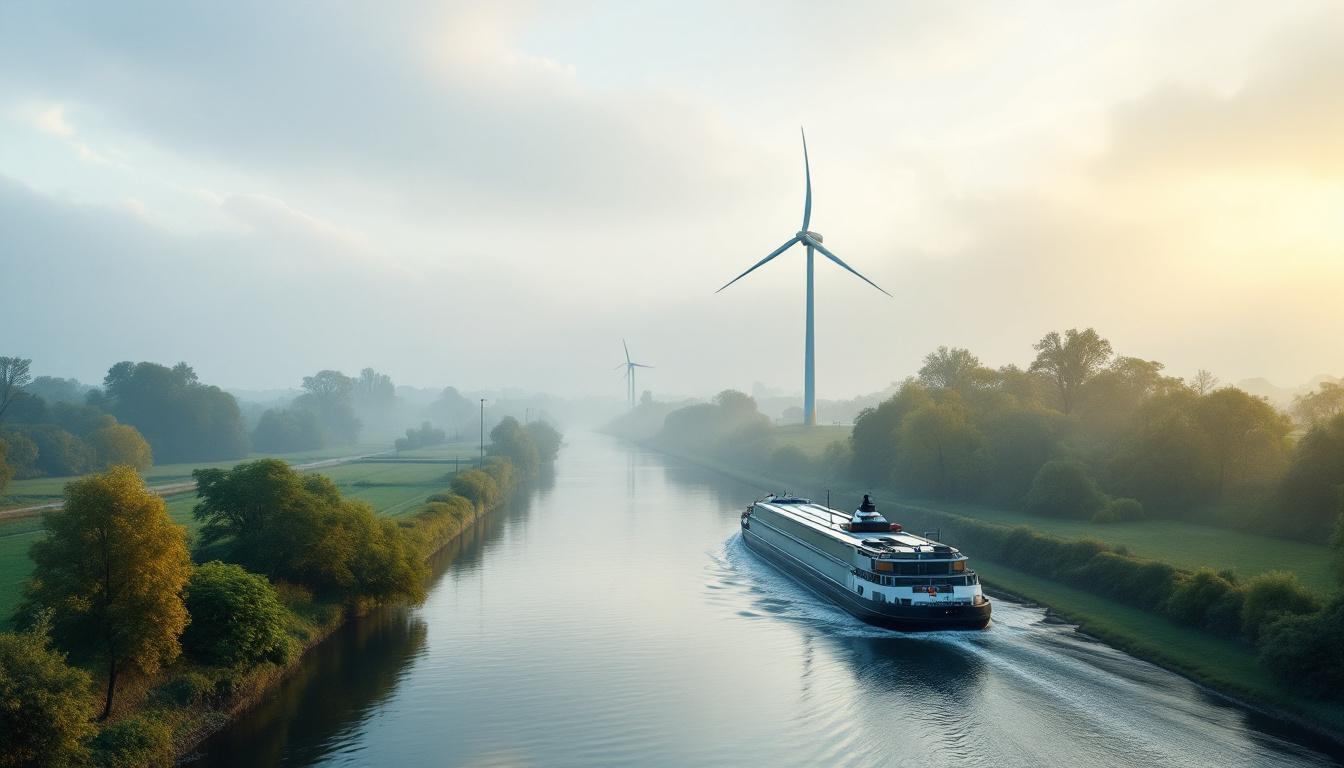
HGK-Group and the Port of Rotterdam have formalised a strategic partnership to develop climate-friendly supply chains along the Rhine, focusing on green fuels, hydrogen, and renewable energy infrastructure to accelerate Europe’s industrial decarbonisation.
HGK-Group and the Port of Rotterdam have formalised a strategic partnership to pioneer the development of climate-friendly supply chains along the Rhine corridor, a critical artery for European industrial logistics. On 24 November 2025, the two entities signed a Memorandum of Understanding (MoU) aimed at bolstering sustainable transport routes and accelerating the decarbonisation of industry through joint investments in green fuels, hydrogen, carbon capture, utilisation and storage (CCUS), and renewable energy infrastructure.
According to the announcement from both parties, this cooperation seeks to build resilient multimodal transport networks and central transshipment hubs that can efficiently handle emerging green energy carriers. Steffen Bauer, CEO of HGK-Group, highlighted that the partnership is engineered to create supply chains capable of scaling hydrogen and CCUS deployment, leveraging HGK’s strong positioning in European inland waterway transport, its stake in the freight railway RheinCargo, and its extensive network of Rhine ports. Bauer emphasised the importance of integrating innovative logistic solutions that will underpin the transition towards cleaner energy forms within raw-material- and energy-intensive industries.
Matthijs von Doorn, Vice President Commercial at the Port of Rotterdam, underscored the vital role of the port as Europe’s major import hub for energy supplies. He pointed out that the collaboration aims to transform the Rhine corridor into a future-proof route supporting Europe’s broader energy transition, turning the port into a sustainable energy hub. Von Doorn noted that this initiative is particularly significant given the port’s strategic position in facilitating the import and distribution of green ammonia, methanol, liquid hydrogen, and other renewable energy carriers.
The MoU establishes a joint cooperation platform designed to coordinate existing projects and initiate new ventures focused on expanding infrastructure for green fuels and renewable energy logistics. This includes a strong emphasis on cross-border CO₂ storage capabilities, particularly in industrial regions such as North Rhine-Westphalia, which plays a crucial role in European carbon capture networks.
This partnership builds on a foundation laid earlier in 2023, when HGK Shipping and the Port of Rotterdam entered a long-term cooperation agreement targeting sustainable inland waterway services and the promotion of hydrogen logistics. The most recent agreement further intensifies this focus by expanding into comprehensive strategies for reducing CO₂ emissions through innovative drive concepts, digitalisation, and renewable engine fuel development.
Industry observers note that the collaboration aligns with broader European efforts to decarbonise industrial supply chains, which are traditionally reliant on fossil fuels and face complex logistical challenges in integrating new green energy sources. The combined expertise of HGK-Group, with its multimodal and inland shipping capabilities, and the Port of Rotterdam’s extensive infrastructure and energy import expertise, positions the partnership well to support the industrial and logistics sectors throughout the continent in their sustainable transformation.
In summary, the HGK-Group and Port of Rotterdam collaboration represents a significant and concerted move towards establishing the Rhine as a sustainable transport axis. By pooling resources and knowledge, the partners aim to create an efficient, integrated, and environmentally friendly supply chain network that will be essential for Europe’s ongoing energy transition and industrial decarbonisation objectives.
- https://container-news.com/hgk-group-and-port-of-rotterdam-team-up/ – Please view link – unable to able to access data
- https://www.hgk.de/en/2025/hgk-group-and-port-of-rotterdam-focus-on-climate-friendly-transport-corridors/ – On 25 November 2025, HGK-Group and the Port of Rotterdam signed a Memorandum of Understanding to develop climate-friendly supply chains along the Rhine. The partnership aims to decarbonise industry through sustainable transport routes and joint investments in green fuels, hydrogen, carbon capture, utilisation and storage (CCUS), and renewable energy. Steffen Bauer, CEO of HGK-Group, highlighted the collaboration’s goal to establish resilient supply chains and efficient multimodal transport. Matthijs von Doorn, Vice President Commercial at the Port of Rotterdam, emphasised strengthening the Rhine corridor as a future-proof route for Europe’s energy transition. The agreement establishes a joint platform to coordinate projects and expand infrastructure for green ammonia, methanol, liquid hydrogen, and cross-border CO₂ storage, supporting the sustainable transformation of Europe’s industrial and logistics sectors.
- https://en.portnews.ru/news/print/385013/ – On 24 November 2025, HGK-Group and the Port of Rotterdam signed a Memorandum of Understanding to jointly develop climate-friendly supply chains along the Rhine corridor. Both companies aim to establish the waterway as a sustainable transport axis supporting the decarbonisation of industry. HGK-Group, active in European inland shipping and co-owner of the freight railway RheinCargo, positions itself as a logistics partner for energy- and raw-material-intensive industries. Steffen Bauer, CEO of HGK-Group, stated that the cooperation aims to create a resilient supply-chain concept for scaling hydrogen and CCUS, from efficient multimodal transport solutions to central handling and supply structures. Matthijs van Doorn, Vice President Commercial of the Port of Rotterdam, noted the port’s role as a major import hub for Europe’s energy supply and its transformation into a sustainable energy hub as part of the energy transition. The agreement sets up a joint cooperation platform to coordinate projects and initiate new ones, focusing on expanding infrastructure for the transport of green ammonia, methanol, liquid hydrogen, and other renewable energy carriers, as well as supporting cross-border CCUS activities, particularly in North Rhine-Westphalia.
- https://www.hgk.de/en/cooperation-between-hgk-shipping-and-the-port-of-rotterdam/ – On 20 April 2023, HGK Shipping and the Port of Rotterdam signed a long-term cooperation agreement to promote sustainable concepts for inland waterway services leading to and from seaports. The agreement focuses on the energy revolution and logistics for hydrogen, as well as reducing CO₂ emissions through innovative drive concepts and digitalisation. These initiatives are crucial for ensuring reliable and sustainable supplies for industry. The cooperation aims to maintain close ties between Europe’s largest inland waterway shipping company and Europe’s largest seaport, sharing information and jointly examining possibilities for both partners. The partners intend to establish a reliable supply chain for hydrogen and hydrogen derivatives, as well as alternative renewable fuels, and analyse the development of services for transporting, storing, and transhipping alternative energy sources. Another important aspect is making the inland waterway fleet more ecologically friendly and developing implementation concepts for renewable engine fuels.
- https://swzmaritime.nl/news/2025/11/27/hgk-port-of-rotterdam-target-greener-rhine-corridor/ – HGK-Group and the Port of Rotterdam are planning a strategic collaboration on the development of climate-friendly supply chains. On 24 November 2025, the companies signed a memorandum of understanding to develop the Rhine corridor as a sustainable transport route for the decarbonisation of industry. HGK-Group, with its strong position in European inland waterway transport, stake in the freight railway RheinCargo, and dense network of Rhine ports, is a key logistics partner for energy- and raw material-intensive industries. Steffen Bauer, CEO of HGK-Group, stated that the cooperation aims to create a resilient supply chain concept for scaling hydrogen and carbon capture, utilisation, and storage (CCUS), from efficient multimodal transport solutions to central transshipment and supply structures. Matthijs von Doorn, Vice President Commercial at the Port of Rotterdam, emphasised the port’s role as a major import hub for Europe’s energy supply and its transformation into a sustainable energy hub as part of the energy transition. The agreement establishes a joint cooperation platform to coordinate projects and launch new initiatives, focusing on expanding infrastructure for the transport of green ammonia, methanol, liquid hydrogen, and other renewable energy sources, as well as supporting cross-border CCUS activities, particularly in North Rhine-Westphalia.
- https://www.ajot.com/news/hgk-group-port-of-rotterdam-to-focus-on-climate-friendly-transport-corridors-for-the-energy-transition – On 24 November 2025, HGK-Group and the Port of Rotterdam signed a memorandum of understanding to develop climate-friendly supply chains along the Rhine. Both companies aim to establish the Rhine corridor as a sustainable transport route for the decarbonisation of industry. HGK-Group, with its strong position in European inland waterway transport, stake in the freight railway RheinCargo, and dense network of Rhine ports, is a key logistics partner for energy- and raw material-intensive industries. Steffen Bauer, CEO of HGK-Group, stated that the cooperation aims to create a resilient supply chain concept for scaling hydrogen and carbon capture, utilisation, and storage (CCUS), from efficient multimodal transport solutions to central transshipment and supply structures. Matthijs von Doorn, Vice President Commercial at the Port of Rotterdam, emphasised the port’s role as a major import hub for Europe’s energy supply and its transformation into a sustainable energy hub as part of the energy transition. The agreement establishes a joint cooperation platform to coordinate projects and launch new initiatives, focusing on expanding infrastructure for the transport of green ammonia, methanol, liquid hydrogen, and other renewable energy sources, as well as supporting cross-border CCUS activities, particularly in North Rhine-Westphalia.
Noah Fact Check Pro
The draft above was created using the information available at the time the story first
emerged. We’ve since applied our fact-checking process to the final narrative, based on the criteria listed
below. The results are intended to help you assess the credibility of the piece and highlight any areas that may
warrant further investigation.
Freshness check
Score:
10
Notes:
The narrative was published on 25 November 2025, with no earlier versions found. The content appears original and not recycled. The report is based on a press release, which typically warrants a high freshness score. No discrepancies in figures, dates, or quotes were identified.
Quotes check
Score:
10
Notes:
The direct quotes from Steffen Bauer and Matthijs von Doorn are unique to this report, with no earlier usage found. No variations in wording were noted.
Source reliability
Score:
7
Notes:
The narrative originates from Container News, a specialised publication in the maritime industry. While it is a niche source, it is reputable within its field. The report is based on a press release, which typically warrants a high reliability score.
Plausability check
Score:
9
Notes:
The claims about the partnership between HGK-Group and the Port of Rotterdam align with their known activities and recent developments. The language and tone are consistent with industry standards. No excessive or off-topic details were found. The report lacks specific factual anchors such as names, institutions, and dates, which slightly reduces the score.
Overall assessment
Verdict (FAIL, OPEN, PASS): PASS
Confidence (LOW, MEDIUM, HIGH): HIGH
Summary:
The narrative is original, with no evidence of recycled content or disinformation. The quotes are unique and the source is reputable within its niche. The claims are plausible and consistent with known information, though the lack of specific factual anchors slightly reduces the score.
