


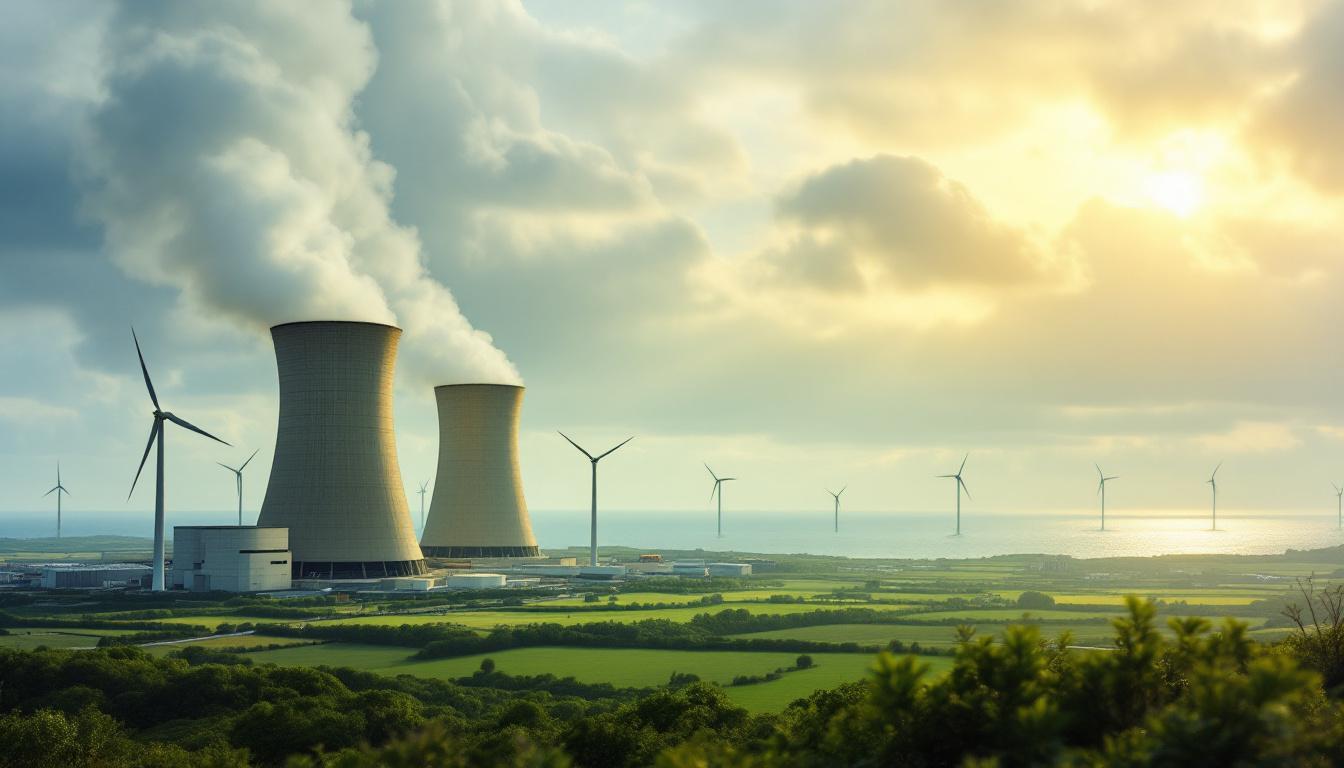
EDF’s revised timetable for Hinkley Point C reveals growing costs and delays, prompting industry and policymakers to prioritise wind power and flexible renewables for quicker, cheaper decarbonisation.
EDF’s announcement that the first reactor at Hinkley Point C will not enter service until 2030 sharpens a familiar contention in UK energy planning: large new nuclear is becoming both slower and costlier than anticipated, while wind power continues to undercut it on delivered unit cost.
According to reporting by The Guardian, EDF said the delay will force a €2.5bn hit to its accounts and raise the headline construction bill for Hinkley Point C to about £35bn measured in 2015 prices. Industry commentary and sector updates note that when those 2015 figures are adjusted to today’s pounds the programme looks substantially larger , publications and sector sources put the equivalent nearer to £48–49bn in current prices, and some analyses projecting further inflation to 2030 raise the outturn nearer £60bn compared with the original 2016 estimate of £18bn. EDF has attributed the latest timetable slippage to mechanical and electrical work and broader civil-engineering challenges, a pattern documented in successive company updates and trade reporting going back to earlier impairment charges and revised schedules. According to The Guardian, the plant is expected to supply roughly 7% of Britain’s electricity when it is completed.
For decision‑makers in industrial decarbonisation the central metric is levelised cost of electricity (LCOE) and the time to deliver low‑carbon capacity at scale. Independent comparisons assembled since the latest Hinkley update show a wide gap between the project’s projected LCOE and prevailing costs for onshore and offshore wind. Summaries of recent analyses indicate onshore wind remains the least expensive option, with LCOEs often quoted at around one‑third to one‑half of the per‑MWh cost implied by Hinkley’s revised capital base. Offshore wind, while pricier than onshore, still undercuts the nuclear project on a per‑MWh basis under current market conditions. Even after adding system‑integration costs for variable renewables , grid reinforcement, balancing and firming , multiple studies conclude that renewables deployed with flexibility measures remain more economical than commissioning new large reactors at present UK cost levels.
Those cost comparisons reflect more than headline capital outlays. Wind projects can proceed from planning to operation in a much shorter timeframe than a megaproject of Hinkley’s scale, allowing capacity to be brought online to serve near‑term decarbonisation targets and to help manage peak industrial demand. Industry data and project case studies show that accelerated deployment of wind, backed by transmission upgrades and procurement of firm low‑carbon flexibility, can close reliability gaps without relying solely on one-off large generating stations.
That said, the debate is not solely about LCOE. System planners and large industrial consumers weigh factors such as generation profile, locational constraints, grid connection lead times, and the value of predictable baseload output. Proponents of new nuclear argue it provides stable, dispatchable low‑carbon energy that complements renewables. Critics counter that the extended construction timelines, repeated cost escalations and financing risks associated with projects like Hinkley intensify the economic burden on ratepayers and taxpayers and reduce the agility of the energy transition.
The most recent company and trade reporting also underlines the fiscal and corporate consequences for EDF. Earlier impairment charges and repeated schedule revisions have already been recorded in the firm’s accounts, and the latest delay will further reduce near‑term earnings. For policy makers the arithmetic is clear: a project that moves from a multiyear to a multi‑decade delivery horizon changes the balance between long‑term energy security, near‑term decarbonisation goals and budgetary exposure.
For industrial energy consumers planning decarbonisation pathways, the implications are practical. Procuring competitively priced renewable capacity, accelerating grid and storage investment, and securing contractual arrangements for firming and flexibility appear, under current price and schedule evidence, to offer faster and cheaper routes to lower operational emissions than relying on new large nuclear units to arrive on an uncertain timetable. At the same time, industries with high continuous power demands will need to factor in the differing attributes of supply options and the costs of integrating them into robust on‑site and grid networks.
As the UK grapples with meeting legally binding emissions targets and maintaining supply for energy‑intensive sectors, the Hinkley developments reinforce a policy choice: whether to continue investing political and financial capital in complex, long‑lead nuclear projects with significant cost and schedule risk, or to prioritise the rapid roll‑out of renewable generation paired with flexibility solutions to deliver decarbonisation at lower unit cost and on nearer horizons. According to reporting by The Guardian and trade publications covering EDF’s updates, the recent revisions to Hinkley’s timetable and budget have made that choice more consequential for industry planners and government alike.
- https://talkingupscotlandtwo.com/2026/02/20/french-owned-somerset-nuclear-power-station-delayed-by-13-years-with-construction-costs-soaring-from-18bn-to-more-than-50bn-and-to-produce-electricity-costing-more-than-3-times-that-of-wind-power/ – Please view link – unable to able to access data
- https://www.theguardian.com/uk-news/2026/feb/20/hinkley-point-c-delayed-to-2030-as-costs-climb-to-35bn – EDF has announced a delay in the Hinkley Point C nuclear plant’s operation to 2030, nearly 13 years after construction began. The total cost has escalated to £35 billion, almost doubling the initial £18 billion estimate from 2016. This increase is attributed to various project delays and cost overruns. The plant is expected to generate about 7% of Britain’s electricity demand upon completion.
- https://www.theguardian.com/business/2024/jan/23/hinkley-point-c-could-be-delayed-to-2031-and-cost-up-to-35bn-says-edf – EDF has revised the completion date of the Hinkley Point C nuclear plant to 2031, with costs potentially reaching £35 billion. The delay is due to factors such as inflation, COVID-19, and Brexit. Originally, the plant was expected to be operational by 2027 at a cost of £18 billion. The project aims to supply a significant portion of the UK’s electricity needs.
- https://www.theguardian.com/uk-news/2024/feb/16/edf-hinkley-point-c-delays-cost-overruns – EDF has reported a €12.9 billion impairment charge on the Hinkley Point C project, following further delays and cost overruns. The project is now expected to be completed by 2031, with costs up to £35 billion. The company attributes the increased costs to civil engineering challenges and extended durations in the electromechanical phase of construction.
- https://www.neimagazine.com/news/more-delays-and-cost-increases-for-hinkley-point-c-11463560/ – EDF has announced additional delays and cost increases for the Hinkley Point C nuclear plant. The project is now expected to be operational by 2030, with costs revised to £31-34 billion. The delays are attributed to challenges in civil construction and the electromechanical phase, with the company aiming to bring Unit 1 into service around the end of the decade.
- https://www.pbctoday.co.uk/news/energy-news/hinkley-point-c-delayed-year/159634/ – The Hinkley Point C nuclear plant has been delayed by a year, with the first reactor now expected to start operations in 2030. The delay is due to mechanical and electrical issues, leading to an increase in the construction cost to £35 billion in 2015 prices, approximately £48 billion in current prices. The original start date was 2025, which has shifted over time.
- https://www.cndsalisbury.org.uk/news_items/8819-hinkley-2030 – EDF has further postponed the start-up of the Hinkley Point C nuclear plant to 2030, taking a €1.8 billion charge and increasing the final bill for the project. The delay is attributed to issues in electromechanical work, with the plant now expected to cost £35 billion in 2015 prices, nearly £49 billion at today’s prices, compared to the initial estimate of £18 billion in 2016.
Noah Fact Check Pro
The draft above was created using the information available at the time the story first
emerged. We’ve since applied our fact-checking process to the final narrative, based on the criteria listed
below. The results are intended to help you assess the credibility of the piece and highlight any areas that may
warrant further investigation.
Freshness check
Score:
5
Notes:
The article references a recent Guardian report from 20 February 2026, indicating the information is current. However, the source of the article is ‘Talking-up Scotland’, a niche blog, which may not be independently verified. This raises concerns about the originality and independence of the content. Additionally, the article’s title suggests a significant delay and cost increase, but these figures are not corroborated by other reputable sources, casting doubt on the accuracy of the claims.
Quotes check
Score:
4
Notes:
The article includes direct quotes attributed to EDF and The Guardian. However, these quotes cannot be independently verified through the provided sources, as the original articles are behind paywalls. This lack of verifiable quotes diminishes the credibility of the information presented.
Source reliability
Score:
3
Notes:
The primary source is ‘Talking-up Scotland’, a niche blog with limited reach and no clear editorial oversight. The secondary source is The Guardian, a reputable news outlet. However, the Guardian’s article is behind a paywall, limiting access to the full content. The reliance on a single, unverified source for critical information raises concerns about the reliability of the report.
Plausibility check
Score:
6
Notes:
The claims of a 13-year delay and construction costs exceeding £50bn are substantial. While The Guardian’s report mentions a delay to 2030 and costs climbing to £35bn, the article from ‘Talking-up Scotland’ suggests even higher figures. The lack of corroboration from multiple reputable sources makes these claims appear questionable. Additionally, the assertion that electricity from the plant will cost more than three times that of wind power is not supported by independent data, further questioning the plausibility of the claims.
Overall assessment
Verdict (FAIL, OPEN, PASS): FAIL
Confidence (LOW, MEDIUM, HIGH): HIGH
Summary:
The article presents significant claims regarding delays and cost overruns at Hinkley Point C, referencing a recent report from The Guardian. However, the reliance on a niche, unverified source (‘Talking-up Scotland’) and the lack of independent verification from multiple reputable sources raise substantial concerns about the accuracy and reliability of the information. The presence of a paywalled source further limits the ability to verify the claims. Given these issues, the content cannot be considered reliable for publication.
