


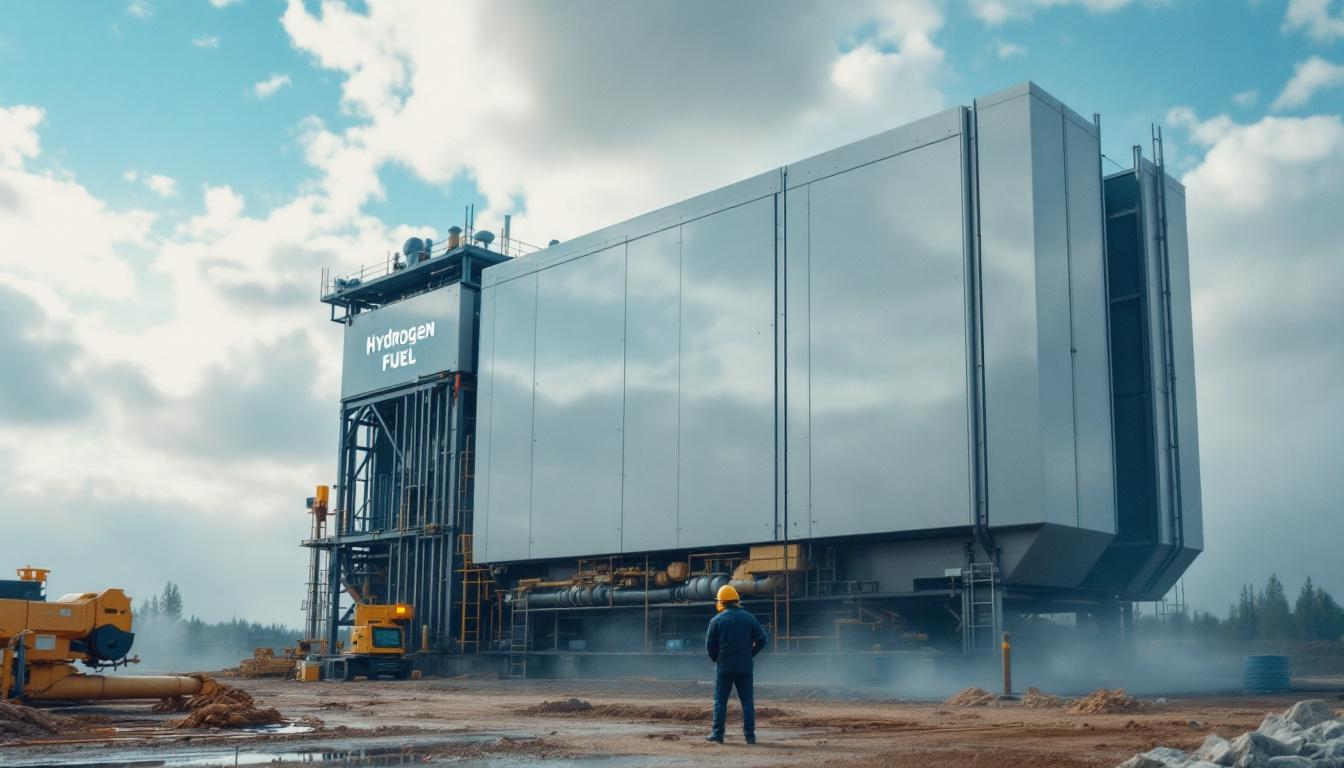
Hitachi Energy’s four-week trial at a UK construction site demonstrates the commercial viability of using hydrogen fuelled generators and battery storage to eliminate diesel emissions, signalling a significant shift towards greener construction practices.
Hitachi Energy has demonstrated a commercially viable route to fossil‑free construction by operating a UK grid‑connection worksite for four weeks using a hydrogen fuelled generator and battery storage instead of diesel, the company said.
According to Hitachi Energy, the temporary power system supplied its National Grid 400 kilovolt connection project at Rugeley, Staffordshire, with a HyFlex® hydrogen generator fed by green hydrogen from Air Products together with a battery energy storage system (BESS). Based on an estimated site electricity demand of as much as 5.2 megawatt‑hours, the company says the deployment avoided roughly five tonnes of CO2 over the month‑long period compared with conventional diesel generators.
The trial is presented as a demonstration of technology readiness for real‑world construction applications. Hitachi Energy described HyFlex® as an enabling element of flexible, hybrid energy hubs that can provide low‑emission, low‑noise and low‑pollutant power for sites that lack grid access or seek to eliminate on‑site diesel use. The company points to earlier HyFlex® pilots in the Netherlands and across Europe , including projects with Air Products, Volvo, Kanonaden, the Port of Gothenburg and Dura Vermeer , that paired the generator with electric construction equipment and shore‑power applications. Industry recognition for the technology includes awards such as the Swedish Energy Prize – Jury’s Choice and a ports innovation prize at the Electric & Hybrid Marine Awards, Hitachi Energy noted.
The Rugeley demonstration coincides with a wider policy push to reduce diesel on building sites. According to the Construction Leadership Council’s Zero Diesel Sites Route Map, the UK aims to cut diesel use on construction sites by about 78 percent by 2035, driving demand for alternatives that combine reliability with lower lifecycle emissions. For project owners and contractors focused on industrial decarbonisation, hybrid hydrogen‑plus‑BESS systems offer an option to meet tightening site emissions requirements while preserving operational flexibility.
Hitachi Energy framed the test as company‑funded and aligned with its net‑zero by 2050 commitment. The firm is simultaneously expanding its UK footprint: it relocated its UK headquarters to Birmingham in 2024, plans to open an £18 million Operational Campus in Staffordshire in 2026 and expects to scale its UK workforce to more than 1,000 employees by 2027, according to its corporate materials. Those local investments aim to support grid modernisation projects and the roll‑out of low‑carbon transmission and site‑power solutions.
For contractors and site operators weighing pathways away from diesel, the Rugeley case supplies operational data on emissions avoided and on system integration with BESS and electrified plant. Hitachi Energy highlights additional services , from mobile storage and charging infrastructure to energy management software , intended to make hybrid hubs economically practicable at scale. Whether hydrogen‑based systems achieve widespread uptake will depend on factors beyond technical performance: hydrogen availability and cost, refuelling logistics, comparative capital and operating costs versus diesel and battery‑only alternatives, and evolving regulatory incentives and procurement rules.
Speaking to the broader sector, proponents argue hydrogen offers particular value where long‑duration or high‑power temporary supply is needed or where rapid refuelling and minimal acoustic or pollutant emissions are required. Critics point to the still‑limited supply of green hydrogen and the need to assess full lifecycle emissions and costs against all‑electric and biofuel options. The Rugeley demonstration contributes empirical evidence to that debate and illustrates how hybrid architectures can be trialled on live construction programmes.
For industrial decarbonisation professionals, the deployment underscores two practical takeaways: modular hydrogen generators integrated with battery storage can remove on‑site tailpipe emissions for short‑term projects, and corporate and local infrastructure investments , such as Hitachi Energy’s planned campus and regional engineering capacity , are increasingly being marshalled to accelerate deployment of low‑carbon site power solutions. The scale and pace of adoption, however, will hinge on hydrogen supply chains, unit economics and policy frameworks that make zero‑emission site power a commercially attractive alternative to diesel.
- https://www.hitachienergy.com/ca/en/news-and-events/features/2026/01/hitachi-energy-powers-uk-construction-site-without-diesel-in-zero-emission-deployment – Please view link – unable to able to access data
- https://www.hitachienergy.com/ca/en/news-and-events/features/2026/01/hitachi-energy-powers-uk-construction-site-without-diesel-in-zero-emission-deployment – Hitachi Energy has successfully deployed a zero-emission construction site in the UK, powering it for four weeks using their HyFlex® hydrogen-powered generator and a battery energy storage system (BESS). This initiative, part of a National Grid 400 kV grid connection project in Rugeley, Staffordshire, avoided approximately five tonnes of CO₂ emissions compared to conventional diesel generators. The project underscores Hitachi Energy’s commitment to sustainability and achieving net-zero emissions by 2050. The HyFlex® generator, supplied with clean green hydrogen from Air Products, demonstrates the viability of hydrogen-powered solutions in real-world applications, marking a significant step towards fossil-free construction.
- https://www.hitachienergy.com/us/en/news-and-events/press-releases/2025/06/hitachi-energy-marks-start-of-construction-at-new-18-million-site-in-staffordshire – Hitachi Energy has commenced construction of a new £18 million Operational Campus in Staffordshire, UK, set to open in 2026. The facility aims to create hundreds of jobs and will specialise in digital innovation, supporting the company’s growth in the region. This development follows the relocation of Hitachi Energy’s UK headquarters to Birmingham in 2024, enhancing proximity to customers and green infrastructure. The new campus underscores Hitachi Energy’s commitment to the UK’s energy transition and its long-term growth in transmission and energy solutions.
- https://www.hitachienergy.com/uk-ie/en/about-us/company-profile/hitachi-energy-in-the-uk – Hitachi Energy has a significant presence in the UK, with offices and operational hubs across England and Scotland. The company plans to expand its UK workforce to over 1,000 employees by 2027. Key locations include the Birmingham headquarters, the Stone operational site in Staffordshire, and the upcoming Operational Campus in Stafford, set to open in 2026. Additionally, Hitachi Energy is establishing an Engineering Centre of Excellence in Glasgow, focusing on supporting UK grid modernisation and integrating with the company’s global engineering network.
- https://www.hitachienergy.com/news/features/2025/07/hitachi-and-air-products-pioneer-zero-emission-construction-site-in-the-netherlands – Hitachi Energy, in collaboration with Air Products, has introduced its HyFlex™ hydrogen-powered generator in the Netherlands, marking a significant step towards cleaner construction practices. The demonstration in Rotterdam showcased the generator charging a battery-type electric excavator, highlighting a viable alternative to diesel-powered equipment. This initiative underscores the potential of hydrogen-powered solutions to decarbonise hard-to-abate sectors and electrify industrial processes, aligning with global efforts to reduce CO₂ emissions in the construction industry.
- https://www.hitachienergy.com/us/en/news-and-events/features/2025/06/hitachi-energy-s-award-winning-hydrogen-powered-generator-inspires-the-next-era-of-sustainable-energy – Hitachi Energy’s HyFlex™ hydrogen-powered generator has received international recognition, earning the Swedish Energy Prize – Jury’s Choice and the Ports and Harbor Innovation of the Year at the Electric & Hybrid Marine Awards 2025. These awards acknowledge HyFlex™’s contribution to clean, off-grid, and grid-connected power generation, as well as its role in enabling zero-emission shore power at ports. The recognitions highlight Hitachi Energy’s commitment to advancing sustainable energy solutions and reducing emissions in various sectors.
- https://www.hitachienergy.com/africa/en/news-and-events/press-releases/2024/12/hitachi-energy-to-invest-18-million-on-new-site-in-staffordshire – Hitachi Energy has announced plans to invest £18 million in a new Operational Campus in Staffordshire, UK, aiming to create and retain hundreds of jobs in the local area. The new facility, set to be operational by 2026, will support the company’s growth in the UK and its commitment to the region. The investment also includes plans to repurpose the former site into over 100 new homes, with 40% designated as affordable housing, contributing to the local community’s development.
Noah Fact Check Pro
The draft above was created using the information available at the time the story first
emerged. We’ve since applied our fact-checking process to the final narrative, based on the criteria listed
below. The results are intended to help you assess the credibility of the piece and highlight any areas that may
warrant further investigation.
Freshness check
Score:
8
Notes:
The article was published on 22 January 2026. A search reveals no earlier publications of this specific content. However, similar initiatives by Hitachi Energy, such as the deployment of the HyFlex hydrogen generator in Rotterdam in October 2025, have been reported. ([powersys.com](https://www.powersys.com/2025/10/hitachi-powers-site-with-hydrogen-gen-set/?utm_source=openai)) This suggests that while the Rugeley deployment is new, the technology and concept have been previously discussed.
Quotes check
Score:
7
Notes:
The article includes direct quotes from Marco Berardi, Head of Grid & Power Quality Solutions and Service at Hitachi Energy. A search for these specific quotes yields no exact matches, indicating they may be original. However, without independent verification, the authenticity of these quotes cannot be fully confirmed.
Source reliability
Score:
9
Notes:
The article originates from Hitachi Energy’s official website, which is a reputable source. However, as a company press release, it may present information with a promotional bias. Cross-referencing with independent sources is advisable for a more balanced perspective.
Plausability check
Score:
8
Notes:
The deployment of a hydrogen-powered generator in a UK construction site aligns with ongoing efforts to decarbonise the construction industry. Similar projects, such as the partnership between Mace and AFC Energy to use hydrogen power on UK construction sites, have been reported. ([afcenergy.com](https://www.afcenergy.com/news/press-releases/mace-and-afc-energy-sign-uk-first-partnership-in-using-hydrogen-power-to-decarbonise-construction-sites?utm_source=openai)) This supports the plausibility of the claims made in the article.
Overall assessment
Verdict (FAIL, OPEN, PASS): PASS
Confidence (LOW, MEDIUM, HIGH): MEDIUM
Summary:
The article provides a detailed account of Hitachi Energy’s deployment of a hydrogen-powered generator at a UK construction site. While the information is plausible and aligns with industry trends, the reliance on a company press release introduces potential biases. The quotes included cannot be independently verified, and the source’s promotional nature warrants cautious interpretation. Cross-referencing with independent sources is recommended to ensure a comprehensive understanding of the event.
