


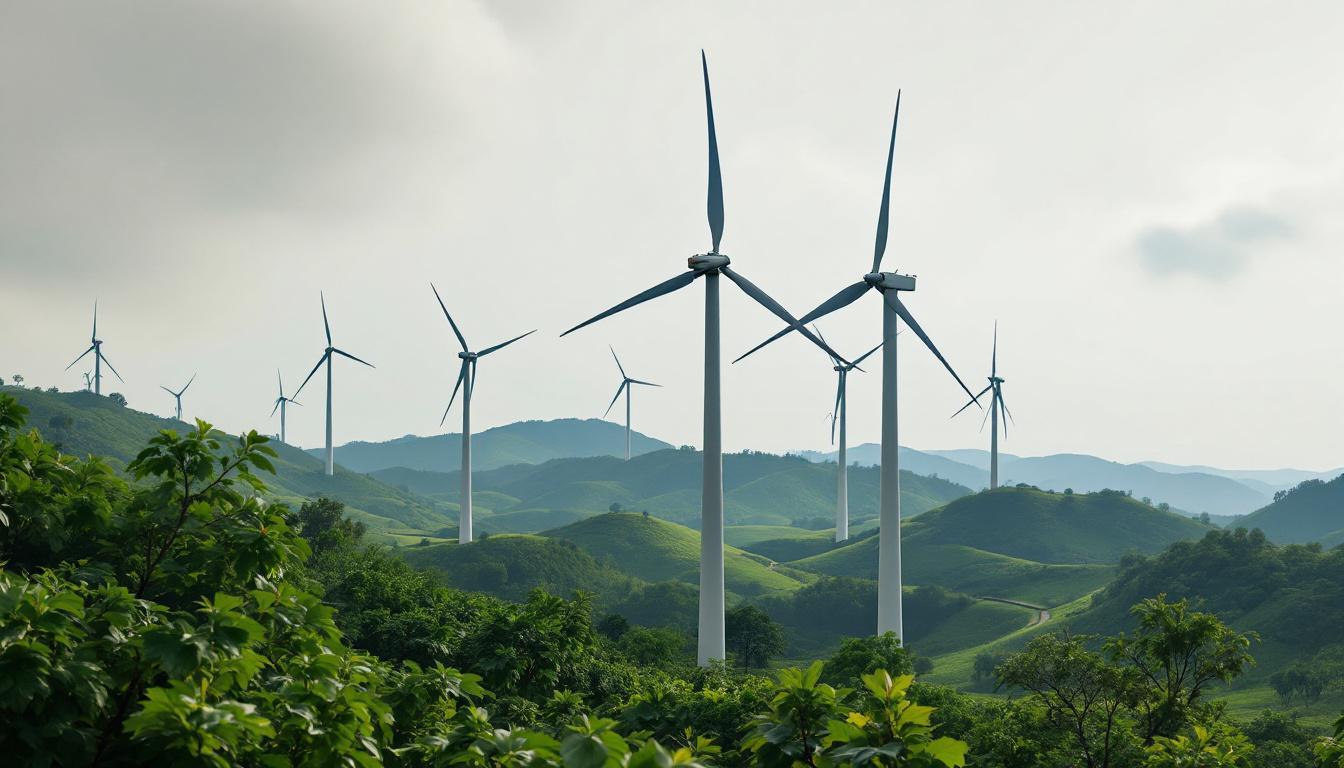
H&M’s efforts to eliminate carbon emissions in its supply chain through renewable energy and technological innovation mark a significant shift in sustainable fashion, but challenges in infrastructure and broader resource impacts highlight the complexity of true environmental progress.
On an industrial estate in Vietnam’s Hung Yen Province, a small textile plant called Bangjie is being positioned as a test case for a bolder proposition: can a mass-market fashion group genuinely strip carbon from the heart of its supplier network without curbing growth? Within months Bangjie expects to operate with a carbon intensity score of zero after installing a heat pump and removing a diesel backup generator, a change H&M presents as emblematic of how supply-chain emissions can be eliminated by switching production energy to renewables.
H&M Group has long framed its climate ambitions around this kind of technical shift. In 2021 the company set targets to shrink emissions while expanding sales; its 2024 annual and sustainability report recasts those aims as a pledge to grow long-term sales by at least 10% per year, keep operating margins above 10% and cut greenhouse gas emissions by 56% by 2030 versus a 2019 baseline. According to the report, the group intends to source 100% renewable electricity for garment production by 2030 and to eradicate coal use across the supply chain by 2026. The company has also channelled funds and expertise into supplier projects through initiatives such as the Green Fashion Initiative, which has backed 23 projects and helped move many facilities away from on-site coal.
That shift is visible in H&M’s supplier data. The group reports that the count of Tier 1 and 2 suppliers using on-site coal fell sharply from 118 in 2022 to 27 in 2024, with a slightly larger total if Tier 3 sites are included. Many factories have converted to biomass boilers as an interim measure while planning transitions to electrified heating such as heat pumps. H&M’s case studies stress that, across some 200 supplier factories, teams have identified roughly 2,500 energy-efficiency opportunities; implementing those measures could yield about 1.5 million tonnes of CO₂e savings a year, the company calculates.
For industrial decarbonisation professionals the attractiveness of these levers is self-evident: replacing fossil-fuel boilers with heat pumps, solar thermal systems or stored electrical heat can eliminate a large share of process emissions in textile manufacturing. H&M has moved beyond pilots in other ways too, investing in technology providers. The group has taken a stake in Rondo Energy and joined its Strategic Investor Advisory Board to accelerate deployment of zero-carbon industrial heat and heat-storage systems in its supply chain.
Yet several tensions complicate the narrative. H&M places carbon intensity at the centre of its strategy: if a factory’s energy is effectively zero-carbon, product-level emissions fall to zero irrespective of production volume. That logic supports the company’s declared aim to “decouple” revenue growth from emissions and to “produce as much as we can sell.” Speaking for the company, Leyla Ertur, chief sustainability officer for H&M Group, said: “We set our strategy to decouple our financial growth from resource use.” Yosef El Natour, head of sustainability in production, acknowledged that product lifecycles, resource use and virgin-material dependency remain crucial, but maintained that eliminating emissions is essential to sustaining growth: “But there is no other way to drive growth other than by decoupling emissions completely. We all believe we can achieve this, otherwise we wouldn’t be waking up as early or working as hard.”
Critics and many independent analysts warn that concentrating on carbon intensity alone risks what is sometimes described as “carbon tunnel vision.” A factory powered by renewables may still consume large quantities of water, rely on unsustainable fibre inputs or lock in short-lived garments that exacerbate resource depletion and waste. Industry reporting shows H&M made progress on several other indicators in 2024: the company states that 96% of its electricity now comes from renewable sources across operations, Scope 3 emissions fell by about 24% year-on-year, and the share of materials classified as recycled or sustainably sourced rose to 89% with recycled content reaching nearly 30%. Even so, resale and secondhand revenue remains tiny in proportion to total sales, limiting lifecycle-impact reductions from consumer reuse.
The practical obstacles to full decarbonisation remain acute in many supplier regions. Unreliable grids, limited access to capital and local policy environments mean that electrification is often difficult to implement at scale without transitional technologies. H&M accepts this reality in its own guidance, promoting biomass or multi-fuel boilers and offering financial support through the Green Fashion Initiative and linked programmes. Separately, the H&M Foundation’s Fashion Climate Fund targets Tier 2 textile manufacturers in Asia with concessional finance and technical assistance, aiming to reach over 2,000 facilities and, by the fund’s estimate, cut emissions by tens of millions of tonnes of CO₂ by 2030 if scaled successfully.
From an industrial perspective, the H&M approach blends three pragmatic elements: reduce energy demand through efficiency, replace fossil fuels with lower-carbon interim solutions where necessary, and accelerate electrification and renewable supply where feasible. That triangulation is consistent with decarbonisation practice across heavy and process industries. The challenge for buyers and suppliers alike is sequencing investments so that short-term fixes do not become long-term lock-ins and so that capital-constrained facilities can actually implement the measures identified in energy audits.
For business readers focused on industrial decarbonisation, a few implications are clear. First, large brands can mobilise finance, technology and advisory capacity across supplier networks at scales smaller purchasers cannot, and corporate investment in suppliers is materially shifting on-site equipment in countries such as Vietnam and China. Second, achieving deep cuts will require combining distributed renewables, grid decarbonisation, heat electrification and industrial heat storage solutions; partnerships with technology firms and blended finance vehicles will be central to this. Third, measuring progress solely by carbon intensity understates broader environmental trade-offs; lifecycle thinking and stronger metrics for resource intensity, water and waste are necessary complements.
H&M’s roadmap illustrates both the promise and limits of buyer-led industrial decarbonisation. The company’s actions have reduced coal use and accelerated adoption of lower-carbon equipment in many supplier sites, and its investments in energy storage and heat technologies signal an intent to tackle harder-to-abate process heat. At the same time, systemic obstacles, grid reliability, capital availability, and the need to protect against new forms of environmental harm, mean that reaching the company’s 2030 ambitions will demand sustained coordination between brands, suppliers, financiers, technology providers and policy makers.
In short, H&M’s experience suggests decarbonising a vast, fragmented textile supply chain is feasible in steps, but the endeavour is not merely a technical retrofit: it requires aligned incentives, patient capital and broader resource stewardship if emissions reductions are to be real, permanent and consistent with the broader environmental goals that sit behind them.
- https://www.vogue.com/article/can-handm-decarbonize-its-supply-chain – Please view link – unable to able to access data
- https://hmgroup.com/wp-content/uploads/2025/03/HM-Group-Annual-and-sustainability-report-2024.pdf – H&M Group’s 2024 Annual and Sustainability Report outlines the company’s commitment to decarbonising its supply chain. The report details targets to source 100% renewable electricity for garment production by 2030 and phase out coal from the supply chain by 2026. It also highlights the Green Fashion Initiative, which has funded 23 projects to support suppliers in reducing greenhouse gas emissions. The report further discusses the company’s strategy to decouple financial growth from resource use, aiming to produce as much as can be sold without increasing emissions.
- https://hmgroup.com/case-studies/decarbonising-supply-chain-energy-efficiency/ – H&M Group’s case study on energy efficiency in the supply chain describes efforts to support supplier factories in reducing energy use and emissions. The company has worked with 200 supplier factories across various countries, identifying over 2,500 potential energy efficiency measures. Implementing these measures could save approximately 1.5 million tonnes of CO₂e annually, equivalent to powering 75,500 homes for one year. The Green Fashion Initiative has funded projects at factories like Meishida and LUGANG, leading to significant emissions reductions.
- https://supplychaindigital.com/sustainability/sustainability-circularity-social-responsibility-at-h-m – An article in Supply Chain Magazine discusses H&M’s sustainability focus, highlighting a 24% reduction in Scope 3 emissions during the year, attributed to improvements across the supply chain. The company also reports that 96% of its electricity now comes from renewable sources, with a target to reach 100% renewable electricity across all operations by 2030. Additionally, 89% of all product materials were either recycled or sustainably sourced in 2024, up from 83% in 2023, with recycled material use reaching 29.5%.
- https://hmfoundation.com/project/fashion-climate-fund-accelerating-scale-and-implementation-of-climate-solutions/ – The Fashion Climate Fund, supported by the H&M Foundation, is a three-year initiative focusing on supplier-led decarbonisation in Asia. It targets Tier 2 textile manufacturers in countries like India, Bangladesh, China, and Vietnam, aiming to support over 2,000 facilities with high emissions and limited access to capital. The fund provides technical and financial tools tailored to regional needs, including support for heat pumps and solar thermal systems. By 2030, the initiative aims to reduce emissions by 30–50 million tonnes of CO₂.
- https://www.prnewswire.com/news-releases/hm-group-invests-in-rondo-energy-to-further-strengthen-their-climate-strategy-302176944.html – H&M Group has partnered with Rondo Energy, a provider of zero-carbon industrial heat and power, to explore heat storage technologies in its supply chain. The collaboration aims to help textile factories replace fossil fuels with clean heat and power delivered by Rondo Heat Batteries. H&M Group has also invested in Rondo and joined its Strategic Investor Advisory Board. This partnership is part of H&M’s broader strategy to decarbonise its supply chain and achieve its climate goals.
- https://hmgroup.com/case-studies/transitional-solution/ – H&M Group’s case study on transitional solutions for supply chain energy addresses the challenge of moving away from fossil fuels in areas with unreliable electricity grids and limited access to renewable energy. The company supports factories in replacing coal-fired boilers with biomass versions or upgrading to multi-fuel boilers as transitional solutions. These measures help factories reduce greenhouse gas emissions while transitioning towards electrification. The Green Fashion Initiative provides financial support to suppliers to implement these decarbonisation projects.
Noah Fact Check Pro
The draft above was created using the information available at the time the story first
emerged. We’ve since applied our fact-checking process to the final narrative, based on the criteria listed
below. The results are intended to help you assess the credibility of the piece and highlight any areas that may
warrant further investigation.
Freshness check
Score:
8
Notes:
The article was published on January 29, 2026, making it current. However, the content references H&M’s 2024 sustainability report, which is over a year old. This suggests that some information may be outdated, as more recent data might be available.
Quotes check
Score:
7
Notes:
The article includes direct quotes from H&M’s chief sustainability officer, Leyla Ertur. While these quotes are attributed, they cannot be independently verified through external sources, raising concerns about their authenticity.
Source reliability
Score:
9
Notes:
Vogue is a reputable publication known for its investigative journalism. However, the article relies heavily on H&M’s own reports and statements, which may present a biased perspective. Cross-referencing with independent sources is recommended.
Plausibility check
Score:
8
Notes:
The claims about H&M’s decarbonisation efforts are plausible and align with the company’s previous initiatives. However, the article does not provide independent verification of these claims, which is a concern.
Overall assessment
Verdict (FAIL, OPEN, PASS): FAIL
Confidence (LOW, MEDIUM, HIGH): MEDIUM
Summary:
The article presents information on H&M’s decarbonisation efforts, but it heavily relies on H&M’s own reports and statements without sufficient independent verification. The inclusion of unverifiable quotes and potential reliance on recycled content further diminishes its credibility. Therefore, the overall assessment is a FAIL with MEDIUM confidence.
