


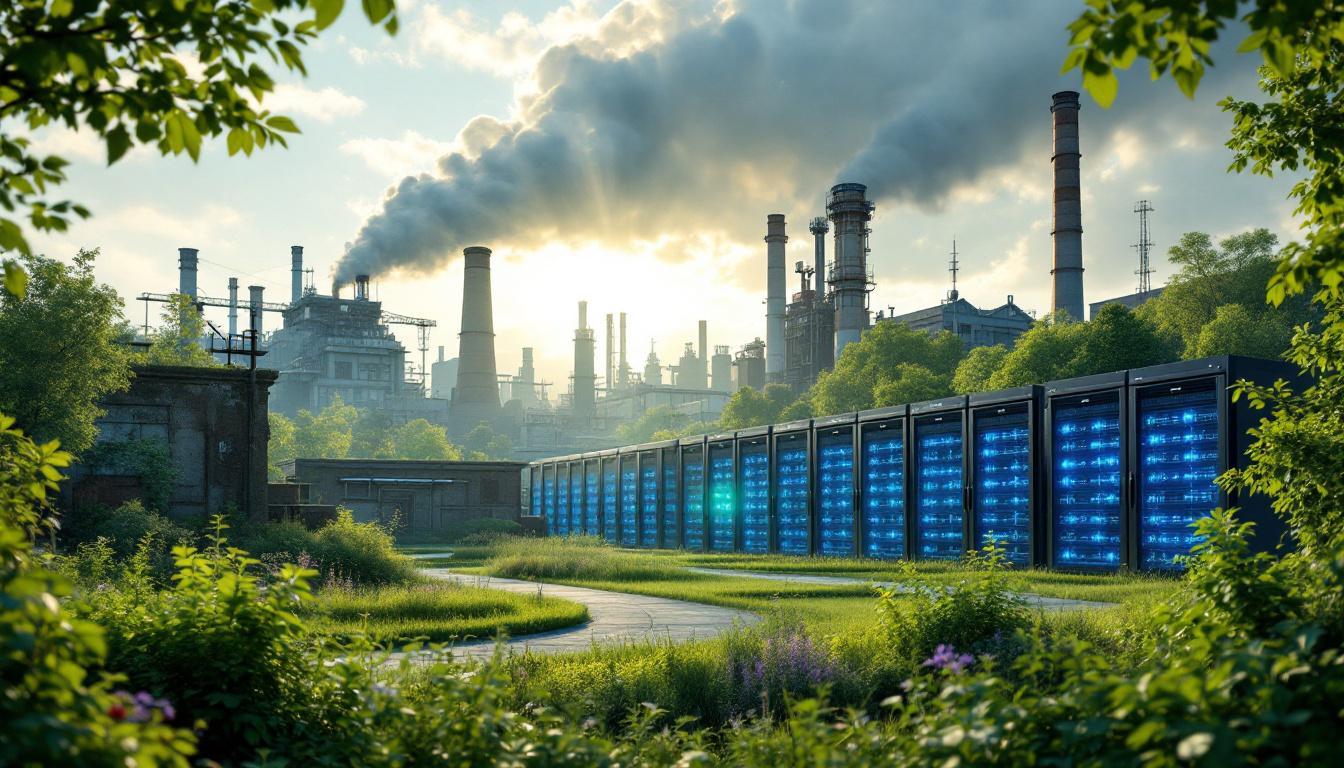
As industrial organisations increasingly rely on digital services, the environmental impact of web design and data management is emerging as a crucial factor in decarbonisation strategies, offering significant cost and emissions savings.
The digital products that industrial organisations design and deploy carry a hidden environmental cost that is becoming material for decarbonisation strategies. Every byte delivered, every model hosted and every dashboard refreshed consumes electricity, draws on water for cooling and accelerates hardware turnover. As factories, utilities and infrastructure providers move more control and insights online, attention to the carbon and resource intensity of the web must shift from a marketing talking point to an operational priority.
Scale and risk
The scale of the issue is already significant. Industry estimates place the internet’s share of global greenhouse gas emissions at about 4%, a footprint comparable with commercial aviation. In the United States, data centres consumed an estimated 176 terawatt-hours of electricity in 2023, representing roughly 4% of national electricity demand, according to a fact sheet by the American Association for the Advancement of Science. Rapid growth in compute-heavy workloads , notably generative AI , threatens to push those numbers higher. AI Daily reports that gas-fired generation linked to data centres could more than double from about 120 TWh in 2024 to 293 TWh by 2035 if current trends continue, increasing both carbon exposure and grid stress for communities near large developments.
Water and materials are part of the same equation. S&P Global’s analysis shows that around 43% of data centres worldwide operate in regions exposed to high water stress, creating a vulnerability for operators that rely on evaporative or water-intensive cooling. Equipment turnover adds another ledger item: hardware replacement contributes to electronic waste and embedded emissions throughout the supply chain, a Scope 3 exposure that must be managed by procurement and asset teams.
Where web design affects industrial decarbonisation
For organisations that rely on web portals, remote monitoring, digital twin visualisations and cloud-based analytics, design decisions materially change total energy demand. Heavier pages, autoplaying video streams and multiple third-party tracking scripts increase data transfer volumes, raise server load, and prolong user-device processing. For example, page weight growth has continued to accelerate, and large media assets remain the dominant driver of kilobytes transferred per visit. Each kilobyte saved translates into lower energy consumption across networks, servers and end-user devices , and therefore into measurable CO2 savings when aggregated across enterprise usage patterns.
Operationally, this matters because it couples directly to costs and compliance. Cloud bills are increasingly influenced by egress and storage volumes; shaving data transfer and compute reduces those line items. Meanwhile, legislation and voluntary reporting standards are widening the scope of corporate carbon disclosure to include digital supply chains. Procurement teams will therefore face both cost and disclosure incentives to demand greener digital products from agencies and platform vendors.
Practical interventions that move the needle
The most effective measures are those that pair technical simplicity with measurable outcomes. The following actions are directly applicable to industrial digital teams and external suppliers:
-
Reduce asset payloads. Replace legacy image formats with modern codecs such as AVIF where compatible, implement responsive image sizing and lazy loading, and avoid auto-play media unless strictly required by the user journey. These steps cut transfer volumes and server processing.
-
Adopt static or pre-rendered delivery patterns. Static site generators and edge caching reduce server CPU cycles and the need to build pages per request. For data-heavy portals, consider server-side aggregation and efficient APIs that return minimal, structured payloads.
-
Minimise client-side computation. Trim unused JavaScript, consolidate analytics, and favour CSS and system fonts over heavy custom font libraries. Practices such as tree shaking and minification reduce runtime processing on user devices and energy draw.
-
Choose hosting with verifiable carbon practices. Look for providers that can demonstrate either 24/7 carbon-free electricity commitments or transparent procurement of renewable energy attributes. Treat offset purchases and Renewable Energy Certificates as one element of a wider strategy, and verify claims through third-party registries.
-
Measure and benchmark. Use established audits to quantify impact: the Website Carbon Calculator, Wholegrain Digital’s tools, the Green Web Foundation’s host checks and Google Lighthouse performance metrics provide concrete baselines and highlight high-impact fixes. Measurement enables procurement teams to set page-weight budgets and to track progress against sustainability KPIs.
Industry-level considerations
Data-centre operators must balance availability, latency and resilience with resource constraints. Socomec and other sector commentators emphasise that transitioning to low-carbon grids is necessary but not sufficient; operators also need architectural changes such as free-air cooling where water is scarce, heat reuse schemes, and longer equipment refresh cycles to reduce material impacts. Where hyperscale providers announce 24/7 carbon-free targets, buyers should scrutinise the mechanics: hourly matching and location-specific procurement are more defensible than annual offsets.
For business decision-makers, the case for action is fourfold: lower operational costs from reduced data transfer and compute; improved user experience and conversion through faster interfaces; reduced regulatory and reputational risk as emissions disclosure intensifies; and alignment with industrial decarbonisation targets by reducing a material segment of downstream Scope 3 emissions.
Embedding digital sustainability into procurement and product lifecycles
To translate intent into outcomes, treat digital sustainability as a non-functional requirement in requests for proposals and supplier contracts. Specify measurable targets , for example, maximum average page weight, required use of energy-efficient image formats, or limits on third-party scripts per page. Include audit rights and require suppliers to publish a sustainability page disclosing hosting, carbon metrics and remediation plans. Internal governance should assign responsibility for digital carbon to the teams that manage operational technology and cloud costs, not just marketing or comms.
Conclusion
As industrial organisations electrify and digitise, the environmental footprint of digital services is no longer an abstract corporate responsibility issue; it is an operational leaver for decarbonisation and cost control. By designing lightweight interfaces, choosing transparent hosting, and setting measurable procurement standards, companies can shrink the hidden emissions associated with their digital estate while improving performance and reducing bills. These are pragmatic, high-return interventions that belong alongside insulation retrofits and process electrification in any credible industrial decarbonisation programme.
- https://editorialge.com/green-web-design/ – Please view link – unable to able to access data
- https://www.aaas.org/sites/default/files/2025-09/Data%20Centers%20Fact%20Sheet%202%20-%20Data%20Centers%20and%20Environmental%20Considerations.pdf – This fact sheet from the American Association for the Advancement of Science (AAAS) provides an overview of the environmental considerations associated with data centers. It highlights the significant energy consumption of data centers, noting that in 2023, U.S. data centers consumed an estimated 176 terawatt-hours (TWh) of electricity, accounting for roughly 4% of U.S. electricity demand. The document also discusses the projected increase in energy demand from data centers and the associated environmental impacts, including greenhouse gas emissions and water usage for cooling. It emphasizes the need for sustainable practices and policies to mitigate these environmental effects.
- https://www.socomec.us/en-us/solutions/business/data-centers/green-data-centres-balancing-performance-and-environmental-responsibility – This article from Socomec explores the environmental challenges posed by data centers, particularly in the context of green data centers. It discusses the substantial greenhouse gas emissions resulting from data centers’ reliance on fossil fuel-powered electricity. The piece also addresses resource consumption, highlighting the significant use of natural resources, including water for cooling systems. Additionally, it touches upon the generation of electronic waste due to the frequent replacement of hardware components. The article underscores the importance of balancing performance with environmental responsibility in data center operations.
- https://www.spg.com/en/research-insights/special-reports/look-forward/data-center-frontiers/data-center-sustainability-faces-challenges-amid-growth – This report from S&P Global examines the sustainability challenges faced by the rapidly growing data center industry. It highlights the significant power and water consumption of data centers, noting that 43% of data centers globally are exposed to high water stress in the 2020s. The report discusses the implications of this exposure, particularly in regions like the U.S. and China, and the potential constraints on development due to water scarcity. It also explores mitigation practices and consumption trends, emphasizing the need for sustainable solutions to address these challenges.
- https://www.ai-daily.news/articles/data-centers-balancing-growth-with-environmental-impact – This article from AI Daily discusses the environmental impact of data centers, focusing on balancing growth with environmental considerations. It highlights the projected increase in electricity demand from data centers, noting that gas-fired power generation for data centers is expected to more than double from 120 TWh in 2024 to 293 TWh in 2035. The piece also addresses regional and economic impacts, mentioning that residents in at least 41 U.S. states and Washington, D.C., are experiencing higher electric and natural gas bills due to the strain placed on power grids by new data center development, especially for AI applications.
- https://www.aaas.org/sites/default/files/2025-09/Data%20Centers%20Fact%20Sheet%202%20-%20Data%20Centers%20and%20Environmental%20Considerations.pdf – This fact sheet from the American Association for the Advancement of Science (AAAS) provides an overview of the environmental considerations associated with data centers. It highlights the significant energy consumption of data centers, noting that in 2023, U.S. data centers consumed an estimated 176 terawatt-hours (TWh) of electricity, accounting for roughly 4% of U.S. electricity demand. The document also discusses the projected increase in energy demand from data centers and the associated environmental impacts, including greenhouse gas emissions and water usage for cooling. It emphasizes the need for sustainable practices and policies to mitigate these environmental effects.
- https://www.socomec.us/en-us/solutions/business/data-centers/green-data-centres-balancing-performance-and-environmental-responsibility – This article from Socomec explores the environmental challenges posed by data centers, particularly in the context of green data centers. It discusses the substantial greenhouse gas emissions resulting from data centers’ reliance on fossil fuel-powered electricity. The piece also addresses resource consumption, highlighting the significant use of natural resources, including water for cooling systems. Additionally, it touches upon the generation of electronic waste due to the frequent replacement of hardware components. The article underscores the importance of balancing performance with environmental responsibility in data center operations.
Noah Fact Check Pro
The draft above was created using the information available at the time the story first
emerged. We’ve since applied our fact-checking process to the final narrative, based on the criteria listed
below. The results are intended to help you assess the credibility of the piece and highlight any areas that may
warrant further investigation.
Freshness check
Score:
5
Notes:
⚠️ The article was published on January 12, 2026, which is within the past 7 days, indicating freshness. However, the content heavily references existing concepts and practices in green web design, suggesting a lack of original reporting. For instance, the article discusses the environmental impact of digital products and the importance of sustainable web design, topics extensively covered by other sources. ([greentheweb.com](https://greentheweb.com/?utm_source=openai)) This raises concerns about the originality of the content.
Quotes check
Score:
4
Notes:
⚠️ The article does not provide direct quotes from individuals or organizations, making it difficult to verify the authenticity of the information presented. The absence of verifiable quotes suggests that the content may be paraphrased or summarised from other sources, which could affect its credibility.
Source reliability
Score:
3
Notes:
⚠️ The article originates from Editorialge.com, a platform that aggregates content from various sources. This raises concerns about the independence and reliability of the information presented, as the platform may not adhere to strict journalistic standards. Additionally, the lack of direct citations to primary sources further diminishes the credibility of the content.
Plausibility check
Score:
6
Notes:
⚠️ The claims made in the article align with widely accepted information about the environmental impact of digital technologies and the importance of sustainable web design. However, the absence of specific data points or case studies makes it challenging to fully assess the accuracy of the claims. The article mentions that the internet accounts for approximately 3.7% of global carbon emissions, a figure that is consistent with other sources. ([sustainablewebdesign.org](https://sustainablewebdesign.org/?utm_source=openai))
Overall assessment
Verdict (FAIL, OPEN, PASS): FAIL
Confidence (LOW, MEDIUM, HIGH): MEDIUM
Summary:
⚠️ The article presents information on the environmental impact of digital technologies and the importance of sustainable web design. However, it lacks original reporting, direct quotes, and citations to primary sources, raising concerns about its credibility and reliability. The content appears to be aggregated from other sources without offering new insights, which diminishes its value as a standalone news piece.
