


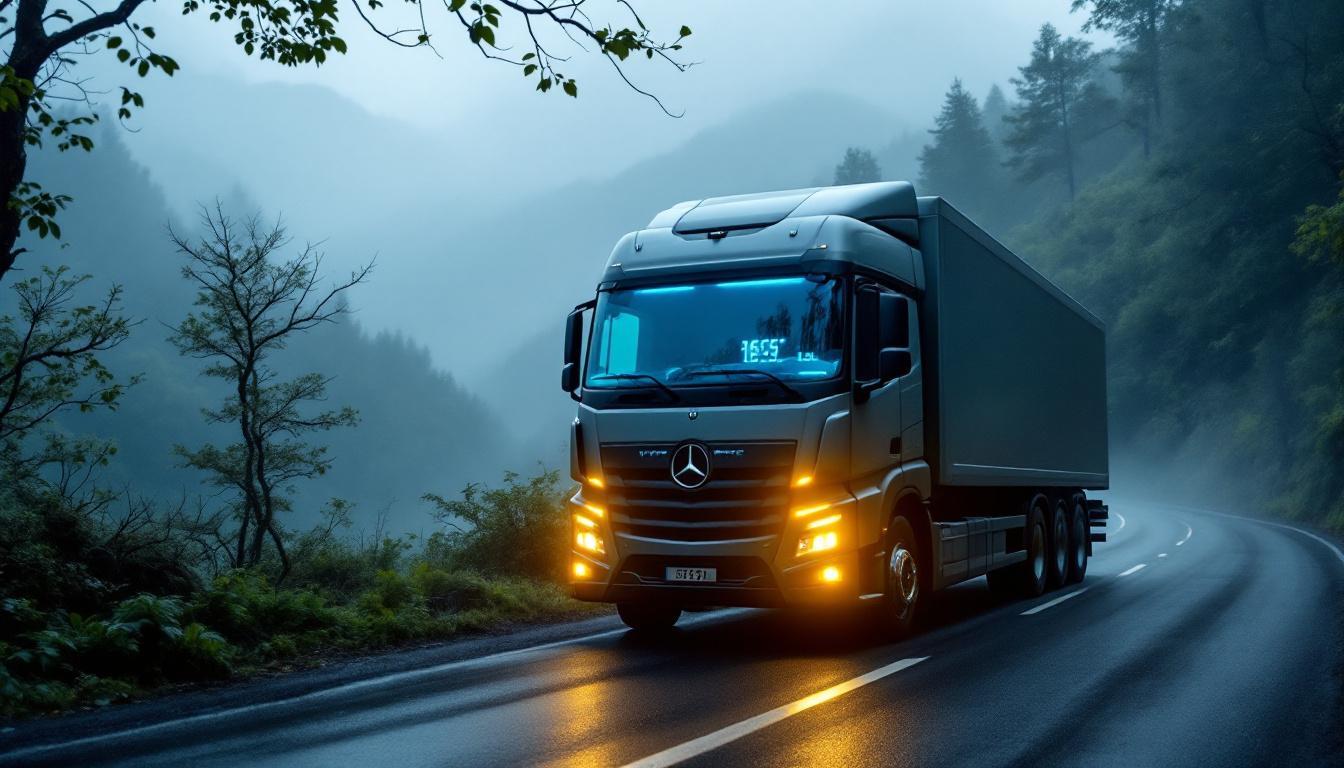
The hydrogen truck sector is transitioning from pilot projects to commercial fleets, driven by policy support, infrastructure development, and technological advances, with market forecasts showing rapid growth potential over the next decade.
The hydrogen fuel‑cell truck sector is being repositioned from niche demonstration projects to commercially significant fleets, driven by tightening emissions rules, strategic public–private partnerships and rapid technical progress in fuel‑cell powertrains and hydrogen storage. According to a market study by Allied Market Research, the segment generated about $181.6m in 2022 and, on that basis, could expand to roughly $3.7bn by 2032, implying a compound annual growth rate around 36% between 2023 and 2032. The Allied analysis highlights heavy‑duty vehicles, shorter‑range applications (under 400 km) and systems above 250 kW as current revenue leaders, and identifies Asia‑Pacific as the largest regional market.
Those conclusions sit alongside a range of alternative forecasts that reflect different scope and methodology. Precedence Research estimates a substantially larger hydrogen trucks market, valued at more than $5.2bn in 2023 and projecting to exceed $118.1bn by 2032, pointing to aggressive fleet investments and accelerating roll‑outs by manufacturers. Research and Markets offers a separate view, projecting growth to around $50.8bn by 2034 from a 2025 base of $6.54bn, while a further industry study forecasts a mid‑decade market of about $16.2bn by 2030 at a roughly 33% CAGR from 2025. These divergent numbers underline that market sizing for hydrogen trucks remains sensitive to assumptions about policy support, refuelling infrastructure build‑out and the timing of large commercial programmes.
Commercial momentum is tangible in heavy‑duty freight. Allied’s report notes heavy‑duty configurations accounted for the largest share of revenues in 2022, a pattern echoed by field deployments and manufacturer roadmaps. Industry roll‑outs already underway illustrate the practical case for hydrogen in long‑haul and high‑payload duty cycles: Hyundai’s Xcient hydrogen truck programme, developed with H2 Energy, scaled mass manufacture for heavy cargo applications and targets multi‑hundred‑kilometre ranges with refuelling times counted in minutes, according to vehicle documentation and programme statements. Nikola Corporation and other OEMs continue to pursue fuel‑cell heavy‑truck development despite past commercial and financial hurdles, contributing to hydrogen hubs and pilot fleets in key ports and corridors.
Policy and infrastructure remain the pivotal constraints and enablers. Allied highlights limited refuelling networks as a principal barrier to adoption even as governments increase support: subsidies, targets for zero‑emission vehicles and hydrogen station funding are accelerating in many jurisdictions. Research and Markets and other industry reports emphasise recent advances in fast‑refuelling hardware, high‑density storage and modular fuel‑cell stacks as central to making hydrogen competitive against diesel and battery electric alternatives for certain duty cycles. Where regulators set stringent CO2 targets for heavy‑duty vehicles, fleet operators are evaluating hydrogen as a practicable zero‑tailpipe‑emission option, particularly for routes where battery weight and charging duration are disadvantages.
Cost dynamics are shifting but remain transitional. Several analyses point to lower operating costs over life‑time as a potential commercial advantage once fuel price parity and station density improve, while capital and hydrogen supply chain investments keep up‑front economics challenging today. Allied notes that partnerships between governments and private firms are creating opportunities to defray these early costs and accelerate scale. Large‑scale procurement commitments, corridor projects and integrated refuelling hubs are increasingly deployed to reduce perceived risk for fleet managers and financiers.
Segmentation trends are instructive for industrial decarbonisation planners. Allied projects faster percentage growth for light‑duty truck segments and for lower‑power systems, reflecting demand for urban and regional zero‑emission delivery vehicles as well as technology maturation that makes smaller fuel‑cell systems commercially viable. At the same time, longer‑range (>400 km) and higher‑power (>250 kW) configurations are forecast to grow strongly, aligning with needs in intercity and heavy‑haul logistics.
The COVID‑19 pandemic interrupted early production and deployment plans, reducing near‑term demand and straining supply chains, but it also catalysed policy interest in resilient, low‑carbon transport. Allied points to renewed government support for hydrogen refuelling networks in several markets as a direct outcome of pandemic‑era stimulus and clean‑energy strategies.
For corporate purchasers and industrial decarbonisation leads, the market picture requires pragmatic scenario planning. Forecasts vary widely depending on assumed policy trajectories and infrastructure investments. Operational decisions should weigh specific route profiles, payload and duty‑cycle requirements, access to planned refuelling corridors and long‑term total cost of ownership models rather than relying solely on headline market projections. Where public incentives and committed hydrogen supply are present, hydrogen fuel‑cell trucks are becoming a commercially credible option for decarbonising heavy freight; where those conditions are absent, uptake will remain constrained.
Industry activity from OEMs and pilot projects suggests the technology is moving from trials to scaled deployments, but the pace and scale of transition will be uneven across regions and subsegments. Stakeholders in procurement, fleet operations and supply‑chain planning should therefore monitor policy commitments, announced infrastructure projects and large OEM fleet orders closely, as these will be the most reliable indicators of where hydrogen trucks will become an economically compelling decarbonisation pathway.
- https://www.openpr.com/news/4407446/global-hydrogen-fuel-cell-truck-market-technological – Please view link – unable to able to access data
- https://www.alliedmarketresearch.com/press-release/hydrogen-fuel-cell-truck-market.html – Allied Market Research’s report on the hydrogen fuel cell truck market highlights a valuation of $181.6 million in 2022, with projections estimating growth to $3.7 billion by 2032, reflecting a compound annual growth rate (CAGR) of 36.0% from 2023 to 2032. The report identifies key growth drivers, including stringent environmental regulations, advancements in infrastructure, and the extended driving range of hydrogen fuel cell trucks. However, it also notes challenges such as limited refueling infrastructure. The report emphasizes the potential for reduced operating costs and the benefits of partnerships between government and private entities in fostering market expansion.
- https://www.precedenceresearch.com/press-release/hydrogen-trucks-market – Precedence Research’s analysis of the hydrogen trucks market indicates a valuation exceeding $5.23 billion in 2023, with expectations to surpass $118.1 billion by 2032, growing at a CAGR of 41.38% from 2023 to 2032. The report attributes this rapid growth to increased investments from vehicle manufacturers and commercial fleets in hydrogen-powered trucks, alongside technological advancements in hydrogen cells aimed at reducing CO2 emissions. It also highlights significant developments by major automakers, such as Hyundai’s launch of a Class 8 hydrogen-powered fuel cell electric truck under the NorCAL ZERO Project in May 2024.
- https://www.globenewswire.com/news-release/2025/09/18/3152248/0/en/Hydrogen-Truck-Industry-Report-2025-2034-Key-Advancements-in-Fuel-Cell-Technology-Hydrogen-Storage-and-Fast-Refueling-are-Driving-Expansion.html – Research and Markets’ report on the hydrogen truck industry projects a market value of $6.54 billion in 2025, with expectations to reach $50.78 billion by 2034, growing at a CAGR of 25.58%. The report emphasizes the critical role of hydrogen fuel cell trucks in the clean transportation sector, focusing on zero-emission vehicles as alternatives to diesel trucks. It highlights key advancements in fuel cell technology, hydrogen storage solutions, and fast refueling infrastructure as primary drivers of market expansion, particularly for heavy-duty applications. The report also notes the influence of government incentives and infrastructure development in accelerating market growth.
- https://www.globenewswire.com/news-release/2025/09/29/3158062/0/en/Hydrogen-Truck-Market-to-Grow-at-33-4-CAGR-by-2030.html – A recent report projects the hydrogen truck market to grow at a compound annual growth rate (CAGR) of 33.4% from 2025 to 2030, with the market size expected to reach $16.2 billion by 2030. The report attributes this growth to the global shift towards decarbonized transportation, with hydrogen technology emerging as a key solution for reducing carbon emissions in the transport sector. It also highlights supportive government regulations and policies, including subsidies and investments in infrastructure, as factors creating a favorable environment for the adoption of hydrogen-powered trucks.
- https://en.wikipedia.org/wiki/Nikola_Corporation – Nikola Corporation, founded in 2015, is an American company specializing in hydrogen fuel cell and battery-electric vehicles, with a focus on heavy-duty trucks. In November 2018, Nikola unveiled the Nikola Tre hydrogen-powered semi-truck concept aimed at the European market, with production initially planned for 2022–2023. The company has faced challenges, including significant financial losses, but continues to develop and deliver hydrogen fuel cell trucks, contributing to the growing hydrogen hub at the Port of Los Angeles.
- https://en.wikipedia.org/wiki/Hyundai_Xcient – The Hyundai Xcient is a heavy-duty truck produced by Hyundai Motor Company. In 2020, Hyundai, in partnership with Swiss company H2 Energy, began mass manufacturing hydrogen fuel cell-powered 34-ton cargo trucks under the Xcient brand. These vehicles offer a range of 400 km on a full tank and require 8 to 20 minutes for refueling. The initiative aims to support the transition to zero-emission freight transportation, with plans to ship 1,600 units to Switzerland by 2025.
Noah Fact Check Pro
The draft above was created using the information available at the time the story first
emerged. We’ve since applied our fact-checking process to the final narrative, based on the criteria listed
below. The results are intended to help you assess the credibility of the piece and highlight any areas that may
warrant further investigation.
Freshness check
Score:
3
Notes:
⚠️ The article is a press release dated 27 February 2026, published on openPR.com. openPR is a platform for distributing press releases and may not provide original reporting. The content is based on a report from Allied Market Research, which is also cited in other press releases. This suggests the information may be recycled across multiple platforms, raising concerns about originality and freshness.
Quotes check
Score:
2
Notes:
⚠️ The article includes direct quotes from the Allied Market Research report. These quotes are not independently verifiable through other sources, as they originate from a proprietary report. This lack of external verification raises concerns about the reliability and authenticity of the quoted information.
Source reliability
Score:
4
Notes:
⚠️ The primary source is Allied Market Research, a market research firm. While they provide detailed reports, their findings are often behind paywalls and may not be independently verified. The secondary source, openPR.com, is a press release distribution platform and may not offer original reporting. This reliance on potentially unverified sources diminishes the overall reliability of the information presented.
Plausibility check
Score:
5
Notes:
⚠️ The projected growth of the hydrogen fuel cell truck market aligns with industry trends towards decarbonisation and sustainable transport. However, the lack of independent verification and reliance on proprietary reports without external corroboration raises questions about the accuracy of these projections.
Overall assessment
Verdict (FAIL, OPEN, PASS): FAIL
Confidence (LOW, MEDIUM, HIGH): HIGH
Summary:
⚠️ The article is a press release dated 27 February 2026, based on a report from Allied Market Research. The reliance on proprietary, paywalled sources without independent verification, along with the recycled nature of the content across multiple platforms, raises significant concerns about the freshness, originality, and reliability of the information. The lack of independently verifiable quotes and the promotional nature of the content further diminish its credibility.
