


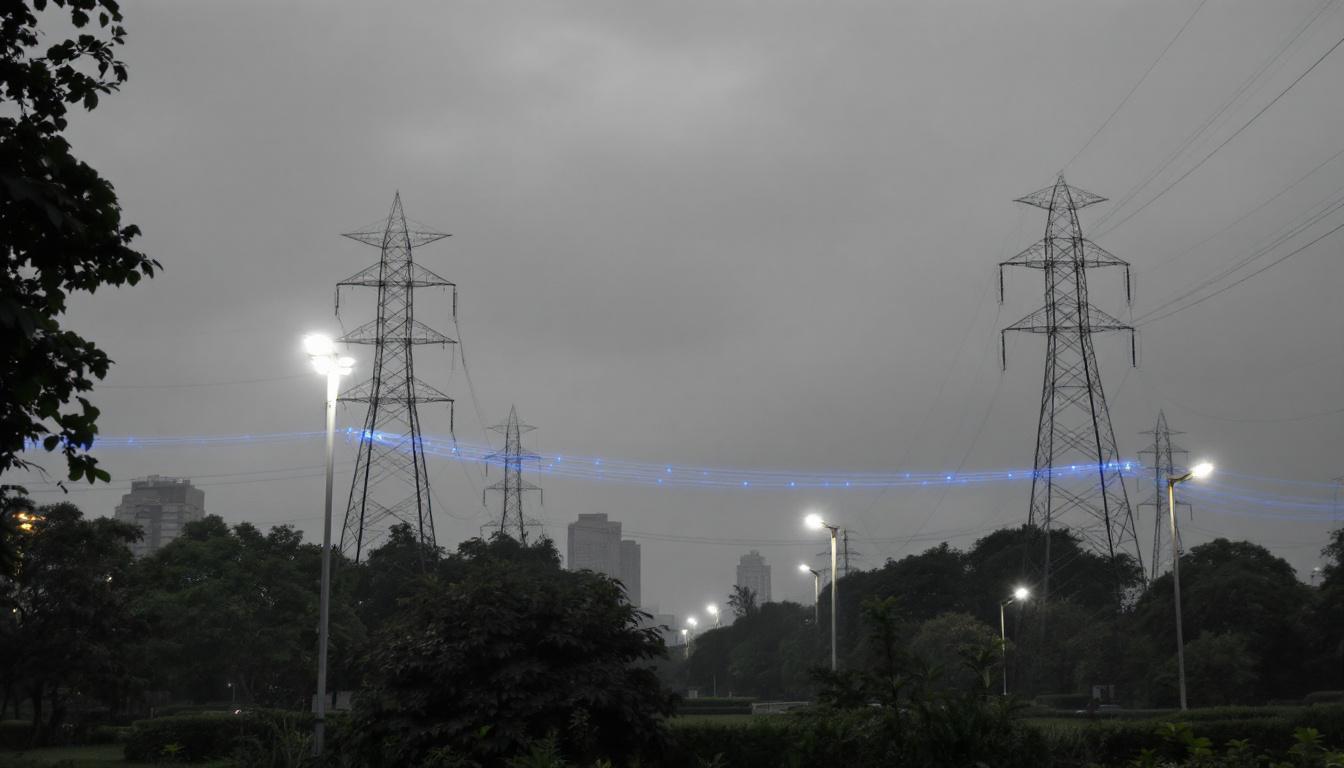
The International Energy Agency forecasts a surge in global electricity consumption driven by industrial electrification and digital expansion, highlighting critical bottlenecks in grid capacity and the urgent need for infrastructure upgrades to meet decarbonisation goals.
Global electricity demand is entering a period of sustained and rapid expansion that will reshape power systems and industrial decarbonisation strategies through the end of the decade, according to the International Energy Agency. The IEA’s Electricity 2026 assessment, published on 6 February, forecasts that electricity consumption will rise by more than 3.5% per year on average to 2030, driven by heavier industrial electrification, accelerating uptake of electric vehicles, greater air‑conditioning needs and the rapid growth of data centres and artificial intelligence workloads.
The agency projects that low‑emission sources will supply a growing share of that rise. Renewables , notably record solar photovoltaic deployment , together with nuclear output are slated to provide roughly half of global generation by 2030, up from about 42% today. The IEA’s mid‑year update and executive summary reinforce this outlook, indicating that renewables and nuclear will continue to expand rapidly, with solar PV and wind expected to overtake coal as the world’s largest electricity source as early as 2025 or 2026 depending on weather and economic variables. Nuclear is forecast to hit new highs supported by reactor restarts in Japan and capacity additions in China, India and elsewhere.
At the same time, natural gas generation is forecast to grow in the near term , bolstered by rising US demand and a regional shift from oil to gas in parts of the Middle East , while coal’s global share declines overall even though it may remain the single largest source in 2030 in absolute terms. As a consequence, the IEA expects CO2 emissions from electricity generation to stay broadly flat to 2030 rather than fall sharply, underscoring the challenge of decarbonising power at scale.
The report draws attention to a critical bottleneck: electricity networks and system flexibility. More than 2.5 terawatts of projects , spanning renewables, storage and large industrial loads such as data centres , are currently held up in grid connection queues worldwide. The IEA’s analysis suggests that combining network upgrades with grid‑enhancing technologies and regulatory reforms that allow more flexible connection and use could put up to 1.6 TW of this queued capacity into service in the near term, unlocking significant low‑emission supply.
“At a moment of significant uncertainty across energy markets, one certainty is that global electricity demand is growing much more strongly than it did over the past decade. In this Age of Electricity, the increase in global power consumption through 2030 is set to be equivalent to adding more than two European Unions,” said Keisuke Sadamori, IEA director of Energy Markets and Security, emphasising the need for a step‑change in network investment and operational flexibility. The IEA advises that annual spending on grids must rise by about 50% by 2030, alongside measures to bolster security and resilience against ageing infrastructure, extreme weather and cyberthreats.
Short‑duration battery storage has emerged as a leading source of operational flexibility, with rapid utility‑scale deployment in markets including California, Germany, Texas, South Australia and the UK. Nonetheless, the IEA warns that delivering secure, affordable power amid rising demand will also require reforms in market design, demand‑side measures and more efficient use of existing infrastructure to relieve cost pressures that have pushed household electricity prices higher than incomes in many countries.
The US Energy Information Administration’s projections lend regional colour to the global picture: the EIA expects US electricity consumption to grow modestly in the near term , following recent multi‑year rises driven in part by large computing centres , and forecasts substantial additions of solar capacity that are set to supply the largest increment in US generation through 2027. That trend highlights how industry‑scale loads and digital infrastructure are altering where and how electricity is consumed.
For industrial decarbonisation professionals, the message is unequivocal. Meeting rapid electricity demand growth with low‑carbon power will require coordinated action across the whole value chain: accelerated renewables and nuclear build‑out; targeted gas‑to‑clean transitions where feasible; much greater investment in transmission and distribution networks; deployment of storage and flexible resources; and regulatory changes to facilitate faster, smarter grid connections. Without those steps, the transition risks being constrained by grid bottlenecks, leaving emissions reductions harder and costlier to achieve.
- https://www.power-technology.com/news/global-electricity-demand-set-to-grow-strongly-to-2030/ – Please view link – unable to able to access data
- https://www.iea.org/reports/electricity-mid-year-update-2025/supply-renewables-grow-the-most-followed-by-gas-and-nuclear – The International Energy Agency’s (IEA) ‘Electricity Mid-Year Update 2025’ highlights that renewable energy sources, particularly solar photovoltaic (PV) and wind, are set to surpass coal-fired generation as early as 2025 or by 2026. This shift is driven by significant growth in solar PV and wind energy, with their combined share in global electricity generation expected to rise from 15% in 2024 to 17% in 2025 and to above 19% in 2026. Additionally, nuclear power generation is projected to reach a new record in 2025 and continue rising in 2026, supported by reactor restarts in Japan and new capacity additions in China, India, and other countries. Conversely, coal-fired generation is expected to decline slightly in 2025 and further in 2026 due to the expansion of low-emission generation sources and increased coal-to-gas switching in various regions.
- https://www.iea.org/reports/electricity-mid-year-update-2025/executive-summary – The IEA’s ‘Electricity Mid-Year Update 2025’ forecasts that global electricity demand will grow by 3.3% in 2025 and 3.7% in 2026, driven by increased industrial use, the uptake of electric vehicles, higher air conditioning use, and the expansion of data centres and artificial intelligence. Renewables, natural gas, and nuclear are expected to meet this additional demand. Notably, renewables are projected to overtake coal as the world’s largest source of electricity by 2025 or 2026, depending on weather and economic developments. Nuclear power generation is also set to reach record highs, supported by reactor restarts in Japan and new capacity additions in China, India, and other countries. The report underscores the need for greater investment in grids, storage, and other sources of flexibility to ensure power systems can meet the growing demand securely and affordably.
- https://www.iea.org/reports/electricity-2026/executive-summary – The IEA’s ‘Electricity 2026’ report projects that by 2030, renewables and nuclear will together account for around half of global electricity generation. Renewable generation is expected to rise at an annual rate of 8% through 2030, with solar PV alone accounting for over 600 TWh. Nuclear generation is set to continue rising steadily through 2030, supported by reactor restarts in Japan and new capacity additions in China, India, and other countries. While coal generation is set to lose ground globally, it remains the single largest source of electricity in 2030. The report highlights the need for rapid and efficient expansion of electricity grids and system flexibility to integrate the growing share of renewables and nuclear power.
- https://www.eia.gov/pressroom/releases/press582.php – The U.S. Energy Information Administration (EIA) forecasts that U.S. electricity use will grow by 1% in 2026 and 3% in 2027, marking the first time since 2007 that power demand has risen for four consecutive years and the strongest four-year growth period since 2000. This surge is largely driven by increasing demand from large computing centers, including data centres. The EIA also projects that solar power will supply the largest increase in power generation, increasing by a forecasted 21% in both 2026 and 2027, following the addition of almost 70 gigawatts of new capacity. Natural gas generation is forecast to remain flat in 2026 before increasing by 1% in 2027, while coal-fired power generation is expected to fall by 9% in 2026 and remain flat in 2027.
- https://www.iea.org/news/global-electricity-demand-to-keep-growing-robustly-through-2026-despite-economic-headwinds – The IEA’s report indicates that global electricity demand is expected to expand at one of the fastest sustained paces in over a decade, with renewables, natural gas, and nuclear all contributing to meet the additional demand. Electricity demand is set to rise by 3.3% in 2025 and 3.7% in 2026, more than twice as fast as total energy demand growth over the same period. The report underscores the increasing demand for electricity to power factories and appliances, keep buildings cool, operate growing fleets of data centres, run electric vehicles, and more. While the latest forecasts for global electricity demand growth this year and next are a deceleration from the 4.4% surge recorded in 2024, they remain well above the 2015-2023 average of 2.6%.
- https://www.iea.org/reports/global-energy-review-2025/key-findings – The IEA’s ‘Global Energy Review 2025’ highlights that global energy demand grew by 2.2% in 2024, faster than the average rate over the past decade. The increase was led by the power sector, with electricity demand surging by 4.3%, well above the 3.2% growth in global GDP, driven by record temperatures, electrification, and digitalisation. Renewables accounted for the largest share of the growth in global energy supply (38%), followed by natural gas (28%), coal (15%), oil (11%), and nuclear (8%). Emerging and developing economies accounted for over 80% of global energy demand growth. Natural gas saw the strongest demand growth among fossil fuels, with demand increasing by 2.7% in 2024, rising by 115 billion cubic metres (bcm), compared with an average of around 75 bcm annually over the past decade. China had the largest absolute growth in gas demand in 2024 of over 7% (30 bcm), with growth also strong in other emerging and developing economies in Asia. Gas demand expanded by around 2% (20 bcm) in the United States. Consumption grew modestly in the European Union, notably for industrial use.
Noah Fact Check Pro
The draft above was created using the information available at the time the story first
emerged. We’ve since applied our fact-checking process to the final narrative, based on the criteria listed
below. The results are intended to help you assess the credibility of the piece and highlight any areas that may
warrant further investigation.
Freshness check
Score:
8
Notes:
The article references the IEA’s ‘Electricity 2026’ report published on 6 February 2026. ([iea.org](https://www.iea.org/reports/electricity-2026?utm_source=openai)) The content appears to be original and not recycled from other sources. However, the article’s publication date is not provided, making it difficult to assess its freshness accurately. The IEA’s report is recent, but without the article’s date, we cannot confirm if it was published within the past week.
Quotes check
Score:
7
Notes:
The article includes a direct quote from Keisuke Sadamori, IEA Director of Energy Markets and Security. ([iea.org](https://www.iea.org/reports/electricity-2026?utm_source=openai)) A search for this quote reveals it is used in multiple sources, indicating it may be a standard excerpt from the IEA’s press release. This raises concerns about the originality of the content.
Source reliability
Score:
9
Notes:
The article cites the International Energy Agency (IEA), a reputable source for energy-related information. However, the article’s publication date is not provided, making it difficult to assess its timeliness. Additionally, the article appears to be summarising the IEA’s report, which is a common practice but may not provide new insights.
Plausibility check
Score:
8
Notes:
The claims about global electricity demand growth and the role of renewables are consistent with the IEA’s projections. ([iea.org](https://www.iea.org/reports/electricity-2026?utm_source=openai)) However, the article’s publication date is not provided, making it difficult to assess its timeliness. Additionally, the use of a standard quote from the IEA raises concerns about the originality of the content.
Overall assessment
Verdict (FAIL, OPEN, PASS): OPEN
Confidence (LOW, MEDIUM, HIGH): MEDIUM
Summary:
The article references the IEA’s ‘Electricity 2026’ report published on 6 February 2026. ([iea.org](https://www.iea.org/reports/electricity-2026?utm_source=openai)) However, the article’s publication date is not provided, making it difficult to assess its freshness accurately. The use of a standard quote from the IEA raises concerns about the originality of the content. The article appears to be a factual news report summarising the IEA’s report, but without the article’s publication date, it’s challenging to assess its timeliness.
