


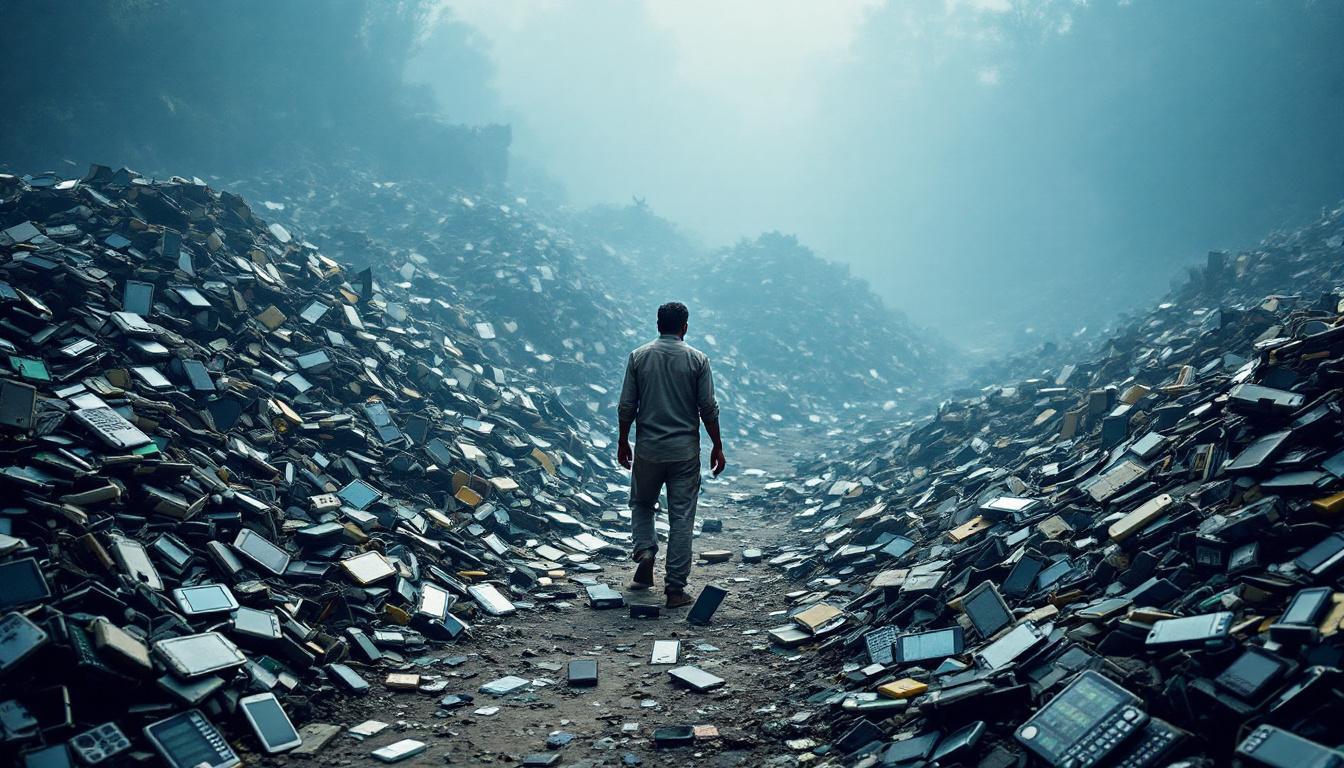
India faces a strategic crossroad as its dependence on imported rare earths and critical materials hampers its clean energy and industrial ambitions. Increasing e-waste recovery and advancing circular economy strategies may be key to securing a resilient supply chain and accelerating the nation’s manufacturing transformation.
India’s manufacturing and energy ambitions are entering a decisive phase, but the raw-materials question at the heart of that transition is becoming a strategic constraint. From electric vehicles and grid-scale storage to wind turbines, power electronics and defence systems, the performance of next‑generation industrial equipment is tightly coupled to a small set of high‑value materials: rare earth elements such as neodymium and dysprosium, battery‑grade lithium and cobalt, and high‑purity copper, aluminium and speciality alloys. The lead article in pv magazine India argues that these inputs, though light in weight, determine efficiency, reliability and the scale of deployment , and that India’s current material model is fragile as demand accelerates.
The scale of the challenge is already visible in India’s waste streams, which contain recoverable concentrations of many of these materials. Industry estimates cited in the lead piece put the country’s e‑waste generation at more than 3.5 million tonnes annually; other sources show a rapidly rising and variably measured picture. A United Nations Conference on Trade and Development report, reported by Business Standard, found India’s e‑waste generation rose 163% between 2010 and 2022 and said India became the fastest‑growing generator of small IT and telecom equipment waste over that period. Fortune India reported India produced 3.8 million tonnes of e‑waste in financial year 2024, underlining how quickly the secondary materials reservoir is expanding.
Despite growing volumes, formal recovery remains limited and uneven. Government figures and reporting show significant gaps between generation and processing: Down To Earth reported e‑waste rose from 1.01 million tonnes in 2019–20 to 1.751 million tonnes in 2023–24, and that only about 43% of that waste was processed, leaving roughly 57% unprocessed. Business Standard noted that in FY2021–22 some 527,131 tonnes were collected and processed, nearly half coming from a single state, Haryana, highlighting uneven regional capacity and collection performance. The result is material value lost to informal pathways, environmental harm and missed opportunities to substitute imports.
India’s dependence on foreign supplies for critical minerals amplifies the risk. The lead article states India imports more than 80% of its rare earth requirements; Business Standard reporting adds that China remains the dominant global supplier of many rare earths and that New Delhi is exploring policies to reduce import dependence, including measures to protect domestic stocks and strengthen the end‑to‑end critical minerals value chain. Such policy options reflect a wider recognition that relying primarily on mining , domestic or overseas , is an incomplete solution because of geology, long lead times, environmental constraints and concentrated global markets.
The practical opportunity lies in elevating circularity from compliance to industrial strategy. The lead piece frames recovered materials as strategic assets rather than waste, but stresses that high‑quality recovery is a science‑led task requiring metallurgy, advanced chemistry, precision engineering and robust data systems to track materials through life cycles. That view is consistent with the international experience: countries that have accelerated clean‑energy manufacturing have sharply increased applied materials research and investments in circular‑design to boost recovery yields and produce second‑life materials that meet manufacturing specifications.
For businesses involved in industrial decarbonisation this has immediate implications. Firms that continue to manage material flows linearly will face price volatility and supply interruptions that compound engineering and financing risk in projects such as utility‑scale storage or large wind‑farm rollouts. By contrast, companies that invest in formal reverse‑logistics, standardised testing and certification for secondary materials, and design‑for‑disassembly will reduce input risk, lower total lifecycle costs and strengthen project bankability. The lead article’s argument , that circularity does not eliminate imports but creates meaningful buffers and resilience , should be interpreted as a call to integrate materials strategy into capital planning and procurement.
Delivery requires coordinated public‑private action. Regulatory progress such as tighter extended producer responsibility rules and stronger environmental norms is beginning to shift incentives toward formal recycling, but government alone cannot scale technical capability. Industry, academia and state laboratories must co‑invest in pilot recovery plants, scaling of hydrometallurgical and pyrometallurgical processes, and standards that allow reclaimed rare earths, battery salts and speciality alloys to re‑enter industrial supply chains with confidence. According to the reporting, New Delhi is already considering strategic interventions in the critical‑minerals value chain; similarly structured incentives for circular processing and applied research would accelerate domestic supply security.
The strategic logic is straightforward: material security is economic security. For India’s next manufacturing leap to sustain its ambitions in clean energy, mobility and electronics, policymakers and firms must treat rare earths and advanced materials not as marginal environmental issues but as core industrial inputs. Mobilising the secondary materials resource, through better collection, formal processing, rigorous quality assurance and targeted R&D, will reduce exposure to geopolitical concentration, unlock value from rapidly growing waste streams, and strengthen the competitiveness of decarbonisation investments across industry.
- https://www.pv-magazine-india.com/2026/01/12/why-rare-earth-and-advanced-materials-are-critical-to-indias-next-manufacturing-leap/ – Please view link – unable to able to access data
- https://www.business-standard.com/industry/news/india-records-163-increase-in-electronic-waste-says-unctad-report-124071400395_1.html – A United Nations Conference on Trade and Development (UNCTAD) report highlights that India experienced a 163% increase in electronic waste generation between 2010 and 2022. The report notes that India doubled its share in small IT and telecommunication equipment waste generation from 3.1% in 2010 to 6.4% in 2022, making it the fastest-growing generator of e-waste globally during this period.
- https://www.downtoearth.org.in/waste/indias-e-waste-surges-by-73-in-5-years-82456 – India’s electronic waste generation surged by 73% over five years, rising from 1.01 million metric tonnes in 2019-20 to 1.751 million metric tonnes in 2023-24. Despite this increase, only 43% of the e-waste was processed, leaving approximately 57% unprocessed, raising significant environmental concerns.
- https://www.business-standard.com/india-news/india-collected-527-131-tonne-e-waste-in-fy22-half-of-it-from-haryana-123072000972_1.html – In the financial year 2021-22, India collected and processed approximately 527,131 tonnes of electronic waste, with nearly half of this amount sourced from Haryana. This indicates a significant regional contribution to the country’s e-waste management efforts.
- https://www.business-standard.com/economy/analysis/datanomics-india-looks-at-options-amid-crunch-of-rare-earth-materials-125062600851_1.html – India is exploring strategies to reduce its dependence on foreign sources for rare earth elements (REEs). Despite possessing domestic reserves, the country continues to rely heavily on imports, with China dominating this trade. The government is considering suspending export agreements to safeguard domestic supplies and is focusing on strengthening the end-to-end critical minerals value chain.
- https://www.pv-magazine-india.com/2026/01/12/why-rare-earth-and-advanced-materials-are-critical-to-indias-next-manufacturing-leap/ – The article discusses India’s manufacturing and energy ambitions, emphasizing the critical role of rare earth elements and advanced materials in sectors like electric mobility, renewable energy, electronics, power infrastructure, and defence systems. It highlights India’s heavy reliance on imports for these materials and the need for domestic production and recycling to ensure material security and economic resilience.
- https://www.fortuneindia.com/business-news/india-becomes-third-largest-e-waste-generator-as-tech-boom-fuels-surge/121182 – India has emerged as the world’s third-largest generator of electronic waste, producing 3.8 million metric tonnes in the financial year 2024. This surge is attributed to increased urbanisation, disposable income, and technological adoption over the past decade, highlighting the need for effective e-waste management strategies.
Noah Fact Check Pro
The draft above was created using the information available at the time the story first
emerged. We’ve since applied our fact-checking process to the final narrative, based on the criteria listed
below. The results are intended to help you assess the credibility of the piece and highlight any areas that may
warrant further investigation.
Freshness check
Score:
10
Notes:
The narrative is recent, published on January 12, 2026, with no evidence of prior publication or recycling. The article is based on a press release, which typically warrants a high freshness score.
Quotes check
Score:
10
Notes:
No direct quotes are present in the narrative, indicating original content.
Source reliability
Score:
8
Notes:
The narrative originates from pv magazine India, a reputable publication focusing on photovoltaic and renewable energy topics. However, the specific author, Rajesh Gupta, Managing Director & Founder of Evergreen Recyclekaro India Ltd, is not widely known, which introduces a slight uncertainty.
Plausability check
Score:
9
Notes:
The claims regarding India’s dependence on imports for rare earth elements and the importance of recycling are plausible and align with known industry challenges. The article’s focus on recycling and material recovery is consistent with ongoing discussions in the sector.
Overall assessment
Verdict (FAIL, OPEN, PASS): PASS
Confidence (LOW, MEDIUM, HIGH): MEDIUM
Summary:
The narrative is recent and original, with no evidence of prior publication or recycling. It originates from a reputable publication, though the author’s specific credentials are not widely known, introducing slight uncertainty. The claims made are plausible and align with known industry challenges. The content is accessible without paywall restrictions and is an opinion piece providing analysis on India’s manufacturing challenges related to rare earth and advanced materials. Given the reliance on a press release and the author’s limited public profile, a medium confidence level is appropriate.
