


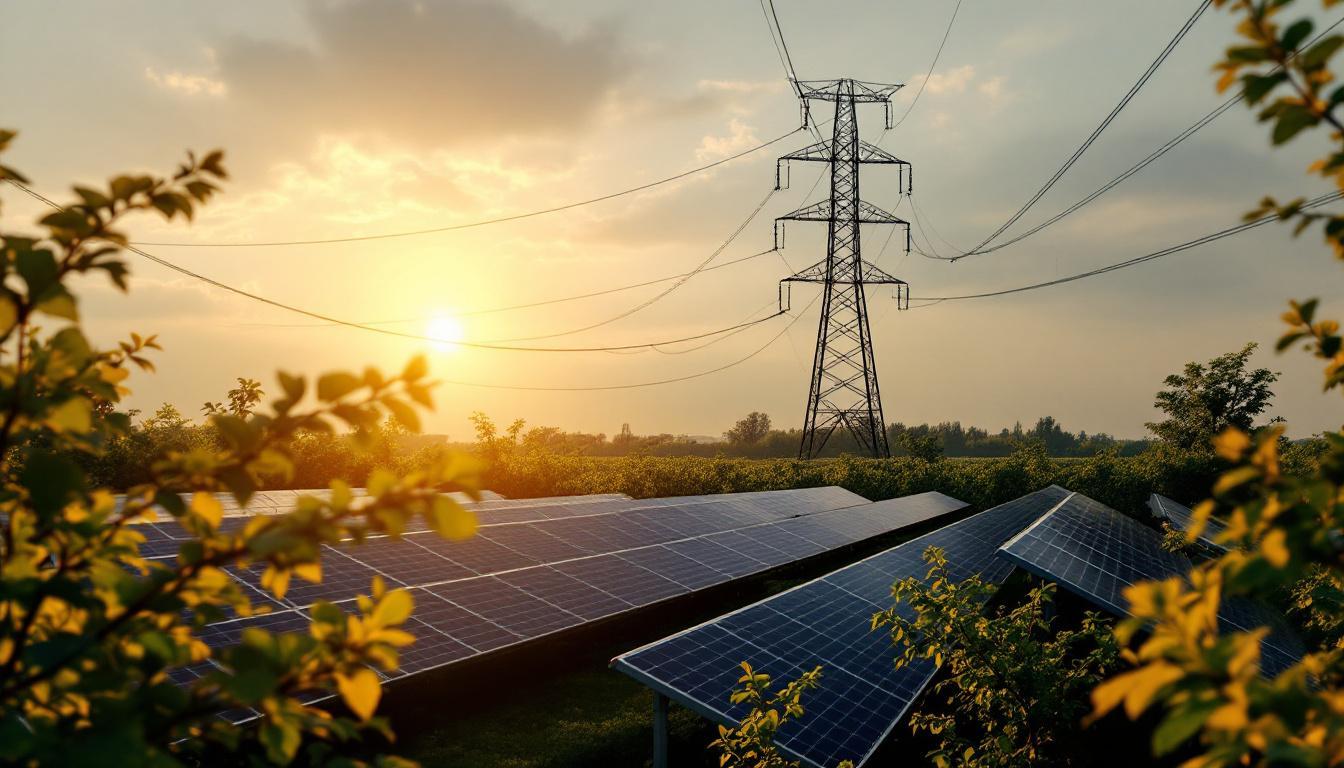
Wood Mackenzie warns that achieving India’s clean energy ambitions requires a $1.5 trillion investment in the power grid and decisive regulatory reforms to unlock private capital and accelerate renewable deployment by 2035.
“India’s next decade is decisive,” said Joshua Ngu, Vice Chairman, Asia Pacific at Wood Mackenzie, as he outlined the scale and urgency of capital required for the country’s energy transition. Wood Mackenzie’s assessment, presented at India Energy Week 2026, estimates that roughly $145 billion a year will be necessary to preserve growth ambitions while pursuing net-zero objectives. The bulk of this financing, the consultancy argues, must go to renewable generation, grid modernisation and storage if India is to avoid locking in carbon-intensive infrastructure.
The power system sits at the centre of that challenge. Industry analysis shows that non-fossil capacity now outweighs fossil capacity on the system, but the shift from a high-carbon to a flexible, low-carbon grid depends on rapid deployment of variable renewables combined with significant investments in transmission, distribution and grid-balancing resources. Wood Mackenzie’s figures indicate cumulative transition investment needs of about $1.5 trillion between 2026 and 2035, with grid works, “the wires”, emerging as a decisive element, according to Rashika Gupta, Vice President, Power and Renewables Research at Wood Mackenzie. “The $1.5 trillion investment between 2026 and 2035 for energy transition is not just about adding megawatts; it is about the wires,” she said.
Market and regulatory reforms are being flagged as critical to unlocking private capital for these network upgrades. Wood Mackenzie highlighted the Electricity Amendment Bill as a potential enabler of distribution competition and clearer, longer-term investment signals; without such reforms, investors may remain wary of financing sophisticated grid projects at scale. Independent projections reinforce the magnitude of the task: Indian industry bodies and market studies point to several hundred billion dollars of spending required by 2030 on generation, transmission and storage to meet a 500 GW renewables ambition and to support an electricity system that could exceed 1,300–1,400 GW by 2035.
Despite rapid renewables roll-out, hydrocarbons will remain economically and operationally significant in the near term. Wood Mackenzie notes India is on course to reach its 1.5 billion tonnes coal production target by 2030 and that oil import dependence is projected to climb, creating strategic vulnerabilities. Natural gas presents both demand upside and supply questions; Wood Mackenzie projects domestic gas demand could double from roughly 72 bcm in 2024 to beyond 140 bcm by mid-century, with liquefied natural gas imports potentially rising to about 90 Mtpa by 2050 if gas remains price-competitive.
Material bottlenecks in manufacturing and storage threaten to slow deployment unless addressed. Although India has grown into the world’s second-largest solar module manufacturer, gaps remain in wafer and cell vertical integration. Wood Mackenzie warns that new domestic cell content rules from June 2026 may tighten near-term supply until additional capacity, estimated at about 24 GW, comes online. In batteries, announced Advanced Chemistry Cell capacity tops 200 GWh, but execution risks and scheme design flaws mean only roughly half that output may be realised by 2030, the consultancy estimates.
High-profile low-carbon technologies face an even steeper climb. India’s ambition to achieve 5 mtpa of green hydrogen by 2030 is dominated by early-stage project work rather than bankable assets, while carbon capture, utilisation and storage remains largely at the policy and pilot phase. “the 2026 launch of the Carbon Credit Trading Scheme (CCTS) marks a crucial transition from the PAT scheme’s energy-efficiency focus to mandatory emissions caps. By imposing these limits, India is decoupling industrial growth from carbon intensity and turning compliance into a competitive differentiator. Ultimately, this framework provides the regulatory certainty required to enable adoption of low-carbon technologies,” Hetal Gandhi, Lead – CCUS, Asia Pacific at Wood Mackenzie, said.
Policy-driven and multilateral finance is already beginning to position itself alongside private capital. The World Bank, for example, approved an additional $1.5 billion in financing in 2024 to support low-carbon pathways, including green hydrogen development and renewables scaling, signalling the kinds of blended finance instruments likely to be required. Domestic estimates and industry presentations similarly point to hundreds of billions of dollars of investment needs through 2030 for renewables, network reinforcement and storage, with transmission-only programmes in some reports reaching into the tens of trillions of rupees by 2035.
For industrial decarbonisation professionals, the implications are clear. Technology deployment alone will not be sufficient; success hinges on coordinated policy reform, finely targeted incentives and mobilising a mix of public, private and international finance to underwrite both generation and the grid that must carry it. Wood Mackenzie emphasises that India’s manufacturers and service providers have an opportunity to capture market share as global supply chains diversify away from China, but this will require sustained policy certainty, faster project execution and stronger domestic value chains for wafers, cells and batteries.
Ngu closed his assessment with a forward-looking note: by scaling domestic manufacturing and maintaining policy momentum, India could meet its 500 GW ambition and become central to the global renewable supply base. Whether that outcome materialises will depend on investment decisions made now and over the next decade, and on the ability of regulators, financiers and industry to translate targets into bankable, deliverable projects.
- https://www.pv-magazine-india.com/2026/01/28/india-requires-145-billion-in-annual-energy-investment-to-bridge-growth-and-climate-targets/ – Please view link – unable to able to access data
- https://economictimes.indiatimes.com/small-biz/sustainability/india-needs-145-bn-annual-energy-investment-to-align-growth-with-climate-goals-wood-mackenzie/articleshow/127681489.cms – Wood Mackenzie estimates that India requires approximately $145 billion in annual energy investments to sustain economic growth and meet its net-zero targets. The majority of this capital is needed to scale up renewable power generation, modernize grid infrastructure, and enhance energy storage capabilities. Joshua Ngu, Vice Chairman of Asia Pacific at Wood Mackenzie, emphasized the importance of these investments in determining whether India will adopt carbon-intensive infrastructure or lead in low-carbon industrialization.
- https://www.worldbank.org/en/news/press-release/2024/06/28/world-bank-approves-additional-1-5-billion-in-financing-to-support-india-s-low-carbon-transition – The World Bank approved an additional $1.5 billion in financing to support India’s low-carbon transition. This funding aims to promote the development of a vibrant market for green hydrogen, scale up renewable energy, and stimulate finance for low-carbon energy investments. The initiative aligns with India’s goal of decoupling economic growth from emissions growth and achieving its net-zero target by 2070.
- https://www.ibef.org/industry/renewable-energy-presentation – India is set to invest over $360 billion in renewable energy and infrastructure by 2030. This includes $190 billion to $215 billion needed to achieve 500 GW of renewable capacity and an additional $150 billion to $170 billion for electricity transmission and storage. The renewable energy sector has attracted significant foreign direct investment, reflecting growing global interest in India’s clean energy transition.
- https://energy.economictimes.indiatimes.com/news/power/india-to-invest-13-trillion-in-transmission-infra-1-3-trillion-in-smart-meters-by-2035-report/122893521 – India is projected to invest approximately ₹13–14 trillion in transmission infrastructure and ₹1.3 trillion in smart meters by 2035 to meet its projected electricity demand of over 4,000 TWh. The country’s power generation capacity is expected to rise to 1,300–1,400 GW by 2035, necessitating significant capital infusion across generation, transmission, distribution, and digital infrastructure.
- https://www.business-standard.com/industry/news/india-needs-700-bn-in-power-sector-to-meet-net-zero-target-moody-s-125021900887_1.html – Moody’s Ratings estimates that India’s power sector requires a $700 billion investment over the next 10 years to achieve its 2070 net-zero pledge. The power sector accounts for around 37% of carbon emissions in the country, and significant decarbonization investments are necessary to meet emission cut goals.
- https://www.livemint.com/industry/energy/green-investments-india-renewables-green-energy-paris-agreement-net-zero-decarbanization-11736933021589.html – India is expected to see a five-fold growth in green investments, reaching ₹31 trillion between 2025 and 2030. This is a crucial part of the estimated ~$10 trillion investments needed through 2070 to achieve the country’s net-zero goals, as per the Updated First Nationally Determined Contribution (NDC) under the Paris Agreement.
Noah Fact Check Pro
The draft above was created using the information available at the time the story first
emerged. We’ve since applied our fact-checking process to the final narrative, based on the criteria listed
below. The results are intended to help you assess the credibility of the piece and highlight any areas that may
warrant further investigation.
Freshness check
Score:
8
Notes:
The article was published on January 28, 2026, and reports on statements made at India Energy Week 2026. Similar reports from January 27, 2026, are available, indicating that the content is fresh and not recycled. ([economictimes.indiatimes.com](https://economictimes.indiatimes.com/small-biz/sustainability/india-needs-145-bn-annual-energy-investment-to-align-growth-with-climate-goals-wood-mackenzie/articleshow/127681489.cms?from=mdr&utm_source=openai))
Quotes check
Score:
7
Notes:
Direct quotes from Joshua Ngu and Rashika Gupta are used. These quotes appear in multiple sources from January 27 and 28, 2026, suggesting they are accurately attributed. ([economictimes.indiatimes.com](https://economictimes.indiatimes.com/small-biz/sustainability/india-needs-145-bn-annual-energy-investment-to-align-growth-with-climate-goals-wood-mackenzie/articleshow/127681489.cms?from=mdr&utm_source=openai)) However, the exact wording of the quotes varies slightly between sources, which may indicate paraphrasing or slight inaccuracies.
Source reliability
Score:
6
Notes:
The article originates from pv magazine India, a niche publication focusing on the photovoltaic industry. While it is a specialist source, its reach and influence are limited compared to major news organisations. The content is based on a press release from Wood Mackenzie, which is a reputable consultancy. However, reliance on a single source for such significant claims raises concerns about the independence and potential bias of the information.
Plausibility check
Score:
7
Notes:
The claim that India requires $145 billion annually to meet its energy and climate goals aligns with similar reports from other sources. For instance, The Economic Times published a report on January 28, 2026, stating the same figure. ([economictimes.indiatimes.com](https://economictimes.indiatimes.com/small-biz/sustainability/india-needs-145-bn-annual-energy-investment-to-align-growth-with-climate-goals-wood-mackenzie/articleshow/127681489.cms?from=mdr&utm_source=openai)) However, the reliance on a single source for such a significant claim raises concerns about the independence and potential bias of the information.
Overall assessment
Verdict (FAIL, OPEN, PASS): FAIL
Confidence (LOW, MEDIUM, HIGH): MEDIUM
Summary:
The article presents significant claims about India’s energy investment needs, primarily sourced from a press release by Wood Mackenzie. While the content is fresh and the quotes are plausibly attributed, the heavy reliance on a single source without independent verification raises concerns about the reliability and independence of the information. The slight variations in quoted wording and the lack of corroboration from other reputable sources further diminish confidence in the accuracy of the claims.
