


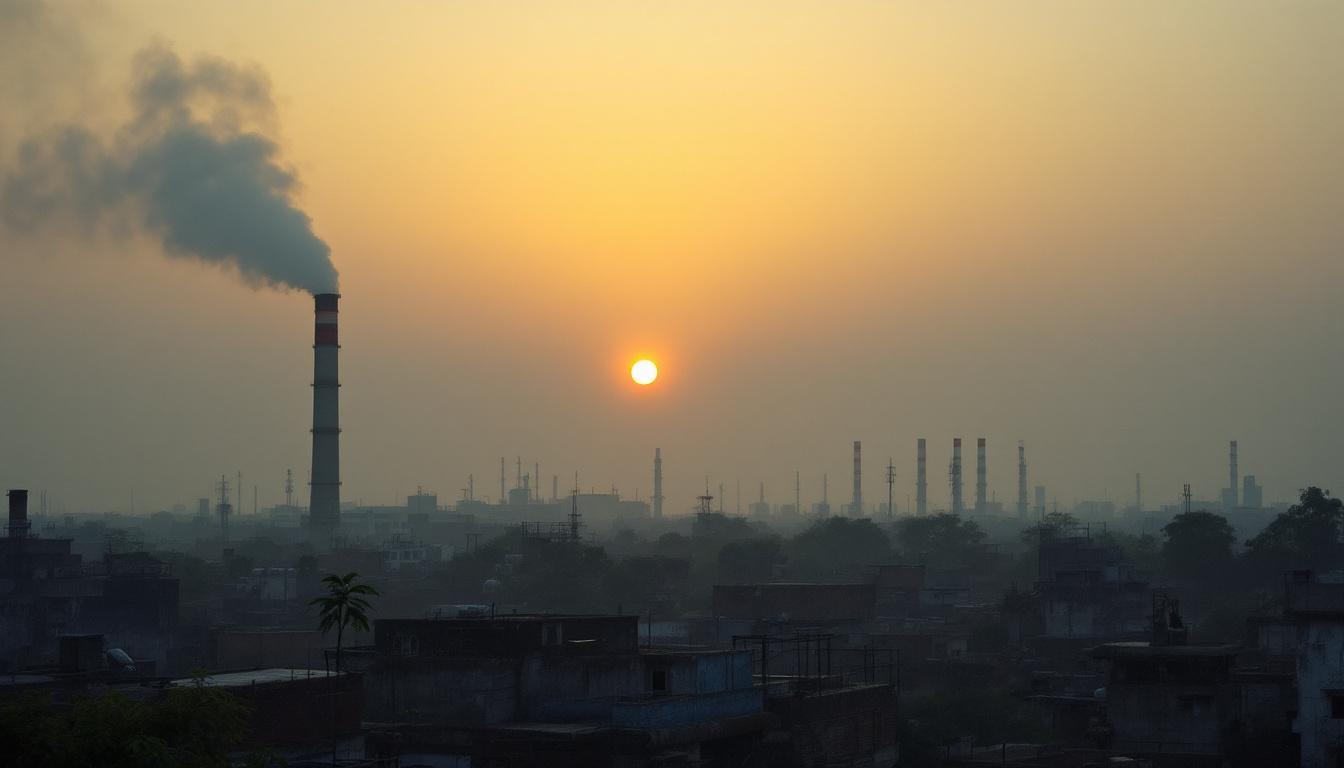
India’s expanding heavy industry sector presents a critical turning point: harnessing opportunities in green technologies or risking long-term carbon lock-in that threatens export competitiveness and economic resilience, according to new reports from Renewable Watch and industry analyses.
India’s industrial expansion presents a pivotal inflection point: a chance to marry rapid manufacturing growth with a competitive, low‑carbon future or to entrench long‑lived, carbon‑intensive assets that will erode export access and economic resilience. According to the Industrial Transition Accelerator and Boston Consulting Group briefing, extracted in a recent piece by Renewable Watch, heavy industry already accounts for roughly 20–25% of India’s greenhouse‑gas footprint even as production in steel, cement, aluminium, chemicals, aviation and shipping scales up to meet domestic demand and global market opportunities.
The chemicals sector exemplifies both the opportunity and the structural challenge. India is positioned to become a global leader in green molecules, buoyed by low‑cost renewable electrons, falling electrolyser costs and an export‑oriented project pipeline. The ITA/BCG data highlighted India’s standing as the world’s third‑largest ammonia producer in 2022–23 with 17.4 Mt output, yet around 86% of domestic ammonia consumption is currently met through imports or ammonia embedded in fertiliser products. That import dependence exposes downstream agriculture and industry to gas‑price volatility; the report notes a pipeline of 51 green ammonia and methanol projects that could unlock about $130 billion of investment and expand green hydrogen capacity beyond 6 Mtpa by 2030 if realised. Independent coverage by Economic Times and other outlets similarly finds a commercial‑scale clean industrial pipeline of 65 projects valued at over $150 billion, but warns only six projects have reached Final Investment Decision, underscoring persistent off‑take, financing and execution risks.
Steel is the single largest industrial emitter and a test case for managing scale while averting carbon lock‑in. Industry figures in the report place iron and steel at an estimated 10–12% of national emissions and show Indian steel’s average emission intensity (~2.54 tCO₂/tcs in FY23–24) remains materially higher than the global average (~1.91 tCO₂/tcs), driven by a predominance of blast furnace and coal‑based DRI routes. Planned additions still skew toward fossil‑based technologies, blast furnace ironmaking accounts for about 80% of new capacity in the pipeline, creating a meaningful risk that near‑term capital deployment will entrench high‑emissions pathways. Government targets are shifting the baseline: consultation between industry and government has set a goal to cut emission intensity below 2.2 tCO₂/tcs by FY29–30, and policy initiatives such as the National Green Hydrogen Mission and a proposed National Green Steel Mission aim to accelerate pilots and commercial roll‑outs of green hydrogen, higher scrap use and best available technologies.
The cement sector, while inherently hard to abate because of process emissions from calcination, starts from a relatively stronger position. Renewable Watch draws attention to India’s status as the world’s second‑largest cement producer (770 Mtpa capacity) and an average emission intensity close to the global mean (0.60–0.65 tCO₂/t). The Ministry of Environment, Forest and Climate Change has introduced mandatory emission‑intensity cuts for 186 plants between 2025–27, and prominent cement companies have set net‑zero timelines for 2040–2050 alongside investments in waste‑heat recovery, thermal substitution and CCUS testbeds led by the Department of Science and Technology. Nevertheless, scaling breakthrough solutions such as kiln electrification and CCUS will require deeper policy support and de‑risked financing to bridge the long commercial lead times.
Aluminium offers a fast, cost‑effective emissions lever through power decarbonisation. The report stresses that roughly 80% of aluminium’s footprint stems from captive or grid‑backed thermal generation and that switching to round‑the‑clock renewables can deliver material reductions at a modest premium. Policy action is emerging, MoEFCC‑mandated GEI targets for certain smelters and net‑zero commitments from major producers, but structural barriers remain: storage capex, transmission constraints and supply‑chain dependence on imported battery components heighten execution risk. Independent analysis suggests that rapid renewable deployment, particularly open‑access solar, could also deliver short‑term industrial gains; one study cited by The New Indian Express estimates 20 GW of additional solar could reduce industrial emissions materially and lower production costs for electric‑arc‑furnace steelmakers.
Aviation and shipping expose Indian carriers and exporters to growing compliance costs and market premiuming on low‑carbon inputs. The ITA/BCG briefing notes India’s comparative advantage in feedstocks for sustainable aviation fuel (SAF) and an estimated potential production of 8–10 Mtpa by 2040, which could create a domestic market and export surplus. Commercial activity is nascent: current pipelines include a few HEFA and PtL projects and small pilots by IOCL and Mangalore Refineries, while industry estimates warn Indian carriers could face $0.5–2.3 billion in costs from CORSIA implementation between 2027–2035 if SAF uptake lags. Competing regional industrial strategies in Southeast Asia increase the premium on early policy clarity and investment incentives to secure market share.
Taken together, independent reporting amplifies the headline opportunity: multiple outlets point to a commercial pipeline of roughly 65 clean industrial projects spanning chemicals, steel, cement, aluminium and aviation, concentrated in states with strong renewable potential and port infrastructure such as Odisha, Gujarat, Andhra Pradesh, Karnataka, Maharashtra, Tamil Nadu and Rajasthan. Industry estimates circulated in press summaries place the potential investment at over $150 billion, with more than 200,000 jobs and annual CO₂ abatement on the order of 160–175 MtCO₂ if projects proceed to execution. Yet several analyses, including coverage by Economic Times and Whalesbook, caution that the bulk of this pipeline has not yet reached financial close and that only a handful of projects are FID‑ready.
For industrial decarbonisation to be investment‑grade and export‑protective, three practical priorities emerge from the combined reporting. First, offtake and demand signals must be hardened: long‑term, bankable contracts for green molecules, low‑carbon steel and SAF will be essential to attract the high upfront capital these projects require. Second, policy instruments should be aligned to lower both technology and market risk, targeted subsidies or contracts‑for‑difference, stabilised grid access for RTC renewables, and clearer carbon‑pricing or intensity frameworks such as the Carbon Credit Trading Scheme’s newly announced sectoral intensity targets can help. DownToEarth and other outlets highlight that the CCTS represents India’s first binding industrial intensity benchmarks for select sectors, a step toward creating regulatory certainty. Third, financing innovations and public‑private risk‑sharing will be critical to bridge the valley of death for early commercial deployments, especially for green hydrogen electrolysers, CCUS and large‑scale storage.
For B2B decision‑makers in industrial decarbonisation the implications are clear: India’s comparative advantages, abundant renewables, falling electrolysis costs, and strong domestic demand growth, create an opening to build competitive, low‑carbon supply chains. But converting project pipelines into deployed, exportable capacity will depend on rapid policy calibration, scaled finance solutions and credible demand commitments from both domestic buyers and international off‑takers. If managed well, the transition can simultaneously cut import exposure, create jobs and secure market access in geographies tightening procurement standards; if mismanaged, a wave of fossil‑biased capital expenditure risks locking India into higher emission trajectories and forfeiting premium markets.
Industry data and recent reporting converge on one practical near‑term yardstick: mobilise the handful of FID‑ready projects into operational assets while expanding the set of bankable projects through contract mechanisms and targeted public support. That dual track, pilot to scale, and policy certainty to private capital, will determine whether India’s industrial rise becomes a global case study in clean manufacturing or a cautionary example of missed industrial decarbonisation.
- https://renewablewatch.in/2026/01/07/decarbonising-indias-industrial-sector-report/ – Please view link – unable to able to access data
- https://www.whalesbook.com/news/English/environment/India-Ranks-Third-Globally-with-65-Clean-Energy-Industrial-Projects-Eyeing-dollar150-Billion-Investment/6909eab90c28418ab2d21e58 – India has developed a pipeline of 65 clean energy industrial projects, positioning it third globally after China and the USA. These projects span sectors like chemicals, steel, cement, aluminium, and aviation, primarily in states such as Odisha, Gujarat, Andhra Pradesh, Karnataka, Maharashtra, Tamil Nadu, and Rajasthan. The Industrial Transition Accelerator (ITA) estimates that fully realizing this pipeline could attract over $150 billion in investments, create more than 200,000 jobs, and reduce annual CO₂ emissions by 160–170 million tonnes. However, challenges like securing ‘off-take’ agreements and financing are hindering progress, with only six projects having reached the Final Investment Decision (FID) stage.
- https://energy.economictimes.indiatimes.com/news/renewable/india-holds-worlds-third-largest-clean-industry-pipeline-only-six-projects-reach-investment-stage/125099803 – India has established a pipeline of 65 commercial-scale clean industrial projects valued over $150 billion, ranking third globally after China and the USA. These projects, concentrated in states with strong renewable energy potential and port infrastructure, aim to reduce annual CO₂ emissions by 160–175 million tonnes and create over 200,000 jobs. Despite this potential, only six projects have reached the Final Investment Decision (FID) stage due to challenges such as high capital costs, regulatory delays, and limited long-term ‘off-take’ contracts.
- https://www.newindianexpress.com/xplore/2025/Apr/07/indias-heavy-industries-can-set-decarbonisation-rolling-with-access-to-20-gw-solar-goldmine-report – India’s industrial sector, accounting for 607 million tonnes of direct CO₂ emissions annually, has the potential to reduce emissions by 29 million tonnes per year by integrating 20 GW of solar power. This shift could help India meet its climate goal of reducing emission intensity by 45% from 2005 levels by 2030. The report highlights that open-access solar offers a cost-competitive solution, with steelmakers using electric arc furnaces potentially reducing production costs by up to 10%. However, challenges like high upfront investments and infrastructure bottlenecks remain.
- https://www.ey.com/en_in/newsroom/2025/02/green-manufacturing-and-industrialisation-key-to-powering-indias-us-dollar-7-trillion-future-by-2030 – As India aims to become a $7 trillion economy by 2030, prioritizing green manufacturing and aggressive decarbonisation is crucial, especially in hard-to-abate sectors like oil & gas, steel, and cement. A report by EY-Parthenon suggests that replacing 15% of India’s refinery hydrogen consumption with green hydrogen could reduce CO₂ emissions by approximately 6.3 million metric tonnes by 2035. The success of the government’s SIGHT program, targeting 5 million tonnes per annum of green hydrogen production by 2030, is vital for making green hydrogen economically viable.
- https://www.downtoearth.org.in/climate-change/india-sets-first-ever-ghg-emission-intensity-targets-under-ccts – India has introduced its first-ever greenhouse gas (GHG) emission intensity targets under the Carbon Credit Trading Scheme (CCTS). The draft mandates facilities in four high-emission sectors—cement, aluminium, pulp & paper, and chlor-alkali—to meet GHG emission intensity targets for 2025-26 and 2026-27, using 2023-24 as the baseline. These targets represent India’s first binding industrial CO₂ emission intensity benchmarks and are intended to support national climate commitments.
- https://en.wikipedia.org/wiki/Electricity_sector_in_India – The electricity sector in India consumed a total of 1,622 TWh in the fiscal year 2023-24, with an estimated figure of 1,694 TWh for 2024-25. Per capita consumption reached 1,395 kWh for 2023-24, with an estimated figure of 1,538 kWh for 2024-25. This figure is relatively low compared to the global average of 3,486 kWh for 2022. The nation achieved 100% household electrification as reported by its states as of March 31, 2021.
Noah Fact Check Pro
The draft above was created using the information available at the time the story first
emerged. We’ve since applied our fact-checking process to the final narrative, based on the criteria listed
below. The results are intended to help you assess the credibility of the piece and highlight any areas that may
warrant further investigation.
Freshness check
Score:
10
Notes:
The narrative is based on a press release from Renewable Watch dated January 7, 2026, summarising the ‘India Insights Briefing: Unlocking India’s Clean Industrialisation Opportunity’ report by the Industrial Transition Accelerator (ITA) and Boston Consulting Group (BCG). The report was released on November 4, 2025. The press release provides a fresh perspective on the report’s findings, justifying a high freshness score.
Quotes check
Score:
10
Notes:
The press release includes direct quotes from the ITA and BCG report. No identical quotes were found in earlier material, indicating original content.
Source reliability
Score:
8
Notes:
The narrative originates from Renewable Watch, a publication focusing on renewable energy and sustainability. While it is a specialised outlet, it is not widely recognised as a major news organisation, which introduces some uncertainty.
Plausability check
Score:
9
Notes:
The claims about India’s clean industrial projects pipeline and potential investments align with information from other reputable sources, such as the Economic Times and Manufacturing Today India. However, the narrative lacks specific factual anchors like names, institutions, and dates, which slightly reduces its credibility.
Overall assessment
Verdict (FAIL, OPEN, PASS): PASS
Confidence (LOW, MEDIUM, HIGH): MEDIUM
Summary:
The narrative is based on a recent press release summarising a report by the ITA and BCG, providing fresh insights into India’s clean industrial projects pipeline. While the source is specialised and lacks some specific factual anchors, the information aligns with other reputable sources, justifying a medium confidence level.
