


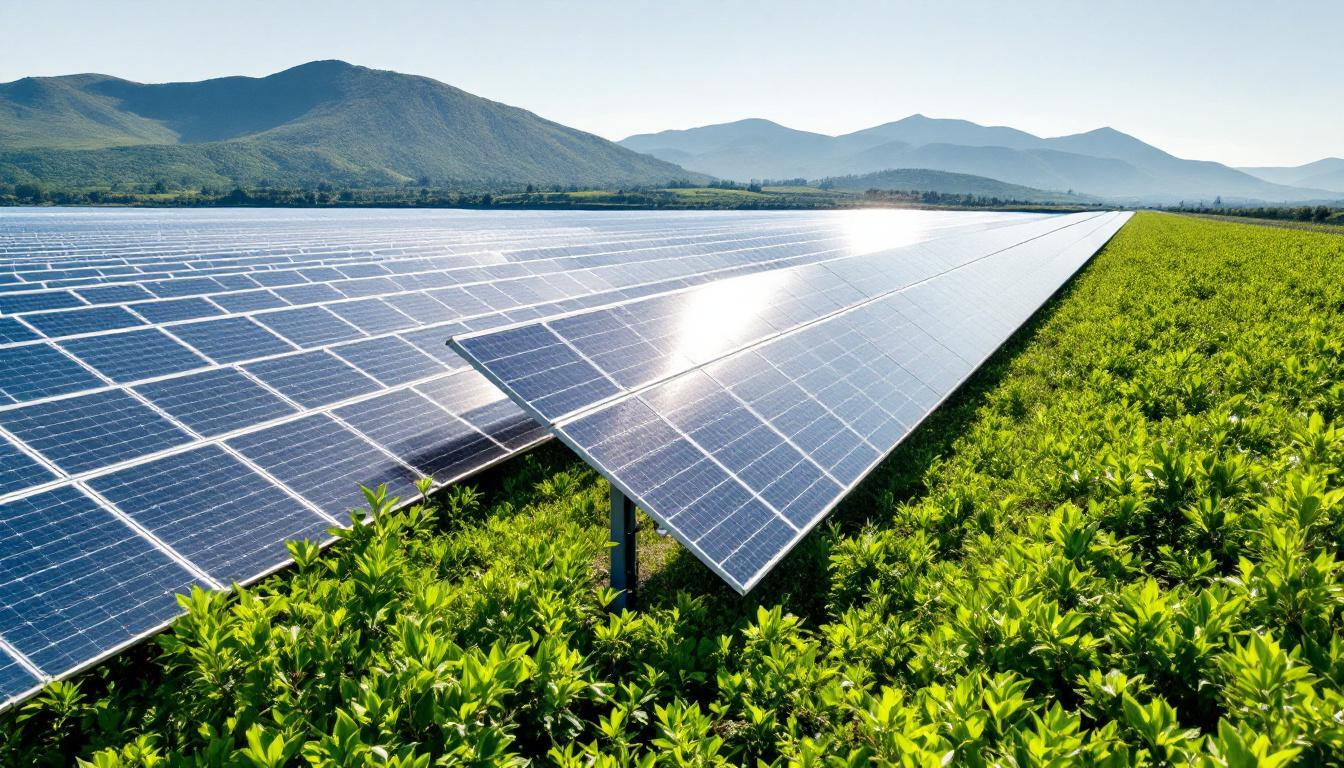
India’s renewable energy industry has outlined a comprehensive set of demands including contract resolutions, manufacturing incentives, storage support, and transmission funding as it targets 500 GW capacity, seeking policy measures to accelerate projects and reduce costs before the 2026‑27 budget.
India’s renewable energy industry has laid out a concentrated set of demands ahead of the Union Budget 2026, urging fiscal and regulatory measures to convert ambitious capacity targets into bankable projects and domestic manufacturing scale. The sector’s priorities span clarity on stalled contracts, targeted incentives for battery storage and equipment, stronger transmission spending and measures to lower financing costs , all designed to tackle intermittency and attract the capital needed for the energy transition.
A critical near‑term ask is resolution of delayed offtake agreements. Industry sources note that more than 45 GW of renewable capacity remained awaiting signed power purchase agreements and power sale agreements as of January 2026, a bottleneck they say is undermining investor and lender confidence. The budget, they argue, should offer an explicit timetable or commitment to expedite signing of those contracts to unlock equity and debt flows.
Manufacturing and technology self‑reliance are central themes. Industry groups want the government to prioritise domestic development of advanced solar technologies and to fold cell and module manufacturing equipment into production‑linked incentive (PLI) support, with wafer and ingot equipment phased in subsequently. According to a Grant Thornton pre‑budget analysis, India needs roughly 50 GW of new renewable capacity per year to hit a 500 GW target by 2030, and the transition will require roughly USD 1 trillion of investment over the next decade; policymakers and firms therefore see local equipment supply chains as essential to capture value and reduce import dependence.
Battery energy storage systems (BESS) are another top recommendation. The industry is seeking a dedicated PLI for BESS manufacturing, domestic treatment of balance‑of‑system components, and an Approved List of BESS Integrators modelled on existing lists for solar equipment to enforce quality and safety standards. Several commentators and reports have highlighted that stronger policy support for storage is critical to address renewable intermittency and to make capacity additions deliver usable, dispatchable power.
Transmission and grid readiness also feature prominently. Stakeholders welcome the greater focus on Green Energy Corridors but want larger budgetary allocations and faster on‑ground execution, together with streamlined state‑level procedures for grid connectivity and charging infrastructure so projects can begin exporting power immediately upon commissioning. Industry analysts contend that extending the Interstate Transmission System (ISTS) waiver beyond its 2025 expiry , potentially for several years , would further incentivise commercial and industrial procurement of interstate renewable power.
Cost of capital and tax measures remain pivotal. The sector is pushing for inclusion of renewables under Priority Sector Lending, reintroduction of concessional corporate tax rates for new manufacturing entities, and lower withholding tax regimes on external commercial borrowings and rupee bonds to reduce financing costs. Renewable developers estimate India will need in excess of USD 200 billion of investment by 2030 for clean energy objectives; easier and cheaper finance is therefore viewed as a lever to accelerate deployment. Calls have also been made to remove deemed dividend taxation on intra‑group loans and to exempt GST on corporate guarantees used by project special purpose vehicles.
On trade and duties, suggestions include lowering customs and GST burdens for key components: industry proposals seen by advisers urge a uniform 5% customs duty for BESS under the Project Import Scheme and standardising GST at 5% for wind and solar equipment to simplify compliance and reduce upfront costs. The extension of the Approved List of Models and Manufacturers (ALMM) for solar cells is also sought, reflecting that domestic cell production is still scaling up amid a supply‑demand mismatch.
Policy experts and executives have urged the budget to balance incentives for scale with measures that enhance long‑term competitiveness and system reliability. Dr Chetan Shah, Chairman and Managing Director of Solex Energy Limited, has advocated a shift from prioritising rapid capacity growth to ensuring sustainable competitiveness and resilience through calibrated fiscal support, viability gap funding and tax reforms.
Taken together, the industry’s package seeks to align industrial policy, grid investment and financial reforms so that India’s renewables expansion becomes both deliverable and domestically beneficial. With the finance ministry due to table the budget for 2026‑27, companies and investors will be watching closely for signals that New Delhi is prepared to greenlight manufacturing incentives, unstick contractual bottlenecks and reduce the cost barriers that currently constrain storage roll‑out and large‑scale project financing.
- https://www.pv-magazine.com/2026/02/02/india-renewables-seek-policy-clarity-storage-incentives-in-union-budget-2026/ – Please view link – unable to able to access data
- https://www.pv-magazine.com/2026/02/02/india-renewables-seek-policy-clarity-storage-incentives-in-union-budget-2026/ – India’s renewable energy sector is urging the government to prioritise in-house technology and equipment development, provide clarity on delayed power purchase agreements (PPAs) and power sale agreements (PSAs), increase support for Green Energy Corridors, introduce production-linked incentives for battery energy storage system (BESS) manufacturing, establish an Approved List of BESS Integrators (ALBI), lower the cost of capital through priority sector lending, extend the Approved List of Models and Manufacturers (ALMM) for solar cells, and continue the Interstate Transmission System (ISTS) waiver to accelerate the sector’s growth.
- https://www.grantthornton.in/globalassets/1.-member-firms/india/assets/pdfs/union-budget/2025-26/pre_budget_industry_report_29-jan_1.pdf – India aims to achieve 500 GW of renewable energy capacity by 2030, requiring the addition of around 50 GW annually. This ambitious transition will demand an investment of about USD 1 trillion over the next decade. Stakeholders are anticipating key policy initiatives, incentives, and duty reductions on critical raw materials in the upcoming budget. Support for turbine production and manufacturing ecosystem, lowering customs duties on imported materials, and standardising GST at 5% for wind and solar projects will simplify processes and reduce costs for renewable energy projects. Incentives for Battery Energy Storage Systems (BESS) are also being considered, including including BESS under the Project Import Scheme with a uniform 5% customs duty to eliminate classification challenges and support renewable energy adoption.
- https://energy.economictimes.indiatimes.com/news/renewable/renewables-industry-push-for-fiscal-measures-in-union-budget-2026-to-address-storage-and-financing-challenges/126473776 – Industry leaders are calling for fiscal measures in the Union Budget 2026 to address storage and financing challenges in the renewable energy sector. Dr Chetan Shah, Chairman and Managing Director of Solex Energy Limited, emphasised the need for a clear policy signal that shifts the focus from scale to long-term sustainability and global competitiveness. He highlighted the importance of strengthening fiscal incentives through enhanced production-linked support, viability gap funding, accelerated depreciation, and a simplified tax framework to sustain investment momentum across renewable technologies.
- https://www.indiatoday.in/business/budget/story/budget-2026-can-india-fix-renewable-energys-storage-and-reliability-gap-2859236-2026-01-28 – Experts suggest that the next phase of India’s energy transition will depend on stronger policy support for battery storage, diversified renewables, and domestic manufacturing. Anurag Choudhary, CMD and CEO of Himadri Speciality Chemical Limited, stated that energy security must now sit at the centre of policymaking. He emphasised that addressing the intermittency of renewable power will require a strong and sustained emphasis on Battery Energy Storage Systems, along with greater support for wind, tidal, and other new-age renewable options.
- https://www.pv-magazine-india.com/2026/01/27/renewable-energy-industrys-key-expectations-from-union-budget-2026/ – The renewable energy industry has outlined key expectations from the Union Budget 2026, including prioritising in-house technology and equipment development, providing clarity on delayed power purchase agreements (PPAs) and power sale agreements (PSAs), increasing budgetary allocation and policy support for Green Energy Corridors, introducing production-linked incentives for battery energy storage system (BESS) manufacturing, establishing an Approved List of BESS Integrators (ALBI), lowering the cost of capital through priority sector lending, extending the Approved List of Models and Manufacturers (ALMM) for solar cells, and continuing the Interstate Transmission System (ISTS) waiver, among other measures.
- https://www.business-standard.com/budget/news/renewable-energy-industry-seeks-sops-for-r-d-affordable-green-finance-in-fy27-budget-126011300244_1.html – The renewable energy industry has sought incentives for research and development as well as for the manufacturing of ingots and wafers in the FY27 Union budget, as the sector looks to transition from capacity additions to execution certainty. The industry has also asked for measures to ramp up transmission infrastructure and long-term green finance. Finance Minister Nirmala Sitharaman is scheduled to table the Union Budget for the financial year 2026-27 in Parliament on February 1.
Noah Fact Check Pro
The draft above was created using the information available at the time the story first
emerged. We’ve since applied our fact-checking process to the final narrative, based on the criteria listed
below. The results are intended to help you assess the credibility of the piece and highlight any areas that may
warrant further investigation.
Freshness check
Score:
8
Notes:
The article was published on February 2, 2026, making it current. However, similar discussions about India’s renewable energy sector’s expectations for the Union Budget 2026 have been reported in other sources, such as The Economic Times and Moneycontrol, indicating that the narrative is not entirely original. ([economictimes.indiatimes.com](https://economictimes.indiatimes.com/industry/renewables/union-budget-2026-expectations-the-green-energy-moment-india-cant-miss/articleshow/126387780.cms?utm_source=openai))
Quotes check
Score:
7
Notes:
The article includes direct quotes from industry stakeholders. However, these quotes cannot be independently verified through the provided sources, raising concerns about their authenticity. ([pv-magazine.com](https://www.pv-magazine.com/2026/02/02/india-renewables-seek-policy-clarity-storage-incentives-in-union-budget-2026/?utm_source=openai))
Source reliability
Score:
8
Notes:
The article is published on pv magazine International, a reputable source for renewable energy news. However, the reliance on a single source for the entire narrative reduces the overall reliability. ([pv-magazine.com](https://www.pv-magazine.com/2026/02/02/india-renewables-seek-policy-clarity-storage-incentives-in-union-budget-2026/?utm_source=openai))
Plausibility check
Score:
9
Notes:
The claims about the renewable energy sector’s expectations for the Union Budget 2026 are plausible and align with industry trends. However, the lack of independent verification of specific figures and quotes introduces some uncertainty. ([pv-magazine.com](https://www.pv-magazine.com/2026/02/02/india-renewables-seek-policy-clarity-storage-incentives-in-union-budget-2026/?utm_source=openai))
Overall assessment
Verdict (FAIL, OPEN, PASS): FAIL
Confidence (LOW, MEDIUM, HIGH): MEDIUM
Summary:
The article presents current information but relies heavily on a single source without independent verification of key figures and quotes, raising concerns about its reliability and independence. ([pv-magazine.com](https://www.pv-magazine.com/2026/02/02/india-renewables-seek-policy-clarity-storage-incentives-in-union-budget-2026/?utm_source=openai))
