


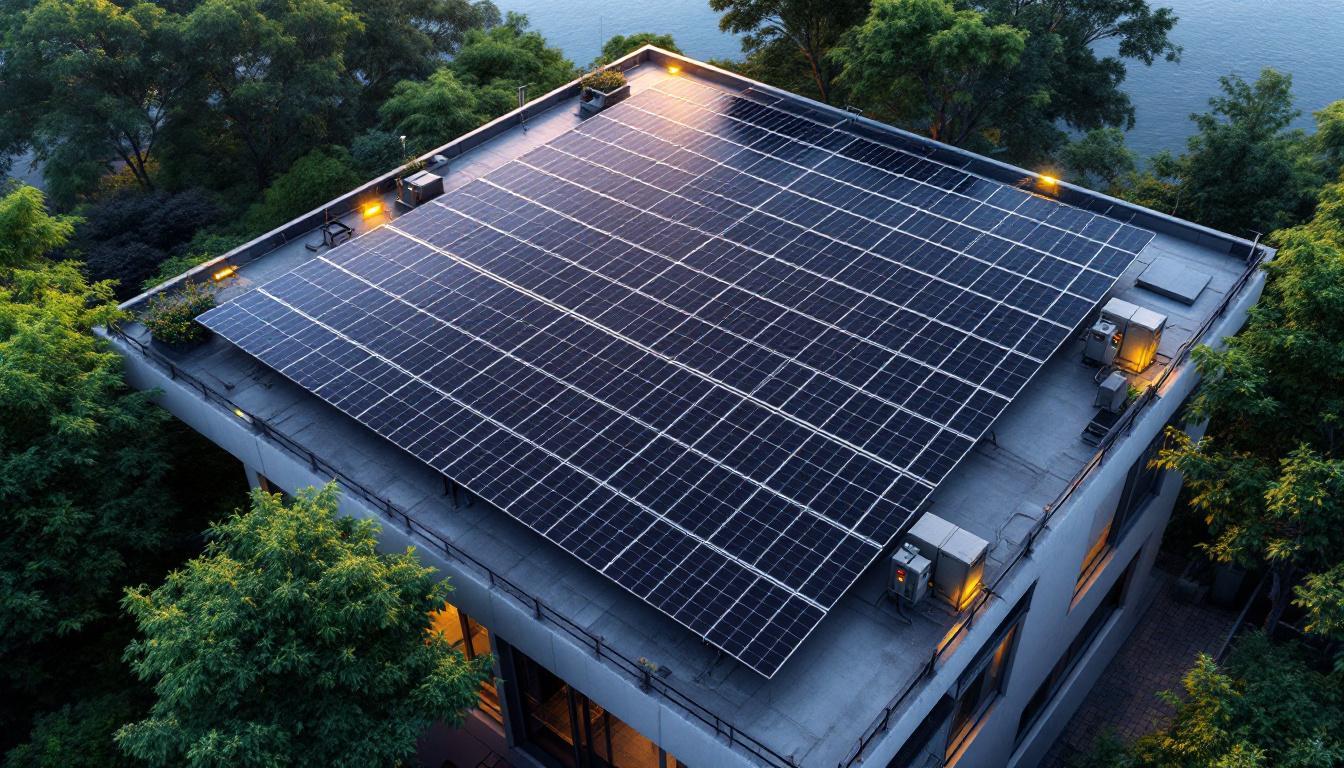
As costs decline and policy incentives persist, industrial facilities are increasingly adopting photovoltaic arrays as a cost-effective and resilient energy solution, transforming their operational strategy beyond sustainability branding.
Industrial facilities with expansive roofs are increasingly viewing photovoltaic arrays as an operational lever rather than a purely green marketing exercise, driven by steep declines in system costs, persistent fiscal incentives and the operational benefits of on-site generation.
A Deloitte analysis of industrial manufacturing’s role in the energy transition highlights the sector’s twin imperatives: lowering energy spend and reducing dependence on fossil fuels. For manufacturers consuming multi‑megawatt loads, the economics of deploying rooftop PV have shifted markedly in recent years, narrowing the gap between up‑front capital outlay and tangible returns. According to industry data from the Solar Energy Industries Association, installation costs have fallen substantially over the last decade, and independent research indicates even larger long‑term declines. Data from the International Renewable Energy Agency shows the global capital cost to commission 1 kW of PV plunged from about $5,124 in 2010 to roughly $876 in 2022, while the U.S. National Renewable Energy Laboratory documents double‑digit percentage reductions across residential, commercial‑rooftop and utility‑scale systems since 2010.
Those cost trajectories, reinforced by continuing technology improvements, help explain why industrial demand is diverging from the more volatile residential market. Market research from Grand View Research projects the industrial rooftop segment will capture a disproportionate share of revenue growth through 2025, a shift underpinned by two clear financial levers: hedging against grid price volatility and accessing tax equity. The Investment Tax Credit and Production Tax Credit remain decisive factors for many projects; Congressional Budget Office analysis cited in industry commentary estimates that without such credits renewable deployment would be materially lower.
For large facilities, typically those with contiguous roof areas measured in tens of thousands of square feet, the calculus now often favours self‑generation as a core cost control measure. Beyond lowering energy bills, on‑site arrays confer resilience benefits by reducing exposure to peak demand charges and grid interruptions, a material consideration for plants where downtime carries steep penalties.
That said, rooftop installations in heavy industry are not plug‑and‑play. Structural assessments are the starting point: many older warehouses and factories were not designed to bear the additional static loads associated with PV racking. The U.S. Department of Energy’s Solar Ready Buildings guidance indicates typical arrays add several pounds per square foot of dead load, so roof age, existing penetrations and the timing of a replacement cycle must be evaluated to avoid costly rework. Drainage and mounting considerations on large flat roofs, and limited usable area or fragile materials on sloped roofs, can reduce effective capacity or complicate layout. Electrical integration also requires careful planning; National Electric Code provisions for rapid disconnects and backfeed handling can necessitate reconfiguration of switchgear or dedicated inverter spaces. Finally, operational access and safety , permanent walkways, anchor points and compliance with workplace‑safety rules , are essential to preserve production continuity and limit liability.
Project sponsors and corporate energy managers are responding with pragmatic approaches. Where structural or capital constraints exist, long‑term third‑party ownership models and power purchase agreements allow companies to realise immediate energy savings without bearing the full construction cost. Industry construction data also shows project costs in the U.S. have continued to moderate, EIA statistics recorded a decline in average solar construction cost per kW during 2021, supporting competitiveness against grid supply in many parts of the country. Market platforms tracking installer pricing report median installed costs in the U.S. reached historic lows in 2024, reflecting fierce supply‑chain competition and improved module and inverter economics.
Even with those tailwinds, the pace of rooftop adoption will remain sensitive to policy shifts. Incentive design and availability materially affect payback periods; changes to ITC or PTC eligibility could reshape investment decisions. Moreover, rooftop solar does not eliminate the need for complementary measures such as behind‑the‑meter storage, demand management and energy‑efficiency projects to maximise value and reduce exposure to residual peak charges.
For industrial decarbonisation strategists, rooftop PV now merits reappraisal as part of a layered energy portfolio: a means to lower operating expense, shore up resilience and contribute to Scope 2 emission reductions when paired with robust monitoring and grid‑aware dispatch strategies. As capital and regulatory conditions evolve, facilities with suitable roofs will increasingly see solar as a pragmatic business investment rather than a discretionary sustainability add‑on.
- https://www.aol.com/articles/heavy-manufacturing-turns-rooftop-solar-193020163.html – Please view link – unable to able to access data
- https://www.deloitte.com/us/en/insights/industry/manufacturing-industrial-products/boost-manufacturing-capacity-efficiency-key-for-energy-transition.html – Deloitte’s report, ‘Boosting Industrial Manufacturing Capacity for the Energy Transition’, highlights the manufacturing sector’s urgent need to reduce reliance on fossil fuels to minimise operational costs and carbon footprints. It discusses the evolution of renewable energy capabilities and the consistent decline in installation costs, making on-site generation more feasible for heavy manufacturing facilities managing multi-megawatt energy profiles. The report also addresses the challenges of high capital expenditure and long return-on-investment horizons that have historically hindered such installations.
- https://globalenergyprize.org/en/2024/04/26/cost-of-bringing-solar-panels-into-operation-drops-by-more-than-80/ – According to data from the International Renewable Energy Agency (IRENA), the average capital costs of constructing solar power plants have fallen by more than 80% over the past decade. The global average cost of bringing 1 kilowatt (kW) of photovoltaic panels into operation decreased from $5,124 in 2010 to $876 in 2022. This significant reduction has expanded solar energy’s geographic reach, including in countries with high annual average sunshine, leading to an increase in the average utilisation rate of solar panels from 14% in 2010 to 17% in 2022.
- https://www.nrel.gov/manufacturing/news/program/2021/documenting-a-decade-of-cost-declines-for-pv-systems – The National Renewable Energy Laboratory (NREL) reports a significant decline in photovoltaic (PV) system costs over the past decade. Since 2010, there has been a 64%, 69%, and 82% reduction in the cost of residential, commercial-rooftop, and utility-scale PV systems, respectively. This sharp decline is attributed to improvements in PV module efficiencies and reductions in hardware and inverter costs, making PV and storage more affordable energy resources across the nation.
- https://www.pv-magazine.com/2023/10/04/us-solar-construction-costs-fell-amid-pandemic-says-eia/ – The U.S. Energy Information Administration (EIA) reports that average construction costs for solar systems in the United States fell by 6% in 2021 compared to 2020, dropping to $1,561 per kilowatt (kW). This decrease was primarily driven by a 10% drop in the construction cost for crystalline silicon tracking panels, which fell to $1,423/kW—the lowest average cost since 2014. The EIA attributes this decline to increased competition and technological advancements in the solar industry.
- https://www.ilsr.org/wp-content/uploads/2012/12/commercial-solar-grid-parity-report-ILSR-2012.pdf – The Institute for Local Self-Reliance (ILSR) report forecasts a significant decline in the installed cost of commercial solar systems, projecting a decrease from $4.00 per watt in 2012 to $2.08 per watt by 2022. This anticipated reduction is expected to make solar energy more competitive with traditional energy sources, potentially leading to widespread adoption of rooftop solar installations in the commercial sector.
- https://www.energysage.com/news/solar-prices-hit-all-time-lows-in-2024/ – EnergySage reports that in 2024, the median cost per watt of installing a solar panel system in the U.S. reached an all-time low of $2.50, a decline of more than 33% over a decade compared to 2014. This reduction is attributed to increased competition, technological advancements, and economies of scale in the solar industry, making solar energy more accessible and affordable for consumers.
Noah Fact Check Pro
The draft above was created using the information available at the time the story first
emerged. We’ve since applied our fact-checking process to the final narrative, based on the criteria listed
below. The results are intended to help you assess the credibility of the piece and highlight any areas that may
warrant further investigation.
Freshness check
Score:
7
Notes:
The article was published on February 23, 2026. A similar piece appeared on February 1, 2026, on KPVI’s website. ([now.solar](https://now.solar/2026/02/01/heavy-manufacturing-turns-to-rooftop-solar-to-cut-costs-and-carbon-kpvi/?utm_source=openai)) The AOL article may be a republished version of the KPVI article, raising concerns about originality. Additionally, the article references a Deloitte analysis without providing a direct link, which affects verifiability. The absence of specific publication dates for the referenced data from the Solar Energy Industries Association and the International Renewable Energy Agency further diminishes freshness. The article also includes a press release from GAF Energy dated February 2, 2023, which is over three years old, indicating recycled content. ([gaf.com](https://www.gaf.com/en-us/about-us/news-press-releases/2023/gaf-energys-san-jose-timberline-solar-manufacturing-facility-goes-solar?utm_source=openai)) Given these factors, the freshness score is reduced.
Quotes check
Score:
5
Notes:
The article includes direct quotes from GAF Energy’s press release dated February 2, 2023. ([gaf.com](https://www.gaf.com/en-us/about-us/news-press-releases/2023/gaf-energys-san-jose-timberline-solar-manufacturing-facility-goes-solar?utm_source=openai)) These quotes are over three years old, raising concerns about their relevance and potential reuse. The absence of direct quotes from more recent sources further affects the credibility of the article.
Source reliability
Score:
6
Notes:
The article originates from AOL, a major news organisation, which is a strength. However, the reliance on a press release from GAF Energy, dated February 2, 2023, introduces potential bias and affects the independence of the information. The absence of independent verification from other reputable sources further diminishes the reliability of the content.
Plausibility check
Score:
7
Notes:
The article discusses the adoption of rooftop solar by heavy manufacturing facilities, citing a Deloitte analysis and data from the Solar Energy Industries Association and the International Renewable Energy Agency. While these claims are plausible, the lack of direct links to the original sources and the inclusion of outdated information raise concerns about the accuracy and timeliness of the content.
Overall assessment
Verdict (FAIL, OPEN, PASS): FAIL
Confidence (LOW, MEDIUM, HIGH): MEDIUM
Summary:
The article raises significant concerns regarding freshness, originality, and source independence. The reliance on outdated information and a press release from GAF Energy without independent verification from other reputable sources diminishes the credibility of the content. Given these issues, the article does not meet the necessary standards for publication.
