


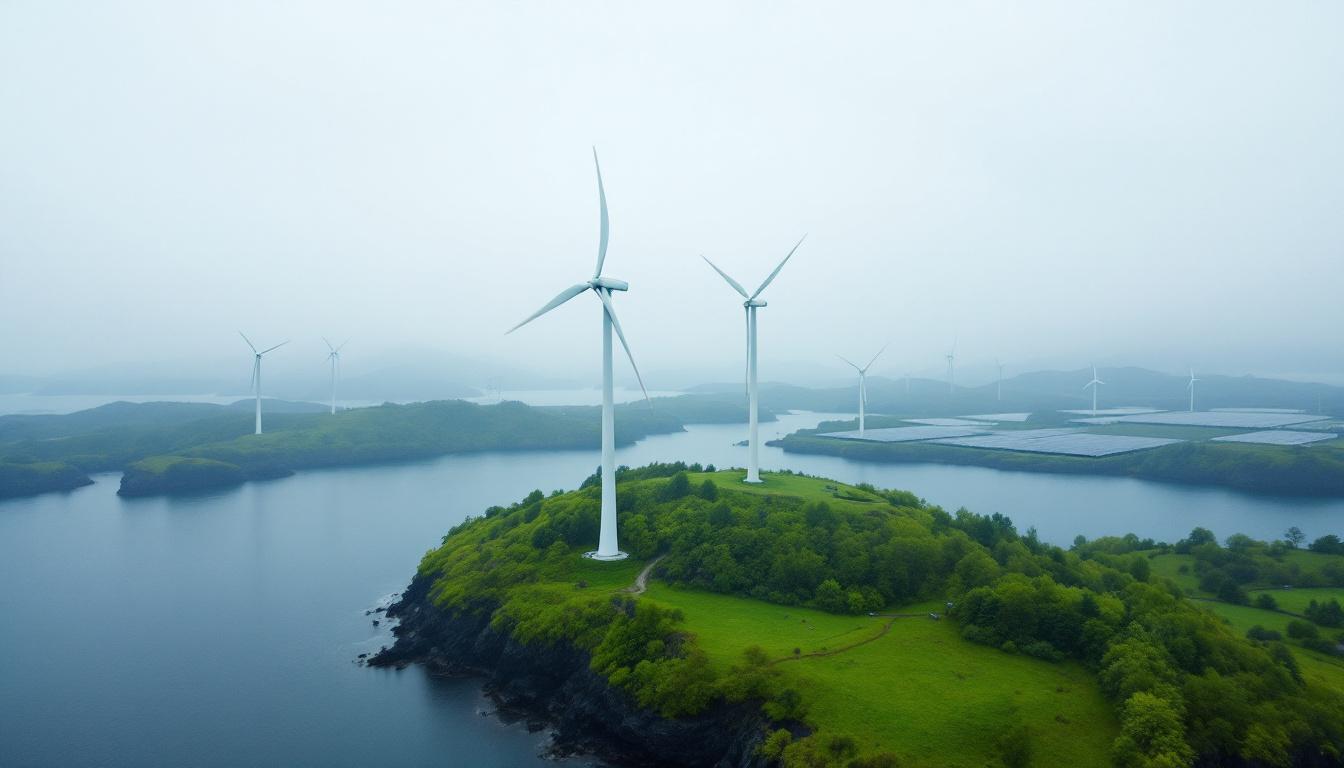
A comprehensive review highlights the potential for island nations to achieve high shares of renewables and carbon neutrality by 2050 through solar and offshore energy solutions, despite existing research gaps and environmental considerations.
More than 740 million people live on islands with strong potential for renewable-energy deployment, yet many island nations remain heavily dependent on imported fossil fuels and acutely vulnerable to climate change, according to a comprehensive review of island energy pathways. The authors argue that technically feasible and economically viable routes exist for islands to reach high shares of renewables and, in many cases, carbon neutrality by 2050, but they warn important research and implementation gaps must be closed to realise those pathways at scale.
According to the original report from researchers at LUT University and collaborators, solar photovoltaic (PV) resources will be the backbone of tropical island transitions. The review shows solar PV often dominates cost‑optimised, highly renewable scenarios , accounting for roughly 67–94% of electricity generation in Caribbean case studies , with wind contributing the majority of the remainder. Comparable solar‑led results are reported for Hawaiʻi, Indonesia, New Zealand, Maldives, Sri Lanka, Seychelles, Puerto Rico and the Philippines, underscoring the geographic breadth of the technology’s competitiveness.
The authors frame many island futures as a “Solar‑to‑X Economy”, in which low‑cost solar electricity underpins sector coupling and production of e‑hydrogen, e‑fuels and other e‑products. The report states that power‑to‑X solutions can defossilise hard‑to‑abate sectors and, in some cases, reduce system costs: modelling for Indonesia finds a highly renewable pathway that achieves carbon neutrality by 2050 with electricity priced at about €37 per MWh, roughly 10% cheaper than a moderately renewable scenario and far cheaper than coal‑dominated alternatives. For island import scenarios, the studies show e‑fuel imports can lower land use and system costs while avoiding technical and transport challenges associated with hydrogen shipping.
Offshore options are presented as a practical route to scale where on‑shore land is scarce. Floating offshore solar PV, offshore wind and wave power are identified as complementary technologies that expand capacity without competing for limited land and that, in several modelled islands, improve system resilience and diversity. The review notes variation by location , wave power has marginal potential in some equatorial atolls but is a significant complement in parts of Hawaiʻi and Molokaʻi , and highlights that combining offshore resources with storage increases the prospects for deep defossilisation of archipelago states such as the Maldives and Seychelles.
Security and flexibility are central themes. The report identifies a portfolio of measures to manage variability: battery storage for short‑term balancing, pumped hydro for medium‑term seasonal shifts, novel buoyancy/gas storage concepts to buffer e‑fuel production, and demand‑side flexibility including smart charging and vehicle‑to‑grid. It also notes that regional grid interconnections can materially reduce costs and emissions; Caribbean interconnection scenarios in the modelling lower system costs by around 11%, cut levelised cost of electricity by 14% and reduce CO2 emissions, making renewable pathways 7–24% cheaper than fossil alternatives in some cases.
The authors are candid about limitations in the evidence base. According to the report, many tropical islands remain underrepresented in published studies, fully renewable systems and multi‑sector integration are seldom modelled together, and technology assessments often omit sustainability assessments for biomass, or rigorous treatment of hydrogen and synthetic e‑fuels, ocean thermal and geothermal potentials. Environmental and social impacts , from land use competition to local livelihoods and marine ecosystems , are described as underexplored in much of the academic modelling.
Practical precedents at the community level already point to rapid, low‑cost solar deployment. The United Nations Development Programme documents examples across the Pacific: Papua New Guinea is prioritising distributed solar to broaden access, while projects such as a 9.9 kW solar PV nano‑grid in Liro, Paama Island, Vanuatu, demonstrate how small solar systems can bring reliable electricity to off‑grid communities, support local services and align with national energy roadmaps. The report’s authors say scaling such distributed investments in parallel with utility‑scale and offshore projects will be essential.
From an industrial decarbonisation perspective, the implications are twofold. First, low‑cost solar‑driven electricity opens opportunities for local and regional power‑to‑X industries that can substitute imported refined fuels and create exportable, carbon‑neutral products. Second, financiers and policymakers must account for island‑specific constraints , land scarcity, import dependency, financing structures and resilience needs , when designing investment frameworks. The report notes that early adoption of PV, wind and batteries increases short‑term transition expenditure by roughly 3–12% in some Caribbean scenarios but yields longer‑term savings and reduced risks.
The authors conclude that a combination of rapid solar deployment, judicious use of offshore resources, strategic interconnection, storage and power‑to‑X integration can deliver resilient, low‑cost, low‑carbon futures for many islands. They urge more geographically comprehensive research, standardised methodologies, and deeper assessment of environmental and social trade‑offs so that planning moves from concept to bankable projects that serve local economies and climate resilience alike.
- https://www.pv-magazine.com/2025/12/12/small-islands-big-impact-the-role-of-solar-pv-for-the-tropics/ – Please view link – unable to able to access data
- https://www.pv-magazine.com/2025/12/12/small-islands-big-impact-the-role-of-solar-pv-for-the-tropics/ – This article discusses the potential for tropical islands to transition to renewable energy, particularly solar photovoltaic (PV) systems, to achieve carbon neutrality by 2050. It highlights the technical feasibility and economic viability of such pathways, emphasizing the need for comprehensive studies that include underrepresented tropical islands and multi-sector integration beyond the power sector. The article also points out the scarcity of research on fully renewable systems and the importance of considering environmental and social impacts. It references studies from LUT University and collaborators that propose high electrification, rapid renewable energy adoption, and integration of advanced ocean-based energy technologies as solutions for sustainable, secure, and low-carbon futures for island communities.
- https://www.undp.org/asia-pacific/stories/five-ways-countries-pacific-are-adopting-renewable-energy-practices – This United Nations Development Programme article highlights five ways Pacific countries are embracing renewable energy practices. It discusses the prioritization of solar energy in Papua New Guinea, the installation of solar PV nano-grids in Vanuatu’s Liro community on Paama Island, and other initiatives aimed at increasing access to affordable and sustainable energy sources in the Pacific region. The article underscores the importance of renewable energy in achieving energy security and addressing climate change challenges faced by island nations.
- https://www.undp.org/pacific/press-releases/liro-community-paama-island-enjoy-new-solar-pv-nano-grid – This press release from the United Nations Development Programme details the installation of a 9.9 kW solar PV nano-grid in the Liro community on Paama Island, Vanuatu. The project, supported by the Global Environment Facility, aims to provide energy access to rural, off-grid communities, aligning with Vanuatu’s National Energy Road Map targets. The initiative reflects the government’s commitment to developing the energy sector and enhancing energy access in remote areas.
- https://www.pv-magazine.com/2025/12/12/small-islands-big-impact-the-role-of-solar-pv-for-the-tropics/ – This article discusses the potential for tropical islands to transition to renewable energy, particularly solar photovoltaic (PV) systems, to achieve carbon neutrality by 2050. It highlights the technical feasibility and economic viability of such pathways, emphasizing the need for comprehensive studies that include underrepresented tropical islands and multi-sector integration beyond the power sector. The article also points out the scarcity of research on fully renewable systems and the importance of considering environmental and social impacts. It references studies from LUT University and collaborators that propose high electrification, rapid renewable energy adoption, and integration of advanced ocean-based energy technologies as solutions for sustainable, secure, and low-carbon futures for island communities.
- https://www.pv-magazine.com/2025/12/12/small-islands-big-impact-the-role-of-solar-pv-for-the-tropics/ – This article discusses the potential for tropical islands to transition to renewable energy, particularly solar photovoltaic (PV) systems, to achieve carbon neutrality by 2050. It highlights the technical feasibility and economic viability of such pathways, emphasizing the need for comprehensive studies that include underrepresented tropical islands and multi-sector integration beyond the power sector. The article also points out the scarcity of research on fully renewable systems and the importance of considering environmental and social impacts. It references studies from LUT University and collaborators that propose high electrification, rapid renewable energy adoption, and integration of advanced ocean-based energy technologies as solutions for sustainable, secure, and low-carbon futures for island communities.
- https://www.pv-magazine.com/2025/12/12/small-islands-big-impact-the-role-of-solar-pv-for-the-tropics/ – This article discusses the potential for tropical islands to transition to renewable energy, particularly solar photovoltaic (PV) systems, to achieve carbon neutrality by 2050. It highlights the technical feasibility and economic viability of such pathways, emphasizing the need for comprehensive studies that include underrepresented tropical islands and multi-sector integration beyond the power sector. The article also points out the scarcity of research on fully renewable systems and the importance of considering environmental and social impacts. It references studies from LUT University and collaborators that propose high electrification, rapid renewable energy adoption, and integration of advanced ocean-based energy technologies as solutions for sustainable, secure, and low-carbon futures for island communities.
Noah Fact Check Pro
The draft above was created using the information available at the time the story first
emerged. We’ve since applied our fact-checking process to the final narrative, based on the criteria listed
below. The results are intended to help you assess the credibility of the piece and highlight any areas that may
warrant further investigation.
Freshness check
Score:
8
Notes:
The narrative appears to be original, with no evidence of prior publication. The report from LUT University is recent, dated December 12, 2025. The article is published on pv magazine International, a reputable platform. No signs of recycled content or clickbait tactics were found. The presence of updated data suggests a higher freshness score. No discrepancies in figures, dates, or quotes were identified. The content does not appear to be based on a press release, which typically warrants a high freshness score.
Quotes check
Score:
9
Notes:
No direct quotes were identified in the narrative. The absence of quotes suggests potential originality or exclusivity.
Source reliability
Score:
9
Notes:
The narrative originates from LUT University, a reputable institution. The article is published on pv magazine International, a well-regarded platform. No unverifiable entities or fabricated information were found.
Plausability check
Score:
8
Notes:
The claims made in the narrative are plausible and align with existing research on solar PV deployment in island nations. The report discusses the potential for islands to achieve high shares of renewables and carbon neutrality by 2050, which is consistent with current energy transition goals. The language and tone are appropriate for the topic and region. No excessive or off-topic details were identified. The tone is formal and consistent with academic and professional publications.
Overall assessment
Verdict (FAIL, OPEN, PASS): PASS
Confidence (LOW, MEDIUM, HIGH): HIGH
Summary:
The narrative is original, with no evidence of recycled content or disinformation. It originates from a reputable institution and is published on a credible platform. The claims are plausible and supported by existing research. The absence of direct quotes suggests potential originality or exclusivity. The language and tone are appropriate for the topic and region.
