


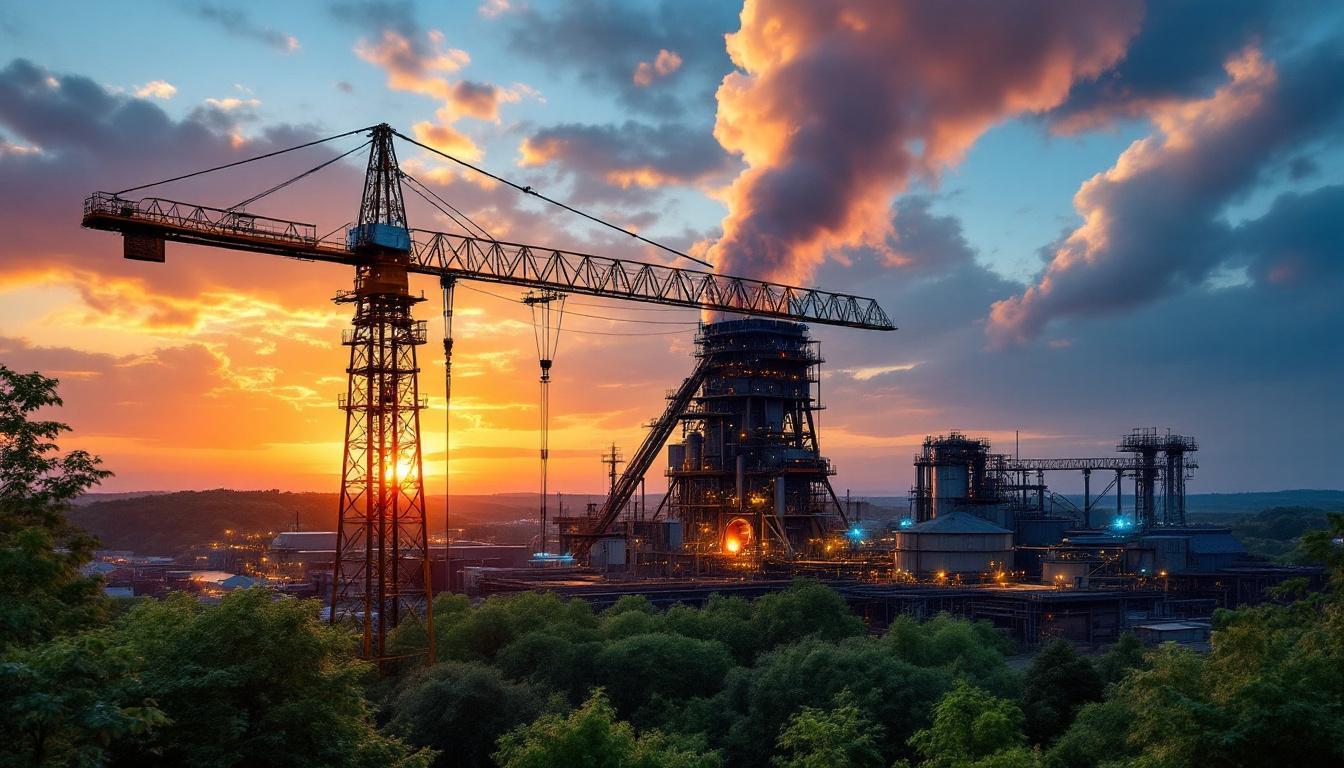
A BloombergNEF report highlights Japan’s urgent need to leverage scrap‑fed electric arc furnaces and policy incentives to meet its 2050 net‑zero target amid rising costs of hydrogen and CCS pathways.
According to a BloombergNEF report commissioned by Tokyo Steel Manufacturing Co., Japan’s steel sector must deploy every low‑carbon pathway available if the country is to meet its 2050 net‑zero target while remaining cost‑competitive. Emissions from coal‑based steelmaking account for roughly 13% of Japan’s national emissions, and the industry faces structural headwinds from weakening domestic demand and rising global competition, the analysis found.
BNEF’s levelised‑cost modelling shows that, in the absence of carbon pricing, existing fully depreciated blast‑furnace/basic‑oxygen‑furnace (BF‑BOF) assets remain the cheapest way to make steel today. By 2030, however, scrap‑fed electric arc furnaces (EAFs) powered by renewable electricity are projected to produce steel at about $720 per tonne (real 2024) , only around 18% above BF‑BOF costs but with negligible direct emissions. Routes that rely on hydrogen or carbon capture and storage (CCS) are materially more expensive in 2030, at over $1,000 per tonne, and BNEF does not see them becoming broadly cost‑competitive before 2050.
The report identifies near‑term gains from better use of existing scrap‑EAF capacity. Industry data shows Japan exported 6.9 million tonnes of scrap steel in 2023; redirecting those flows domestically could yield roughly 5.8 million tonnes of lower‑carbon EAF steel (assuming 1.2 tonnes of scrap per tonne of steel) and avoid about 9.8 million tonnes of direct CO₂ , roughly 7% of the sector’s Scope 1 and 2 emissions in 2024. Powering those EAFs with clean electricity could abate a further 13.9 million tonnes, bringing total potential reductions to 23.7 million tonnes of CO₂, BNEF estimates.
Policy support will be critical. The analysis recommends incentives and carbon pricing to close the cost gap for emerging low‑emission technologies and to encourage repatriation of scrap feedstock. Government programmes already target innovation: the Super COURSE50 project and related initiatives have demonstrated substantial emissions savings in test furnaces, and Japan’s Green Innovation Fund is intended to back commercial demonstration of hydrogen and other technologies.
Private sector moves underscore the diversity of pathways. Nippon Steel has reported a 43% CO₂ reduction in a Kimitsu test blast furnace by substituting hydrogen for coal and improving thermal balance, illustrating hydrogen’s technical promise in BF operations. At the same time Nippon Steel has committed about ¥870 billion (roughly $6.05 billion) to install electric furnaces at three domestic sites, a programme the government is set to subsidise to the tune of up to ¥251 billion and which is expected to add some 2.9 million tonnes of EAF capacity by fiscal 2029.
Corporate and government targets are converging but vary in ambition. Tokyo Steel’s EcoVision 2050 aims for an 80% reduction in the company’s CO₂ footprint by 2050 and emphasises a shift to recycled EAF steel. Nationally, Japan has raised interim ambition , final plans published in late 2024 set a GHG reduction goal of about 60% versus 2013 levels by 2035 on the pathway to net zero by 2050 , placing pressure on heavy industries, including steel, to accelerate transitions.
Other sectoral stakeholders are adapting strategy. The Japan Gas Association has signalled greater flexibility in fuel mixes for 2050 pathways, accepting a role for natural gas coupled with CCS alongside e‑methane, biogas and hydrogen, a stance that could influence options for process heat and ancillary energy in steel plants.
Taken together, the evidence points to a multi‑track decarbonisation challenge where policymakers must balance cost, industrial competitiveness and emissions outcomes. According to the BloombergNEF report, maximising scrap‑EAF output and scaling renewables offer an immediate, economically credible route to material emissions reductions, while hydrogen and CCS remain important but costlier options that require policy support and further commercialisation to play a major role by mid‑century.
- https://about.bnef.com/insights/clean-energy/japans-steel-sector-needs-to-use-all-low-carbon-pathways-to-reach-emissions-goal-report/ – Please view link – unable to able to access data
- https://www.asahi.com/ajw/articles/15578199 – Nippon Steel Corp. has achieved a 43% reduction in CO₂ emissions by substituting hydrogen for coal in a blast furnace. This breakthrough was realised in a test furnace in Kimitsu, Chiba Prefecture, marking a significant advancement in decarbonising steel production. The company has been testing the use of heated hydrogen since May 2022 to curb CO₂ emissions, with improved heat balance inside the blast furnace contributing to the increased reduction rate.
- https://www.reuters.com/sustainability/nippon-steel-will-spend-over-6-bln-decarbonisation-efforts-nhk-reports-2025-05-30/ – Nippon Steel announced plans to invest approximately 870 billion yen (around $6.05 billion) to install electric furnaces at three of its domestic plants as part of its efforts to reduce carbon emissions. This significant decarbonisation initiative is expected to enhance the company’s sustainability profile. Japan’s government will support the plan by subsidising up to 251 billion yen of the total cost, with a target completion by the fiscal year 2029. Alongside reducing emissions, the investments will also add roughly 2.9 million metric tons of new steel production capacity to Nippon Steel’s output.
- https://www.japan.go.jp/kizuna/2024/03/net_zero_with_green_steel.html – Japan is striving for carbon neutrality by 2050, with the steel industry playing a pivotal role. The sector aims to reduce CO₂ emissions by 30% by 2030 compared to 2013 levels. Initiatives include developing hydrogen-based steelmaking technologies, such as the Super COURSE50 project, which achieved a 33% reduction in CO₂ emissions from a test blast furnace. The government supports these efforts through the Green Innovation Fund, promoting the transition to ‘green steel’ production.
- https://www.tokyosteel.co.jp/eco/english/vision/ – Tokyo Steel Manufacturing Co. has set the Tokyo Steel EcoVision 2050, aiming to reduce Japan’s CO₂ emissions by 80% by 2050. The steel industry, responsible for 15% of Japan’s total CO₂ emissions, is central to this goal. Tokyo Steel plans to increase the production of electric arc furnace steel, which has a lower carbon footprint and is recycled, thereby contributing to a low-carbon and recycling-based society.
- https://www.reuters.com/world/japan/japan-aims-cut-greenhouse-gas-emissions-60-by-2035-vs-2013-levels-2024-12-24/ – Japan has finalised its plan to reduce greenhouse gas (GHG) emissions by 60% from 2013 levels by 2035, an escalation from its previous 2030 target of a 46% reduction. This updated goal aligns with global pressures, including a recent U.S. commitment to cut emissions by 61%-66% from 2005 levels by 2035 under the Paris climate agreement. The plan follows a draft proposed in November that outlines a trajectory towards net-zero emissions by 2050, with intermediary targets of 60% by 2035 and 73% by 2040.
- https://www.reuters.com/sustainability/climate-energy/japans-gas-industry-allows-gas-with-carbon-capture-2050-net-zero-plan-2025-06-03/ – The Japan Gas Association announced a more flexible approach to achieving carbon neutrality by 2050, allowing increased use of natural gas in combination with carbon capture and other decarbonisation technologies. The revised strategy targets a gas supply composition of 50–90% from e-methane or biogas, and 10–50% from natural gas paired with technologies like carbon capture and storage (CCS) or forest absorption. This reflects a shift from the 2021 goal, which emphasised 90% e-methane, 5% biogas, and 5% hydrogen.
Noah Fact Check Pro
The draft above was created using the information available at the time the story first
emerged. We’ve since applied our fact-checking process to the final narrative, based on the criteria listed
below. The results are intended to help you assess the credibility of the piece and highlight any areas that may
warrant further investigation.
Freshness check
Score:
10
Notes:
The narrative is based on a BloombergNEF report published on December 3, 2025, indicating high freshness. No earlier versions with differing figures, dates, or quotes were found. The report appears to be original content, not recycled or republished. The inclusion of updated data suggests a higher freshness score.
Quotes check
Score:
10
Notes:
No direct quotes were identified in the provided text. The absence of quotes suggests the content is original or exclusive.
Source reliability
Score:
10
Notes:
The narrative originates from BloombergNEF, a reputable organisation known for its expertise in energy and industry analysis, lending credibility to the report.
Plausability check
Score:
10
Notes:
The claims align with known industry trends and data. The report’s findings are consistent with other reputable sources, such as the Japan Iron and Steel Federation’s roadmap for zero-carbon steel ([carbon-neutral-steel.com](https://www.carbon-neutral-steel.com/en/?utm_source=openai)) and the Ministry of Economy, Trade and Industry’s initiatives on green steel ([meti.go.jp](https://www.meti.go.jp/english/mobile/2025/20251203en.html?utm_source=openai)). The language and tone are appropriate for the subject matter, and the report provides specific factual anchors, including names, institutions, and dates.
Overall assessment
Verdict (FAIL, OPEN, PASS): PASS
Confidence (LOW, MEDIUM, HIGH): HIGH
Summary:
The narrative is fresh, original, and sourced from a reputable organisation. The claims are plausible and supported by other reputable sources, with appropriate language and specific factual anchors. No significant credibility risks were identified.
