


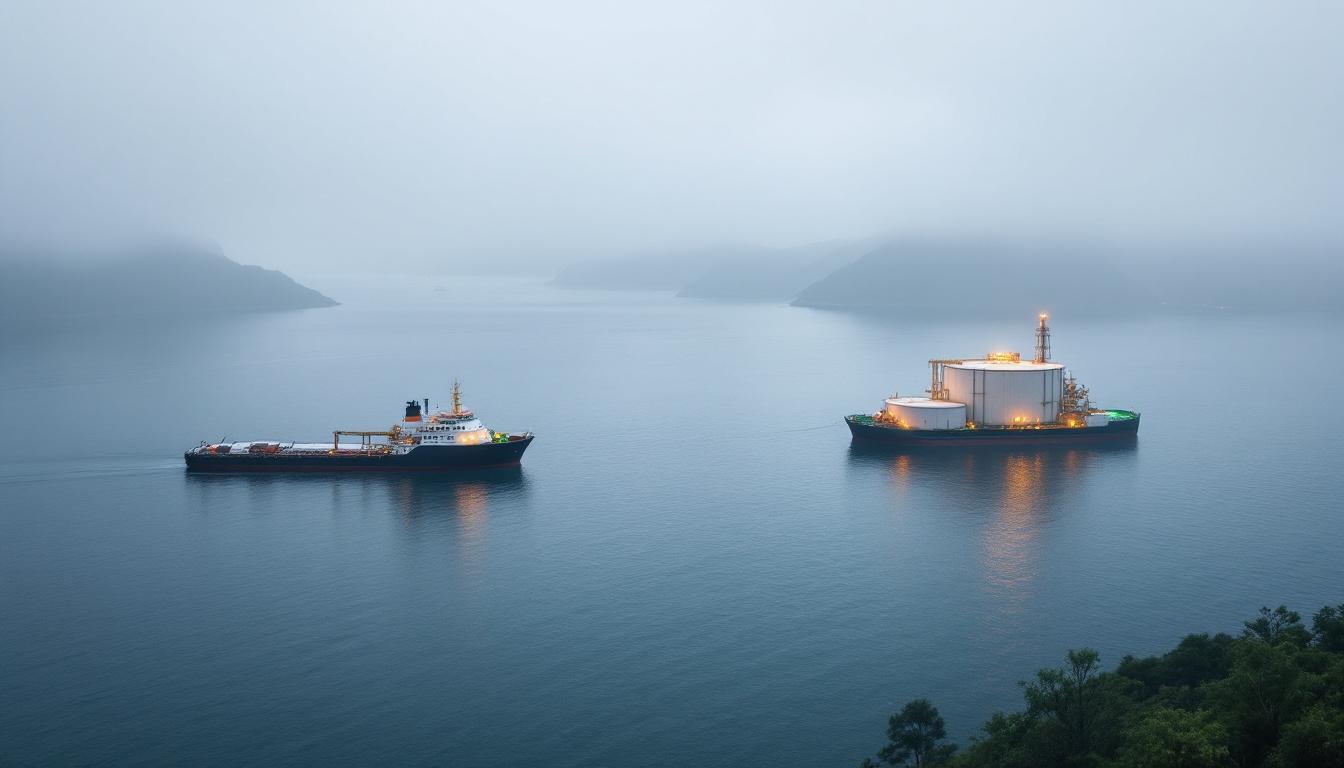
Japan aims to nearly 30-fold boost its carbon capture, utilisation, and storage capacity by 2035, relying on international storage collaborations to overcome cross-border transport challenges and lead regional industrial decarbonisation efforts.
Japan is poised for a significant expansion in carbon capture, utilisation, and storage (CCUS) capacity, with projections indicating a nearly 30-fold increase from the current 0.3 million tonnes per annum (Mtpa) to 12.5 Mtpa by 2035. This rapid scale-up positions Japan as one of the Asia-Pacific region’s fastest-growing markets for CCUS, driven largely by heavy industry sectors such as steel and petrochemicals, which face substantial challenges in cutting emissions. According to analysis by Wood Mackenzie, this growth underscores Japan’s emerging role as a leader in industrial decarbonisation within the region.
The expansion is underpinned by robust policy frameworks, with Japan ranking second in Asia-Pacific for CCUS readiness. The government has established clear national targets, implemented funding mechanisms to lower costs, and developed a maturing storage regulatory regime. Additionally, the transition of the government’s GX emissions trading system (ETS) from voluntary to mandatory offers stronger economic incentives to facilitate deployment. However, despite these favourable conditions, Japan is projected to miss its 2030 CCUS capacity targets by around five years, primarily due to delays in establishing cross-border CO₂ storage agreements that are vital to the country’s decarbonisation strategy.
Cross-border transport of captured CO₂ to overseas storage facilities represents the decisive bottleneck in Japan’s plan. Among nine advanced CCUS projects shortlisted by the government, which collectively represent over 20 Mtpa of potential capacity, nearly 60% depend on international storage partnerships. Japan is actively pursuing storage deals with Australia, Indonesia, and Malaysia to secure overseas sequestration options. Transport costs for CO₂ shipments from Japan to Australia are estimated to be 7 to 9 times higher than domestic transport, but early bilateral agreements could limit overall cost increases to 15 to 20%, crucially maintaining market competitiveness.
Japan’s approach combines domestic innovation in carbon capture technologies with overseas storage access, recognising that neither alone will suffice for the industrial decarbonisation goals. The country’s strategic partnerships with Australian firms, such as the collaboration between Electric Power Development (J-Power) and Australian CCS developers deepC Store and Azuli, exemplify this approach. These partnerships support commercialization of projects that could store up to one billion metric tons of CO₂ in offshore basins, helping to scale Japan’s cross-border storage capacity to meet demand.
Furthermore, the Tomakomai CCS facility on Hokkaido Island illustrates Japan’s commitment to onshore capture and storage, targeting 1.5 to 2 Mtpa of CO₂ capture starting by 2030. This project is part of Japan’s broader goal to achieve carbon neutrality by 2050, including commitments from major Japanese corporations in the energy and industrial sectors.
From a financial perspective, Wood Mackenzie estimates that Japan will need at least $10 billion in government support to realise its CCUS ambitions through to 2050, assuming carbon prices reach $69 per tonne by mid-century. However, even with such incentives, standalone CCUS projects remain economically challenging. Globally, successful projects rely on a mix of revenue streams and support mechanisms, including grants, tax credits, ETS revenues, and premiums for low-carbon products, illustrating the complexity of creating viable business cases.
Japan’s leadership in carbon capture extends beyond its borders. By 2050, the country is expected to host the third-largest CO₂ capture capacity in Asia-Pacific and dominate cross-border CO₂ storage demand, accounting for nearly 68% of the regional requirement. Projections indicate capture capacity could reach 55 Mtpa by mid-century, with up to 80% of this volume transported abroad for sequestration. This outlook positions Japan as the lead hub for captured CO₂ trade in the Asia-Pacific region, a vital role given that emissions from Eastern Asia contribute about 7% of the region’s greenhouse gases and 2.5% globally.
Complementing Japan’s national efforts are regional industry initiatives, such as the global consortium led by BHP, which is exploring CCUS deployment in Asian steelmaking, a sector notoriously difficult to decarbonise. These collaborations may accelerate technology development and infrastructure deployment, improving prospects for cost reductions and scalability.
In summary, Japan’s CCUS sector is on an accelerated growth path with strong governmental backing and growing industry collaboration. However, the pace of development hinges critically on overcoming cross-border storage challenges and joint action within the Asia-Pacific region. When successful, Japan’s strategy could establish a cost-effective, internationally integrated CCUS market that significantly advances industrial decarbonisation efforts in one of the world’s most carbon-intensive sectors.
- https://carbonherald.com/japan-ccus-capacity-set-for-30x-growth-by-2035-wood-mackenzie-says/?utm_source=rss&utm_medium=rss&utm_campaign=japan-ccus-capacity-set-for-30x-growth-by-2035-wood-mackenzie-says – Please view link – unable to able to access data
- https://www.woodmac.com/press-releases/japans-ccus-capacity-set-to-surge-30-fold-by-2035/ – Wood Mackenzie projects that Japan’s carbon capture, utilisation, and storage (CCUS) capacity will increase from 0.3 Mtpa to nearly 12.5 Mtpa by 2035, positioning Japan as a leader in Asia-Pacific’s industrial decarbonisation efforts. However, achieving full government targets will require accelerated development of cross-border storage partnerships, with Japan expected to reach its 2030 targets by 2035 due to the time needed to finalise these agreements.
- https://energy.economictimes.indiatimes.com/news/power/japan-to-lead-622-billion-investment-in-asia-pacific-carbon-capture-and-storage-by-2050-key-report/122059871 – Cumulative investment in carbon capture and storage (CCS) across Asia Pacific is projected to reach $622 billion by 2050, with Japan leading the region in cross-border CO₂ storage, according to global consultancy Wood Mackenzie. Japan is expected to have the third-largest CO₂ capture capacity in Asia Pacific by mid-century and account for nearly 68 per cent of the projected 74 million tonnes per annum (Mtpa) of cross-border CO₂ storage demand.
- https://www.reuters.com/sustainability/climate-energy/japanese-companies-team-up-carbon-capture-project-hokkaido-2024-10-15/ – Japan Petroleum Exploration Co, Idemitsu Kosan Co, and Hokkaido Electric Power Co have collaborated to develop a carbon capture and storage (CCS) facility in northern Japan. The project, located in the Tomakomai area on Hokkaido Island, aims to capture and store 1.5 to 2 million metric tons of CO₂ per year, with operations set to begin by 2030. This initiative is part of Japan’s goal to achieve carbon neutrality by 2050.
- https://www.hydrocarbonengineering.com/gas-processing/17102024/wood-mackenzie-japan-to-lead-captured-co2-trade-in-asia-pacific-by-2050/ – Wood Mackenzie projects that Japan will become the lead trade hub for captured CO₂ by 2050 in the Asia-Pacific region. With greenhouse gas emissions accounting for approximately 7% of Eastern Asia’s emissions and 2.5% of the global total, Japan’s focus on addressing hard-to-abate emissions is crucial. Capture capacity in Japan is expected to reach 55 million tonnes per year by 2050, with nearly 80% of the captured carbon transported to other countries for sequestration.
- https://www.reuters.com/sustainability/climate-energy/bhp-leads-global-steelmakers-group-study-asian-carbon-capture-hubs-2025-08-11/ – BHP, the world’s leading mining company, is heading a global consortium of major steelmakers and energy firms to explore carbon capture, utilisation, and storage (CCUS) opportunities across Asia. The initiative aims to assess the feasibility of deploying CCUS technologies in steelmaking—a sector considered ‘hard-to-abate’ due to its high carbon emissions. The one-year pre-feasibility study will investigate the potential for developing large-scale CCUS projects that could store or utilise captured carbon dioxide across the region.
- https://www.reuters.com/business/energy/japans-j-power-partners-with-australias-carbon-capture-developers-2024-08-07/ – Electric Power Development (J-Power) of Japan has formed a strategic partnership with Australian carbon capture and storage developers, deepC Store and Azuli. The collaboration involves commercialising a project that captures carbon dioxide emissions from Japan, Australia, and nearby regions, storing the CO₂ in Australia. The Australian developers possess greenhouse gas assessment permits in the Bonaparte and Browse Basins, off Northwest Australia’s coast. J-Power is set to join the venture in the GHG acreages, potentially storing up to 1 billion metric tons of CO₂.
Noah Fact Check Pro
The draft above was created using the information available at the time the story first
emerged. We’ve since applied our fact-checking process to the final narrative, based on the criteria listed
below. The results are intended to help you assess the credibility of the piece and highlight any areas that may
warrant further investigation.
Freshness check
Score:
10
Notes:
The narrative is based on a recent press release from Wood Mackenzie dated 13 November 2025, indicating high freshness. ([woodmac.com](https://www.woodmac.com/press-releases/japans-ccus-capacity-set-to-surge-30-fold-by-2035/?utm_source=openai))
Quotes check
Score:
10
Notes:
The direct quotes from Hetal Gandhi, Lead – CCUS, Asia Pacific at Wood Mackenzie, are unique to this release, with no earlier matches found online, suggesting originality. ([woodmac.com](https://www.woodmac.com/press-releases/japans-ccus-capacity-set-to-surge-30-fold-by-2035/?utm_source=openai))
Source reliability
Score:
10
Notes:
The narrative originates from Wood Mackenzie, a reputable global research and consultancy firm, enhancing its reliability. ([woodmac.com](https://www.woodmac.com/press-releases/japans-ccus-capacity-set-to-surge-30-fold-by-2035/?utm_source=openai))
Plausability check
Score:
10
Notes:
The claims align with Japan’s known efforts in carbon capture and storage (CCUS) and are supported by recent developments, including the enactment of the CCS Business Act in May 2024. ([energy.gov](https://www.energy.gov/sites/default/files/2025-01/U.S.%20Japan%20CO2%20Shipping%20Feasibility%20Study_Screening%20Assessment.pdf?utm_source=openai))
Overall assessment
Verdict (FAIL, OPEN, PASS): PASS
Confidence (LOW, MEDIUM, HIGH): HIGH
Summary:
The narrative is fresh, original, and originates from a reliable source. The claims are plausible and supported by recent developments in Japan’s CCUS sector.
