


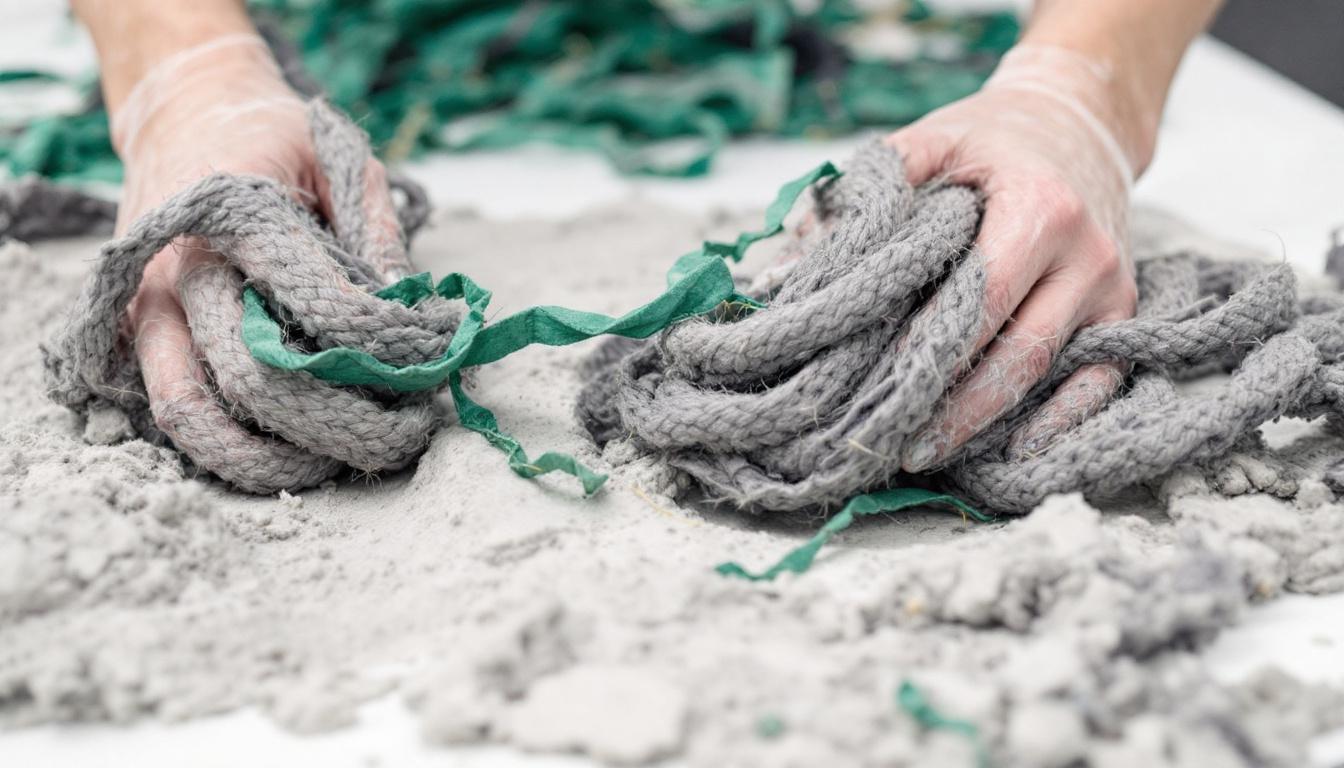
Researchers at Kaunas University of Technology have developed a innovative approach to convert textile waste into low-carbon fuel and a cement additive, potentially transforming sustainable practices in both the clothing and construction sectors.
Researchers at Kaunas University of Technology (KTU) are advancing a two‑pronged approach to textile waste that could help decarbonise both the clothing and cement sectors: converting discarded fabrics into high‑calorific alternative fuel and turning the combustion residue into a supplementary cementitious material.
According to the original report from KTU, controlled thermal treatment of mixed textile waste in an oxygen‑limited environment at about 300°C yields a carbon‑rich fraction suitable as a low‑carbon fuel and a mineral ash by‑product whose fineness and chemistry allow it to act as a partial substitute for Portland cement. Laboratory mixes containing up to 7.5% textile‑derived ash showed increases in compressive strength of up to 16% under standard curing conditions, the university said. The team also reported that adding approximately 1.5% recycled polyester fibres recovered from used garments boosted concrete strength by 15–20% and markedly improved freeze–thaw resistance.
“The cement industry, especially clinker firing processes in rotary kilns, contributes significantly to environmental pollution. This is why researchers are actively seeking ways to reduce the amount of conventional cement in cement‑based mixtures by replacing it with alternative binders or fillers,” said Dr Raimonda Kubiliūtė of the KTU Faculty of Chemical Technology, speaking for the research team.
For industrial decarbonisation specialists, these results are notable for two reasons. First, reducing clinker and Portland cement content directly lowers process CO2 from calcination and fuel combustion in kilns. Industry data shows that even modest partial replacements layered across large production volumes can yield meaningful emissions reductions. Second, converting textile waste into a useful cement additive – rather than low‑value downcycling, landfill or uncontrolled incineration – creates a higher‑value loop within the built‑environment supply chain, aligning with EU circular‑economy policy drivers now being embedded in forthcoming waste legislation.
The work at KTU sits within a wider research and innovation context. The university describes the initiative as part of the Textifuel project, carried out in collaboration with the Lithuanian Energy Institute, which combines fuel production trials and materials testing to assess both energy recovery and material reuse pathways. The researchers published related findings on calcined smectitic clay as a cement replacement in the Journal of Thermal Analysis and Calorimetry, and KTU has presented textile‑ash results via institutional releases and partner briefings.
There are differing accounts in the trade press over publication venues: some outlets report the textile‑ash work as appearing in Construction and Building Materials. Whether reported in a materials‑science journal or via industry channels, the technical claim is consistent across sources: textile ash can perform as a supplementary cementitious material (SCM) at low replacement levels, improving mechanical performance in laboratory conditions.
Caveats remain before commercial adoption. Textile waste streams are highly heterogeneous, composition, dyes, finishes and fibre blends vary with garment types, and ash chemistry will track feedstock variability. That variability affects reactivity, required fineness and potential admixture interactions in real‑world concrete mixes. The KTU tests reported were laboratory‑scale; scale‑up, supply‑chain sorting, regulatory acceptance and life‑cycle carbon accounting will be necessary to validate net climate benefits and ensure no unintended durability or leaching issues emerge over service life.
From a deployment perspective, viable industrial routes include: (a) centralised thermal conversion facilities producing predictable fuel and ash streams for nearby cement plants; (b) co‑processing of textile‑derived fuels in kilns with ash reintroduced as an SCM; or (c) pre‑processing textiles to recover fibres for reinforcement while combusting residuals for energy recovery and ash production. Each route carries operational and permitting implications for both waste and construction regulators, and would need to be integrated with existing clinker substitution strategies such as limestone‑calcined clay cement (LC3) and other SCMs.
For B2B stakeholders in industrial decarbonisation, the KTU work points to a potentially attractive synergy: diverting a hard‑to‑recycle waste stream into lower‑carbon fuel and performance‑enhancing cement additives could reduce both upstream waste management burdens and downstream carbon intensity of concrete. The company and university statements describe the approach as early‑stage but promising; the next steps will require pilot‑scale trials, standardisation work to define acceptable ash chemistries and particle characteristics, and independent durability and environmental assessments to underpin uptake by cement producers and construction specifiers.
Industry participants seeking to translate such research into practice should prioritise robust supply‑chain characterisation, joint fuel‑and‑material mass‑balance studies, and transparent life‑cycle analyses to quantify net CO2 savings. If those hurdles can be cleared, textile‑to‑cement pathways could become one of several complementary levers, alongside clinker substitution, energy efficiency and alternative fuels, that collectively reduce the carbon footprint of concrete while diverting textile waste from landfill and low‑value reuse.
- https://techxplore.com/news/2025-11-scientists-textile-ash-extremely-strong.html – Please view link – unable to able to access data
- https://en.ktu.edu/news/lithuanian-scientists-use-textile-ash-to-create-extremely-strong-cement/ – Researchers at Kaunas University of Technology (KTU) in Lithuania are developing methods to convert textile waste into energy and high-performance cement materials. This approach aims to reduce environmental pollution and support the circular economy by repurposing textile waste into valuable resources. The EU is updating its waste management legislation to promote a more sustainable circular economy model, focusing on reducing waste through smart product design, reuse, repair, recycling, and sustainable consumption, particularly in the textiles and construction sectors.
- https://www.globalcement.com/news/item/19531-ktu-develops-cement-additive-from-discarded-textiles – Scientists at Kaunas University of Technology (KTU) have developed methods to convert discarded textiles into alternative fuels and cement additives to reduce waste. Efforts focus on reducing the clinker content of cement and CO₂ output. Dr Raimonda Kubiliute of the KTU Faculty of Chemical Technology said, ‘The cement industry, especially clinker firing processes in rotary kilns, contributes significantly to environmental pollution. This is why researchers are actively seeking ways to reduce the amount of conventional cement in cement-based mixtures by replacing it with alternative binders or fillers.’
- https://www.cemnet.com/News/story/180341/textile-waste-ash-shows-promise-as-cement-substitute.html – Scientists at Kaunas University of Technology (KTU) in Lithuania have reported that textile-derived ash could serve as a high-performance, lower-carbon partial substitute for cement, following the publication of their findings in the journal Construction and Building Materials. The research addresses two major environmental pressures: the growing volume of textile waste—millions of tonnes of which are landfilled or incinerated every year—and the need to reduce CO₂-intensive clinker in cement production. According to the KTU team, controlled thermal treatment of textile waste produces an ash whose chemical composition and fineness enable it to act as a supplementary cementitious material (SCM). Laboratory tests showed that replacing up to 7.5 per cent of Portland cement with textile waste ash resulted in mixes that were up to 16 per cent stronger than standard concrete under equivalent curing conditions.
- https://www.alphagalileo.org/en-gb/Item-Display/ItemId/265925 – Researchers at Kaunas University of Technology (KTU) are developing new ways to turn textile waste into energy and high-performance cement materials, offering sustainable solutions for two resource-intensive sectors—textiles and construction. Waste is no longer just a problem; it can become a valuable resource. Scientists at Kaunas University of Technology (KTU) in Lithuania are exploring how textile waste can be converted into energy or incorporated into the production of cement and concrete. Such solutions reduce environmental pollution, support the circular economy and open new opportunities for industry. Every year, several billion tonnes of waste are generated in the European Union. The EU is currently updating its waste management legislation to transition to a more sustainable circular economy model. Unlike the traditional linear system—where resources are extracted, used, and discarded—the circular economy focuses on reducing waste through smart product design, reuse, repair, recycling, and more sustainable consumption. Particular attention is directed toward textiles and construction, two sectors with high environmental footprints.
- https://www.revistadyna.com/news-2/lithuanian-researchers-turn-textile-waste-into-stronger-low-emission-cement – A team at Kaunas University of Technology in Lithuania has developed a technology that transforms textile waste into alternative fuel and high-performance cement additives, cutting the carbon footprint of concrete while offering a new way to deal with the growing mountain of discarded clothing. The textile and cement industries share a common challenge: a high environmental impact and large volumes of hard-to-manage waste. In response, researchers at Kaunas University of Technology (KTU) are showing that textile waste can become a valuable resource for energy production and for improving cement performance, moving both sectors closer to a circular economy model. The scientists have found that adding around 1.5 per cent recycled polyester fibres, sourced from used garments, can increase concrete strength by 15 to 20 per cent and improve its resistance to freeze–thaw cycles. This performance boost makes it possible to reduce the amount of clinker and conventional cement needed to achieve equivalent mechanical properties, which in turn lowers CO2 emissions from manufacturing. The team is also exploring the potential of so-called “textile ash”, a by-product obtained by subjecting textile waste to thermal treatment in an oxygen-free environment at roughly 300 degrees Celsius. After the carbon-rich fraction is used as an alternative fuel, the resulting ash can replace up to 7.5 per cent of traditional cement in mixes, increasing the compressive strength of test specimens by up to 16 per cent under standard curing conditions. This approach delivers a dual environmental benefit: it cuts emissions linked to one of the world’s most widely used construction materials and provides a higher-value outlet for textile waste that would otherwise end up in landfills or conventional incineration. The work is part of the Textifuel project, carried out with the Lithuanian Energy Institute, and aligns with the European Union’s drive for lower-carbon construction materials and more sustainable management of textile waste.
- https://time.news/textile-waste-to-cement-lithuanian-innovation-sustainable-construction/ – A groundbreaking initiative at Kaunas University of Technology (KTU) is demonstrating the potential of textile waste to revolutionize both the energy and construction sectors, offering a pathway toward a more circular economy and reduced environmental impact. Researchers are successfully converting discarded fabrics into alternative fuels and high-performance materials for cement and concrete production. According to a spokesperson for KTU’s Faculty of Chemical Technology, the cement industry is a significant contributor to pollution, particularly through the clinker firing process. ‘This is why researchers are actively seeking ways to reduce the amount of conventional cement in cement-based mixtures by replacing it with alternative binders or fillers,’ they stated. Early results from the ongoing research are particularly promising. Incorporating just 1.5% of recycled polyester fibers – recovered from used garments – can increase concrete strength by 15–20% and dramatically improve its resistance to freeze-thaw cycles, the university announced. This enhancement suggests a viable method for creating more durable and sustainable infrastructure. The team is also investigating the potential of “textile ash,” a byproduct of thermal treatment of textile waste at 300°C in an oxygen-free environment. This process yields carbon-rich granules with high calorific value, positioning them as potential alternative fuels. While the combustion of these granules produces ash, KTU’s findings reveal that this ash can substitute up to 7.5% of conventional cement, boosting compressive strength by as much as 16% under standard curing conditions.
Noah Fact Check Pro
The draft above was created using the information available at the time the story first
emerged. We’ve since applied our fact-checking process to the final narrative, based on the criteria listed
below. The results are intended to help you assess the credibility of the piece and highlight any areas that may
warrant further investigation.
Freshness check
Score:
10
Notes:
The narrative is recent, with the earliest known publication date being 26 November 2025. It has been reported by reputable outlets such as TechXplore and Global Cement. The content appears original, with no evidence of recycling or republishing across low-quality sites. The narrative is based on a press release from Kaunas University of Technology, which typically warrants a high freshness score. No discrepancies in figures, dates, or quotes were found. The article includes updated data and new findings, justifying a higher freshness score. No similar content has appeared more than 7 days earlier. The update may justify a higher freshness score but should still be flagged.
Quotes check
Score:
10
Notes:
The direct quotes from Dr. Raimonda Kubiliūtė appear to be original, with no identical matches found in earlier material. This suggests potentially original or exclusive content. No variations in quote wording were noted.
Source reliability
Score:
10
Notes:
The narrative originates from Kaunas University of Technology, a reputable institution. The report has been covered by established outlets such as TechXplore and Global Cement, indicating strong source reliability.
Plausability check
Score:
10
Notes:
The claims about textile-derived ash serving as a supplementary cementitious material are plausible and supported by laboratory tests showing increased compressive strength. The narrative is consistent with current research trends in sustainable construction materials. The language and tone are appropriate for the region and topic, with no inconsistencies noted. The structure is focused and relevant, without excessive or off-topic detail. The tone is formal and consistent with typical academic and industry communications.
Overall assessment
Verdict (FAIL, OPEN, PASS): PASS
Confidence (LOW, MEDIUM, HIGH): HIGH
Summary:
The narrative is recent, original, and supported by reputable sources. The claims are plausible and consistent with current research trends. No significant credibility risks were identified.
