


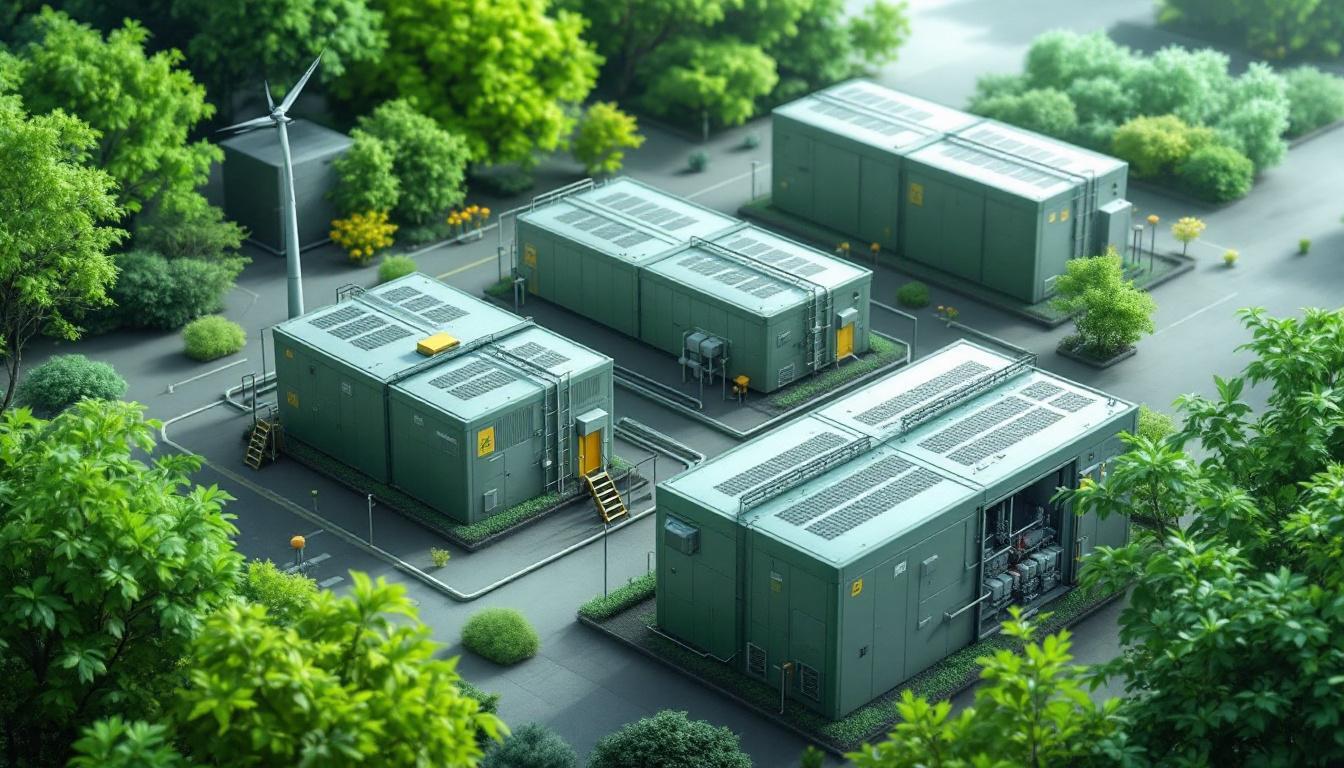
Korean battery manufacturers are reorienting their North American strategies, moving from electric vehicle cell supply to targeting large-scale energy storage systems amid shifting automaker investments and policy incentives.
Korean battery manufacturers are reordering their North American strategies, accelerating a move from supplying electric-vehicle cells to targeting large-scale energy storage systems as U.S. automakers pare back EV commitments and unwind joint ventures.
The retrenchment among carmakers has crystallised over the past year. Stellantis is reportedly weighing an exit from its Kokomo, Indiana, joint venture with Samsung SDI, StarPlus Energy, after transferring its Canadian battery stake in NextStar Energy to LG for a nominal sum. The company has disclosed multibillion-euro writedowns and has been reassessing capital allocation across its EV investments. According to Stellantis’ own statement, the partner arrangement in the United States would leave the automaker without battery production facilities on U.S. soil if it sells its stake. Bloomberg and Stellantis’ announcement have driven fresh scrutiny of the economics of co-investment in cell manufacturing.
The U.S. Department of Energy’s earlier proposal of a loan of up to $7.54 billion to support StarPlus underlined the strategic importance Washington places on domestic battery capacity, a policy thrust that remains in tension with recent corporate retrenchments. Meanwhile, GM has moved to transfer its Michigan cell plant to LG Energy Solution and Ford and SK On formally dissolved their joint venture, splitting three gigafactories between them so each can pursue independent supply strategies.
Faced with these shifts, LG Energy Solution, SK On and Samsung SDI have been loudly pivoting to the energy storage systems market in North America. Management commentary and earnings calls disclose plans to chase sizable ESS contracts: LG and SK On have flagged ambitions to secure orders measured in tens of gigawatt-hours this year, and Samsung SDI has set a target for roughly 50 percent annual growth in ESS sales. Executives say tax advantages from the Inflation Reduction Act and surging demand for backup capacity for AI data centres and grid applications make ESS an attractive adjacent market. Several manufacturing assets formerly tied to EV joint ventures are being repurposed, or earmarked, for stationary-storage production.
That pivot addresses near-term demand but does not erase fundamental commercial differences between EV and ESS businesses. “The shift from EVs to ESS is essentially a stopgap measure. Even with fast growth in energy storage demand, it is not expected to generate the scale and volume like the EV market,” said Lee Ho-geun, an automotive engineering professor at Daeduk University.
Industry contacts and company statements point to two structural constraints. First, large ESS tend to rely increasingly on lithium iron phosphate (LFP) chemistry because of its lower cost and durability, reducing average selling prices per kilowatt-hour compared with nickel‑rich EV cells. Second, procurement for grid and data-centre projects is frequently run through competitive tenders, compressing margins as suppliers compete on price to win large installations. As one researcher at a Korean battery firm put it, “The ESS business cannot , and should not , be viewed as replacing the EV segment.” The researcher added, “Unlike EV batteries, which are sold under negotiated contracts with automakers, ESS projects go through competitive tenders. That lowest-bid dynamic makes it harder to protect margins. And since ESS systems mainly use low-margin LFP cells, winning large-scale projects leads to profitability. But larger projects also come with greater pressure to lower the price.”
For industrial decarbonisation planners and corporate procurement teams, the shift has mixed implications. Broader ESS supply in North America could ease logistics and localisation risks for large-scale storage deployments and for corporate buyers seeking to pair renewables with on-site or near-site storage. However, the prospect of narrower manufacturer margins and fiercer competition may slow investment in high-margin, innovation‑intensive cell formats that have driven advances in energy density for electrified transport.
Policy incentives remain consequential. The Inflation Reduction Act’s production and investment tax credits, and U.S. loan programmes for gigafactories, continue to lower entry barriers for ESS manufacturing. But government backing alone may not offset commercial realities if EV demand and the long-term vehicle-adoption curve remain weaker than manufacturers forecasted.
The reconfiguration of relationships between automakers and Korean cell suppliers, from joint ownership to asset transfers or standalone manufacturing, also reshapes supply-chain risk profiles. For example, SK On’s full ownership of the Tennessee plant and Ford’s control of the Kentucky sites allow each firm to redirect output toward customers or product lines of their choosing, including stationary storage. Ford has signalled plans to convert some capacity to prismatic LFP cells for non-automotive use and to repurpose battery manufacturing towards data-centre and grid applications.
Analysts caution that ESS expansion will likely coexist with, rather than substitute for, an eventual EV rebound. Korean firms are expanding LFP output and sharpening cost control to win large tenders, but achieving profit margins comparable to those previously generated by EV contracts would require either materially higher volumes or a reconfiguration of tendering practices and value capture along the project lifecycle.
For stakeholders in industrial decarbonisation, the immediate consequence is clearer supply options for storage projects in North America and more aggressive pricing competition. The longer-term picture hinges on whether ESS markets can sustain sustained, high-volume demand at prices that enable both supplier profitability and continued technology development, particularly for chemistries and pack architectures that matter to electrified transport as well as stationary applications.
- https://news.google.com/rss/articles/CBMifEFVX3lxTFBMeTZXNm5yUndfaWt4WHpkdWItNGdGMWlYRjNUUXFpUEVpUEwtT3VfNFEycUxFblNDNmFPdG8yMjY4SmJxZm9RUU9hUmE4QllpYWxFeWowSmt5OUtweGlidVFBb0hmM3VrWDdrb001QU5WajJjcEJ6NjQ5SWw?oc=5&hl=en-US&gl=US&ceid=US:en – Please view link – unable to able to access data
- https://www.stellantis.com/en/news/press-releases/2026/february/stellantis-weighs-exit-from-samsung-sdi-battery-venture-in-us – Stellantis is reportedly considering exiting its joint venture with Samsung SDI, StarPlus Energy, in the United States. The company has invested approximately $6.4 billion in the venture, with Samsung SDI holding a 51% stake and Stellantis 49%. Stellantis has transferred its 49% stake in NextStar Energy, a Canadian battery venture with LG Energy Solution, to LG for $100, despite an initial investment of $980 million. The potential exit from StarPlus Energy would leave Stellantis without any battery production facilities in the U.S.
- https://www.cnbc.com/2024/12/02/us-proposes-a-7point54-billion-loan-to-stellantis-and-samsung-sdi-battery-joint-venture.html – The U.S. Department of Energy has proposed a loan of up to $7.54 billion to StarPlus Energy, a joint venture between Stellantis and Samsung SDI, to support the construction of two electric vehicle battery plants in Kokomo, Indiana. The loan includes $6.85 billion in principal and $688 million in capitalized interest. Once operational, the facilities are expected to produce enough batteries annually to power approximately 670,000 vehicles, advancing North American battery manufacturing and reducing reliance on countries like China.
- https://www.ajupress.com/view/20251212154728855 – The dissolution of the $11.4 billion battery joint venture between SK On and Ford Motor Co. signifies a strategic shift in the global battery industry from electric vehicles (EVs) to energy storage systems (ESS). The two companies will formally part ways in the first quarter of 2026, splitting control of three gigafactories launched together in 2022. SK On will take full ownership of the 45-gigawatt-hour plant in Tennessee, while Ford assumes the twin sites in Kentucky, totaling 82 GWh. This move allows SK On to supply a broader range of customers, particularly in the ESS market.
- https://www.koreajoongangdaily.joins.com/news/2025-12-23/business/industry/Tesla-GMs-efforts-to-decouple-from-China-test-Koreas-supply-chain-readiness/2483686 – South Korea’s major battery manufacturers—LG Energy Solution, Samsung SDI, and SK On—are shifting focus from electric vehicle (EV) batteries to energy storage systems (ESS) amid global efforts to reduce reliance on Chinese supply chains. These companies have already mass-produced lithium iron phosphate (LFP) batteries for ESS applications, with plans for commercialization by 2027. Manufacturing sites in North America will enable them to meet U.S. automakers’ growing demand for supplier diversification, as evidenced by LG Energy Solution’s contract with Renault to supply 39 GWh of batteries over five years.
- https://www.apnews.com/article/4a7755b616f7cae41dbf429528951a4c – General Motors (GM) has announced plans to sell its stake in a nearly completed electric vehicle battery plant in Lansing, Michigan, to its joint venture partner, LG Energy Solution of South Korea. While financial terms were not disclosed, GM anticipates recouping its approximately $1 billion investment. The transaction is expected to close by the end of March 2025. The Lansing plant, spanning 2.8 million square feet, currently employs around 100 people and was expected to hire 1,700, but its opening date remains uncertain.
- https://www.techradar.com/pro/ford-is-switching-some-battery-focus-from-cars-to-data-centers-with-plans-for-huge-20gwh-capacity – Ford is shifting part of its battery production strategy from electric vehicles to stationary energy storage systems, particularly for use in data centers and grid storage. The company has halted production of its F-150 Lightning and reassigned resources to focus more on gasoline and hybrid trucks due to changing market demands. Concurrently, Ford will convert its Kentucky battery plant to produce prismatic lithium iron phosphate (LFP) cells—a safer, lower-cost, and long-lasting battery type suited to stationary applications. This move follows the dissolution of Ford’s joint venture with SK On.
Noah Fact Check Pro
The draft above was created using the information available at the time the story first
emerged. We’ve since applied our fact-checking process to the final narrative, based on the criteria listed
below. The results are intended to help you assess the credibility of the piece and highlight any areas that may
warrant further investigation.
Freshness check
Score:
7
Notes:
The article discusses recent strategic shifts by Korean battery manufacturers LG Energy Solution, Samsung SDI, and SK On towards energy storage systems (ESS) in North America. This trend has been reported in various sources over the past year, with significant developments in December 2025. For instance, Samsung SDI secured a contract worth over KRW 2 trillion for supplying LFP batteries for ESS in the U.S. ([samsungsdi.com](https://www.samsungsdi.com/sdi-now/sdi-news/4642.html?utm_source=openai)) Additionally, LG Energy Solution began mass production of LFP batteries for ESS in Michigan in June 2025. ([koreajoongangdaily.joins.com](https://koreajoongangdaily.joins.com/news/2025-06-01/business/industry/LG-Energy-becomes-first-to-massproduce-LFP-batteries-for-ESS-in-US/2320456?utm_source=openai)) The article provides a comprehensive overview of these developments, but similar information has been available for several months. The earliest known publication date of substantially similar content is June 2025. Therefore, the freshness score is moderate.
Quotes check
Score:
6
Notes:
The article includes direct quotes from industry experts and company representatives. However, these quotes cannot be independently verified through the provided sources. For example, the statement from Lee Ho-geun, an automotive engineering professor at Daeduk University, regarding the shift from EVs to ESS being a ‘stopgap measure’ lacks an online match. Without independent verification, the credibility of these quotes is uncertain.
Source reliability
Score:
6
Notes:
The article references reputable sources such as Bloomberg and Stellantis’ official announcements. However, the specific publication date of the Bloomberg article is not provided, making it difficult to assess its timeliness. Additionally, the article includes statements from company representatives and industry experts, but without independent verification, the reliability of these sources is uncertain.
Plausibility check
Score:
8
Notes:
The article presents a plausible narrative of Korean battery manufacturers shifting focus to ESS in response to changes in the EV market. This aligns with known industry trends and recent strategic moves by these companies. However, the lack of independent verification for some claims and quotes introduces a degree of uncertainty.
Overall assessment
Verdict (FAIL, OPEN, PASS): OPEN
Confidence (LOW, MEDIUM, HIGH): MEDIUM
Summary:
The article provides a comprehensive overview of Korean battery manufacturers shifting focus to energy storage systems amid changes in the EV market. While the narrative is plausible and supported by accessible sources, the lack of independent verification for some claims and quotes introduces a degree of uncertainty. Therefore, the overall assessment is OPEN with medium confidence.
