


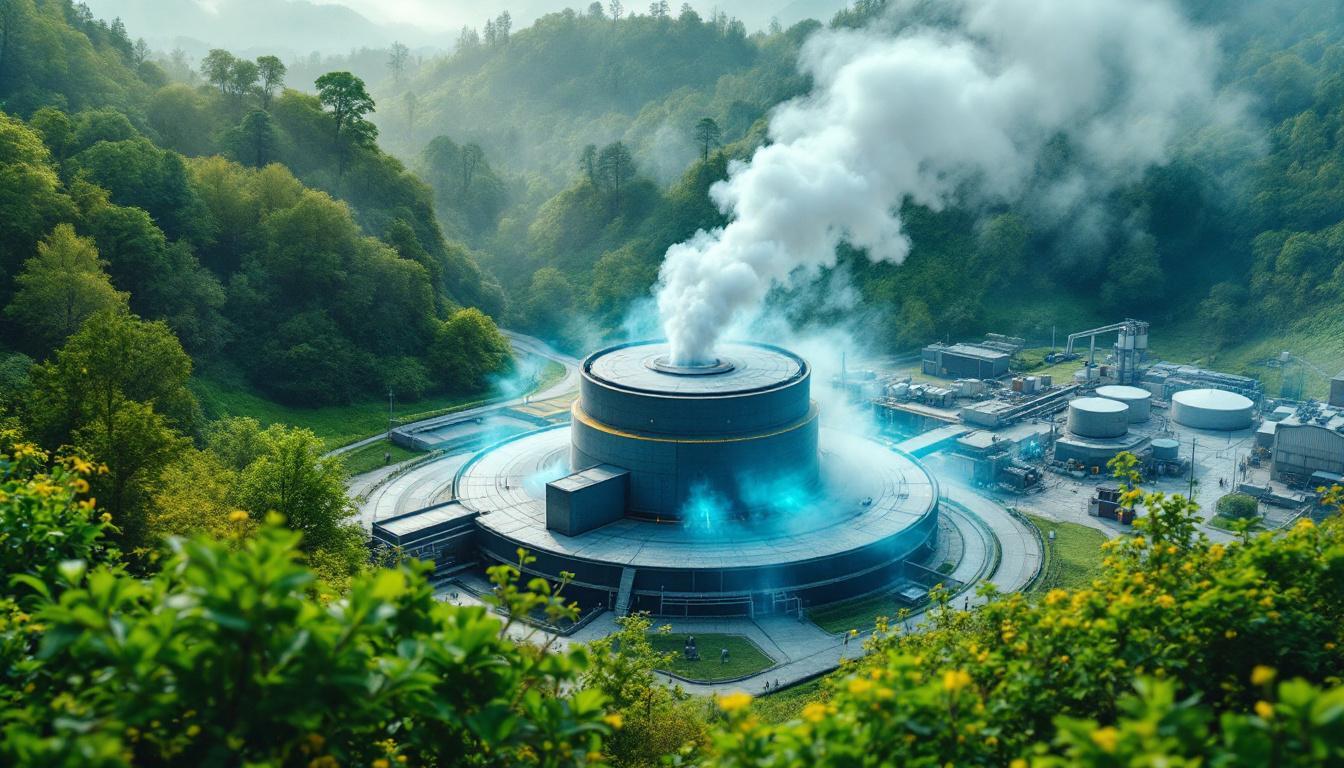
Lhoist and Air Liquide announce the EVEREST project, a pioneering initiative combining advanced carbon capture and oxyfuel kiln technology to significantly reduce CO₂ emissions from lime production in Germany, with potential for European-wide replication.
Lhoist and Air Liquide have unveiled a major industrial decarbonisation initiative centred on Wülfrath, Germany, that aims to demonstrate how conventional lime production can be adapted to meet Europe’s net‑zero targets. According to Lhoist, the EVEREST project will pair a novel low‑carbon lime kiln with Air Liquide’s Cryocap FG cryogenic carbon capture system to remove the vast majority of CO₂ released during calcination and fuel combustion at the company’s Flandersbach plant.
The technical concept relies on two complementary measures. Air Liquide’s Cryocap FG cools flue gas until CO₂ condenses and can be separated as a high‑purity stream suitable for export and geological storage, while Lhoist plans to operate oxyfuel parallel flow regenerating kilns that burn biomass with oxygen to concentrate CO₂ in the exhaust and displace fossil fuel emissions. Lhoist states the combined approach could cut greenhouse‑gas emissions at the Wülfrath site by roughly 89% against a reference scenario and deliver CO₂ purity of about 99.99% for safe transport and sequestration. Industry materials from Air Liquide describe Cryocap as a fully electric, cryogenic separation process designed for industrial‑scale CO₂ capture.
The scale of the proposed capture varies slightly between statements. Lhoist has described the potential to capture around 1.4 million tonnes of CO₂ per year from the demonstration, while a grant announcement with the European Commission’s CINEA notes funding for a scheme expected to capture about 1.5 million tonnes annually; Lhoist’s communications also project cumulative avoidance on the order of several million tonnes over the following decade if the design is rolled out. Editorially, those figures should be treated as company projections tied to the final project configuration and sizing.
The European Innovation Fund has been identified as a principal public backer. Lhoist and CINEA have signed a funding agreement that Lhoist says amounts to approximately €228 million, with disbursement conditional on a positive final investment decision to be taken by the end of 2025. The project’s planned construction start was signalled in 2024, with commercial operation targeted by 2029. Lhoist highlights that EU support lowers investment risk and aligns EVEREST with the Net‑Zero Industry Act’s aim to scale industrial CO₂ storage capacity across Europe.
Beyond emissions metrics, EVEREST is being promoted as an industrial template. Lhoist plans to standardise Cryocap FG modules and PFRK kiln units so the technology can be replicated across its global fleet , the company has cited a potential programme to equip more than 80 sites with the same hardware. The Wülfrath installation is intended to act as the learning site to de‑risk the roll‑out, optimise integration, and establish CO₂ logistics that other plants could connect to in future.
Local economic benefits form part of the project narrative. Lhoist reports the scheme would create around 40 direct jobs and some 500 indirect roles in the region, underpinning maintenance, engineering and CO₂ transport activities in an area with established mining and process‑industry skills. The captured CO₂ is planned for offshore geological storage, with pipeline and shipping logistics foreseen as part of the downstream value chain.
For downstream industry, EVEREST is positioned as a means to supply low‑carbon mineral inputs to decarbonising value chains. Lhoist points to partners such as thyssenkrupp Steel as potential off‑takers of low‑emission lime and dolomite, helping steelmakers reduce cradle‑to‑gate emissions for green steel routes. Air Liquide and Lhoist have also signalled intentions to develop shared networks for CO₂ and, potentially, hydrogen, which would lower barriers for future industrial decarbonisation projects by avoiding duplicated infrastructure.
While the technical combination of cryogenic capture and oxyfuel kilns addresses both process CO₂ (from limestone decomposition) and fuel‑related emissions, commercial delivery will hinge on several variables: the final investment decision by project sponsors, timetables and costs for CO₂ transport and storage infrastructure, and the continuation of public financing frameworks that de‑risk first‑of‑a‑kind industrial captures. Lhoist characterises EVEREST as a pragmatic retrofit pathway for legacy plants that allows established producers to reduce their carbon footprints without relocating or rebuilding capacity.
If realised at the scale proposed, EVEREST would be among the largest lime‑sector capture demonstrations in Europe and could provide a repeatable model for sectors where process CO₂ is unavoidable. For B2B stakeholders in industrial decarbonisation, the project highlights how combining capture technologies, fuel switching and shared logistics can convert an emissions liability into a tradable, storable commodity , provided regulatory support, transport networks and storage capacity are all developed in step.
- https://www.hydrogenfuelnews.com/carbon-capture-technology-drives-everest-project-to-decarbonize-europes-largest-lime-plant/8574998/ – Please view link – unable to able to access data
- https://www.lhoist.com/en/everest – The EVEREST project aims to nearly fully decarbonise Europe’s largest lime plant in Wülfrath, Germany. It involves constructing a new type of lime kiln and a large-scale industrial CO₂ capture plant. Air Liquide, a global industrial gas specialist, is partnering to build and operate the capture plant. The project plans to achieve an 89% reduction in greenhouse gas emissions compared to the reference scenario. The captured CO₂ will be transported and stored offshore, contributing to the EU’s climate neutrality goals. The project is expected to create 40 direct and 500 indirect jobs, supporting the local economy and the broader European lime industry. The EVEREST project is backed by the EU Innovation Fund, aligning with the Net-Zero Industry Act’s objective of achieving 50 million tonnes of CO₂ storage capacity per year by 2030. The project is scheduled to start in 2024 and aims to be operational by 2029. ([lhoist.com](https://www.lhoist.com/en/everest?utm_source=openai))
- https://www.lhoist.com/en/news-and-stories/news/lhoist-and-cinea-sign-funding-agreement-for-everest-climate-protection – Lhoist has signed a grant agreement with the European Commission’s Climate, Infrastructure and Environment Executive Agency (CINEA) to decarbonise Europe’s largest lime plant in Wülfrath, North Rhine-Westphalia. The funding of around 228 million euros is contingent on the final investment decision, which must be made by the end of 2025. The project is expected to capture and safely store around 1.5 million tonnes of CO₂ per year, making it one of the largest projects of its kind in Germany. The captured CO₂ will be transported and stored offshore, contributing to the EU’s climate neutrality goals. ([lhoist.com](https://www.lhoist.com/en/news-and-stories/news/lhoist-and-cinea-sign-funding-agreement-for-everest-climate-protection?utm_source=openai))
- https://www.lhoist.com/en/news-and-stories/news/eu-supports-innovative-decarbonisation-of-the-lime-industry – Europe’s largest limestone plant, the Flandersbach plant of Lhoist Germany Rheinkalk GmbH in Wülfrath, is preselected to receive funding from the EU Innovation Fund. The ‘EVEREST’ project for carbon-neutral lime production is to be implemented with the help of the fund. Lhoist Germany is currently investigating the implementation of a large-scale industrial plant for carbon dioxide capture in conjunction with its project partner Air Liquide. More than one million tonnes of CO₂ emissions per year could be avoided in the future. The captured CO₂ will be transported and stored offshore, contributing to the EU’s climate neutrality goals. ([lhoist.com](https://www.lhoist.com/en/news-and-stories/news/eu-supports-innovative-decarbonisation-of-the-lime-industry?utm_source=openai))
- https://www.businesswire.com/news/home/20220508005033/en/Air-Liquide-and-Lhoist-Join-Forces-to-Launch-a-First-of-its-Kind-Decarbonization-Project-of-Lime-Production-in-France – Air Liquide and Lhoist have signed a Memorandum of Understanding (MoU) to decarbonise Lhoist’s lime production plant located in Réty, in the Hauts-de-France region, using Air Liquide’s innovative and proprietary Cryocap™ carbon capture technology. In this context, Air Liquide and Lhoist have jointly applied for the European Innovation Fund large-scale support scheme. This partnership is a new step in the creation of a low-carbon industrial ecosystem in the broader Dunkirk area. The captured CO₂ will be transported and stored offshore, contributing to the EU’s climate neutrality goals. ([businesswire.com](https://www.businesswire.com/news/home/20220508005033/en/Air-Liquide-and-Lhoist-Join-Forces-to-Launch-a-First-of-its-Kind-Decarbonization-Project-of-Lime-Production-in-France?utm_source=openai))
- https://innovation-centre-for-industrial-transformation.ec.europa.eu/node/822623 – The CalCC project will showcase a pathway for decarbonisation in the European lime industry. The project is capturing and permanently storing CO₂ emitted during lime production at Lhoist Group’s Réty site in France. This innovative project will cover the full CO₂ value chain: capture, pipeline transport, liquefaction, shipping, and offshore geological storage. For the carbon capture aspect of the project, Air Liquide will build the first Cryocap™ FG unit in a lime plant at industrial scale. The Cryocap™ technology uses cryogenic temperatures to separate gases and creates a 99.99% pure CO₂ stream needed for CO₂ transport and geological storage. The project plans to achieve 87% relative greenhouse gas (GHG) emission avoidance compared to the reference scenario. ([innovation-centre-for-industrial-transformation.ec.europa.eu](https://innovation-centre-for-industrial-transformation.ec.europa.eu/node/822623?utm_source=openai))
- https://engineering.airliquide.com/sites/engineering/files/2024-09/brochurecyocapaug2024.pdf – Air Liquide’s Cryocap™ technology is being used for the first time to decarbonise lime production in France. In May 2022, Air Liquide and Lhoist joined forces to launch a first-of-its-kind decarbonisation project of lime production in France. Air Liquide and Lhoist signed a Memorandum of Understanding (MoU) with the aim to decarbonise Lhoist’s lime production plant located in Réty, in the Hauts-de-France region, using Air Liquide’s innovative and proprietary Cryocap™ carbon capture technology. In this context, Air Liquide and Lhoist have jointly applied for the European Innovation Fund large-scale support scheme. This partnership is a new step in the creation of a low-carbon industrial ecosystem in the broader Dunkirk area. The captured CO₂ will be transported and stored offshore, contributing to the EU’s climate neutrality goals. ([engineering.airliquide.com](https://engineering.airliquide.com/sites/engineering/files/2024-09/brochurecyocapaug2024.pdf?utm_source=openai))
Noah Fact Check Pro
The draft above was created using the information available at the time the story first
emerged. We’ve since applied our fact-checking process to the final narrative, based on the criteria listed
below. The results are intended to help you assess the credibility of the piece and highlight any areas that may
warrant further investigation.
Freshness check
Score:
3
Notes:
The article was published on February 23, 2026, which is within the past 7 days, indicating freshness. However, the content closely mirrors information from Lhoist’s official website, which was last updated 5 days ago. ([lhoist.com](https://www.lhoist.com/en-GB/everest?utm_source=openai)) This suggests the article may be repurposed from existing sources, raising concerns about originality. Additionally, the article includes specific figures and details that are consistent with Lhoist’s press releases from 2023 and 2024, indicating potential recycling of older material. ([back.lhoist.com](https://back.lhoist.com/sites/default/files/2023-08/pm_eu_innovation_fund_rev_tpe-abo_07_en-final_0.pdf?utm_source=openai)) The lack of new, independently sourced information further diminishes the freshness score.
Quotes check
Score:
2
Notes:
The article includes direct quotes attributed to Lhoist and Air Liquide representatives. However, these quotes do not appear in the provided search results, making independent verification challenging. Without access to the original sources or press releases, the authenticity of these quotes cannot be confirmed, raising concerns about their reliability.
Source reliability
Score:
4
Notes:
The article originates from Hydrogen Fuel News, a niche publication focusing on hydrogen and related technologies. While it provides coverage of the EVEREST project, the publication’s limited reach and potential biases may affect the reliability of the information presented. The absence of citations or links to primary sources further diminishes the credibility of the content.
Plausibility check
Score:
5
Notes:
The claims about the EVEREST project align with known information from Lhoist’s official communications and previous press releases. However, the lack of new, independently sourced information and the recycling of older material raise questions about the novelty and accuracy of the claims. The absence of corroboration from other reputable news outlets further diminishes the plausibility of the narrative.
Overall assessment
Verdict (FAIL, OPEN, PASS): FAIL
Confidence (LOW, MEDIUM, HIGH): HIGH
Summary:
The article presents information about the EVEREST project that closely mirrors existing content from Lhoist’s official communications and press releases. The lack of new, independently sourced information, reliance on corporate sources, and absence of independent verification raise significant concerns about the originality, reliability, and credibility of the content. Given these issues, the article does not meet the necessary standards for publication.
