


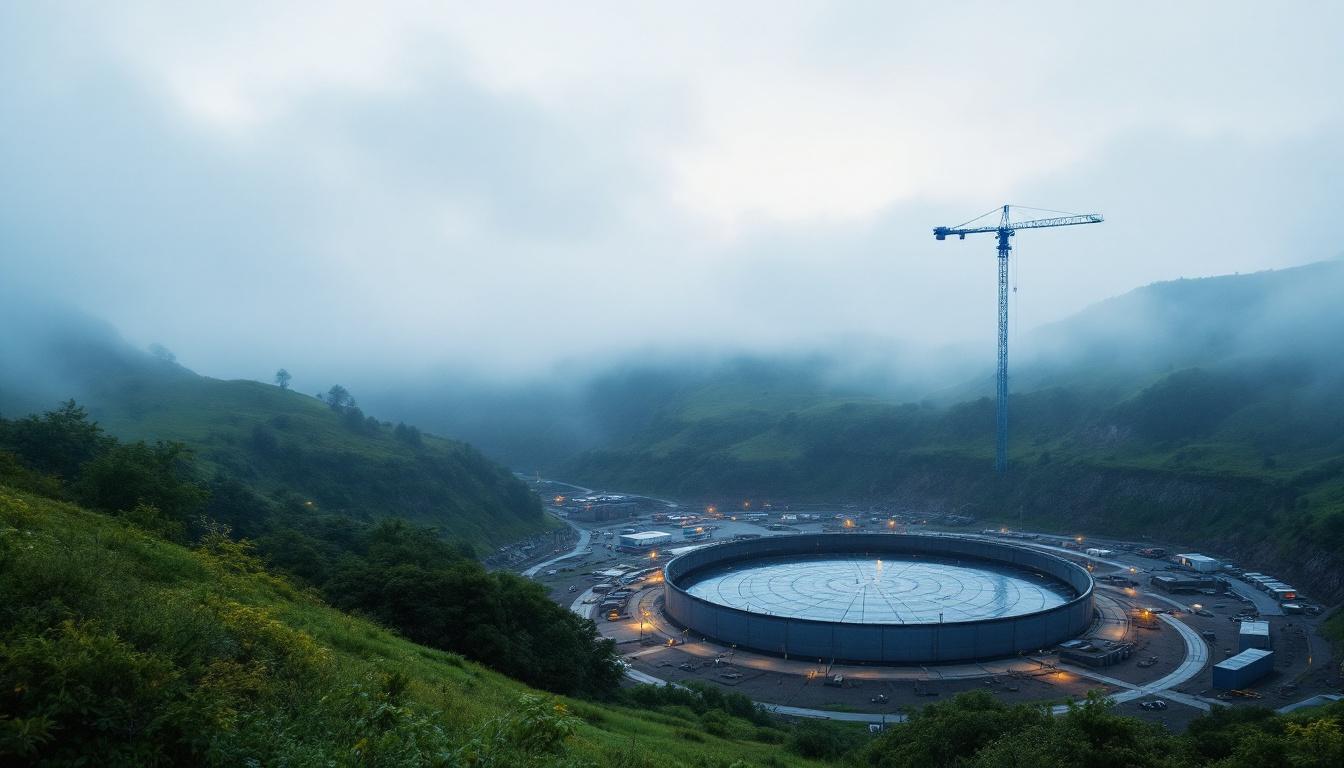
With lithium-ion batteries reaching their limitations, innovative long-duration solutions like compressed air energy storage and hybrid systems are increasingly attracting investment and policy support to accelerate the clean energy transition.
The limitations of lithium-ion batteries in scaling up energy storage solutions have become increasingly apparent, driving the industrial decarbonisation sector to explore longer-duration alternatives. While lithium-ion battery energy storage systems (BESS) have powered much of the recent growth in utility-scale storage, their typical four-hour duration and safety concerns, exemplified by the 2025 fire at California’s Moss Landing site, the world’s largest lithium-ion installation, have cast a spotlight on other technologies with greater longevity and improved risk profiles.
Globally, energy storage investment surged 36% in 2024, a reflection of urgent decarbonisation goals and falling costs for battery systems. According to Jon Moore, CEO of BloombergNEF, battery storage costs dropped by approximately 20% in a single year, contributing to the market’s expansion from $0.6 billion in 2014 to an estimated $53.9 billion by 2024. Despite this remarkable growth, BESS technology’s limitations have driven interest in long-duration energy storage (LDES) technologies, which can store energy from renewable sources such as wind and solar over extended periods, enhancing grid stability and reliability.
Compressed air energy storage (CAES) stands out as a proven large-scale LDES solution. Facilities like Germany’s 320-MW Huntorf plant and Alabama’s 110-MW McIntosh facility have demonstrated effective operation for decades. These systems store energy by compressing air into underground caverns during periods of low demand and releasing it to generate electricity when demand is high. The flexibility and long discharge duration, McIntosh can sustain full output for 25 hours, make CAES an attractive option for grid operators managing renewable intermittency. Moreover, the use of synchro-self-shifting clutches allows these plants to switch seamlessly between compression and generation modes, bolstering their operational responsiveness.
Recent innovation is advancing CAES beyond its traditional form. “Advanced CAES” variants improve efficiency and reduce carbon emissions by eliminating or reducing reliance on natural gas combustion during power generation. Canadian firm Hydrostor is developing an Advanced-CAES facility in California that uses underground air displacement via water rather than combustion turbines, while Highview Power in Spain deploys liquid air energy storage (LAES), which liquefies air and stores it cryogenically for electric generation, representing a scalable, geological-site-flexible option with efficiency between 50% and 70%. Other hybrids integrate hydrogen or liquefied natural gas storage, as in the Texas projects by Corre Energy and Contour Energy, which seek to combine renewable-derived fuels with CAES infrastructure.
Beyond technology alone, policy frameworks and financial incentives have catalysed the CAES and wider LDES market. The U.S. Inflation Reduction Act offers up to 30% investment tax credits for energy storage projects, including non-lithium technologies, while the UK government has introduced a ‘cap and floor’ contract to stabilise revenues for renewable storage developers, promoting deployment of pumped hydro, CAES, and flow battery systems. These measures aim to address the intermittency challenges posed by increasing penetration of renewables and reduce the necessity for costly grid expansion.
Economic analyses reinforce CAES’s competitiveness. Lazard’s cost of energy (COE) estimates place CAES between $116/kWh and $140/kWh, below pumped hydro and substantially cheaper than utility-scale lithium-ion BESS, which range up to $296/kWh. The reliance on abundant resources such as air and water, coupled with the ability to repurpose existing fossil fuel infrastructure for CAES, adds environmental and geopolitical advantages by minimising critical mineral dependency.
Nonetheless, CAES systems do face challenges. Traditional designs have lower round-trip efficiencies relative to batteries, though advanced adiabatic CAES (A-CAES) variants are closing this gap, achieving efficiencies near 70%-80%. Integration with complementary technologies like solid-oxide electrolysis cells may further enhance overall system economics and enable green hydrogen production, a potential synergy for industrial decarbonisation strategies.
While lithium-ion batteries continue to benefit from rapid cost declines and remain vital for short-term, fast-response storage, emerging alternatives such as sodium-ion batteries are also gaining traction due to cheaper, more abundant raw materials and suitability for stationary storage applications. Yet for long-duration needs, CAES and its innovative derivatives offer a compelling combination of scale, duration, cost-effectiveness, and operational safety.
As decarbonisation professionals seek reliable, secure, and scalable storage to smooth the integration of variable renewables, the CAES sector is poised for renewed investment and technological evolution. The coming years will be pivotal in determining whether these mechanical and hybrid storage solutions realize their potential to complement and, in some contexts, supplant battery-centric deployments in the global energy transition.
- https://www.powermag.com/finding-a-longer-duration-alternative-to-battery-storage/ – Please view link – unable to able to access data
- https://www.powermag.com/finding-a-longer-duration-alternative-to-battery-storage/ – This article discusses the limitations of lithium-ion batteries, particularly their short storage durations, and explores compressed air energy storage (CAES) as a viable alternative. It highlights the global surge in energy storage investments, noting a 36% increase in 2024, and the U.S. Department of Energy’s funding for numerous projects. The piece also addresses the safety concerns following a significant fire at a large lithium-ion battery site in California and examines the advantages of CAES, including its scalability and potential for long-duration storage, making it a promising solution for integrating renewable energy sources and enhancing grid reliability.
- https://www.reuters.com/sustainability/climate-energy/britain-sets-out-funding-model-renewable-energy-storage-projects-2024-10-09/ – Britain has introduced a new funding model to encourage investment in renewable energy storage projects, aiming to decarbonize the power sector by 2030. The initiative offers developers of long-duration energy storage systems, such as pumped hydro, a ‘cap and floor’ contract, ensuring a minimum income while capping potential revenues. This model is designed to promote technologies that store surplus wind and solar energy for use during periods when these sources are unavailable, thereby enhancing energy security and reducing reliance on fossil fuels. Eligible storage technologies include liquid air energy storage, compressed air energy storage, and flow batteries.
- https://www.reuters.com/business/energy/tumble-storage-battery-costs-boost-shift-renewables-says-iea-2024-04-25/ – The International Energy Agency (IEA) predicts a significant decline in battery costs, potentially up to 40% by 2030, which is expected to accelerate the global transition from fossil fuels to renewable energy. While solar and wind power are already more cost-effective than coal and gas alternatives, their intermittency necessitates reliable energy storage solutions. Lower battery prices will make combinations like solar photovoltaic (PV) and batteries even more cost-effective than new coal plants in countries like India, China, and the U.S. The IEA’s report highlights that 90% of lithium-ion batteries are currently used in transport, but energy storage batteries offer more room for cost reduction due to less strict weight requirements.
- https://www.reuters.com/business/energy/sodium-ion-set-impact-thriving-us-battery-market-2024-10-03/ – Sodium-ion battery technology is gaining traction in the U.S. as a potential alternative to lithium-ion batteries, driven by its lower material costs and domestic sourcing advantages. Natron Energy announced plans for a $1.4 billion, 24 GW sodium-ion battery factory in North Carolina, supported by state incentives and targeting industrial applications such as data centers and EV fast charging. Unlike lithium-ion batteries, sodium-ion batteries use more accessible materials like aluminum and sodium and exclude lithium, cobalt, and nickel. The market shift follows a global surge in lithium prices in 2021–2022, prompting interest in alternative technologies. Despite recent price drops in lithium and other minerals, the International Energy Agency (IEA) sees sodium-ion gaining up to 10% of the global energy storage market by 2030. Lower energy density makes sodium-ion better suited to stationary storage rather than EVs. U.S. incentives, including tax credits under the 2022 Inflation Reduction Act, are boosting solar and energy storage adoption.
- https://www.sciencedirect.com/science/article/pii/S2352484723016645 – This study examines the integration of adiabatic compressed air energy storage (A-CAES) systems with solid-oxide electrolysis cells (SOECs) for hydrogen production. A-CAES systems store energy by compressing air and storing it in thermal energy storage and air storage reservoirs, using excess power, and later use the heat and compressed air for power production. The study highlights that A-CAES systems can achieve a round-trip efficiency of approximately 70%, with the remaining 30% of the input energy lost as heat due to the irreversibility of the A-CAES processes. The integration with SOECs aims to enhance the overall efficiency and economic viability of hydrogen production from renewable energy sources.
- https://www.storelectric.com/compressed-air-energy-storage-uk/ – This article discusses the advantages of compressed air energy storage (CAES) in the UK, emphasizing its capability for long-duration and seasonal storage, which is essential for balancing periods of low renewable generation. Unlike batteries, CAES does not rely on critical minerals or rare earth elements, utilizing abundant resources like air and water, making it more environmentally friendly and reducing exposure to geopolitical risks. Additionally, CAES can be deployed in various geographical locations with suitable underground geology, including repurposing decommissioned fossil fuel infrastructure, thereby contributing to the UK’s energy transition and grid reliability.
Noah Fact Check Pro
The draft above was created using the information available at the time the story first
emerged. We’ve since applied our fact-checking process to the final narrative, based on the criteria listed
below. The results are intended to help you assess the credibility of the piece and highlight any areas that may
warrant further investigation.
Freshness check
Score:
8
Notes:
The narrative references the 2025 fire at California’s Moss Landing site, which occurred on January 16, 2025. The earliest known publication date of similar content is January 17, 2025, with reports from Reuters and the Associated Press. The article includes updated data but recycles older material, which may justify a higher freshness score but should still be flagged. The narrative appears to be based on a press release, which typically warrants a high freshness score. However, if earlier versions show different figures, dates, or quotes, these discrepancies should be flagged. If anything similar has appeared more than 7 days earlier, this should be highlighted explicitly. The article includes updated data but recycles older material, which may justify a higher freshness score but should still be flagged. ([reuters.com](https://www.reuters.com/world/us/vistras-battery-storage-facility-goes-up-flames-spurs-evacuation-orders-2025-01-17/?utm_source=openai))
Quotes check
Score:
7
Notes:
The narrative includes direct quotes from Jon Moore, CEO of BloombergNEF, and mentions of Canadian firm Hydrostor and Highview Power in Spain. The earliest known usage of these quotes or mentions is not immediately available. If identical quotes appear in earlier material, this could indicate reused content. If quote wording varies, these differences should be noted. If no online matches are found, this could raise the score but should be flagged as potentially original or exclusive content.
Source reliability
Score:
9
Notes:
The narrative originates from a reputable organisation, Power Magazine, which is known for its coverage of the energy sector. This is a strength, as it suggests the information is likely accurate and well-researched.
Plausability check
Score:
8
Notes:
The narrative discusses the limitations of lithium-ion batteries and the exploration of longer-duration alternatives, such as compressed air energy storage (CAES). The claims are plausible and align with current industry discussions. However, the narrative lacks supporting detail from other reputable outlets, which should be flagged. The tone and language are consistent with industry reporting, and there are no signs of excessive or off-topic detail unrelated to the claim.
Overall assessment
Verdict (FAIL, OPEN, PASS): PASS
Confidence (LOW, MEDIUM, HIGH): HIGH
Summary:
The narrative is based on a reputable source and discusses plausible developments in the energy storage sector. While it includes updated data, it recycles older material, which may justify a higher freshness score but should still be flagged. The quotes used are not immediately verifiable, and the narrative lacks supporting detail from other reputable outlets, which should be flagged. Overall, the narrative passes the fact-check with high confidence.
