


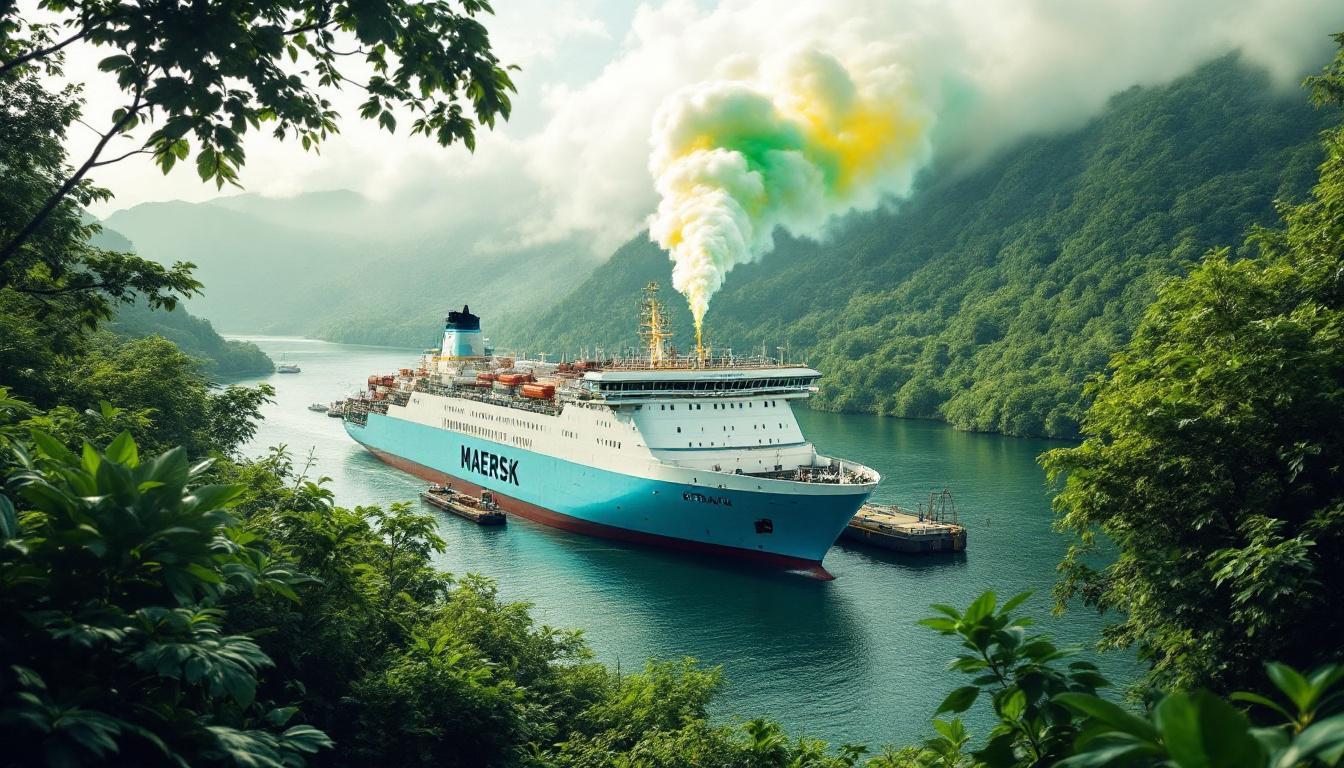
Vincent Clerc, CEO of A.P. Moller‑Maersk, reveals the shipping giant’s focus on ethanol blending and diversified fuel pathways to accelerate decarbonisation and secure international support for low-carbon shipping.
Vincent Clerc, chief executive of A.P. Moller‑Maersk, has told the Financial Times that the company is exploring ethanol as a green marine fuel in a move that could both diversify the global supply chain and advance decarbonisation of container shipping. Clerc said the United States and Brazil are the leading producers of ethanol and argued that spreading the economic benefits of a low‑carbon transition beyond a single market would help secure broader international support for new fuel pathways.
Maersk’s interest in ethanol follows a series of fuel experiments and supply deals as the company adapts its fleet strategy to meet stringent emissions targets. In October 2025 Maersk began testing a 10% blend of Brazilian ethanol mixed with methanol and marine diesel in vessel engines, a trial intended to assess operational performance and open potential markets for Brazilian producers. Company modelling suggests such a shift could create very large demand: a 10% ethanol blend across deep‑sea container trades could imply global demand on the order of tens of billions of litres annually, while Brazil’s production this year was forecast at roughly 35 billion litres. According to Maersk, the tests form part of broader work to identify scalable, costed routes away from heavy fuel oil.
The shipping sector’s transition is complex and capital‑intensive. Existing vessels require expensive retrofits to run alternative fuels and many shipowners are placing orders for new dual‑fuel designs. Maersk has pursued multiple fuel options in parallel. In October 2024 it signed a long‑term bio‑methanol offtake with LONGi Green Energy Technology for supply from a facility in central China to feed its growing fleet of dual‑fuel methanol ships. The group also has secured early supplies through partnerships such as an agreement with Equinor for green methanol bunkering in Rotterdam and a memorandum of understanding with Shanghai International Port Group to develop green methanol bunkering infrastructure in China.
At the same time, new commercial‑scale e‑methanol production is emerging in Europe. In May 2025 the world’s first commercial e‑methanol plant began operations in Denmark; the Kasso facility will produce about 42,000 tonnes a year, a volume Maersk has said it will purchase in part to fuel its methanol‑capable vessels. Industry data shows that the plant’s annual output would be sufficient to power a single very large container ship on the Asia‑Europe route, highlighting the scale gap between current clean‑fuel production and the needs of global liner trades.
The debate over geographic concentration of supply underpins Clerc’s comments to the Financial Times. He warned that if benefits and jobs from new fuel value chains were concentrated in one country, some governments might resist, whereas a more evenly distributed supply base would attract wider political backing. That argument has found resonance across sectors: in September 2025 a new Global Ethanol Association launched from Switzerland with a Marine Fuel Sector Initiative aimed at marshalling cross‑industry support and investment to convert ethanol’s potential into commercial marine demand.
Competition among fuel options persists. Late last year Hapag‑Lloyd and North Sea Container Line won a tender to use low‑emission hydrogen‑derived fuels on container ships from 2027 under a three‑year contract, underscoring that shipowners are testing several pathways simultaneously. Industry analysts say no single fuel is likely to dominate in the near term; instead a mix of biofuels, e‑fuels and hydrogen‑derived products will be needed to decarbonise different ship types and trades.
For shipowners and charterers, the immediacy of regulatory pressure and the economics of fuel supply and retrofit investments will shape which options scale. Maersk’s multi‑pronged approach , from methanol offtakes and e‑methanol purchases to ethanol blending trials , reflects an attempt to keep strategic flexibility while helping to build alternative supply chains beyond incumbent hubs. According to the Financial Times interview, Clerc sees that diversification as central both to reducing Maersk’s exposure to particular suppliers and to building the political coalition necessary for a global green shipping transition.
- https://www.marinelink.com/news/maersk-exploring-ethanol-green-fuel-order-534246 – Please view link – unable to able to access data
- https://www.marinelink.com/news/maersk-tests-brazilian-ethanol-mix-531309 – In October 2025, Maersk began testing a blend of Brazilian ethanol with methanol and marine diesel in its vessel engines. This initiative aims to further decarbonise operations and could open new markets for Brazil’s ethanol industry. The shipping sector, responsible for about 3% of global greenhouse gas emissions, is seeking sustainable fuel alternatives. Maersk’s testing involves a 10% ethanol blend, potentially creating global demand for 50 billion litres of ethanol annually, while Brazil’s expected production for the year is around 35 billion litres.
- https://www.marinelink.com/news/maersk-inks-methanol-supply-deal-longi-518629 – In October 2024, Maersk entered into a long-term bio-methanol offtake agreement with LONGi Green Energy Technology for its dual-fuel methanol vessels. The agreement aims to lower greenhouse gas emissions from Maersk’s growing fleet of dual-fuel methanol container vessels. LONGi will deliver bio-methanol produced at a facility in Xu Chang, Central China. With this addition, Maersk is making progress in securing enough methanol for its owned dual-fuel methanol fleet, with seven vessels already in operation.
- https://www.marinelink.com/news/worlds-first-commercialscale-emethanol-plant-525690 – In May 2025, the world’s first commercial-scale e-methanol plant began operations in Denmark, with Maersk set to purchase part of the production as a low-emission fuel for its fleet of container ships. The plant, located in Kasso, will produce 42,000 metric tons of e-methanol per year. Maersk operates 13 dual-fuel methanol container vessels and has ordered another 13. The plant’s annual production is sufficient to power one large 16,000-container vessel sailing between Asia and Europe.
- https://www.marinelink.com/news/equinor-supply-fuel-maersks-507899 – In September 2023, Maersk signed an agreement with Norwegian energy company Equinor to secure the supply of methanol for its new methanol-enabled feeder vessel during its initial months of operation. The agreement ensures methanol supply for the ship from its entry into operation on a loop from Northern Europe into the Baltic Sea. The green methanol will be bunkered in Rotterdam. The vessel features dual fuel main and auxiliary engines capable of operating on cleaner-burning methanol.
- https://www.marinelink.com/news/maersk-teams-shanghai-port-green-methanol-503896 – In March 2023, Maersk and Shanghai International Port Group signed a memorandum of understanding for a green methanol marine fuel project in the Shanghai port. Maersk plans to deploy 19 vessels capable of running on e-methanol between 2023 and 2025 as part of its net-zero emissions target by 2040. Shanghai International Port Group aims to become one of the world’s first commercial green methanol refueling points and a regional green methanol fuel bunkering center.
- https://www.marinelink.com/news/global-ethanol-association-launches-529697 – In September 2025, the Global Ethanol Association (GEA) officially launched as an independent, non-profit international organization headquartered in Switzerland. GEA’s mission is to unite resources and expertise, foster cross-sector collaboration, and amplify a powerful industry voice to unlock new opportunities across emerging sectors and accelerate sustainability, innovation, and growth in established ethanol markets. GEA’s first flagship program is the Marine Fuel Sector Initiative, an industry-led effort to transform ethanol’s market potential into commercial reality and establish it as a cornerstone of the sustainable marine fuel mix.
Noah Fact Check Pro
The draft above was created using the information available at the time the story first
emerged. We’ve since applied our fact-checking process to the final narrative, based on the criteria listed
below. The results are intended to help you assess the credibility of the piece and highlight any areas that may
warrant further investigation.
Freshness check
Score:
8
Notes:
The narrative is based on a recent interview with Maersk’s CEO, Vincent Clerc, published on January 11, 2026. This indicates high freshness. However, similar reports on Maersk’s ethanol trials have appeared since October 2025, suggesting some recycled content. ([maersk.com](https://www.maersk.com/news/articles/2025/12/05/new-fuel-trial-laura-maersk-ethanol-methanol-blend?utm_source=openai))
Quotes check
Score:
7
Notes:
Direct quotes from Vincent Clerc in the recent interview match those from earlier reports, indicating potential reuse of content.
Source reliability
Score:
8
Notes:
The narrative originates from a reputable source, the Financial Times, enhancing its credibility.
Plausability check
Score:
9
Notes:
The claims about Maersk’s exploration of ethanol as a green fuel align with the company’s previous initiatives and industry trends, making them plausible. ([maersk.com](https://www.maersk.com/news/articles/2025/12/05/new-fuel-trial-laura-maersk-ethanol-methanol-blend?utm_source=openai))
Overall assessment
Verdict (FAIL, OPEN, PASS): PASS
Confidence (LOW, MEDIUM, HIGH): MEDIUM
Summary:
The narrative is based on a recent interview with Maersk’s CEO, indicating high freshness. However, some content appears recycled from earlier reports, and direct quotes from the CEO match those from previous publications, suggesting potential reuse. Despite these concerns, the source is reputable, and the claims are plausible, leading to a PASS verdict with MEDIUM confidence.
