


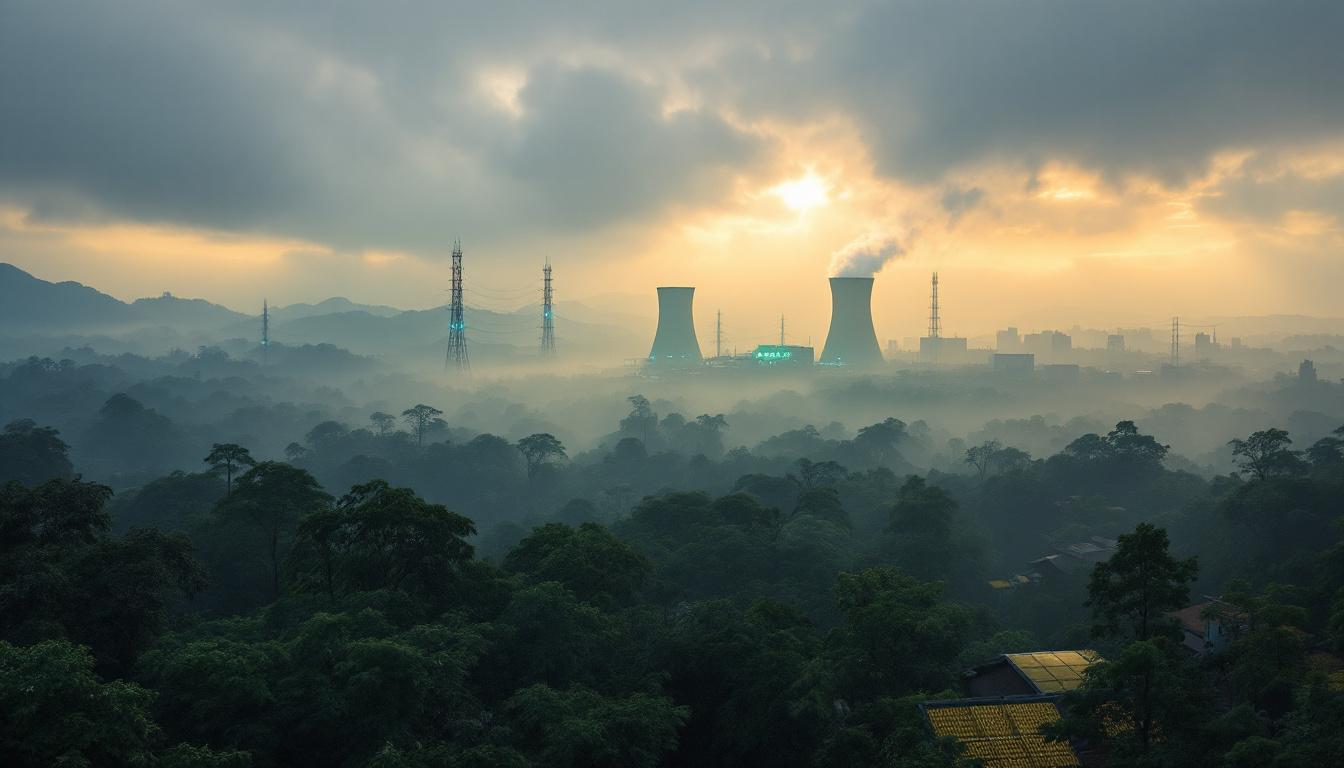
As digital infrastructure drives unprecedented electricity demand, Malaysia is rapidly expanding its low-carbon energy options, including reconsidering nuclear power and integrating regional energy initiatives to meet its 2050 net-zero goals.
Malaysia’s path to decarbonising its power system is being redrawn by two simultaneous forces: a surge in electricity-hungry digital infrastructure and a strategic push to broaden the country’s low‑carbon options. Policymakers and industry now face a choice between simplistic labels and a pragmatic assessment of which technologies can deliver large volumes of dependable, low‑emission power as the grid is asked to shoulder an unprecedented new load.
Digital infrastructure will be the defining driver. Projections vary, but the scale is indisputable. According to a Business Today analysis, data centres and artificial‑intelligence workloads could demand as much as 19.5 gigawatts by 2035, a figure that would consume more than half of the electricity used in Peninsular Malaysia. Government and industry sources present a different but still dramatic picture: Malaysia already had 18 operational data centres with at least 800 megawatts of demand as of late 2024, and official forecasts anticipate the number of facilities rising to 81 by 2035, with renewable generation targets increasing to 40% by that date, and to 70% by 2050, according to the Malaysian Investment Development Authority. Independent market tracking suggests even larger build‑outs, with pipelines of projects and expansions in Johor and elsewhere potentially adding multiple gigawatts of IT load. These competing estimates underscore one clear need: rapid, large‑scale additions of low‑carbon, reliable generation and grid flexibility.
The immediate system response has been cautious and pragmatic. Network operators and planners are preparing for interim gas capacity additions to maintain supply security, but analysts warn that new fossil‑fuel investments risk long‑term lock‑in that would complicate the 2050 net‑zero objective. Tenaga Nasional Bhd (TNB), the country’s dominant utility, is preparing for a materially larger role in supporting the sector’s growth: the company has outlined plans to enable up to 5,000 MW of data‑centre demand by 2035 and is rolling out measures such as a Green Lane Pathway to speed connections, alongside enhanced transmission and dual‑supply frameworks. “The rapid rise of data centre capacity in the region, especially in Malaysia, means industry players can no longer choose between affordability, reliability, and sustainability,” TNB Chief Retail Officer Datuk Kamal Arifin A. Rahman said in a company statement, reflecting the tight policy trade‑offs now at play.
Meeting these twin imperatives, large-scale, always‑available power for digital industry and deep decarbonisation, requires expanding the notion of what counts as “green.” Life‑cycle assessments published by international research bodies show a wide spread of emissions intensities across generation types; wind and modern nuclear sit at the low end alongside ocean technologies, while solar and hydropower are low but more variable, and fossil fuels remain orders of magnitude higher. Industry syntheses from NREL and the IPCC put nuclear and wind near the bottom of life‑cycle greenhouse‑gas intensity, and ocean energy among the lowest. For Malaysia, that spectrum matters because different parts of the system require different attributes: firm, steady baseload; dispatchable generation to firm renewables; and flexible, variable resources to capture daytime and seasonal solar yield.
That technical distinction explains why policymakers are reconsidering options previously sidelined. The federal government has reintroduced nuclear into long‑term planning under the 13th Malaysia Plan (2026–2030) and authorised a feasibility study, signalling openness to firm, large‑scale zero‑carbon capacity. Advances in Small Modular Reactors (SMRs) are presented within the policy debate as a more adaptable, lower‑capital, scalable route to deliver continuous, high‑capacity power that complements intermittent renewables. At the same time, the government and private sector are accelerating development of a broader renewables mix that can be deployed quickly and in large quantities.
Several emerging resources feature prominently in that mix. Floating photovoltaic arrays are being scaled up, with a 300 MW standalone floating solar project underway in Selangor that demonstrates how reservoir surfaces can be exploited for substantial additional capacity while reducing evaporation losses. Geothermal prospects around Tawau in Sabah are being revived, with estimates of around 100 MW of exploitable resource that could supply dispatchable renewable baseload to a region constrained in land for other technologies. Ocean and tidal potential along Pahang, Selangor and parts of Sarawak has attracted research attention because of its predictability and very low life‑cycle emissions, though commercial deployment will require technology maturation and targeted investment. Sarawak is also pursuing green hydrogen production enabled by its hydropower resources and has already moved to export initial volumes to Singapore, positioning hydrogen as both an industrial feedstock and an exportable energy carrier.
Operationally and commercially, regional integration amplifies Malaysia’s choices. The ASEAN Power Grid concept and pilot initiatives such as the Lao PDR–Thailand–Malaysia–Singapore power integration project have demonstrated cross‑border trade can be technically and commercially viable. According to Business Today coverage, a deliberate strategy that combines variable renewables, dispatchable renewable sources and firm zero‑carbon generation would allow Malaysia not only to meet domestic digital demand but to become an exporter of competitive, low‑carbon electricity across Southeast Asia, creating revenue streams and reinforcing regional decarbonisation. Realising that outcome will require investments in transmission, market arrangements to value capacity and flexibility, and harmonised regulatory frameworks for cross‑border contracts.
For industrial players planning large power draws or seeking to decarbonise operations, the implications are immediate. Energy procurement strategies must move beyond short‑term green certificates toward contracts that secure firm, low‑emission capacity and grid services, capacity payments, long‑duration supply guarantees or integrated solutions combining on‑site renewables, storage, demand management and grid-sourced firm power. Policymakers must incentivise technologies that provide system value rather than only per‑MWh carbon metrics, and design procurement and tariff mechanisms that avoid locking the system into fossil assets.
Malaysia’s choices in the coming decade will determine whether the nation merely copes with a data‑driven demand surge or leverages it into an industrial decarbonisation advantage. Embracing a full palette of low‑carbon resources, from floating solar and geothermal to ocean energy and, where politically acceptable and technically vetted, nuclear, can deliver the scale, reliability and emissions reductions required. The task is to match technology deployment with grid investment, market reform and cross‑border cooperation so that the country’s growing digital economy is powered by electricity that is both abundant and genuinely low carbon.
- https://www.businesstoday.com.my/2026/02/27/50-shades-of-green-energy-reimagining-the-nations-power-mix-for-a-sustainable-decade-ahead/?utm_source=rss&utm_medium=rss&utm_campaign=50-shades-of-green-energy-reimagining-the-nations-power-mix-for-a-sustainable-decade-ahead – Please view link – unable to able to access data
- https://www.mida.gov.my/mida-news/government-commits-to-renewable-energy-growth-as-data-centres-multiply-in-malaysia/ – As of February 2025, Malaysia has 18 operational data centres with a combined electricity demand of at least 800 MW, a figure expected to rise to 81 by 2035. The government is committed to increasing the share of renewable energy in Malaysia’s electricity mix, with 31% of the country’s electricity expected to be generated from renewable sources by 2025. This will rise to 40% by 2035 and 70% by 2050. Efforts to meet the energy needs of data centres without disrupting the overall electricity supply are a key priority, with a focus on minimising cost implications for all consumers. ([mida.gov.my](https://www.mida.gov.my/mida-news/government-commits-to-renewable-energy-growth-as-data-centres-multiply-in-malaysia/?utm_source=openai))
- https://www.businesstoday.com.my/2025/02/17/govt-unveils-green-energy-plans-for-data-centre-expansion/ – As of December 2024, Malaysia has 18 operational data centres with a combined electricity demand of at least 800 MW, a figure expected to rise to 81 by 2035. The government has implemented the Power Usage Effectiveness (PUE) standard to ensure energy efficiency in new data centres seeking investment incentives. Additionally, the Ministry of Housing and Local Government has introduced Data Centre Planning Guidelines to streamline and standardise the approval process for data centre projects. The government is committed to increasing the share of renewable energy in Malaysia’s electricity mix, with 31% of the country’s electricity expected to be generated from renewable sources by 2025. This will rise to 40% by 2035 and 70% by 2050. Efforts to meet the energy needs of data centres without disrupting the overall electricity supply are a key priority, with a focus on minimising cost implications for all consumers. ([businesstoday.com.my](https://www.businesstoday.com.my/2025/02/17/govt-unveils-green-energy-plans-for-data-centre-expansion/?utm_source=openai))
- https://www.thestar.com.my/news/nation/2025/02/17/government-commits-to-renewable-energy-growth-as-data-centres-multiply-in-malaysia – As of February 2025, Malaysia has 18 operational data centres with a combined electricity demand of at least 800 MW, a figure expected to rise to 81 by 2035. The government is committed to increasing the share of renewable energy in Malaysia’s electricity mix, with 31% of the country’s electricity expected to be generated from renewable sources by 2025. This will rise to 40% by 2035 and 70% by 2050. Efforts to meet the energy needs of data centres without disrupting the overall electricity supply are a key priority, with a focus on minimising cost implications for all consumers. ([thestar.com.my](https://www.thestar.com.my/news/nation/2025/02/17/government-commits-to-renewable-energy-growth-as-data-centres-multiply-in-malaysia?utm_source=openai))
- https://estatemarketpulse.com/2025/12/11/malaysia-data-centers-electricity-demand/ – As of late 2025, Malaysia hosts around 522 MW of operational data centre IT load across approximately 46–62 facilities. Johor dominates with over 60% of total capacity, followed by Selangor, Kuala Lumpur, and Cyberjaya. Under construction: an additional ~1,250 MW, led by Vantage KUL2 (256 MW, AI-ready, started August 2024) and AirTrunk JHB1 in Johor, plus 42 approved projects in Johor alone. Planned and announced projects push the pipeline to ~3 GW more, including YTL Green Data Center Park in Johor (500 MW, solar-powered), Empyrion campus in Johor (200 MW, announced December 2025), and upcoming campuses from STACK, EdgeConneX, Edgnex, and Epoch Digital adding another ~1.1 GW. ([estatemarketpulse.com](https://estatemarketpulse.com/2025/12/11/malaysia-data-centers-electricity-demand/?utm_source=openai))
- https://www.businesstoday.com.my/2025/11/30/tnb-targets-5000-mw-to-power-malaysias-data-centre-boom – Tenaga Nasional Bhd (TNB) is positioning itself at the centre of Malaysia’s fast-growing data centre industry, with plans to support up to 5,000 megawatts of energy demand by 2035 as the country accelerates its digital ambitions. TNB currently has 27,690 megawatts of installed capacity, representing 51.4 percent of the market. Its infrastructure includes 26,000 kilometres of transmission lines and a distribution network stretching 734,000 kilometres. Through its retail division, the utility supplies more than 10.4 million customers nationwide and delivers around 138,000 gigawatt hours of electricity annually. According to TNB Chief Retail Officer Datuk Kamal Arifin A. Rahman, the rapid rise of data centre capacity in the region, especially in Malaysia, means industry players can no longer choose between affordability, reliability, and sustainability. The challenge now is how to meet all three at once. One of TNB’s key offerings is the Green Lane Pathway, designed to shorten data centre connection timelines from 36 months to 12 months. Combined with a robust dual-supply framework and the integration of renewable energy, the pathway aims to create an efficient and environmentally responsible energy ecosystem for digital infrastructure. ([businesstoday.com.my](https://www.businesstoday.com.my/2025/11/30/tnb-targets-5000-mw-to-power-malaysias-data-centre-boom?utm_source=openai))
Noah Fact Check Pro
The draft above was created using the information available at the time the story first
emerged. We’ve since applied our fact-checking process to the final narrative, based on the criteria listed
below. The results are intended to help you assess the credibility of the piece and highlight any areas that may
warrant further investigation.
Freshness check
Score:
8
Notes:
The article was published on February 27, 2026. A similar narrative appeared in Business Today on February 24, 2026, discussing Malaysia’s restrictions on non-AI data centres due to power and water concerns. ([businesstoday.com.my](https://www.businesstoday.com.my/2026/02/24/govt-halts-non-ai-data-centres-to-ease-strain-on-power-water-supply?utm_source=openai)) The earlier article focuses on policy changes, while the current piece delves into the broader energy strategy, indicating originality.
Quotes check
Score:
7
Notes:
The article includes direct quotes from Prime Minister Anwar Ibrahim regarding the restriction of non-AI data centres. These quotes are consistent with statements made in the February 24, 2026, Business Today article. ([businesstoday.com.my](https://www.businesstoday.com.my/2026/02/24/govt-halts-non-ai-data-centres-to-ease-strain-on-power-water-supply?utm_source=openai)) However, the absence of independent verification for these quotes raises concerns about their authenticity.
Source reliability
Score:
6
Notes:
The article originates from Business Today, a niche publication. While it provides detailed insights, its limited reach and potential biases may affect the reliability of the information presented.
Plausibility check
Score:
8
Notes:
The claims about Malaysia’s energy strategy, including the projected 19.5 GW demand from data centres by 2035 and the emphasis on diverse renewable sources, align with recent developments and reports. However, the article’s tone and structure, with excessive detail and off-topic information, may be a distraction tactic.
Overall assessment
Verdict (FAIL, OPEN, PASS): FAIL
Confidence (LOW, MEDIUM, HIGH): MEDIUM
Summary:
While the article presents plausible information consistent with recent developments, the reliance on a single, potentially biased source and the absence of independent verification for key claims, particularly direct quotes from government officials, undermine its credibility. The excessive detail and off-topic information may also be a distraction tactic. Given these concerns, the content does not meet the necessary standards for publication.
