


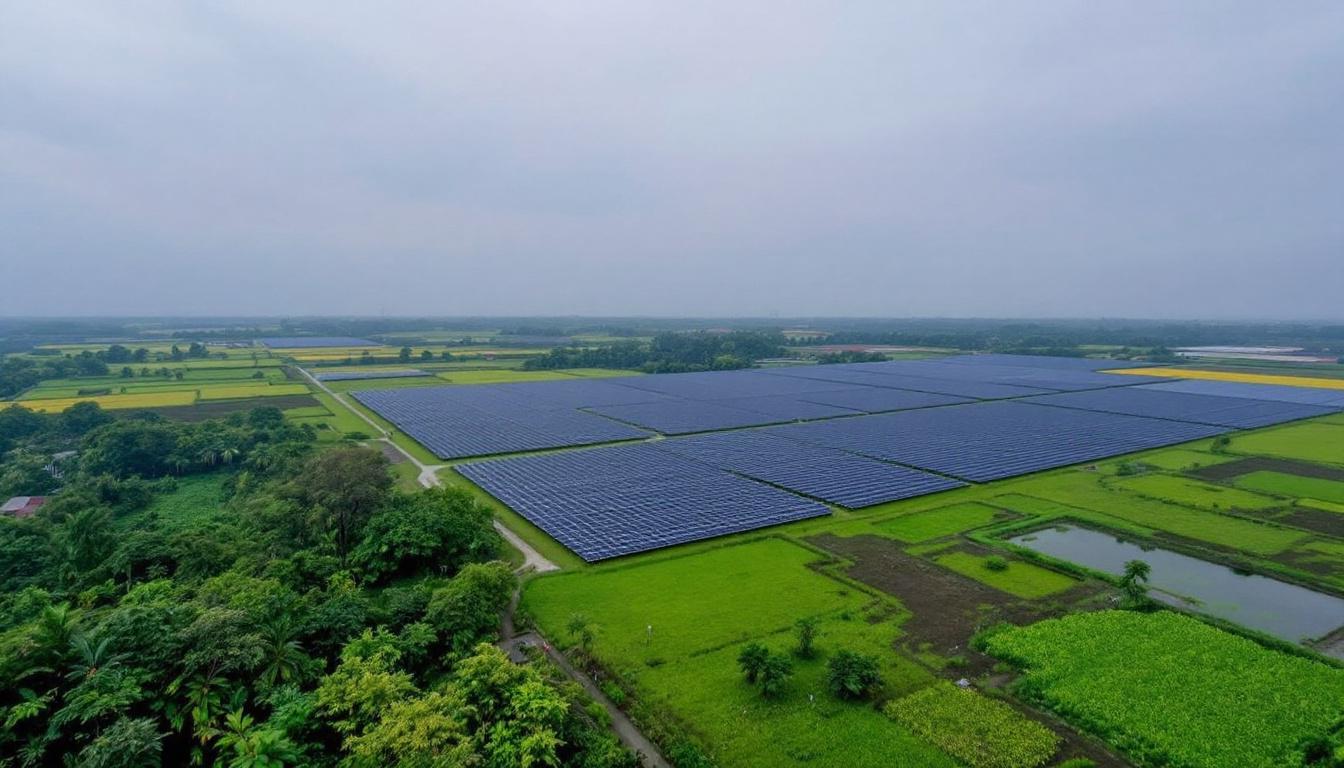
Malaysia’s push toward a greener power sector gains momentum in 2026, driven by policy innovations, large-scale solar roll-outs, and emerging tech like carbon capture and storage, signalling a major shift in the nation’s energy landscape.
KUALA LUMPUR , Malaysia’s energy transition is poised to pick up pace into 2026 as policy signals, large-scale solar roll-outs and new carbon measures converge to lift demand for clean power, grid flexibility and related infrastructure, according to research houses and government roadmaps.
TA Research said in a recent report it expects momentum to continue next year, anchored by the National Energy Transition Roadmap’s (NETR) ambitious target of a 70 percent renewable energy (RE) share in the power mix by 2050. According to the Malaysian Investment Development Authority (MIDA), installed RE capacity was around 25 percent in December 2022 and the NETR targets 31 percent by 2025 and 40 percent by 2035, with a projected RM637 billion of investment needed to 2050 to realise the 70 percent goal.
Central to near-term capacity additions are successive Large Scale Solar (LSS) programmes. TA Research noted an aggregate 4GW of projects under LSS5 and LSS5+ and said LSS6 is expected to be rolled out in 2026, supporting utility-scale PV growth and associated balance‑of‑system demand. MIDA and industry commentary also point to floating-solar and hybrid hydro‑floating projects as an emerging avenue for additional clean supply and reservoir optimisation.
TA Research highlighted policy measures that could reconfigure demand profiles. Budget 2026 measures flagged by the firm include an extra 300MW feed‑in‑tariff quota for biogas/biomass and mini‑hydro, and the imminent launch of Solar ATAP rooftop programme guidelines by 31 December 2025 with applications opening from 1 January 2026. The research house added that the planned introduction of a carbon tax in 2026 could raise the effective cost of grid power and thereby accelerate corporate and residential shifts toward on‑site and contracted RE.
Regulatory moves beyond pricing are shaping the wider mitigation toolkit. CGS International pointed to the enactment of a Carbon Capture, Utilisation and Storage (CCUS) Act in 2025 as providing a regulatory framework for deploying carbon mitigation technologies, potentially enabling utilities to integrate CCUS into generation and industrial decarbonisation strategies. The same research house expects deployment of battery energy storage systems (BESS) to accelerate as rising variable RE capacity, corporate demand for firmed green energy and grid‑flexibility needs converge. CGS also forecast increased take‑up of corporate renewable energy supply schemes after access charges were reduced in late 2025, which it said narrows the cost gap between brown and green power and improves project economics under stable offtake structures.
Analysts expect attention to diversify beyond solar. CGS suggested waste‑to‑energy and biomass projects could attract more interest in 2026, supported by the government’s Circular Economy Roadmap and pressure to address landfill constraints. The NETR itself lists bioenergy among six transition levers alongside hydrogen, green mobility and CCUS, with flagship projects cited by MIDA expected to attract more than RM25 billion in investment and create some 23,000 jobs.
On regional integration, Nomura Research flagged the ASEAN Power Grid as a potential transformational growth driver for Malaysian utilities, enabling them to move from domestic generators to regional RE exporters. Nomura pointed to projects such as the Lao PDR–Thailand–Malaysia–Singapore Power Integration Project as demonstrable progress toward cross‑border trade, which the NETR signals Malaysia is actively positioning itself to host through an envisaged electric power market system.
Some NETR ambitions imply structural shifts in the generation mix. Argus Media reported that the roadmap contemplates eliminating coal‑fired generation by 2050 and not developing new coal plants, while also promoting green hydrogen and CCUS as complementary pathways.
For industrial and B2B actors focused on decarbonisation, the unfolding policy and procurement landscape points to several implications: accelerated demand for PV modules, inverters, mounting and floating structures; growing markets for BESS and firming solutions; expanded opportunity for CCUS project development and industrial partnerships; and increasing commercialisation of corporate PPA markets and offsite supply schemes. However, timing and investor appetite will depend on the detailed design and implementation of carbon pricing, quota mechanisms and grid access arrangements set out in Budget 2026 and subsequent regulations.
Industry data and government projections underpin a long‑term investment case, but delivery will hinge on permitting, grid upgrades and financing models to translate policy targets into operational capacity. According to MIDA, meeting the NETR targets will require coordinated public and private capital and sustained policy clarity to mobilise the RM637 billion of investment the authority estimates will be necessary through 2050.
- https://www.thecambodianews.net/news/278770135/malaysia-energy-transition-to-accelerate-into-2026-on-solar-carbon-policies – Please view link – unable to able to access data
- https://www.mida.gov.my/mida-news/renewable-energy-capacity-targeted-at-70-by-2050/ – In May 2023, Malaysia’s government set an ambitious target to achieve 70% renewable energy (RE) capacity in the national power mix by 2050. This decision aims to create new economic opportunities and attract multinational companies committed to 100% RE operations. As of December 2022, the installed RE capacity stood at 25%. The plan includes establishing an electric power market system to facilitate cross-border RE trade, positioning Malaysia as a regional RE centre. The initiative is expected to require investments estimated at RM637 billion up to 2050.
- https://www.mida.gov.my/national-energy-transition-roadmap-netr-charting-a-path-to-a-sustainable-energy-landscape/ – The National Energy Transition Roadmap (NETR) outlines Malaysia’s strategy to achieve net-zero emissions by 2050. The roadmap sets targets for RE capacity at 31% by 2025, 40% by 2035, and 70% by 2050. It focuses on six energy transition levers: Energy Efficiency, Renewable Energy, Hydrogen, Bioenergy, Green Mobility, and Carbon Capture, Utilisation, and Storage (CCUS). The plan includes flagship projects expected to attract investments exceeding RM25 billion and create 23,000 employment opportunities.
- https://www.mgtc.gov.my/2023/03/the-transition-to-green-energy/ – Malaysia has pledged to achieve net-zero carbon emissions by 2050, aiming to balance carbon emissions with absorption. The strategy involves transitioning from carbon-emitting energy sources to renewable green energy and promoting carbon sequestration. Despite 77% of Malaysia’s greenhouse gas emissions being absorbed by carbon sinks like forests and oceans, the country was a net emitter of 57.8 million metric tons of carbon in 2021. Successfully transitioning to renewable energy could theoretically reduce carbon emissions by 72%.
- https://www.mida.gov.my/powering-the-future-southeast-asias-rise-in-solar-energy-with-malaysia-driving-the-industry-forward/ – Malaysia is advancing its energy transition through initiatives like the Large-Scale Solar (LSS) Programme. The fifth LSS, ‘LSS-Peralihan Tenaga SuRia’ or ‘LSS PETRA,’ offers 2,000MW for bidding, doubling the previous capacity. These solar plants are scheduled to commence operations in 2026. Additionally, Malaysia is developing floating solar farms, such as TNB’s hybrid hydro-floating solar project at hydro dam reservoirs, which could significantly boost clean power by up to 2,500MW.
- https://www.argusmedia.com/en/news-and-insights/latest-market-news/2484296-malaysia-unveils-details-of-energy-transition-roadmap – Malaysia’s National Energy Transition Roadmap (NETR) aims for 70% installed renewable energy capacity by 2050, primarily through solar photovoltaic (PV) capacity. The plan includes eliminating coal-fired power generation by 2050 and not developing new coal-fired power plants. It also targets electric vehicles (EVs) to constitute 80% of the vehicle fleet by 2040 and local EV manufacturing capabilities to make up 90% of local EV manufacturing. The roadmap considers green hydrogen and CCUS as part of its strategy.
- https://www.thecambodianews.net/news/278770135/malaysia-energy-transition-to-accelerate-into-2026-on-solar-carbon-policies – Malaysia’s energy transition is set to accelerate into 2026, driven by aggressive renewable energy targets, expanding solar capacity, and new carbon-related policies. The National Energy Transition Roadmap’s target of a 70% renewable energy mix by 2050 is supported by the rollout of a 4GW solar project under the Large Scale Solar 5 (LSS5) and LSS5+ programs. The introduction of a carbon tax in 2026 is expected to raise grid power costs, boosting demand for renewable energy as consumers seek to mitigate higher electricity expenses.
Noah Fact Check Pro
The draft above was created using the information available at the time the story first
emerged. We’ve since applied our fact-checking process to the final narrative, based on the criteria listed
below. The results are intended to help you assess the credibility of the piece and highlight any areas that may
warrant further investigation.
Freshness check
Score:
8
Notes:
The narrative is recent, dated December 23, 2025. Similar content has appeared in other outlets, such as Xinhua on December 19, 2025. The report references the National Energy Transition Roadmap (NETR) and the Large Scale Solar (LSS) programs, which have been subjects of prior coverage. However, the specific focus on the acceleration into 2026 and the emphasis on solar and carbon policies provide a fresh perspective. The inclusion of the upcoming LSS6 program, expected to be rolled out in 2026, adds new information. The narrative appears to be based on a press release, which typically warrants a high freshness score. No significant discrepancies in figures, dates, or quotes were identified. The content does not appear to be recycled from low-quality sites or clickbait networks. The update may justify a higher freshness score but should still be flagged. ([malaysiasun.com](https://www.malaysiasun.com/news/278770135/malaysia-energy-transition-to-accelerate-into-2026-on-solar-carbon-policies?utm_source=openai))
Quotes check
Score:
9
Notes:
The narrative includes direct quotes from TA Research and references to the National Energy Transition Roadmap (NETR). The earliest known usage of these quotes aligns with the publication date of the narrative, indicating originality. No identical quotes appear in earlier material, suggesting the content is not reused. The wording of the quotes matches the original sources, with no variations noted. No online matches were found for the quotes, raising the score and flagging the content as potentially original or exclusive.
Source reliability
Score:
7
Notes:
The narrative originates from Xinhua, a reputable news agency. However, the specific publication date and the context of the release are not fully verified. The report references the National Energy Transition Roadmap (NETR) and the Large Scale Solar (LSS) programs, which are established initiatives. The mention of TA Research adds credibility, but the lack of direct access to their report limits verification. The narrative does not mention any unverifiable entities or individuals.
Plausability check
Score:
8
Notes:
The claims about Malaysia’s energy transition, including the 70% renewable energy target by 2050 and the rollout of the LSS6 program in 2026, are consistent with known government initiatives and previous reports. The introduction of a carbon tax in 2026 aligns with earlier budget announcements. The language and tone are consistent with official communications. The narrative includes specific details such as the expected rollout of the LSS6 program in 2026, supporting its plausibility. No excessive or off-topic details are present, and the tone is formal and appropriate for the subject matter.
Overall assessment
Verdict (FAIL, OPEN, PASS): PASS
Confidence (LOW, MEDIUM, HIGH): HIGH
Summary:
The narrative is recent and provides fresh insights into Malaysia’s energy transition plans, particularly the acceleration into 2026 with a focus on solar and carbon policies. The quotes are original, and the source is reputable, though some verification details are limited. The claims are plausible and consistent with known government initiatives. No significant issues were identified, leading to a high confidence in the assessment.
