


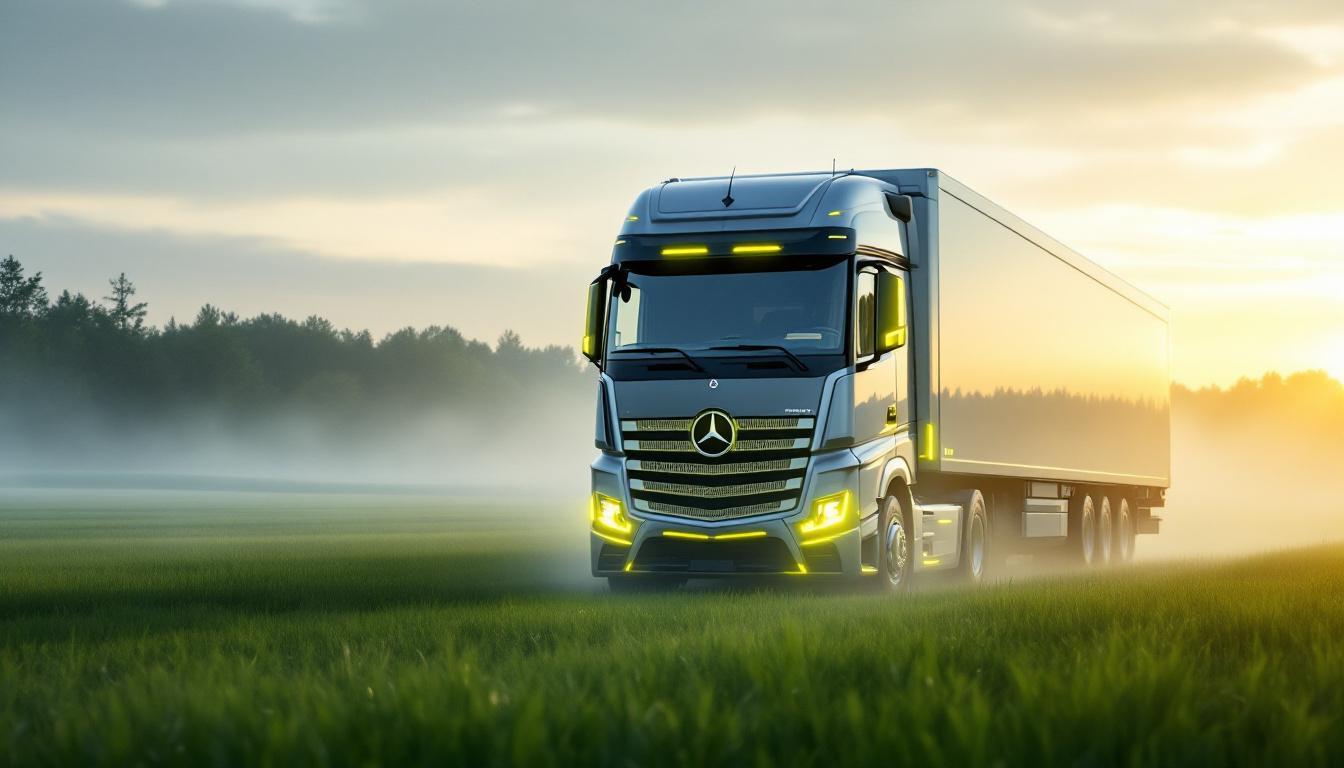
Mercedes-Benz’s new NextGenH2 heavy-duty truck aims to transform hydrogen from a speculative tech into a practical solution for long-distance freight, combining liquid hydrogen fuel with substantial onboard batteries to match diesel performance and reduce emissions.
Mercedes‑Benz’s new NextGenH2 heavy‑duty truck aims to reposition hydrogen from a speculative technology into a practical solution for long‑haul freight, combining liquid hydrogen fuel with substantial on‑board battery capacity to mirror diesel performance while cutting emissions.
Daimler Truck, which unveiled the vehicle, positions the NextGenH2 as a fuel‑cell range‑extended electric heavy truck. The architecture pairs two fuel‑cell units with a large 101 kWh lithium‑iron‑phosphate battery that smooths power delivery, captures regenerative braking energy and supplies peak loads to two electric motors. According to Daimler Truck, the setup produces about 300 kW of continuous output and is integrated with proven elements from the eActros 600 platform, including the e‑axle and the ProCabin, preserving driver ergonomics and safety systems familiar to fleets.
The truck stores 85 kilograms of liquid hydrogen in two tanks, enabling a claimed driving distance of more than 1,000 kilometres on a single fill. Daimler Truck says refuelling takes roughly 10 to 15 minutes using the subcooled liquid hydrogen, or sLH2, standard developed in partnership with Linde. The company plans a small series of 100 trucks from late 2026, with full commercial rollout targeted in the early 2030s.
Industry testing offers practical corroboration beyond the marketing narrative. According to Europawire, the related GenH2 customer trials that began in July 2024 logged over 225,000 kilometres across five prototype trucks operated by logistics and industrial partners. Those trials recorded average hydrogen consumption between 5.6 kg/100 km and 8.0 kg/100 km depending on vehicle weight and duty cycle, and more than 285 refuelling events; operators reported ranges exceeding 1,000 km per fill and 10–15 minute refuelling times at trial stations in Woerth am Rhein and Duisburg.
Adopting liquid hydrogen, rather than compressed gaseous hydrogen, is the technical pivot that underpins the NextGenH2’s claims. Daimler Truck and Linde say the sLH2 approach raises volumetric energy density, enabling longer ranges from practical tank sizes. Linde and Daimler Truck further argue that sLH2 refuelling stations can be delivered at significantly lower cost, reducing capital requirements by a factor of two to three and operational expenditures by around five to six times, potentially easing one of hydrogen’s most persistent barriers to scale.
For fleet decision‑makers weighing options for decarbonisation, the NextGenH2 presents a distinct trade‑off compared with battery‑electric trucks. Battery systems for long‑haul applications confront mass and charging time penalties that can erode payload and utilisation; the NextGenH2’s liquid hydrogen tanks and rapid refill profile are designed to preserve route flexibility and driver schedules comparable to diesel. The inclusion of a large LFP battery, meanwhile, allows the truck to operate as an electric vehicle for transient loads and energy recuperation, reducing total hydrogen demand and smoothing fuel‑cell duty cycles.
Operational realities remain critical. Infrastructure for sLH2 is nascent, and the cost and regulatory work needed to deploy a continent‑spanning refuelling network are substantial. Daimler Truck’s staged production plan, initial limited series followed by broader manufacture in the early 2030s, reflects an expectation that station rollout will be incremental. Independent test figures from customer trials help mitigate scepticism, but scaling from demonstration fleets to commercial volumes will test supply chains for hydrogen production, cryogenic storage and station equipment.
The NextGenH2 also illustrates a broader industrial strategy: pairing mature vehicle platforms with new propulsion systems to lower adoption friction. By reusing components from the eActros 600, Daimler Truck retains parts commonality, service procedures and driver interfaces that reduce training and workshop disruption for operators transitioning fleets.
For companies focused on industrial decarbonisation, the NextGenH2 highlights an emerging pathway for zero‑tailpipe emissions freight that aligns operational continuity with emissions goals. Whether liquid hydrogen becomes the default for long‑haul trucking will depend on how quickly sLH2 production and refuelling infrastructure scale, the relative evolution of battery energy density and charging networks, and the total cost of ownership for operators across vehicle purchase, fuel and infrastructure investments. Daimler Truck’s recent trial data and its collaboration with Linde provide important early evidence that hydrogen can meet the duty cycles of heavy freight; the coming years will determine whether that technical promise becomes a commercially viable alternative to diesel at scale.
- https://metaverseplanet.net/blog/mercedes-hits-the-road-with-liquid-hydrogen-power/ – Please view link – unable to able to access data
- https://www.daimlertruck.com/en/newsroom/pressrelease/daimler-truck-presents-mercedes-benz-nextgenh2-truck-with-small-series-production-planned-from-end-of-2026-53330597 – Daimler Truck has unveiled the Mercedes-Benz NextGenH2 Truck, a fuel cell-powered vehicle designed for long-distance transport. The truck features two liquid hydrogen tanks with a combined capacity of 85 kilograms, enabling a range of over 1,000 kilometers on a single fill. Refueling takes approximately 10 to 15 minutes using the sLH2 standard developed with Linde. Production is planned to begin in late 2026, with full-scale deployment in the early 2030s. The NextGenH2 Truck incorporates components from the eActros 600, including the integrated e-axle and ProCabin, ensuring high performance and driver comfort.
- https://news.europawire.eu/mercedes-benz-genh2-truck-proves-readiness-in-first-customer-trials-with-over-225000-km-driven-on-hydrogen/eu-press-release/2025/09/04/10/23/27/161641/ – Daimler Truck has completed the first year of customer trials for its fuel cell-powered Mercedes-Benz GenH2 Truck, confirming the vehicle’s performance and practicality under everyday operating conditions. Since July 2024, five prototype vehicles have been deployed with Air Products, Amazon, Holcim, INEOS Inovyn, and Wiedmann & Winz, collectively covering more than 225,000 kilometers – equivalent to five circumnavigations of the globe. The results highlight the potential of hydrogen-powered trucks to meet the demands of modern logistics. During the trials, the trucks achieved an average hydrogen consumption of between 5.6 kg/100 km and 8 kg/100 km, depending on application, at gross vehicle weights between 16 and 34 tons. Across 285 refueling operations in Woerth am Rhein and Duisburg, drivers filled a total of 15 tons of liquid hydrogen (sLH2), enabling ranges of more than 1,000 kilometers per tank with refueling times of just 10 to 15 minutes.
- https://northamerica.daimlertruck.com/news-stories/2024/safe-fast-and-simple-daimler-truck-and-linde-set-new-standard-for-liquid-hydrogen-refueling-technology – Daimler Truck and Linde Engineering have developed a new process for handling subcooled liquid hydrogen (sLH2), significantly improving hydrogen refueling efficiency. This innovation allows for higher storage density, greater range, faster refueling, and lower costs. Refueling a 40-ton heavy-duty truck with 80 kg of liquid hydrogen now takes around 10 to 15 minutes, providing a range of over 1,000 kilometers. The sLH2 technology also reduces the required investment for hydrogen refueling stations by a factor of two to three and operational costs by five to six times, facilitating the adoption of hydrogen-powered trucks in long-haul transport.
- https://www.daimlertruck.com/fileadmin/user_upload/bilder/events/dt-strategy-day/20210520_Strategy_Day_FINAL.pdf – Daimler Truck’s strategy document outlines the company’s plans for hydrogen-powered vehicles, including the NextGenH2 Truck. The document specifies ambitions for the GenH2 Truck, targeting a range of approximately 1,200 kilometers, a payload of 24 tons, and a refueling time of 15 minutes by 2027. These targets aim to make hydrogen trucks comparable to conventional diesel trucks in terms of performance and operational efficiency, supporting the transition to zero-emission transport solutions.
- https://www.electrichunter.com/commercial-vehicles/mercedes-benz-genh2-long-haul-freight-620-mile-range-hits-road – The Mercedes-Benz GenH2 Truck is designed for long-distance freight, offering a range of approximately 620 miles (1,000 kilometers) on a single tank. The truck combines lightweight components with an efficient fuel cell system, supported by a 101 kWh lithium-iron-phosphate battery that assists during power spikes and stores energy from braking or downhill driving. Refueling takes about 15 minutes, and the truck is built for highway hauling across the EU and North America, making it suitable for companies aiming to decarbonize their fleets without sacrificing payload or range.
- https://www.electrive.com/2026/01/26/daimler-truck-to-build-100-advanced-h2-powered-semi-trailer-tractors/ – Daimler Truck plans to build 100 advanced hydrogen-powered semi-trailer tractors, known as the NextGenH2 Truck, for deployment by the end of 2026. The truck features a 101 kWh battery and two fuel cell units, delivering a combined output of 300 kW. Refueling takes approximately 10 to 15 minutes, providing a range of over 1,000 kilometers. The NextGenH2 Truck incorporates components from the eActros 600, including the integrated e-axle and ProCabin, ensuring high performance and driver comfort. This initiative marks a significant step towards the commercialization of hydrogen-powered heavy-duty trucks.
Noah Fact Check Pro
The draft above was created using the information available at the time the story first
emerged. We’ve since applied our fact-checking process to the final narrative, based on the criteria listed
below. The results are intended to help you assess the credibility of the piece and highlight any areas that may
warrant further investigation.
Freshness check
Score:
3
Notes:
⚠️ The article was published on 29 January 2026, but the information about Daimler Truck’s NextGenH2 truck has been available since at least 26 January 2026, when Daimler Truck released a press release detailing the vehicle’s features and production plans. ([daimlertruck.com](https://www.daimlertruck.com/en/newsroom/pressrelease/53330597?utm_source=openai)) This indicates that the content may be recycled or republished, potentially reducing its freshness score. Additionally, the article is hosted on Metaverse Planet, a niche publication, which may affect its originality and source independence.
Quotes check
Score:
2
Notes:
⚠️ The article includes direct quotes from Daimler Truck and Linde Engineering regarding the sLH2 technology and its benefits. ([linde-engineering.com](https://www.linde-engineering.com/news-and-events/press-releases/2024/safe-fast-and-simple-daimler-truck-and-linde-set-new-standard-for-liquid-hydrogen-refueling-technology?utm_source=openai)) However, these quotes are not independently verified and appear to be sourced from the press release. The lack of independent verification raises concerns about the authenticity and originality of the quotes.
Source reliability
Score:
2
Notes:
⚠️ The primary source of information is a press release from Daimler Truck and Linde Engineering, which is inherently promotional and may lack objectivity. ([linde-engineering.com](https://www.linde-engineering.com/news-and-events/press-releases/2024/safe-fast-and-simple-daimler-truck-and-linde-set-new-standard-for-liquid-hydrogen-refueling-technology?utm_source=openai)) The article is hosted on Metaverse Planet, a niche publication, which may not have the same editorial standards as major news organisations. This raises concerns about the reliability and independence of the source.
Plausibility check
Score:
5
Notes:
✅ The claims about the NextGenH2 truck’s features, such as its range of over 1,000 kilometres and refuelling time of 10–15 minutes, align with information from Daimler Truck’s press releases. ([daimlertruck.com](https://www.daimlertruck.com/en/newsroom/pressrelease/53330597?utm_source=openai)) However, the article’s tone and language are inconsistent with typical corporate or official language, which may indicate a lack of professionalism or potential bias in the reporting.
Overall assessment
Verdict (FAIL, OPEN, PASS): FAIL
Confidence (LOW, MEDIUM, HIGH): HIGH
Summary:
⚠️ The article presents information about Daimler Truck’s NextGenH2 truck, but it relies primarily on a press release from Daimler Truck and Linde Engineering, which is inherently promotional and lacks independent verification. ([linde-engineering.com](https://www.linde-engineering.com/news-and-events/press-releases/2024/safe-fast-and-simple-daimler-truck-and-linde-set-new-standard-for-liquid-hydrogen-refueling-technology?utm_source=openai)) The article is hosted on Metaverse Planet, a niche publication, and includes subjective commentary, further raising concerns about its reliability and objectivity. Given these factors, the content does not meet the necessary standards for factual reporting and is not covered under our indemnity.
