


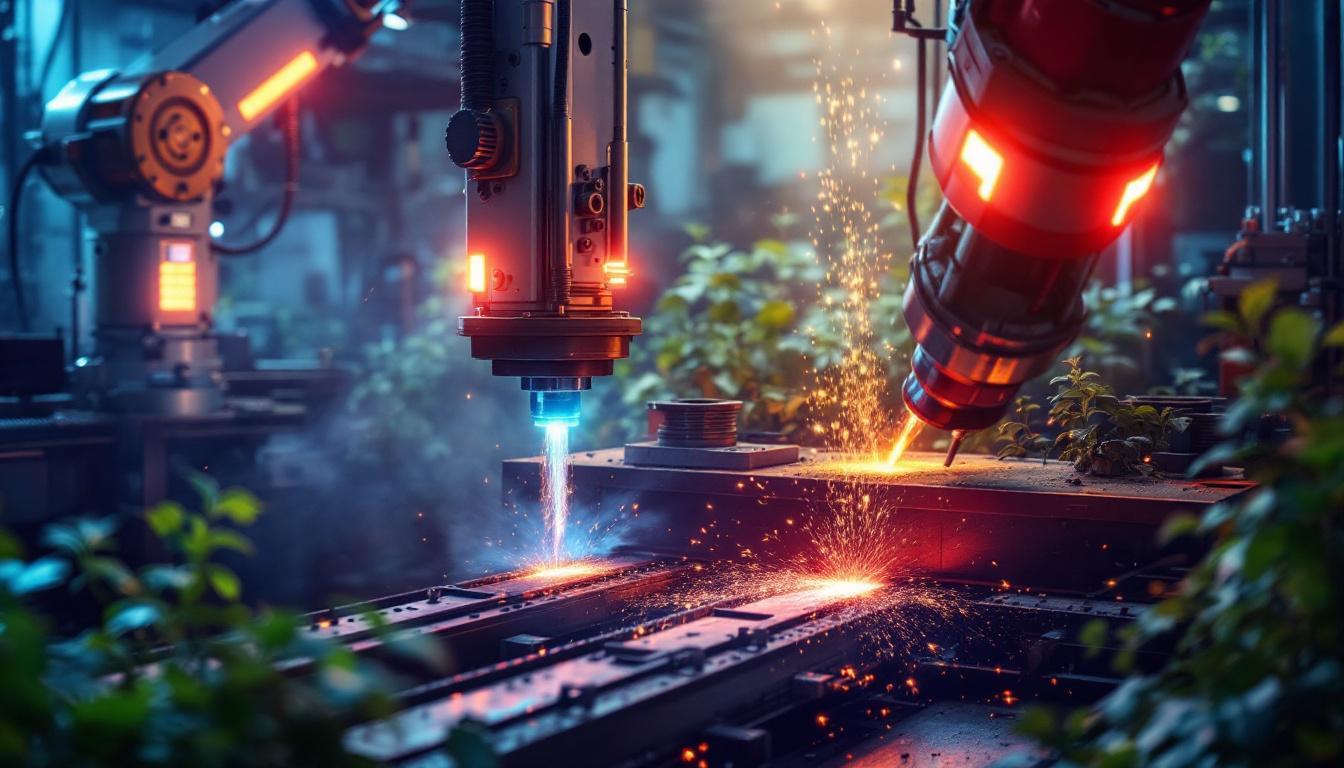
The sector evolves through advanced robotics, laser tech, additive manufacturing, and digitalisation, driving efficiency, environmental responsibility, and customisation.
The metal fabrication sector is being reshaped by a wave of technologies that promise higher throughput, tighter tolerances and a smaller environmental footprint. Manufacturers that combine advanced machinery with data-driven workflows are finding they can meet increasingly exacting client specifications while trimming waste and energy use.
Robotics and automation are central to this shift. Beyond traditional welding arms, vision-guided systems now perform tasks from bin-picking to machine tending, cutting programming time and boosting reliability on the shop floor. According to Apera AI, its Vue vision software enables robots to handle diverse material flows and repetitive operations with greater accuracy, freeing skilled staff for more complex work. Collaborative robots are also gaining ground; Productive Robotics notes cobots’ rapid deployment and ease of use make them ideal for CNC tending, deburring and other machine‑adjacent tasks that improve overall plant productivity.
Laser technologies continue to evolve and broaden their role across fabrication. The transition to high-power fibre lasers and multi-axis cutting platforms delivers finer edge quality and the capacity to process thicker, high-strength steels with minimal thermal distortion. Rivtec and METMAC both highlight developments that reduce cycle times and energy consumption while enabling more intricate geometries. These advances are being paired with robotic motion systems to create fully automated laser cells that cut, sort and load parts with little human intervention.
Additive manufacturing is no longer a niche for prototyping; for many fabricators it complements subtractive and forming processes. Metal 3D printing reduces material loss on complex geometries and accelerates iteration cycles for low-volume, high-value components, a capability that has particular value in aerospace, medical and specialised industrial markets. Fabrication shops are embracing hybrid cells that combine additive deposition with CNC finishing to produce parts that would be expensive or impossible to make by conventional means.
Digitalisation is enabling smarter asset management and process optimisation. Digital twins allow engineers to mirror equipment and production lines virtually, testing layout changes and process parameters before committing them on the floor. Research Corridor and industry practitioners report that linking these models to real‑time telemetry and predictive analytics shortens downtime and improves yield. When combined with in‑process inspection, laser scanning and automated optical systems, this data-driven approach significantly cuts rework and scrap rates.
Sustainability has moved from compliance to competitive strategy. Firms are adopting recycled feedstock, energy-efficient drives and closed-loop material handling to reduce embodied carbon and operating emissions. Powder coating and low-VOC surface treatments are being used alongside lean material nesting and remnant recovery to minimise waste. Vendors and consultancies point to these measures as not only environmentally responsible but also commercially advantageous in markets that increasingly prefer suppliers with verifiable green credentials.
Quality assurance is being transformed by inline metrology and AI. Modern inspection systems capture high-resolution geometric data during manufacture and flag deviations almost instantly; artificial intelligence refines detection over time, identifying subtle trends that precede failures. Industry reporting indicates this convergence of automated inspection and machine learning is enabling fabricators to approach near-zero defect rates on critical components.
The practical result for buyers is faster lead times, greater consistency and wider design freedom. For fabricators, the challenge lies in integrating disparate technologies into coherent workflows: selecting the right mix of lasers, robots, additive systems and software, and upskilling teams to operate them. Fireblast Global and others emphasise that producing precision components for automation and robotics requires close alignment between design, fabrication and assembly disciplines.
As investment shifts from standalone equipment to connected, hybrid production cells, the economics of small-batch and customised manufacture change in favour of agility. Industry data and supplier analyses suggest companies that adopt these integrated approaches will be better placed to serve sectors demanding complex, low-volume parts while meeting tightening sustainability mandates.
The trajectory is clear: metal fabrication is becoming a synthesis of mechanical craft and advanced computing. Firms that marry automation, laser and additive capability with robust digital processes and environmental stewardship will set the benchmark for industrial supply chains in the coming decade.
- https://realtyfact.com/how-modern-technology-is-revolutionizing-custom-metal-fabrication/ – Please view link – unable to able to access data
- https://www.rivtecllc.com/the-future-of-laser-cutting-trends-and-innovations-in-metal-fabrication/ – This article discusses the future of laser cutting in metal fabrication, highlighting trends and innovations such as automation and smart manufacturing integration, advancements in fiber laser technology, and a focus on sustainability and energy efficiency. It emphasizes the role of laser cutting in enhancing productivity, reducing costs, and improving precision in the manufacturing process.
- https://apera.ai/applications/vision-guided-robotics-for-metal-fabrication/ – Apera AI’s article explores the application of vision-guided robotics in metal fabrication. It details how their AI-powered vision software, Vue, automates tasks like bin picking, material handling, assembly, and machine tending, thereby increasing reliability and productivity in manufacturing environments. The article also highlights the benefits of integrating vision-guided robots, including enhanced precision and reduced programming time.
- https://www.fireblast.com/metal-fabrication-for-automation-and-robotics/ – Fireblast Global’s article focuses on high-precision metal fabrication tailored for the automation and robotics industry. It outlines the company’s capabilities in producing components such as machine frames, robotic base plates, and welded support structures. The article emphasizes the importance of precision and integration in supporting automation systems and highlights Fireblast Global’s commitment to delivering consistent, production-ready components.
- https://www.metmac.com/article/detail/trends-in-steel-laser-cutting-technology-innovations-and-advancements.html – This article from METMAC discusses trends and innovations in steel laser cutting technology. It covers the emergence of fiber laser technology, the introduction of multi-axis cutting systems, and the integration of automation and robotics in steel laser cutting. The piece highlights how these advancements contribute to increased efficiency, flexibility, and precision in the metal fabrication industry.
- https://www.researchcorridor.com/insights/next-gen-fabrication-the-rise-of-laser-cutting-robotics-smart-manufacturing-systems/ – Research Corridor’s article examines the rise of laser cutting, robotics, and smart manufacturing systems in metal fabrication. It discusses the development of proprietary laser beam control technologies, the expansion of robotic applications beyond welding to include bending, material handling, inspection, and finishing, and the integration of smart fabrication systems that connect machines and data to optimize production processes.
- https://www.productiverobotics.com/industries/metal-fabrication – Productive Robotics’ article highlights the impact of collaborative robots (cobots) on productivity, efficiency, and quality in the metal fabrication industry. It details how cobots integrate seamlessly with metalworking machinery to automate tasks such as CNC machine tending, welding, and deburring. The article emphasizes the benefits of cobots in freeing up workers to focus on higher-skilled tasks and their ease of use with fast setup and no programming requirements.
Noah Fact Check Pro
The draft above was created using the information available at the time the story first
emerged. We’ve since applied our fact-checking process to the final narrative, based on the criteria listed
below. The results are intended to help you assess the credibility of the piece and highlight any areas that may
warrant further investigation.
Freshness check
Score:
8
Notes:
The article was published on February 14, 2026, which is recent. However, the content appears to be a repurposed press release from Elite Weld & Fab, as indicated by the mention of their website. This suggests the article may lack original reporting and could be recycled content. Additionally, the article includes outdated information, such as the mention of ‘Industry 4.0’, which is a term that has been in use for several years. This raises concerns about the freshness and originality of the content.
Quotes check
Score:
5
Notes:
The article includes direct quotes from Elite Weld & Fab, such as ‘Elite Weld & Fab serves as leading examples in the field.’ However, these quotes cannot be independently verified, as they are sourced from the company’s own website. This lack of external verification raises concerns about the credibility and reliability of the information presented.
Source reliability
Score:
4
Notes:
The article originates from Realty Fact, a platform that has published various articles on diverse topics. While Realty Fact may provide useful information, it is not a major news organisation, and its content may not always be independently verified. The reliance on a single, potentially biased source for information about Elite Weld & Fab further diminishes the reliability of the article.
Plausibility check
Score:
6
Notes:
The claims about technological advancements in metal fabrication, such as automation, robotics, and additive manufacturing, are plausible and align with industry trends. However, the lack of independent verification and reliance on a single source for these claims raises questions about their accuracy and completeness.
Overall assessment
Verdict (FAIL, OPEN, PASS): FAIL
Confidence (LOW, MEDIUM, HIGH): HIGH
Summary:
The article exhibits significant issues with freshness, originality, and source independence. It appears to be a repurposed press release from Elite Weld & Fab, lacking independent verification and relying on a single, potentially biased source. These factors undermine the credibility and reliability of the content, leading to a FAIL verdict.
