


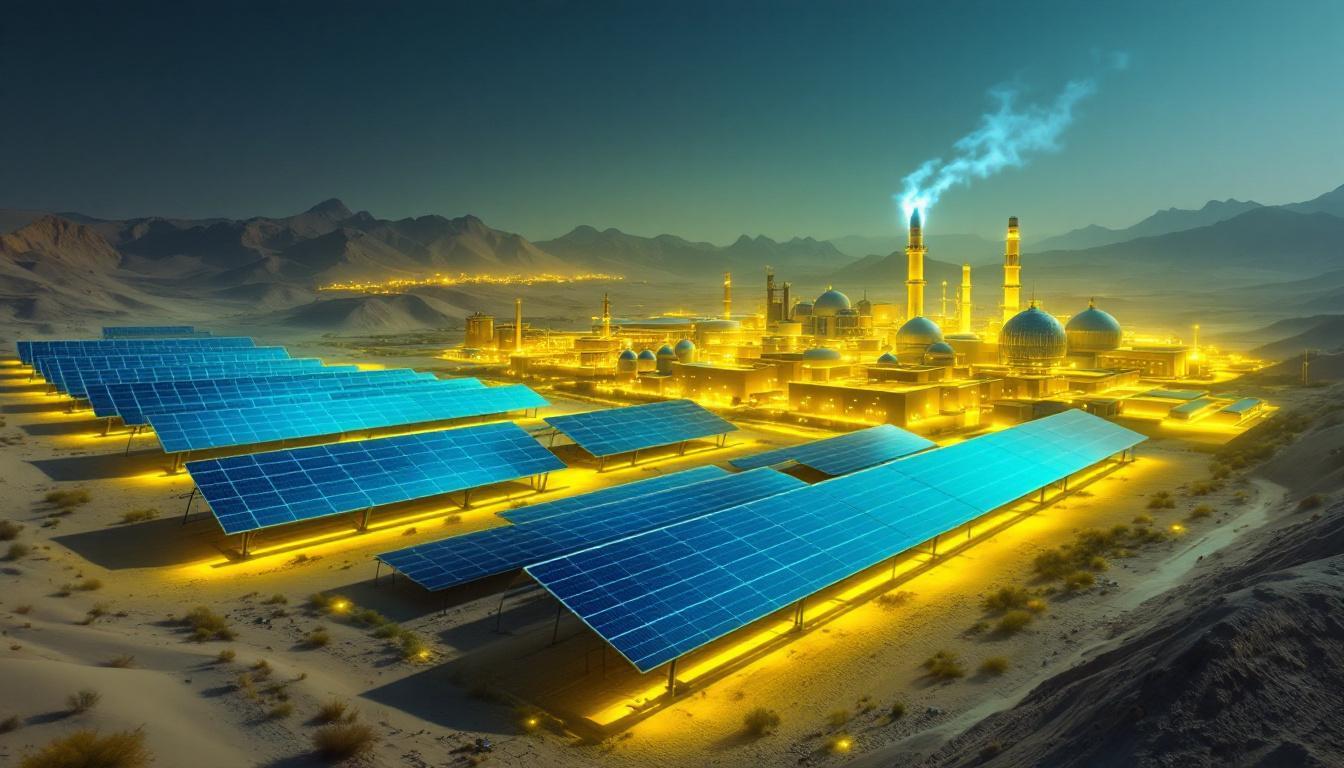
While the Middle East advances its solar capacity and manufacturing capabilities, substantial fossil fuel investments and policy gaps highlight the region’s complex journey towards net zero by 2060, balancing ambition with economic reliance on hydrocarbons.
The Middle East’s pathway to decarbonisation is gathering momentum in its power systems and manufacturing base, even as broader economic incentives and ongoing fossil fuel investment leave the region far from the emission trajectories implied by many national pledges. According to Wood Mackenzie’s Energy Transition Outlook, closing that gap would demand roughly US$5.3 trillion of cumulative spending to hit net zero by 2060; under the consultancy’s central projection the region’s policies and investments instead point to a world warming by about 2.6°C.
The most tangible progress is occurring in electricity. Wood Mackenzie anticipates installed solar capacity swelling from roughly 30 GW in 2025 to near 97 GW by 2030 and continuing to expand to several hundred gigawatts by mid‑century. Independent industry tallies show the Middle East and North Africa added a rapid 12.2 GW of new solar in 2025 alone, bringing cumulative regional PV to more than 34 GW by November 2025, with Saudi Arabia and the United Arab Emirates leading deployments. That build‑out, combined with growing wind and storage roll‑outs, lifts the share of variable renewables in regional generation substantially and is already reshaping power system planning.
This domestic deployment is catalysing a manufacturing push. Wood Mackenzie projects MENA solar module production capacity will reach about 44 GW by the late 2020s, positioning the region as a global supply‑chain node. Market analysis highlights policy and trade dynamics underpinning the shift: local content rules and preferential tariff treatment in important export markets are attracting investment, while strategic partnerships with Chinese manufacturers, expected to supply the large majority of planned capacity, are accelerating factory development. Industry reporting also flags a potential advantage for MENA producers into the US market relative to Asian competitors subject to higher import duties.
Yet despite rapid electricity‑sector change, hydrocarbons remain central to the region’s political economy and investment decisions. Oil and gas continued to expand in 2025, with the Middle East supplying a substantial share of global energy exports. National oil companies are pursuing upstream and LNG expansions and investors are still committing capital to fossil infrastructure, decisions that risk long‑lived emissions and “lock‑in” of carbon‑intensive assets unless paired with stronger mitigation measures.
Country strategies reflect resource endowments and economic priorities. Oman, with more limited proven reserves at current production rates, is among the most assertive adopters of low‑carbon pathways, aiming to overshoot a 30% renewables target for 2030 and to electrify and diversify industry through clean power. Qatar’s extensive gas resource base is driving an expansion of LNG export capacity, reflecting a view that gas will remain a global market pillar for decades. Saudi Arabia is pursuing a dual approach: accelerating renewables to reduce domestic oil consumption while also maintaining upstream growth to preserve export revenues; Wood Mackenzie’s modelling suggests that the kingdom’s clean‑power ambition will face headwinds that could see actual clean generation materially below stated targets. The UAE is combining significant clean‑power rollout with continuing hydrocarbon production growth, creating a similar tension between ambitions and near‑term energy policy.
For industrial decarbonisation practitioners the implications are clear. Rapid scale‑up of cheap solar and accompanying storage creates new opportunities to electrify energy‑intensive processes, cut process emissions where electrification is feasible, and develop low‑carbon feedstocks for industry and desalination. But realising those opportunities will rely on stable policy frameworks, market signals that value low‑carbon products, and technologies for hard‑to‑abate sectors. Wood Mackenzie emphasises that economy‑wide transformation requires not only generation investment but also breakthroughs and demand from buyers willing to pay for lower‑emissions materials and fuels.
The report underlines a policy-practice disconnect: headline climate targets are not yet matched by the level or direction of investment needed to meet them. Economic reliance on hydrocarbon rents, decisions to expand LNG and oil capacity, and the absence of sufficiently strong price or regulatory levers for low‑carbon industrial inputs are cited as the main constraints. On the other hand, the rapid maturation of regional solar supply chains, combined with falling costs and growing deployment, offers a practical lever to cut domestic emissions and to create exportable low‑carbon industrial capacity, if governments and industry align incentives accordingly.
For companies and policymakers engaged in industrial decarbonisation, the region presents both risk and opportunity. The near‑term outlook suggests continued demand for hydrocarbons and potential asset‑base risk for late‑stage fossil projects, while simultaneously opening sizeable markets for electrification solutions, green hydrogen pathways that use abundant renewables, and localisation of clean energy manufacturing. The scale and pace of transition will ultimately depend on whether trade partners, corporate buyers and domestic policy can convert renewable supply‑side momentum into sustained demand for low‑carbon industrial output.
- https://www.greenbuildingafrica.co.za/middle-east-climate-ambitions-face-economic-reality-as-region-eyes-us5-3-trillion-net-zero-bill/ – Please view link – unable to able to access data
- https://www.woodmac.com/zh/press-releases/mena-solar-growth/ – Wood Mackenzie’s latest Energy Transition Outlook reveals that the Middle East’s energy transition is progressing unevenly, with ambitious 2050 and 2060 climate targets increasingly misaligned with current investment and policy trajectories. The report finds that while the region is positioning itself as a global solar manufacturing hub, achieving net zero by 2060 would require cumulative investment of US$5.3 trillion. Under Wood Mackenzie’s base case scenario, the Middle East is instead tracking towards 2.6°C of warming, falling short of the 1.5°C pathway aligned with net zero targets adopted by many countries.
- https://www.woodmac.com/es/press-releases/middle-easts-ambitious-climate-goals-at-odds-with-current-trajectory/ – Wood Mackenzie’s latest Energy Transition Outlook for the Middle East highlights a fundamental tension between the region’s ambitious climate goals and economic realities. While the Middle East is on track to become a global solar manufacturing hub—with 44 GW of production capacity expected by 2028—achieving net zero by 2060 would require cumulative investment of US$5.3 trillion. Under Wood Mackenzie’s base case scenario, the region is projected to reach only 2.6°C of warming, falling short of the 1.5°C net zero pathway most countries have pledged.
- https://www.pv-magazine.com/2026/01/15/mena-region-installs-12-2-gw-of-solar-in-2025/ – The Middle East and North Africa (MENA) region installed 12.2 GW of solar capacity in 2025, marking a significant acceleration in its transition towards sustainable energy. Saudi Arabia led the region with over 11 GW of operational solar capacity, followed by the UAE with more than 6.5 GW. Egypt and Jordan placed third and fourth, with 2.5 GW and 2.1 GW of operational solar respectively. Oman became the fifth country in the region to surpass the 1 GW threshold, with capacity exceeding 1.6 GW.
- https://taiyangnews.info/markets/mena-region-cumulative-solar-pv-capacity-exceeds-34-gw – As of November 2025, the Middle East and North Africa (MENA) region’s cumulative solar photovoltaic (PV) capacity exceeded 34.5 GW, with nearly 15 GW added in 2025 alone. Saudi Arabia led with over 11.1 GW of operational solar PV capacity, followed by the UAE at around 6.6 GW. Egypt topped North Africa with 2.52 GW, highlighting uneven progress across the region. The rapid growth underscores the MENA region’s accelerating shift towards renewable energy sources.
- https://www.pv-magazine.com/2025/05/13/middle-east-north-africa-solar-manufacturing-capacity-to-reach-44-gw-by-2029-says-woodmac/ – Wood Mackenzie forecasts that the Middle East and North Africa (MENA) region’s solar manufacturing capacity will reach 44 GW by 2029, with installations expected to exceed 140 GW by the end of the decade. The region is emerging as a ‘tariff haven’ for solar manufacturing, positioning itself to overtake Southeast Asia as a top solar export hub. This growth is driven by local content requirements and strategic partnerships with Chinese firms, with Chinese companies expected to account for over 85% of MENA’s solar module manufacturing capacity by 2028.
- https://www.greenbuildingafrica.co.za/solar-manufacturing-in-the-middle-east-and-north-africa-mena-region-is-projected-to-reach-44-gw-by-2029/ – According to analysis by Wood Mackenzie, solar manufacturing in the Middle East and North Africa (MENA) region is projected to reach 44 GW by 2029, with installations expected to exceed 140 GW by the end of the decade. The MENA region is emerging as a ‘tariff haven’ for solar manufacturing, offering a 10% basic tariff on solar modules imported to the US, providing producers in the region an advantage over others facing duties up to 651%. This positions the region to offer the most cost-competitive solar modules for the US market.
Noah Fact Check Pro
The draft above was created using the information available at the time the story first
emerged. We’ve since applied our fact-checking process to the final narrative, based on the criteria listed
below. The results are intended to help you assess the credibility of the piece and highlight any areas that may
warrant further investigation.
Freshness check
Score:
8
Notes:
The article was published on 27 February 2026, referencing a Wood Mackenzie report dated 26 February 2026. ([woodmac.com](https://www.woodmac.com/es/press-releases/middle-easts-ambitious-climate-goals-at-odds-with-current-trajectory/?utm_source=openai)) The content appears fresh and original, with no evidence of prior publication or recycling from other sources. However, the article is hosted on Green Building Africa, a niche publication, which may limit its reach and impact.
Quotes check
Score:
7
Notes:
The article includes direct quotes attributed to Jom Madan, principal analyst at Wood Mackenzie. ([woodmac.com](https://www.woodmac.com/es/press-releases/middle-easts-ambitious-climate-goals-at-odds-with-current-trajectory/?utm_source=openai)) A search for these quotes reveals no exact matches in earlier publications, suggesting they are original. However, without access to the full Wood Mackenzie report, it’s challenging to verify the accuracy and context of these quotes.
Source reliability
Score:
6
Notes:
The primary source is a press release from Wood Mackenzie, a reputable global energy research firm. ([woodmac.com](https://www.woodmac.com/es/press-releases/middle-easts-ambitious-climate-goals-at-odds-with-current-trajectory/?utm_source=openai)) The article is published on Green Building Africa, a niche publication focused on sustainable building and construction. While the publication is relevant to the topic, its limited reach and potential biases may affect the overall reliability of the information presented.
Plausibility check
Score:
8
Notes:
The claims regarding the Middle East’s energy transition and the required investment to achieve net zero by 2060 align with Wood Mackenzie’s previous analyses. ([woodmac.com](https://www.woodmac.com/es/press-releases/middle-easts-ambitious-climate-goals-at-odds-with-current-trajectory/?utm_source=openai)) However, the article’s tone and language are consistent with corporate or official communications, which may indicate a promotional angle. The lack of independent verification or additional sources raises concerns about the objectivity and comprehensiveness of the information presented.
Overall assessment
Verdict (FAIL, OPEN, PASS): FAIL
Confidence (LOW, MEDIUM, HIGH): MEDIUM
Summary:
The article presents information from a recent Wood Mackenzie report, but its reliance on a single source without independent verification raises concerns about objectivity and reliability. The niche publication’s limited reach further diminishes the overall credibility of the content. Given these factors, the article does not meet the necessary standards for publication under our editorial indemnity.
