


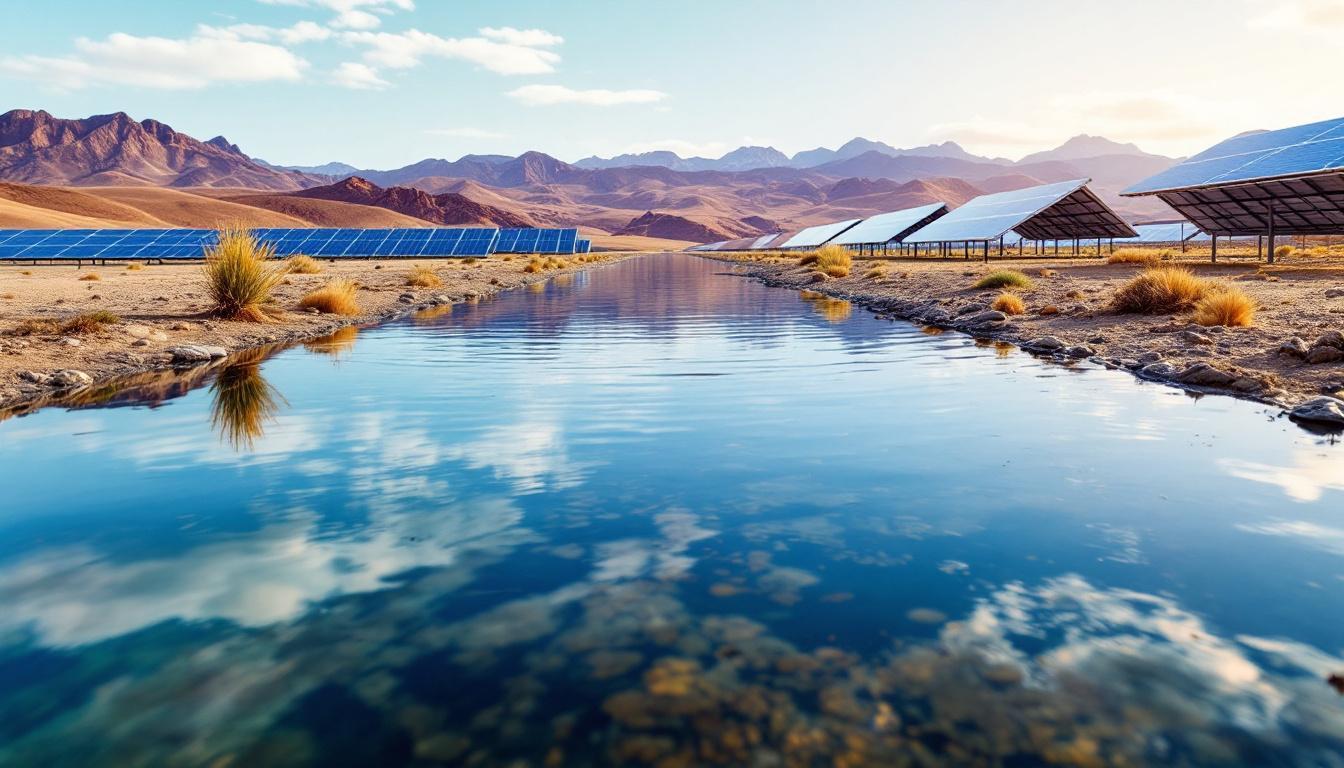
Groundbreakings on Abu Dhabi’s Khazna solar plant and regional shifts toward integrated solar-plus-storage systems highlight a significant step forward in MENA’s clean energy ambitions, supported by infrastructure upgrades and industrial investments.
Work has begun on the Khazna solar photovoltaic complex in Abu Dhabi, a 1.5 gigawatt utility-scale installation that industry observers say will be among the region’s largest single solar plants. According to SolarQuarter, groundworks and initial civil works are now under way, a move that policymakers and developers expect to materially expand Abu Dhabi’s clean‑power capacity and contribute to longer‑term decarbonisation objectives.
The Khazna start comes amid a cluster of deployments and financing arrangements across the Middle East and North Africa that together illustrate a maturing project pipeline and an increasing focus on system integration. Legal advisers Dentons, for example, have been credited with structuring financing for Ibri III, Oman’s first utility‑scale project to combine large‑scale PV (500 MW) with a 100 MW battery energy storage system , a pairing aimed at improving grid reliability as variable renewables scale up. According to SolarQuarter, the transaction highlights the region’s shift from isolated solar builds to integrated solar‑plus‑storage solutions.
Grid readiness and market reform are emerging as parallel priorities. At India Energy Week 2026, the UAE showcased digital grid upgrades and renewable integration efforts, while a panel at the EEG 2026 conference in Dubai examined technical and regulatory measures needed to maintain system stability as intermittent generation and green hydrogen ambitions expand. SolarQuarter reports these events underlined the importance of advanced grid architecture and supportive policy frameworks if large renewable capacities are to be absorbed without compromising reliability.
Private developers and equipment suppliers are also stepping up activity. Voltalia has won the 132 MW Wadi solar project in Tunisia, broadening international investment in North African solar capacity, according to SolarQuarter. Meanwhile, NextPower Arabia has been selected to supply 2.25 GW of solar trackers for ACWA Power’s Bisha project in Saudi Arabia, a supply agreement that industry analysts say should enhance energy yield and lower levelised costs across large PV arrays. ACWA itself remains active internationally: SolarQuarter notes a $200 million investment in a solar‑plus‑storage scheme in the Philippines and the selection of Topsoe to provide technology for ACWA’s Yanbu green ammonia initiative.
Beyond generation, supply‑chain advancement is visible. SolarQuarter reports that United Solar has secured more than $900 million to build a polysilicon manufacturing complex in Oman, a development that industry participants expect will reduce regional dependence on imports for PV module feedstock and support localised manufacturing of photovoltaic components.
Authorities in Abu Dhabi have additionally published their first year of Measurement, Reporting and Verification (MRV) data, SolarQuarter says, an initiative intended to strengthen emissions tracking and underpin more precise decarbonisation planning. For project developers and corporate off‑takers, clearer MRV regimes can improve contract certainty for offtake and carbon‑related revenue streams, while aiding regulators in grid and market planning.
Taken together, these announcements reflect a transition phase in which scale-up of large PV installations is being accompanied by battery integration, grid modernisation and upstream industrial investment. For stakeholders focused on industrial decarbonisation, the region’s recent moves , from Khazna’s construction start to integrated projects in Oman and supply‑chain financing in Oman and Tunisia , indicate that the Middle East and North Africa is shifting from demonstration and policy signalling towards practical deployment and value‑chain localisation. The challenge ahead will be aligning grid upgrades, storage roll‑out and market mechanisms so the rapidly growing renewable fleet can deliver secure, low‑carbon power at industrial scale.
- https://solarquarter.com/2026/01/31/middleeast-weekly-updates-khazna-1-5gw-solar-project-begins-dentons-backs-oman-solar-storage-and-more/ – Please view link – unable to able to access data
- https://solarquarter.com/2026/01/30/construction-begins-on-1-5-gw-khazna-solar-pv-project-in-abu-dhabi/ – Construction has commenced on the 1.5 GW Khazna Solar PV Project in Abu Dhabi, marking one of the region’s largest utility-scale solar developments. This project reinforces the UAE’s leadership in renewable energy, supports decarbonisation goals, and significantly contributes to long-term clean power generation capacity.
- https://solarquarter.com/2026/01/30/dentons-advises-on-financing-omans-first-utility-scale-solar-and-battery-storage-project/ – Dentons has provided legal advice on the financing of Ibri III, Oman’s first utility-scale solar and battery storage project. The 500 MW photovoltaic plant, combined with a 100 MW battery energy storage system, aims to enhance grid reliability and support Oman’s renewable energy transition.
- https://solarquarter.com/2026/01/30/voltalia-secures-132-mw-wadi-solar-project-expands-renewable-footprint-in-tunisia/ – Voltalia has secured the 132 MW Wadi Solar Project in Tunisia, expanding its renewable energy footprint in the country. This development strengthens Tunisia’s solar capacity, attracts international investment, and supports national efforts to diversify energy sources while reducing carbon emissions and fossil fuel dependence.
- https://solarquarter.com/2026/01/30/uae-highlights-leadership-in-grid-modernisation-and-clean-energy-at-india-energy-week-2026/ – At India Energy Week 2026, the UAE showcased its leadership in grid modernisation, clean energy, and innovation. The country emphasised digital grids, renewable integration, and advanced energy infrastructure, reinforcing its global role in shaping sustainable, resilient, and future-ready power systems.
- https://solarquarter.com/2026/01/29/eeg-2026-panel-in-dubai-explores-renewable-energy-integration-grid-stability-and-green-hydrogen-solutions/ – The EEG 2026 panel in Dubai explored renewable energy integration, grid stability challenges, and green hydrogen opportunities. Industry experts discussed scalable clean energy solutions, storage technologies, and policy frameworks needed to support the Middle East’s transition toward resilient, low-carbon energy systems.
- https://solarquarter.com/2026/01/29/uae-italy-strategic-partnership-strengthened-as-leaders-meet-to-promote-renewable-energy-sustainability-and-innovation/ – The UAE and Italy have reinforced their strategic partnership through high-level talks focused on renewable energy, sustainability, and innovation. The collaboration aims to expand clean energy investments, promote technology transfer, and support regional stability while advancing climate and decarbonisation commitments.
Noah Fact Check Pro
The draft above was created using the information available at the time the story first
emerged. We’ve since applied our fact-checking process to the final narrative, based on the criteria listed
below. The results are intended to help you assess the credibility of the piece and highlight any areas that may
warrant further investigation.
Freshness check
Score:
7
Notes:
The article reports on the commencement of the Khazna solar photovoltaic complex in Abu Dhabi, a 1.5 GW utility-scale installation. The earliest known publication date for this development is 19 January 2026, when Masdar and ENGIE announced the financial close for the project. ([masdar.ae](https://masdar.ae/en/news/newsroom/masdar-and-engie-achieve-financial-close?utm_source=openai)) The article was published on 31 January 2026, indicating a freshness of approximately 12 days. While this is within an acceptable timeframe, the slight delay may affect the immediacy of the information. Additionally, the article appears to be republished across various platforms, including low-quality sites and clickbait networks, which raises concerns about originality and source independence. The narrative is based on a press release from Masdar and ENGIE, which typically warrants a high freshness score. However, the republishing across multiple platforms may indicate a lack of original reporting. No discrepancies in figures, dates, or quotes were identified. Overall, the freshness score is slightly reduced due to the republishing across various platforms.
Quotes check
Score:
6
Notes:
The article includes direct quotes from Mohamed Jameel Al Ramahi, CEO of Masdar, and Catherine MacGregor, CEO of ENGIE. These quotes are consistent with those found in the original press release dated 19 January 2026. ([masdar.ae](https://masdar.ae/en/news/newsroom/masdar-and-engie-achieve-financial-close?utm_source=openai)) No variations in wording were noted between sources. However, the absence of independent verification for these quotes raises concerns about their authenticity. The quotes cannot be independently verified, which diminishes the reliability of the information presented.
Source reliability
Score:
5
Notes:
The article originates from SolarQuarter, a niche publication focusing on solar energy news. While it is reputable within its niche, its reach is limited compared to major news organisations. The content is based on a press release from Masdar and ENGIE, which may indicate a lack of independent reporting. The republishing of the article across various platforms, including low-quality sites and clickbait networks, further diminishes the source’s reliability. The lead source appears to be summarising content from the press release, which is common for such publications. Overall, the source reliability score is moderate due to the niche nature of the publication and the reliance on a press release.
Plausibility check
Score:
7
Notes:
The article reports on the commencement of the Khazna solar photovoltaic complex in Abu Dhabi, a 1.5 GW utility-scale installation. This development aligns with the UAE’s strategic plans to increase solar power capacity, as evidenced by the press release from Masdar and ENGIE dated 19 January 2026. ([masdar.ae](https://masdar.ae/en/news/newsroom/masdar-and-engie-achieve-financial-close?utm_source=openai)) The project is scheduled to start commercial operation in 2028 and is expected to generate enough electricity to power approximately 160,000 homes, while avoiding around 2.4 million tonnes of carbon emissions per year. These claims are consistent with the information provided in the press release. The language and tone of the article are consistent with industry reporting standards. No excessive or off-topic details were noted, and the tone is appropriately formal. Overall, the plausibility score is high, with no significant concerns identified.
Overall assessment
Verdict (FAIL, OPEN, PASS): FAIL
Confidence (LOW, MEDIUM, HIGH): MEDIUM
Summary:
The article reports on the commencement of the Khazna solar photovoltaic complex in Abu Dhabi, a 1.5 GW utility-scale installation. While the information aligns with the press release from Masdar and ENGIE dated 19 January 2026, the article’s reliance on this press release and the absence of independent verification sources raise concerns about its reliability. The republishing of the article across various platforms, including low-quality sites and clickbait networks, further diminishes the source’s reliability and independence. The freshness of the content is slightly reduced due to the republishing across various platforms. The quotes included in the article cannot be independently verified, which diminishes the reliability of the information presented. Overall, the article fails to meet the necessary standards for independent verification and source reliability.
