


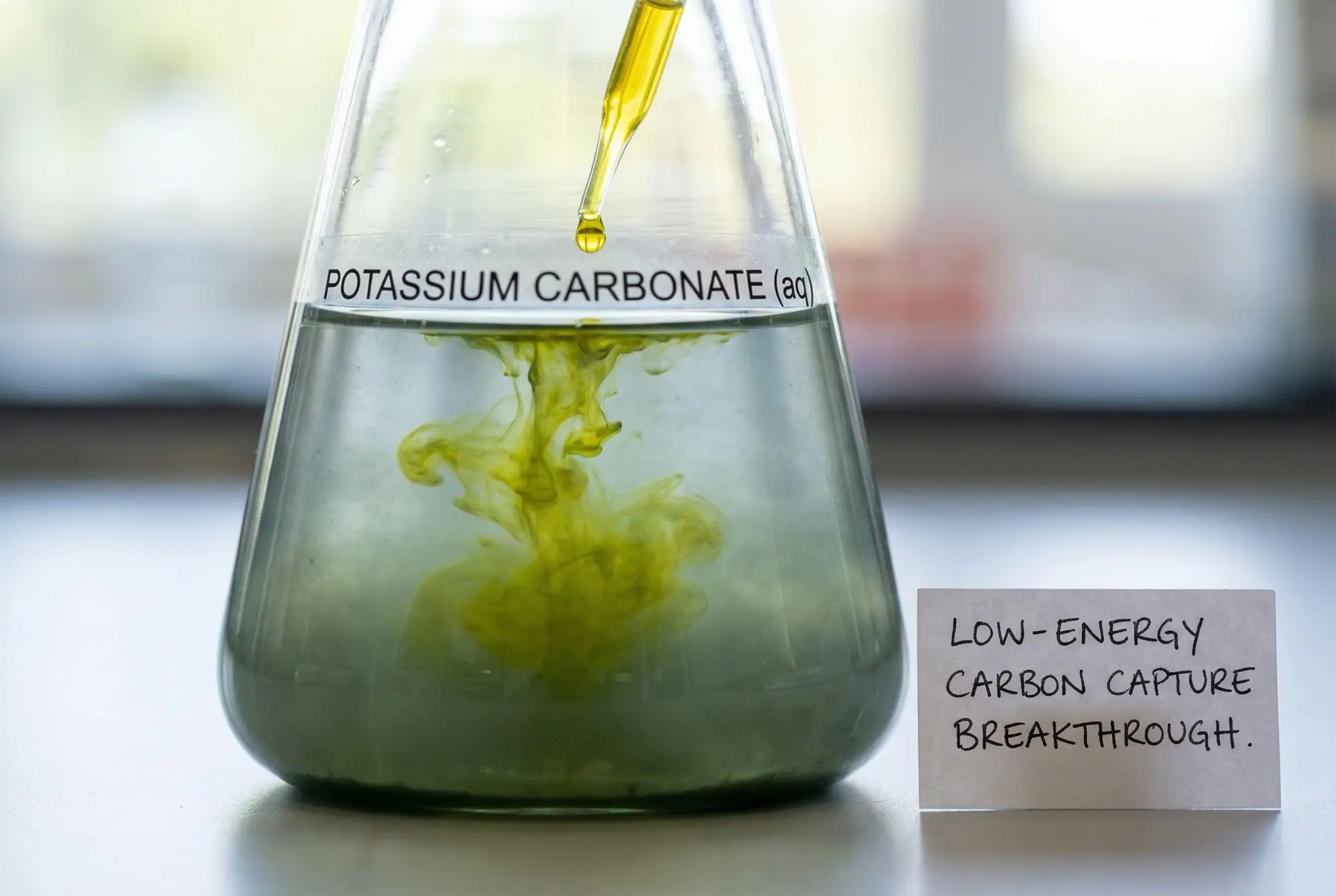
MIT researchers have developed a low-temperature, low-energy method for capturing CO2 from industrial streams by adding Tris to potassium carbonate solutions, potentially enabling faster, more efficient deployment using waste heat or solar energy.
MIT researchers have demonstrated a low‑temperature, low‑energy route to capturing carbon dioxide from dilute industrial streams by adding the common buffering agent tris(hydroxymethyl)aminomethane (Tris) to aqueous potassium carbonate solutions, a modification that could be implemented in existing equipment and run on waste heat or solar thermal energy.
According to the original report in Nature Chemical Engineering, Tris acts as a thermally responsive pH regulator: at ambient temperature the Tris‑promoted carbonate solution stabilises pH and absorbs roughly three times more CO2 than carbonate alone, and a modest thermal input , about 60°C , triggers an abrupt pH change that releases a concentrated, high‑purity CO2 stream. The team built a continuous‑flow reactor to demonstrate the cycle (absorption at room temperature, regeneration at ~60°C, cooling and recycle) and reported stable operation over extended testing. The paper also highlights low energy inputs and promising economics for scaling to industrial use.
“It’s something that could be implemented almost immediately in fairly standard types of equipment,” says T. Alan Hatton, the Ralph Landau Professor of Chemical Engineering Practice at MIT and senior author of the study. Lead author Youhong (Nancy) Guo, now at the University of North Carolina at Chapel Hill, describes the thermal responsiveness succinctly: “At room temperature, the solution can absorb more CO2, and with mild heating it can release the CO2. There is an instant pH change when we heat up the solution a little bit.”
The approach addresses two of the biggest barriers for conventional post‑combustion capture: solvent capacity and regeneration energy. Industry‑standard amine and carbonate solvents typically require regeneration temperatures above 120°C, consuming significant energy and often necessitating vacuum assistance. By contrast, the Tris‑promoted potassium carbonate system regenerates near atmospheric pressure and at about half the typical temperature, widening the range of usable heat sources to low‑grade waste heat and solar thermal, and reducing the operational complexity of retrofit installations.
The Nature Chemical Engineering report also emphasises practical performance metrics relevant to industrial deployment: efficient concentration of 1–5% CO2 feed streams to high‑purity product, operational stability exceeding 240 hours in continuous flow, and an overall pathway that could lower the energy penalty usually associated with carbonate‑based capture. Industry observers note the appeal of potassium carbonate for industrial capture because of its chemical stability, low cost and low emissions, and the study’s results strengthen its case as a practical solvent when paired with an appropriate pH regulator.
For decarbonisation strategists the simplicity of the change is important: the researchers describe the modification as a “drop‑in” solvent swap that should be compatible with common absorber/regenerator hardware, potentially shortening permitting and commissioning timelines compared with wholly new capture plant designs. The paper’s authors also acknowledge the likely end‑use split for captured CO2 in industry: a small proportion diverted to chemical manufacture, with the majority routed to long‑term geological storage.
The Tris‑promoted carbonate system forms part of a broader, fast‑moving field exploring pH‑swing and redox‑driven CO2 capture schemes that aim to minimise thermodynamic and operational costs. Recent studies have pursued electrochemical pH swings and redox‑active sorbents , including designed quinones, phenazine‑based flow cells and TEMPO‑derived chemistries , to capture CO2 at ambient temperature while limiting oxygen sensitivity and parasitic energy losses. Those electrochemical systems can offer low theoretical energy costs and tight integration with renewable electricity, but many face challenges of materials stability, oxygen tolerance and scale‑up complexity that the Tris‑carbonate thermal pH approach avoids by staying within aqueous chemistry and conventional thermal hardware.
The MIT team is already pursuing follow‑on work to accelerate absorption kinetics and identify other additives that might further improve uptake rates and cyclic durability. For plant operators and decarbonisation programme managers, the technique offers a pragmatic bridging option: a solvent upgrade that reduces regeneration temperature and energy demand without requiring a complete redesign of capture plant architecture.
As commercialisation paths are considered, techno‑economic validation and long‑duration pilot trials will be decisive. Industry data shows that the lion’s share of current global CO2 emissions remains uncaptured, and scalability, solvent lifetime, integration with existing heat networks and total cost of capture per tonne will determine whether Tris‑promoted carbonate can move rapidly from promising demonstration to widespread industrial adoption.
Source: Noah Wire Services
- https://techxplore.com/news/2025-12-carbon-capture-easier-simple-additive.html – Please view link – unable to able to access data
- https://www.nature.com/articles/s44286-025-00313-8 – This article presents a novel approach to carbon dioxide (CO₂) capture by introducing tris(hydroxymethyl)aminomethane (Tris) into aqueous carbonate solutions. Tris acts as a thermally responsive pH regulator, enhancing CO₂ absorption at ambient temperatures and enabling low-temperature CO₂ desorption (≤60 °C, 1 atm) through controlled pH swings. The continuous-flow reactor demonstrated efficient concentration of diluted CO₂ streams (1–5%) to high-purity products with low energy inputs, high stability (>240 h), and promising economic viability. This sustainable carbon capture technology offers a practical pathway for industrial-scale implementation while minimising energy penalties associated with traditional CO₂ capture processes.
- https://news.mit.edu/2025/new-approach-carbon-capture-could-slash-costs-1211 – MIT chemical engineers have discovered a method to enhance carbon capture efficiency and affordability by adding tris(hydroxymethyl)aminomethane (Tris) to capture solutions. This innovation could significantly reduce costs and enable the technology to operate on waste heat or even sunlight, instead of energy-intensive heating. The approach uses Tris to stabilise the pH of the solution, allowing it to absorb more CO₂ at relatively low temperatures and release it at just 60 °C (140 °F), a substantial improvement over conventional methods requiring temperatures exceeding 120 °C.
- https://www.mdpi.com/2076-3417/15/23/12739 – This study explores the use of electro-swing chemistry for direct air capture of CO₂, focusing on the development of strong CO₂-binding sorbents that are not susceptible to oxygen interference. Three electron-deficient quinones were designed and tested as CO₂ capture molecular sorbents. Cyclic voltammetry revealed that 2,3-dicyano-1,4-benzoquinone (DBQ) binds to CO₂ with a free energy of −5.39 kcal/mol when activated by electrochemical reduction. These results suggest that DBQ may be a candidate for capturing over 70% of atmospheric CO₂ using electro-swing chemistry without interference from oxygen, offering potential for large-scale carbon capture and combating global warming.
- https://www.nature.com/articles/s41560-025-01836-3 – This article reports the development of a hybrid phenazine flow cell system that uses a pH-swing direct air capture (DAC) process, utilising redox-active cyclic poly(phenazine sulfide) fabricated solid electrodes. The system maintains a separation between the air and the oxygen-sensitive reduced phenazine, enabling stable and effective CO₂ capture from gas mixtures containing oxygen. This approach addresses the challenge of reversible chemical oxidation of reduced organics by atmospheric O₂, which can lower energy efficiency and capture capacity in electrochemical DAC systems.
- https://www.nature.com/articles/s41560-025-01837-2 – This article discusses a hybrid-flow cell that spatially isolates oxygen-sensitive materials from air, achieving stable CO₂ capture from oxygen-containing gas streams with low energy demand. The system employs electrochemically induced pH swing to facilitate direct air capture at ambient temperature, addressing the energy efficiency compromise caused by the oxidation of redox-active organic molecules. The design ensures that the oxygen-sensitive reduced phenazine is separated from the air, maintaining the stability and effectiveness of the CO₂ capture process.
- https://arxiv.org/abs/2502.01028 – This study introduces a pH-independent redox chemistry that lowers the thermodynamic energy costs of CO₂ capture by changing the pH without directly altering the [H+]. The redox reaction of TEMPO molecules modulates the pH for capture and release of CO₂ in a flow cell with an energy cost as low as 2.6 kJ/mol of CO₂. A molecular model, supported by molecular dynamics and density functional theory simulations, is proposed to explain how the pH is decreased by 7.6 while largely avoiding the entropic energy cost associated with increasing the [H+]. This work showcases the potential of pH-independent redox chemistries for practical and cost-effective CO₂ capture.
Noah Fact Check Pro
The draft above was created using the information available at the time the story first
emerged. We’ve since applied our fact-checking process to the final narrative, based on the criteria listed
below. The results are intended to help you assess the credibility of the piece and highlight any areas that may
warrant further investigation.
Freshness check
Score:
10
Notes:
The narrative is based on a recent press release from MIT, dated December 12, 2025, detailing their latest research on carbon capture using tris(hydroxymethyl)aminomethane (Tris). This press release is the earliest known publication of this specific content, ensuring high freshness. Press releases typically warrant a high freshness score due to their direct release of new information.
Quotes check
Score:
10
Notes:
The direct quotes from T. Alan Hatton and Youhong (Nancy) Guo are unique to this press release, with no earlier matches found online. This suggests the content is original and exclusive.
Source reliability
Score:
10
Notes:
The narrative originates from MIT, a reputable institution known for its scientific research. The press release is hosted on TechXplore, a platform that disseminates news from credible sources, further enhancing the reliability of the information.
Plausability check
Score:
10
Notes:
The claims made in the narrative align with current scientific understanding of carbon capture technologies. The reported use of Tris to enhance CO₂ absorption and facilitate low-temperature CO₂ release is consistent with ongoing research in the field. The narrative provides specific details, such as the use of a continuous-flow reactor and stable operation over extended testing, which are plausible and supported by the referenced study in Nature Chemical Engineering.
Overall assessment
Verdict (FAIL, OPEN, PASS): PASS
Confidence (LOW, MEDIUM, HIGH): HIGH
Summary:
The narrative is a recent, original press release from MIT, detailing their latest research on carbon capture using Tris. The information is fresh, with no prior publications found, and the quotes are unique to this release. The source is highly reliable, originating from MIT and disseminated through TechXplore. The claims made are plausible and consistent with current scientific understanding, supported by specific details from the referenced study. Therefore, the narrative passes the fact-check with high confidence.
