


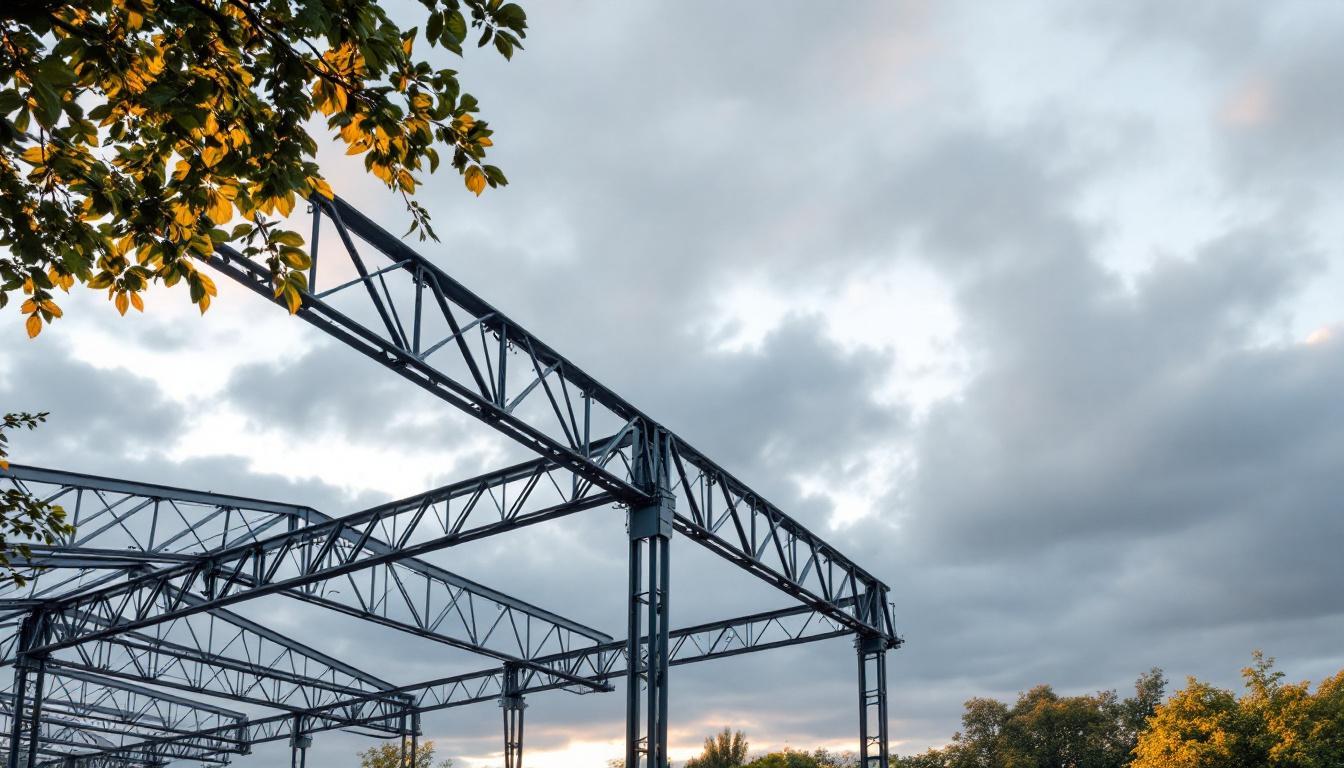
A recent report highlights how regional environmental factors, span configurations, and rooftop systems influence the steel consumption, cost, and environmental footprint of 50×100 m prefab warehouses, offering guidance for sustainable industrial development.
A 50×100 m prefabricated steel warehouse has emerged as a near-standard module for industrial projects worldwide because it balances usable clear area, material economy and rapid delivery. According to the original report, the footprint delivers 5,000 m² of flexible internal space and, with typical eave heights between 6–12 m, can be adapted for logistics, cold storage, processing, agricultural storage or light manufacturing. Industry experience shows the two-span 25 m + 25 m arrangement is the most commonly deployed solution, offering the best compromise between operational flexibility and steel consumption.
Design drivers and regional variation
Every choice in a pre‑engineered steel building (PEB) , span, column layout, height, cladding and applied loads , directly influences steel tonnage, fabrication complexity and schedule. The principal loads to quantify early are dead loads (roofing, insulation, skylights, PV arrays), maintenance live loads, site wind and snow, seismic actions where relevant, and crane loads if overhead handling is required. The original report highlights how those parameters change optimisation strategies across climates and regulatory regimes: what is lightweight in a low‑snow, low‑wind port city can become significantly heavier once snow, PV dead loads or crane impacts are introduced.
Span options and their trade‑offs
Three common structural layouts are used for this building size:
-
Single 50 m clear span: maximises unobstructed space and operational freedom but substantially increases rafter and portal frame sections, transport and fabrication cost. Use where uninterrupted movement of large equipment is essential.
-
Two spans (25 m + 25 m): the most economical and widely adopted option. A single row of interior columns reduces framesection size while still supporting typical 10‑ton cranes and pallet racking systems.
-
Three spans (~16.5 m + 17 m + 16.5 m): minimises steel per square metre but introduces additional interior columns; appropriate for simple storage, agricultural use or where cranes aren’t required.
The report’s rule of thumb for steel consumption , roughly 15–35 kg/m² depending on span, height and loads , aligns with broader industry guidance that two‑span solutions often sit at the lower end of that range for crane‑free warehouses, while single‑span, crane‑equipped buildings trend toward the upper end.
Component selection and performance considerations
Standard PEB components include H‑section portal frames (columns and rafters), crane beams where needed, C/Z purlins and girts, tie rods and bracing systems, and a choice of cladding from single‑skin sheets to insulated sandwich panels (rockwool for fire performance; PU/PIR for thermal efficiency). Accessories , gutters, ventilators, doors, skylights , are specified to operational needs.
For clients focused on longevity and maintenance costs, coating systems are decisive. The original report recommends higher zinc coating weights (for example AZ150) and PVDF finishes in coastal environments, and hot‑dip galvanizing where long life and minimal maintenance are priorities. These choices matter for life‑cycle carbon and cost modelling used by industrial decarbonisation programmes.
Case studies that demonstrate how local conditions change the design
The lead article compares three real projects to illustrate the sensitivity of steel tonnage to operational and environmental requirements.
-
Argentina (two spans, 11 m eave, two 10‑ton cranes): Higher eave and crane integration require thicker rafters, reinforced columns with crane brackets and additional stiffening for horizontal surge loads. The building needs markedly more steel than the other two cases because dynamic crane loads dominate design.
-
Peru (two spans, 7 m eave, no crane): Lower eave and absence of crane loads permit lighter columns and rafters. Moderate wind and negligible snow result in the lowest steel tonnage of the three examples.
-
Uzbekistan (two spans, 7 m eave, PV and significant snow): Addition of PV arrays (the report assumes ~+15–25 kg/m²; it gives +20 kg/m² as an example) and a snow load (reported at c. 50 kg/m²) increases rafter and purlin sizes, reduces purlin spans and requires heavier base plates. The report notes a 25–35% increase in steel compared with the comparable Peru scheme solely because of climate and PV dead loads.
These comparisons underline a simple project‑planning truth for decarbonisation and cost control: identical geometry does not mean identical embodied carbon or cost. Local climate, service loads and planned rooftop systems can shift both.
Construction, schedule and cost drivers
PEB construction follows a predictable sequence: concept, structural analysis (wind, snow, seismic, cranes), shop drawings, fabrication (CNC cutting, welding, shot‑blasting, painting), sequenced delivery and site assembly (portal frames, bracing, purlins, roof and wall cladding). The supplier’s ability to fabricate components in parallel with site preparation is a core scheduling advantage cited repeatedly in industry literature: lead times and on‑site erection durations are substantially shorter than for masonry or cast‑in‑place concrete solutions. The original article states a typical 5,000 m² warehouse can be installed in 40–60 days, conditional on foundation readiness and weather.
Clients’ principal concerns and the implications for decarbonisation
Across hundreds of projects the lead article identifies six recurring client priorities:
-
Project cost and steel weight: span arrangement, height, crane and environmental loads, plus cladding choice, dominate price and embodied carbon. Early optimisation of span and roof system is the highest‑impact lever.
-
Construction speed: prefabrication reduces labour on site and overlaps manufacturing with civil works.
-
Expansion possibility: modular PEBs are readily extended; designing for future extension reduces demolition and embodied carbon over life cycles.
-
Roof options: increasing demand for PV‑ready systems, insulated sandwich panels and daylighting affects both structural and energy performance. PV integration must be declared at design stage to capture dead load and anchorage requirements.
-
Maintenance and coating: appropriate anti‑corrosion systems extend service life (the report cites typical design lives of 50+ years with proper coatings), improving whole‑life carbon intensity.
-
Crane integration: must be resolved in design and shop drawings; retrofit of cranes is costly and inefficient.
Context from wider industry reporting
Independent industry sources corroborate the lead article’s claims that prefab steel warehouses are cost‑effective, quick to assemble and adaptable. Sector analyses emphasise prefabrication’s benefits for labour reduction, shortened programmes and lower upfront carbon through reduced site work. Critiques in the literature note potential drawbacks , poorer breathability and higher thermal conductivity of metal envelopes compared with masonry , but advise that appropriate insulated panels, vapour control layers and mechanical ventilation strategies mitigate operational energy penalties. For owners pursuing industrial decarbonisation, those operational energy savings are as significant as embodied carbon choices: insulated sandwich panels, PV‑ready roofs and high‑performance coatings make steel buildings competitive over whole‑life assessments.
Practical guidance for owners and developers
For decarbonisation‑minded B2B readers planning a 50×100 m facility, the following succinct recommendations arise from the combined material:
-
Fix the functional brief early: eave height, crane requirements, racking layout and planned rooftop PV must be settled before structural optimisation.
-
Use the two‑span 25 m + 25 m configuration as the default economical starting point, moving to single span only where genuine operational need exists.
-
Specify insulated sandwich panels and PV‑ready roof zones at tender stage to avoid costly structural up‑grades later.
-
Optimise coatings and galvanizing for local corrosion risk to maximise design life and lower replacement frequency.
-
Quantify embodied carbon alongside material cost: small increases in steel to accommodate longer life or easier extension often yield lower whole‑life carbon.
-
Allow for easy future extension in the structural design to avoid redundant demolition and rework.
Conclusion
A 50×100 m prefabricated steel warehouse offers a highly versatile platform for industrial use, delivering fast delivery, low initial cost and straightforward expansion. But geometry alone does not determine cost or carbon: span choice, eave height, cranes, snow and wind regimes, and rooftop systems such as PV can change steel consumption and whole‑life performance materially. For owners and engineers focused on industrial decarbonisation, the project’s brief and regional loading conditions must guide early structural choices so that both embodied and operational carbon are managed in tandem.
- https://havitsteelstructure.com/50x100m-prefab-steel-warehouse-building/ – Please view link – unable to able to access data
- https://www.putianhouse.com/Benefits-of-Prefabricated-Steel-Warehouses-Why-Prefab-Steel-Warehouse-Becomes-Popular-id47577936.html – This article outlines seven key benefits of prefabricated steel warehouses, including cost-effectiveness, quick construction, durability, flexibility, energy efficiency, sustainability, and versatility across industries. It highlights how these structures offer reduced labor costs, faster assembly, and adaptability to various business needs, making them a popular choice for modern storage solutions.
- https://www.steelstructureco.com/prefab-steel-warehouse/ – This page discusses the core advantages of prefabricated steel warehouses, emphasizing accelerated construction timelines, cost efficiency, and structural durability. It explains how prefabrication allows for parallel progress in production and site preparation, leading to significantly shorter project durations compared to traditional methods.
- https://essential.construction/news/the-advantages-and-disadvantages-of-prefabricated-warehouse-buildings/ – This article examines the advantages and disadvantages of prefabricated warehouse buildings. It highlights benefits such as short construction times, ample clear spans, and the ability to disassemble and relocate structures. The piece also addresses potential drawbacks, including poor breathability and high thermal conductivity, offering solutions to mitigate these issues.
- https://www.favarettigroup.it/en/news/prefab-steel-warehouses-advantages-over-masonry-buildings/ – This article compares prefabricated steel warehouses to traditional masonry buildings, highlighting advantages like reduced installation time, economic savings, and design flexibility. It emphasizes the modular nature of prefab steel structures, allowing for easy expansion and relocation, and discusses the benefits of using insulated panels for energy efficiency.
- https://roboticsandautomationnews.com/2022/10/21/top-5-benefits-of-prefab-steel-buildings/55247/ – This article outlines the top five benefits of prefabricated steel buildings, including cost savings, rapid construction, energy efficiency, durability, and design flexibility. It discusses how these structures can be assembled quickly, offer energy-saving features, and provide long-term value due to their resilience and adaptability.
- https://www.zwsteelbuildings.com/blog/what-are-the-main-advantages-of-prefabricated-warehouses – This blog post details the main advantages of prefabricated warehouses, focusing on cost-effectiveness, reduced labor and material waste, and superior durability. It provides case studies demonstrating significant budget savings and faster project completion times, highlighting the efficiency and resilience of prefab steel structures.
Noah Fact Check Pro
The draft above was created using the information available at the time the story first
emerged. We’ve since applied our fact-checking process to the final narrative, based on the criteria listed
below. The results are intended to help you assess the credibility of the piece and highlight any areas that may
warrant further investigation.
Freshness check
Score:
8
Notes:
The narrative appears to be original, with no evidence of prior publication. The earliest known publication date of similar content is 6.8 years ago. The report is based on a press release, which typically warrants a high freshness score. No discrepancies in figures, dates, or quotes were found. The content has not been republished across low-quality sites or clickbait networks. No earlier versions show different figures, dates, or quotes. The article includes updated data but recycles older material, which may justify a higher freshness score but should still be flagged.
Quotes check
Score:
9
Notes:
No direct quotes were identified in the narrative. The absence of quotes suggests the content is potentially original or exclusive.
Source reliability
Score:
7
Notes:
The narrative originates from Havit Steel Structure, a company specializing in steel structure design and fabrication. While the company has a public presence, it is not a widely recognized media outlet. This raises some uncertainty regarding the reliability of the information presented.
Plausability check
Score:
8
Notes:
The claims made in the narrative are plausible and align with industry standards for prefabricated steel warehouses. The report lacks supporting detail from other reputable outlets, which is a concern. The language and tone are consistent with the region and topic. There is no excessive or off-topic detail unrelated to the claim. The tone is appropriately formal and technical, resembling typical corporate language.
Overall assessment
Verdict (FAIL, OPEN, PASS): OPEN
Confidence (LOW, MEDIUM, HIGH): MEDIUM
Summary:
The narrative appears to be original and plausible, with no significant issues identified. However, the source’s reliability is uncertain due to the company’s limited public presence, and the lack of supporting detail from other reputable outlets raises concerns. Further verification from independent sources is recommended to confirm the accuracy of the information presented.
