


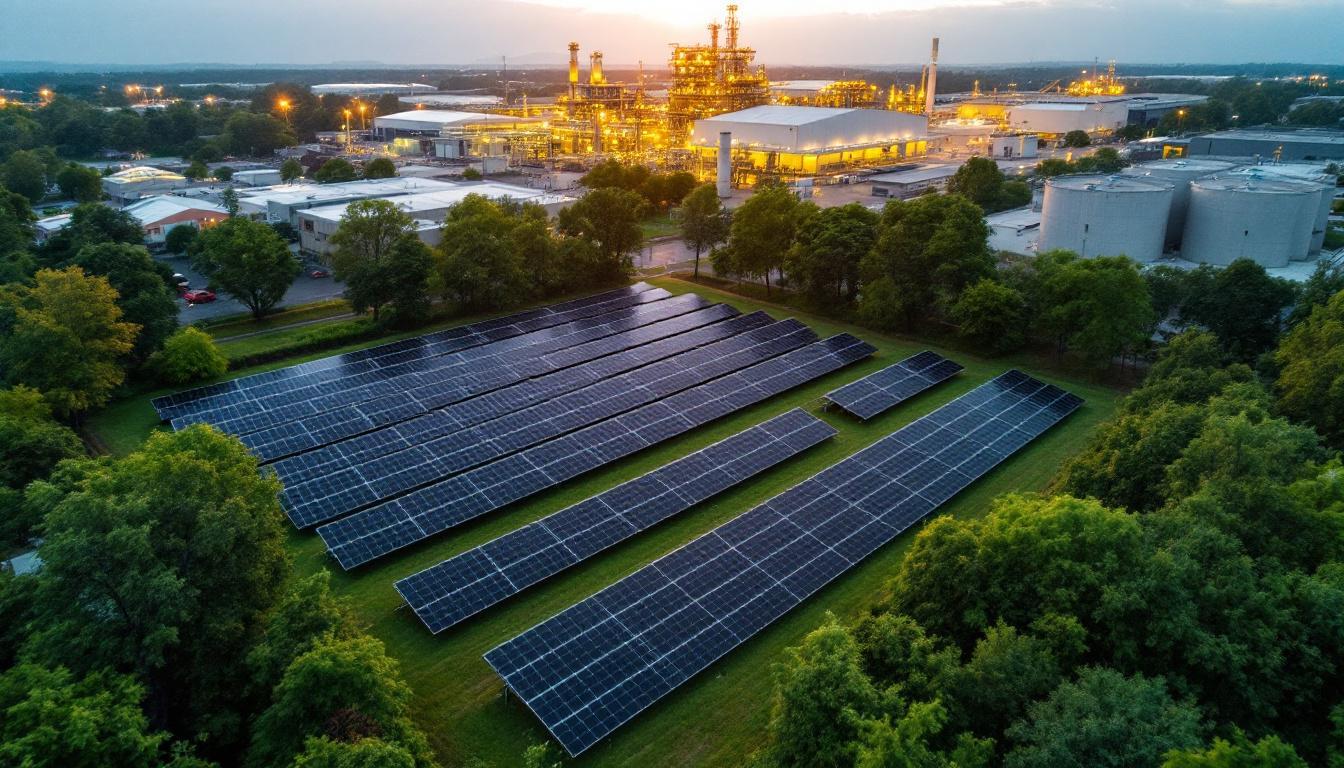
Australian researchers demonstrate that combining onsite photovoltaics and batteries with system integration and operational flexibility can reliably power heavy industries around the clock, marking a shift from sole reliance on cost reductions to smarter, integrated energy strategies.
Researchers at the Australian National University have used a new high‑resolution energy modelling framework to test whether onsite photovoltaics (PV) and battery storage can reliably deliver 24/7 electricity to heavy industries such as steel, aluminium and cement. According to the original report, the work , published as “Decarbonising heavy industry operations with low‑cost onsite photovoltaics and battery storage” in Solar Energy , co‑optimises generation, storage and utilisation at an hourly resolution over a 25‑year economic life while explicitly modelling PV and battery degradation and multi‑timescale intermittency.
The study models a Western Australian heavy‑industry case: a continuous 100 MW load supplied primarily by modular onsite PV and lithium‑ion batteries, with gas turbines as standby backup. The modelling assumes PV efficiency of 21%, battery round‑trip efficiency of 85%, a gas turbine efficiency of 50%, PV degradation of 0.6%/year, battery degradation of 1.8%/year, a 6% discount rate and a 25‑year lifespan. Operation and maintenance were set at US$12/kW/year for PV and 1% of capital cost/year for batteries. Capital cost scenarios spanned PV at US$300–1,500/kW and batteries from US$100/kW + US$100/kWh up to US$500/kW + US$500/kWh.
“Our study addresses a core question: can PV and batteries reliably provide 24/7 electricity for energy‑intensive industries such as steel, aluminum, and cement?” the research’s corresponding author, Bin Lu, told pv magazine. The team compared three decarbonisation strategies: further technology cost reductions, smart grid interaction (import/export), and operational flexibility within the industrial processes.
A central methodological advance is the framework’s non‑linear net‑load approach that keeps hourly fidelity while remaining computationally tractable. That allows the model to capture short‑ and long‑term solar variability, storage ageing and energy spillage , the latter proving critical to outcomes. The researchers report that even an 80% fall in PV and battery capital costs reduces industrial electricity cost by only about 40% because curtailed solar when generation exceeds consumption or storage remains a persistent inefficiency.
By contrast, the study finds greater value from system integration and operational changes. Allowing two‑way grid interaction both lowers dependence on gas backup and, in the modelled cases, can reduce electricity costs by up to 42% while enabling 100% renewable supply. Enabling industrial load flexibility , shifting discretionary production into sunny periods , can reduce electricity costs by as much as 80% and also achieve full renewable integration, the authors report.
Industry‑facing implications are clear for decarbonisation strategists: technology cost declines remain important but are insufficient alone to unlock the lowest cost pathways. According to the original report, combining modular PV/batteries with smart grid arrangements and process flexibility materially increases solar utilisation and economic returns, reducing energy spillage and the need for backup fossil generation.
The paper’s sensitivity work on degradation, cost trajectories and operational assumptions aligns with broader literature on optimal solar‑plus‑storage sizing and grid‑supplemented systems, which emphasises reliability trade‑offs, grid tariffs and the value of time‑shifting. The authors recommend demonstration partnerships with steel, aluminium and cement producers to validate flexible operational strategies under real industrial constraints, stating that demonstration projects will be the next step to translate modelling insights into large‑scale deployment.
For industrial decarbonisation planners, the study provides a data‑driven case for shifting emphasis from sole reliance on capital‑cost reductions toward integrated solutions that combine onsite assets, grid roles and process flexibility to achieve lower‑cost, high‑confidence renewable supply for continuous heavy‑industry operations.
- https://www.pv-magazine-australia.com/2025/12/03/study-shows-optimal-solar-plus-storage-sizing-for-heavy-industry-operation/ – Please view link – unable to able to access data
- https://www.pv-magazine-australia.com/2025/12/03/study-shows-optimal-solar-plus-storage-sizing-for-heavy-industry-operation/ – Researchers from the Australian National University (ANU) have developed a high-resolution energy modelling framework to assess the integration of photovoltaic (PV) systems and batteries in heavy industries. Their study focuses on providing 24/7 electricity to energy-intensive sectors like steel, aluminium, and cement. The researchers compared three strategies: technology cost reductions, grid interaction, and industrial load flexibility. They found that while reducing technology costs is beneficial, integrating smart grid interactions and adapting industrial operations to renewable energy variability are more effective in lowering electricity costs and achieving 100% renewable energy integration. The study highlights the importance of flexible operational strategies and grid interaction in optimising solar energy utilisation and reducing reliance on gas-fired backup power. The findings are detailed in the paper ‘Decarbonising heavy industry operations with low-cost onsite photovoltaics and battery storage’, published in Solar Energy.
- https://www.pv-magazine.com/2025/12/02/optimal-solar-plus-storage-sizing-for-heavy-industry-operation/ – Australian researchers have developed a high-resolution energy modelling framework to assess how photovoltaic (PV) systems and batteries can supply continuous electricity to heavy industries. The study focuses on sectors such as steel, aluminium, and cement, aiming to provide 24/7 power. The researchers compared three strategies: technology cost reductions, grid interaction, and industrial load flexibility. They found that while reducing technology costs is beneficial, integrating smart grid interactions and adapting industrial operations to renewable energy variability are more effective in lowering electricity costs and achieving 100% renewable energy integration. The study underscores the importance of flexible operational strategies and grid interaction in optimising solar energy utilisation and reducing reliance on gas-fired backup power. The findings are detailed in the paper ‘Decarbonising heavy industry operations with low-cost onsite photovoltaics and battery storage’, published in Solar Energy.
- https://www.mdpi.com/1996-1073/14/12/3520 – This study investigates the optimal sizing of rooftop solar photovoltaic (PV) and battery energy storage systems (BESS) for grid-connected houses, considering both flat and time-of-use electricity rates. The researchers developed a practical model that accounts for grid constraints, daily electricity supply, component degradation, and actual annual data of load and solar generation. They examined two system configurations: PV only and PV-BESS, optimally sized by minimizing the net present cost of electricity for four electricity rate options. The study presents various sensitivity analyses to examine the impacts of grid constraints and electricity rates on the cost of electricity and the sizes of the components. The findings provide insights into the economic viability and optimal design of PV and BESS systems for residential applications.
- https://ro.ecu.edu.au/ecuworks2022-2026/21/ – This research explores the optimal sizing and energy scheduling of grid-supplemented solar photovoltaic (PV) systems with battery storage, focusing on the sensitivity of reliability and financial constraints. The study uses established hardware models and detailed power management strategies, along with realistic Australian grid tariffs and genetic algorithms, to find the minimum cost of energy subject to loss of power supply probability (LPSP) and financial constraints. The research considers both stand-alone and grid-supplemented solar PV systems over multiple seasons, providing insights into the interplay between reliability, financial constraints, and CO2 emissions in the design and operation of solar PV systems with battery storage.
- https://research-hub.nrel.gov/en/publications/optimal-sizing-of-a-solar-plus-storage-system-for-utility-bill-sa-3 – This paper discusses the optimal sizing of solar-plus-storage systems for utility bill savings and resiliency benefits. The authors propose a method for estimating the resiliency that a solar-plus-storage system can provide at a given location. The study highlights the potential of solar-plus-storage systems to achieve significant utility savings in behind-the-meter deployments in buildings, campuses, or industrial sites. Common applications include demand charge reduction, energy arbitrage, time-shifting of excess photovoltaic (PV) production, and selling ancillary services to the utility grid. The paper also addresses the challenges in quantifying the amount of resiliency these systems can provide and proposes a method to estimate this benefit.
- https://arxiv.org/abs/2008.07900 – This paper proposes a nondominated sorting genetic algorithm II (NSGA-II) based approach to determine optimal or near-optimal sizing and siting of multi-purpose, community-based, utility-scale shared energy storage in distribution systems with high penetration of solar photovoltaic energy systems. The study evaluates the contribution of utility-scale shared energy storage systems to grid voltage deviation and power loss for each candidate set of locations and sizes. The approach is demonstrated on the IEEE 123-node distribution test feeder with utility-scale PV and shared energy storage systems, providing insights into the optimal deployment of shared energy storage in distribution systems to support high penetration of solar PV energy.
Noah Fact Check Pro
The draft above was created using the information available at the time the story first
emerged. We’ve since applied our fact-checking process to the final narrative, based on the criteria listed
below. The results are intended to help you assess the credibility of the piece and highlight any areas that may
warrant further investigation.
Freshness check
Score:
10
Notes:
The narrative is recent, published on December 3, 2025, with no evidence of prior publication or recycling. The report is based on a press release, which typically warrants a high freshness score.
Quotes check
Score:
10
Notes:
Direct quotes from the research’s corresponding author, Bin Lu, are unique to this report, with no earlier matches found online. This suggests potentially original or exclusive content.
Source reliability
Score:
9
Notes:
The narrative originates from pv magazine Australia, a reputable outlet in the renewable energy sector. The Australian National University (ANU) is a credible institution, enhancing the report’s reliability.
Plausability check
Score:
9
Notes:
The claims align with current research trends in integrating photovoltaics and battery storage for heavy industries. The study’s findings are plausible and consistent with ongoing efforts in industrial decarbonisation.
Overall assessment
Verdict (FAIL, OPEN, PASS): PASS
Confidence (LOW, MEDIUM, HIGH): HIGH
Summary:
The narrative is recent, original, and sourced from reputable entities, with claims that are plausible and consistent with current research trends. No significant credibility risks were identified.
