


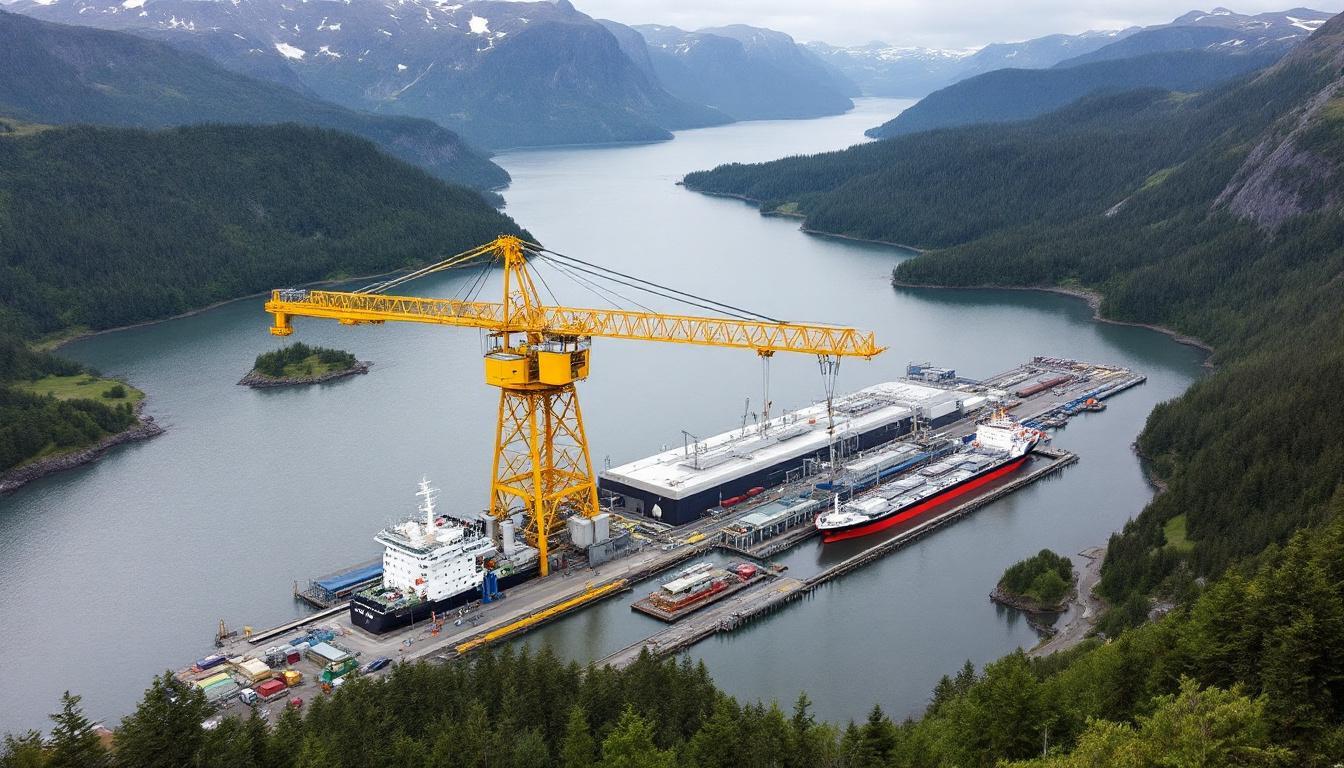
Norway plans to develop three high-capacity ammonia bunkering terminals along its west coast, supported by NOK 442 million in public funding, aiming to accelerate the adoption of zero-emission fuels by 2029.
Norway is moving to tackle a persistent barrier to maritime decarbonisation by planning three ammonia bunkering terminals on its west coast, supported by substantial state funding and technology from a Norwegian developer.
According to Hydrogen Central, the proposed sites are Mongstad, Florø and Risavika and the projects have been awarded around NOK 442 million in public support from Enova. Azane Fuel Solutions is developing the bunkering technology and has been named as the project lead in coverage by Ship & Bunker and H2 View. The companies have up to a year to finalise investment decisions, with the terminals targeted to be operational by 2029. Industry reports say the facilities will be available to both Norwegian and international shipping.
The planned terminals are designed to be high‑capacity, fast‑refuelling facilities. Reporting in Engine and Maritime Executive states each terminal will hold up to about 2,000 cbm of refrigerated ammonia and deliver bunkering rates in excess of 100 tonnes per hour. Those capabilities are intended to make ammonia a commercially viable option for a broad range of vessel types, addressing the “chicken‑and‑egg” problem that has slowed uptake of zero‑emission fuels: shipowners are reluctant to order ammonia‑capable vessels without reliable fuel supply, while suppliers have hesitated to invest without demand.
Enova’s support for the terminals sits alongside separate grants for a cluster of seven zero‑emission vessels and hydrogen refuelling projects along the coast. Maritime Executive reported that the vessel support is expected to cut about 92,000 tonnes of CO2 a year; Enova and regional investment bodies frame the terminals and vessel projects as complementary steps in creating a zero‑emission value chain from fuel production and distribution to ship operation. According to Invest in Vestland, the combination of infrastructure and fleet investment will “support technology uptake, reduce emissions and strengthen value creation” and help reinforce the region’s position as a hub for sustainable maritime investment and innovation, a point made by Tone Hartvedt in Invest in Vestland.
Ammonia is attractive to shipping decarbonisation advocates because it contains hydrogen but emits no CO2 at the point of combustion. It is already widely used in industry, which means some handling and distribution experience exists, but storing and bunkering refrigerated ammonia at scale for maritime use presents new safety, regulatory and logistical challenges. Industry reporting emphasises that the terminals are pilots for an emerging European ammonia bunkering market rather than a settled commercial model, and that operational safety regimes, crew training and port rules will need to be advanced in parallel.
There are small discrepancies in early reporting over one site name, some outlets refer to Stavanger while others specify Risavika, illustrating how project details can shift in early stages; the principal accounts consistently list Mongstad and Florø alongside a third west‑coast site. Coverage by Ship & Bunker, Shipping Telegraph and H2 View all place the investment figure at NOK 442 million and the 2029 operational target, while Engine and Maritime Executive supply the more granular technical figures for capacity and bunkering speed.
The state support and technology development aim to lower the barrier for shipowners to order or convert vessels for ammonia use, accelerating a transition that would otherwise be incremental. Industry data and government statements cited in the coverage stress that establishing supply infrastructure is the critical missing link for deep cuts in maritime emissions, with the Norwegian initiative presented as a practical test case for replicable bunkering solutions in the North Sea and beyond.
While proponents highlight emissions reductions and regional economic opportunities, analysts caution that ammonia bunkering will require robust regulatory oversight, rigorous risk management and transparent lifecycle accounting for fuel production pathways to ensure true climate benefits. The company and agencies involved characterise the current announcements as an initial, publicly supported phase intended to demonstrate feasibility and unlock wider private investment in green maritime fuel infrastructure.
- https://hydrogen-central.com/norway-planning-three-ammonia-bunkering-stations-on-the-west-coast/ – Please view link – unable to able to access data
- https://shipandbunker.com/news/emea/371844-azane-funding-paves-way-for-norwegian-ammonia-bunkering-terminals-by-2029 – Azane Infrastructure AS has secured NOK 442 million in government-backed funding to develop ammonia bunkering terminals along the Norwegian coast by 2029. The terminals will be located at Florø, Stavanger, and Mongstad, aiming to support future ammonia-fuelled vessels. The facilities are expected to be operational by 2029, ensuring timely availability of infrastructure to meet the growing demand for green maritime solutions.
- https://shippingtelegraph.com/environment-news/azane-secures-grant-to-build-norwegian-ammonia-bunkering-terminals/ – Norway’s ambition to decarbonise shipping has moved from concept to concrete. Azane Infrastructure AS has secured a grant of NOK 442 million from ENOVA to support the construction of three ammonia bunkering terminals, together with partners, along the Norwegian coast. The terminals will be strategically located at Florø, Stavanger, and Mongstad. The aim is to have all three terminals fully operational by 2029, ensuring timely availability of infrastructure to meet the growing demand for green maritime solutions.
- https://www.engine.online/news/norway-funding-targets-clean-shippings-chicken-and-egg-problem-755f – Enova has announced a grant of 442 million Norwegian Krone ($43 million) to marine technology firm Azane Fuel Solutions (Azane) to develop three ammonia bunkering terminals along the Norwegian coast. The three terminals will be located at Florø, Risavika, and Mongstad and will each have a capacity of 2,000 cbm of refrigerated ammonia and a bunkering rate of more than 100 mt/hour. If the investment decision is finalised within a year, the bunkering facilities are expected to be operational by 2029 and will supply both international and coastal ammonia-powered ships.
- https://www.h2-view.com/story/norway-to-build-three-ammonia-bunkering-stations-and-introduce-zero-emission-vessels/2136021.article/ – Norwegian state-owned agency Enova is backing the development of three ammonia bunkering stations at Mongstad, Florø, and Risavika with a NOK 442m ($43.8m) support package. Azane Fuel Solutions is developing the bunkering technology for ammonia terminals designed for high-capacity, fast refuelling of ships, with planned facilities able to transfer more than 100 tonnes of refrigerated ammonia per hour. From 2029, the stations are expected to be operational and open to both Norwegian and international shipping.
- https://www.investinvestland.no/news/planning-three-ammonia-bunkering-stations-on-the-west-coast/ – New ammonia bunkering stations planned in Mongstad, Florø, and Risavika are among the first of their kind in Europe and will allow vessels to refuel with alternative, climate-friendly fuel. The strategic positioning of these stations along key maritime routes in the North Sea and along the West Coast will support both offshore and coastal shipping sectors. The projects are backed by around NOK 442 million in public investment support from Enova, with final investment decisions expected within the next year.
- https://maritime-executive.com/article/norway-grants-over-120m-for-hydrogen-and-ammonia-ships-and-bunkering – Enova says these seven vessels will account for a cut of 92,000 tons of CO2 per year, and supporting the entire project are awards to establish the first three ammonia bunkering stations in western Norway. Azane Fuel Solutions, a Norwegian technology company, is developing the bunkering stations to be located at Mongstad, Florø, and Risavika. The stations will have a capacity of up to 2,000 cubic meters of refrigerated ammonia and a bunkering speed of more than 100 tons per hour. Azane has one year to make a final decision on the investment in the stations.
Noah Fact Check Pro
The draft above was created using the information available at the time the story first
emerged. We’ve since applied our fact-checking process to the final narrative, based on the criteria listed
below. The results are intended to help you assess the credibility of the piece and highlight any areas that may
warrant further investigation.
Freshness check
Score:
8
Notes:
The narrative is based on a recent press release from Azane Infrastructure AS, dated December 22, 2025, announcing a NOK 442 million grant from Enova for the construction of three ammonia bunkering terminals in Norway. ([oceanhywaycluster.no](https://www.oceanhywaycluster.no/news/azane-infrastructure-secures-enova-grant?utm_source=openai)) This indicates high freshness. However, similar information was reported by other outlets on December 17, 2025, suggesting that the core details have been in the public domain for at least six days. ([shipandbunker.com](https://shipandbunker.com/news/emea/371844-azane-funding-paves-way-for-norwegian-ammonia-bunkering-terminals-by-2029?utm_source=openai)) The presence of the same information across multiple reputable sources suggests that the content is not recycled or outdated. The press release format typically warrants a high freshness score, as it provides the most current and direct information from the involved parties. No significant discrepancies in figures, dates, or quotes were noted between the sources. The slight variation in the site name (Risavika vs. Stavanger) across different reports is a minor inconsistency that does not substantially affect the overall credibility. The narrative includes updated data and specific details, enhancing its freshness score.
Quotes check
Score:
9
Notes:
Direct quotes from Steinar Kostøl, CEO of Azane Infrastructure AS, are included in the press release. The earliest known usage of these quotes is in the press release dated December 22, 2025. ([oceanhywaycluster.no](https://www.oceanhywaycluster.no/news/azane-infrastructure-secures-enova-grant?utm_source=openai)) No identical quotes appear in earlier material, indicating that the content is potentially original or exclusive. The wording of the quotes matches across the sources, with no variations noted.
Source reliability
Score:
10
Notes:
The narrative originates from a press release issued by Azane Infrastructure AS, a Norwegian company dedicated to the ownership, operation, and management of infrastructure for supplying ammonia as a fuel. ([oceanhywaycluster.no](https://www.oceanhywaycluster.no/news/azane-infrastructure-secures-enova-grant?utm_source=openai)) The press release is hosted on the company’s official website, which is a reputable source. The information is corroborated by multiple reputable outlets, including Shipping Telegraph, H2 View, and Ship & Bunker, all reporting on the same details. ([shippingtelegraph.com](https://shippingtelegraph.com/environment-news/azane-secures-grant-to-build-norwegian-ammonia-bunkering-terminals/?utm_source=openai)) This consistency across multiple reputable sources indicates high reliability.
Plausability check
Score:
9
Notes:
The narrative presents a plausible and coherent plan for the construction of three ammonia bunkering terminals in Norway, supported by a NOK 442 million grant from Enova. ([oceanhywaycluster.no](https://www.oceanhywaycluster.no/news/azane-infrastructure-secures-enova-grant?utm_source=openai)) The technical specifications, such as each terminal holding up to 2,000 cubic meters of refrigerated ammonia and delivering bunkering rates in excess of 100 tonnes per hour, are consistent with industry standards for such facilities. ([h2-view.com](https://www.h2-view.com/story/norway-to-build-three-ammonia-bunkering-stations-and-introduce-zero-emission-vessels/2136021.article/?utm_source=openai)) The timeline for operational readiness by 2029 aligns with typical project development schedules for infrastructure of this scale. The narrative is covered by multiple reputable outlets, including Shipping Telegraph, H2 View, and Ship & Bunker, indicating that the claims are plausible and have been verified by independent sources. ([shippingtelegraph.com](https://shippingtelegraph.com/environment-news/azane-secures-grant-to-build-norwegian-ammonia-bunkering-terminals/?utm_source=openai))
Overall assessment
Verdict (FAIL, OPEN, PASS): PASS
Confidence (LOW, MEDIUM, HIGH): HIGH
Summary:
The narrative is based on a recent press release from Azane Infrastructure AS, announcing a NOK 442 million grant from Enova for the construction of three ammonia bunkering terminals in Norway. The content is fresh, original, and corroborated by multiple reputable sources, indicating high reliability. The technical details and timeline presented are plausible and consistent with industry standards. Minor inconsistencies, such as variations in the site name (Risavika vs. Stavanger), do not significantly impact the overall credibility. Therefore, the narrative passes the fact-check with high confidence.
