


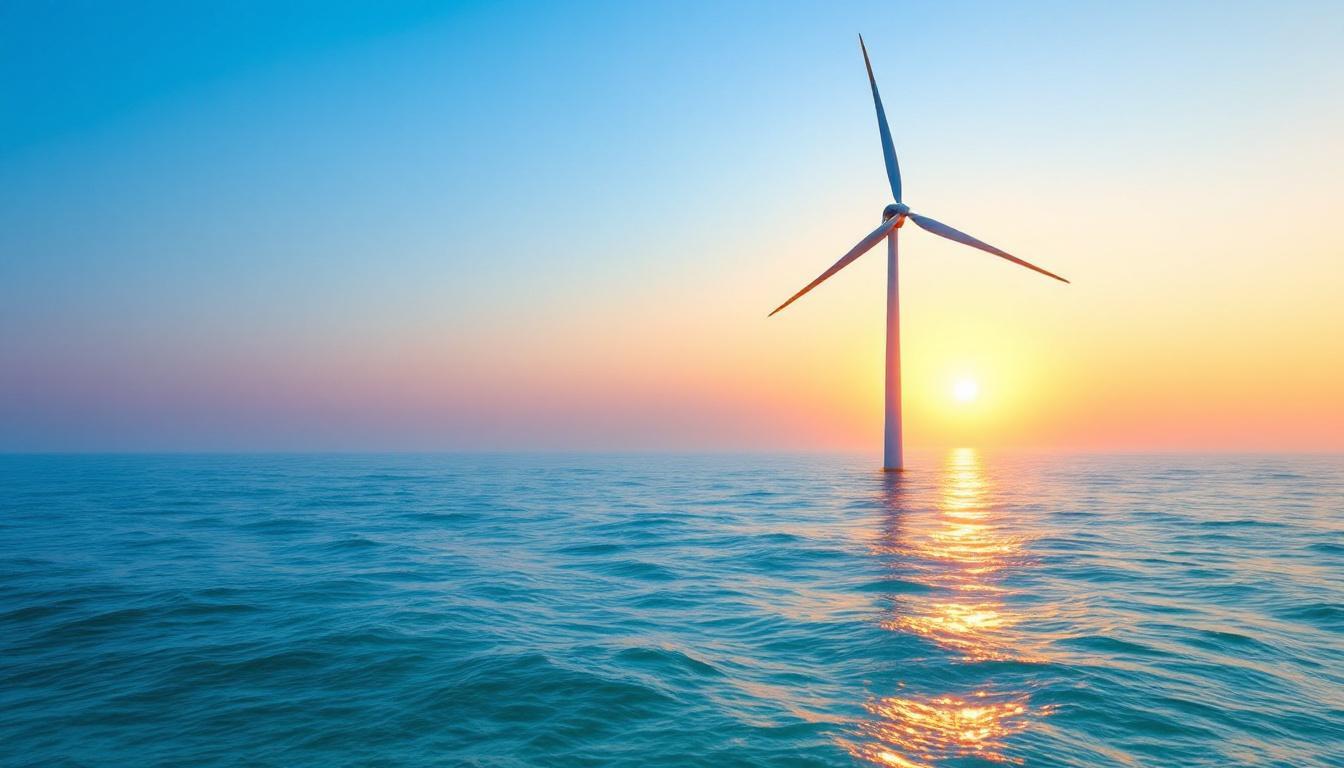
Global offshore wind industry accelerates, driven by technological innovations and rising ambitions in new regions like Oman, as mature markets expand and emerging countries prepare for deployment amidst various challenges.
Offshore wind has moved from niche experiment to a central pillar of the global clean-energy transition, driven by successive waves of engineering innovation, economies of scale and policy ambition. What began in the shallow coastal waters off Denmark in the early 1990s with small, nearshore turbines has evolved into a fast-growing industry now deploying machines that rival the size and output of early thermal generators, and opening deep-water sites previously out of reach.
The sector’s growth has been shaped by advances in turbine design, foundation engineering and installation methods that together have driven down levelised costs and raised capacity factors. Turbines have steadily grown in rotor diameter and rated output; machines above 8MW became common in the 2010s and the latest devices exceed 15MW. Floating foundations, still early in commercialisation, are extending the industry into waters where fixed monopiles are impractical, unlocking vast additional resource potential around the world. According to industry analysis, these technology trends and improving grid connection frameworks are making offshore wind progressively competitive with conventional generation for utility-scale supply.
Regional trajectories vary. Europe retains the most mature market, backed by long-standing policy support and established supply chains in the North Sea and Baltic Sea. China has rapidly scaled capacity at national level and now ranks among the global leaders in deployment. North America is still nascent by comparison but shows accelerating ambition; a University of California Berkeley-led study with GridLab and Energy Innovation indicates the United States could source as much as a quarter of its electricity from offshore wind by 2050 if deployment is substantially ramped up, noting that without offshore projects the required terrestrial renewables buildout would be much more onerous. The same analysis underlines political headwinds, permitting bottlenecks and major infrastructure needs as key barriers to realising that potential.
The Middle East has lagged behind these regions but is moving from exploration to early-stage delivery. Oman illustrates how a country with significant coastline but limited prior offshore experience is preparing to scale wind capacity. Nama Power and Water Procurement Company has shortlisted a dozen international and regional developers for a 1GW onshore wind procurement covering five projects, expected to be commissioned by 2027. Industry sources report that several of the world’s leading independent power producers and developers are in contention, reflecting growing investor confidence in the Omani market. Oman’s national targets, aiming for roughly 30% of electricity from clean sources by 2030 and net-zero emissions by 2050, frame this activity and help explain why substantial wind equipment is already arriving at Omani ports.
The Special Economic Zone at Duqm has emerged as a focal point: OQ Alternative Energy has received the first shipment of large onshore turbine components for the Wind 1 and Wind 2 projects, a milestone that demonstrates local logistics and heavy-lift handling capability. Supplier disclosures indicate the turbines are around 200 metres in total height, with blades of approximately 90.2 metres and individual unit ratings near 6.5MW, each machine capable of supplying thousands of households. Separately, OQ’s partnership plans with regional players and memoranda around local turbine manufacturing in Duqm suggest an ambition to develop elements of a domestic supply chain, a strategy consistent with wider regional trends to capture more value from renewables deployment.
Despite the positive momentum, industry players and analysts caution that substantial challenges remain for both fixed and floating offshore projects. High upfront capital requirements, complex multi-jurisdictional permitting, grid reinforcement and the environmental assessments necessary to protect marine ecosystems create long lead times and require coordinated public-private planning. Supply chain constraints and workforce shortages are emerging pain points as the global pipeline grows; industry reports urge advance investment in ports, specialized vessels and local skills to avoid bottlenecks that could inflate costs or delay delivery.
The commercial case for integrating offshore wind into broader industrial decarbonisation strategies is strengthening. Project developers are increasingly pairing wind generation with utility-scale battery storage and green hydrogen production, enabling temporal shifting of output and direct supply of low-carbon feedstock to hard-to-abate industrial processes. Such hybrid configurations are promoted by proponents as ways to enhance system flexibility, reduce curtailment and provide firm, low-emission energy vectors for manufacturing, desalination and transport electrification.
For countries like Oman, the near-term focus remains on delivering contracted onshore capacity and proving logistical and regulatory frameworks. But the combination of expanding port infrastructure, the arrival of large turbine components, and interest in local manufacturing lays groundwork that could support future offshore ventures, particularly as floating technologies mature and reduce depth constraints. International experience shows that timely policy clarity, streamlined consenting and co‑ordinated grid planning are decisive in converting resource potential into bankable projects.
As the global energy transition intensifies, offshore wind’s role is likely to broaden beyond electricity generation to become an enabler of broader industrial decarbonisation. Realising that promise will depend on sustained investment in technology, ports and workforce development, alongside pragmatic regulation that balances environmental stewardship with the speed required to meet climate and industrial objectives.
- https://www.omanobserver.om/article/1183206/opinion/business/offshore-wind-in-a-changing-global-energy-landscape – Please view link – unable to able to access data
- https://www.omanobserver.om/article/1183206/opinion/business/offshore-wind-in-a-changing-global-energy-landscape – This article discusses the evolution of offshore wind energy from its experimental beginnings in the early 1990s off Denmark’s coast to its current status as a significant contributor to the global renewable energy transition. It highlights technological advancements, cost reductions, and the increasing demand for clean power as key drivers. The piece also notes the expansion of offshore wind in Europe, Asia, and North America, with China emerging as a global leader in the field. Additionally, it touches upon the potential for offshore wind in the Middle East, particularly in Oman, emphasizing the country’s commitment to renewable energy and its plans to generate 30% of its electricity from clean sources by 2030.
- https://time.com/6301046/us-offshore-wind-power-2050-climate-goal/ – A report from the University of California Berkeley, in collaboration with GridLab and Energy Innovation, suggests the U.S. could generate up to 25% of its electricity from offshore wind by 2050. Currently, offshore wind contributes minimally, with only six turbines off Rhode Island generating 30 megawatts. However, with advantages like long coastlines and decreasing turbine costs, offshore wind’s potential is significant. The U.S. lags behind Europe and Asia in offshore wind development but is beginning to invest, including its first large-scale farm off Massachusetts. Meeting future energy needs and decarbonizing the economy will require a vast expansion of renewable sources. Without offshore wind, the U.S. would need to quintuple its 2021 renewable buildout rate; incorporating offshore projects could ease that burden, reducing the needed buildout to three or four times the 2021 rate. Challenges include political opposition, infrastructure needs, streamlined permitting, and substantial financial investment. The Biden administration’s current goal is 30 GW by 2030, well below the EU’s 300 GW by 2050 target. If successful, the expansion could provide cleaner power, lower energy costs, and generate nearly 390,000 jobs, making strong policy support and leadership critical to realizing this potential.
- https://www.enerdata.net/publications/daily-energy-news/oman-shortlists-12-firms-tender-develop-5-wind-projects-1-gw.html – Oman’s Nama Power and Water Procurement Company (PWP) has shortlisted 12 bidders for an onshore wind tender, aiming to develop five projects totaling about 1 GW across the country. The developers include ACWA Power, Sembcorp, Sumitomo, TotalEnergies, Masdar, Al Fanar, Elecnor, Goldwind, Itochu, Gulf Energy Development, Marafiq, EDF Renouvelables, and Hero Asia Investment. The projects are expected to be commissioned by 2027, with capacities ranging from 81 MW to 400 MW. As of end-2023, Oman had only 50 MW of wind capacity, representing less than 1% of the country’s total capacity. Oman plans to reach 30% of renewable energy in its total electricity production mix by 2030 and achieve net-zero emissions by 2050.
- https://www.tradearabia.com/News/energy/386019.html – OQ Alternative Energy, a subsidiary of OQ Group, marked the arrival of the first batch of wind turbines for the Wind 1 and Wind 2 projects at Duqm Port in the Special Economic Zone at Duqm (SEZAD). These projects constitute the largest wind farms under construction in Oman. The shipment includes unprecedented standard components that are the first of their kind in Oman. The total height of each turbine reaches 200 meters above ground level, with the longest wind blades reaching 90.2 meters per blade, in addition to the tallest wind turbine towers to be installed in the country. Each turbine has a production capacity of about 6.5 megawatts (MW), which is enough to supply approximately 2,400 Omani homes with clean energy annually. These qualitative specifications enhance Oman’s technical capabilities in renewable energy and reflect its commitment to integrating the latest global technologies into its energy infrastructure.
- https://www.altenergymag.com/news/2025/12/08/how-offshore-wind-energy-market-is-gaining-momentum-opportunities-trends-and-the-path-forward/46455/ – The article discusses the rapid growth of the offshore wind energy market, driven by technological advancements and declining costs. Innovations in turbine design, foundation technology, installation methods, and floating platforms are enabling offshore wind farms to operate in deeper waters and harsher environments. Larger turbines with higher MW ratings, floating foundations, and improved grid-connection infrastructure are expanding potential deployment zones. As a result, the levelized cost of energy (LCOE) for offshore wind is becoming increasingly competitive with fossil-fuel generation, enhancing project viability and attracting capital from institutions seeking sustainable, long-term returns. The surge in global energy demand, driven by industrialization, population growth, and electrification trends, is pushing many countries to look beyond traditional sources. At the same time, mounting pressure to reduce carbon emissions and meet net-zero targets is accelerating the adoption of renewables, with offshore wind emerging as a scalable alternative.
- https://www.oilandgasmiddleeast.com/news/oman-acwa-total-masdar-windenergy – OQ Alternative Energy, a subsidiary of Oman’s state energy holding company OQ, has signed an agreement with Kuwait-based Naqaa Sustainable Energy to jointly develop 1,100 MW of wind power projects across the wilayats of Duqm, Mahout, and Sadah in Oman’s Dhofar and Al-Wusta governorates. The projects will use locally manufactured wind turbines from Mawarid Turbine, a company expected to be established in Duqm following a memorandum of cooperation signed between OQ and Mawarid in April. Presently, private developers and investors own the total shares in such projects, similar to the existing structure in Saudi Arabia.
Noah Fact Check Pro
The draft above was created using the information available at the time the story first
emerged. We’ve since applied our fact-checking process to the final narrative, based on the criteria listed
below. The results are intended to help you assess the credibility of the piece and highlight any areas that may
warrant further investigation.
Freshness check
Score:
8
Notes:
The article was published on January 24, 2026, and discusses recent developments in offshore wind energy, including technological advancements and global market trends. While the content is current, some information, such as the historical development of offshore wind, may be well-known and not entirely fresh.
Quotes check
Score:
7
Notes:
The article does not contain direct quotes. However, it references industry analyses and reports without providing specific citations or direct links, making it difficult to independently verify the sources of these claims.
Source reliability
Score:
6
Notes:
The article is published by the Oman Observer, a regional news outlet. While it provides a comprehensive overview of offshore wind developments, the lack of citations to primary sources or independent verification raises concerns about the reliability of the information presented.
Plausability check
Score:
7
Notes:
The claims about technological advancements and global market trends in offshore wind energy are plausible and align with known industry developments. However, the absence of specific data points or references to independent studies makes it challenging to fully assess the accuracy of these claims.
Overall assessment
Verdict (FAIL, OPEN, PASS): FAIL
Confidence (LOW, MEDIUM, HIGH): MEDIUM
Summary:
The article provides a general overview of offshore wind developments but lacks specific data points, direct quotes, and citations to primary sources, making it difficult to independently verify the information presented. The content’s origin in the ‘Opinion’ section further suggests a subjective perspective rather than objective reporting.
