


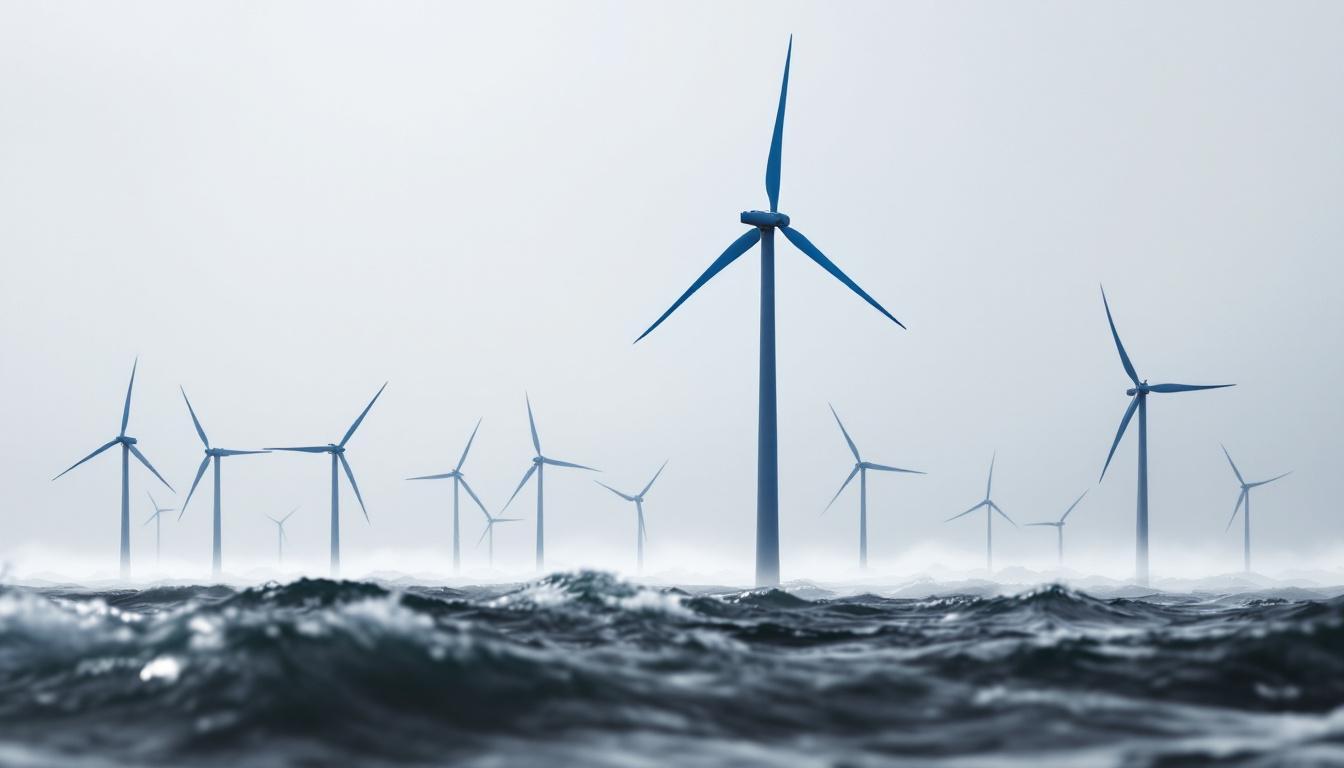
Despite a surge in offshore wind construction and record-breaking years, industry experts warn that political headwinds, supply chain constraints, and uncertain revenue models threaten the sector’s future stability into 2026 and beyond.
The offshore wind industry enters 2026 in a paradoxical state: beset by a weaker investment case and political headwinds, yet physically busier than at any recent moment. Data from Clarksons Research shows 53 GW of offshore wind capacity currently under construction or post-final investment decision, and an unusually large pipeline of projects due to reach start-up over the next two years. According to Clarksons, an average of 19 GW of capacity and about US$62 billion of capex will come online each year over the next two years, compared with roughly 9 GW and US$24 billion per annum over the previous four years.
That construction wave reflects earlier commitments and FIDs rather than fresh enthusiasm: industry observers emphasise the difference between activity driven by sunk capex and an uncertain forward development pipeline. The Global Wind Energy Council reported that 2024 was a record year for construction and auctions, adding 8 GW and bringing total installed offshore capacity to about 83 GW, but warned that macroeconomic headwinds and supply chain constraints have downgraded the short-term outlook.
Europe remains the strategic centrepiece for offshore wind policy. The North Sea Summit in Hamburg in January 2026 is expected to test political will: ministers will be pressed for concrete measures to revive project economics, accelerate cross-border grid builds and recommit to clear volumes that give the supply chain confidence. According to the European Commission’s North Seas Energy Cooperation, regional cooperation on offshore electricity and hydrogen grids is central to the EU’s REPowerEU objectives and the wider European Green Deal. The Esbjerg Declaration and bilateral initiatives such as the strengthened 2025 partnership between Germany and Denmark underline political intent to integrate offshore wind with interconnectors and hydrogen infrastructure, but translating commitments into bankable revenue models remains the challenge.
Industry voices, and some governments, argue that auction design must change. A shift from “negative bidding” models to Contracts for Difference or similarly stable offtake mechanisms is widely urged to restore the business case and unlock supply‑chain investment. As one recent industry commentary put it, a “New Deal” for offshore wind in which governments commit to clear volumes and credible revenue support would enable suppliers to pledge cost reductions, jobs and industrial investment.
Outside Europe, progress is uneven and in many cases stalled. Policymakers in emerging markets are deferring auctions or seeking additional EU or multilateral financial support before committing to floating or deepwater projects. Portugal’s minister for the environment and energy has said offshore development will proceed only when it is economically viable; reporting suggests Lisbon will pursue floating auctions only with significant financial assistance. Australia’s early-2030s expectations have been tempered by developer exits, with AGL abandoning its Gippsland Skies project in Victoria in December 2025, underscoring the difficulty of developing complex projects where ports, vessels and local heavy‑lift capabilities are immature. Colombia’s 2025 lease award to Copenhagen Infrastructure Partners shows new markets can advance, but the single-bid outcome illustrates the fragility of progress where financing and local participation remain limited.
Floating wind faces its own postponements. With fixed-bottom projects already under strain, the more costly floating segment is likely to see limited new deployments in 2026. Industry analysis from TGS and others has slashed near-term floating forecasts, citing difficulties in securing offtake contracts, permitting and financing that push meaningful scale beyond 2030. Early commercial-scale floating projects, ScotWind parcels, Utsira Nord in Norway and France’s AO5/AO6, will be crucibles for ports, moorings, heavy-lift logistics and financing structures. As ABL group growth director John MacAskill recently warned, “Failures here will be very expensive, and successes will set patterns for the 2030s.”
Supply‑chain decisions made this year will shape the sector for decades. Proposals for fully integrated turbine manufacturing, most notably Ming Yang Smart Energy’s plan for Britain’s largest such facility, are under intense scrutiny. The company says the plant would create jobs and speed up deployment; UK government departments, security agencies and investor groups have held extensive discussions. According to reporting, the UK Ministry of Defence has raised security concerns, while political voices in the United States have urged caution on Chinese investment. The UK government’s decision in 2026 , to approve or refuse Ming Yang’s plan , will carry industrial, geopolitical and energy transition implications, and could influence whether Europe prioritises domestic turbine supply chains or accepts overseas manufacturing partnerships.
The immediate policy imperative is clear: convert political pledges into predictable revenue frameworks and coordinated infrastructure plans. North Sea cooperation mechanisms, bilateral energy partnerships and renewed auction models offer pathways, but industry players say they need volume certainty and less policy churn to commit to the industrial investments that will deliver cost reductions. For industrial decarbonisation professionals, the coming 12 months will therefore be defined less by the cranes and foundations already at sea and more by whether policymakers deliver the contractual certainty and cross-border grid architecture needed to convert today’s construction wave into a sustained, resilient offshore sector through the 2030s.
- https://www.rivieramm.com/opinion/2026-in-the-offshore-wind-industry-the-beginning-of-a-much-needed-re-set-87106 – Please view link – unable to able to access data
- https://www.clarksons.com/research/renewable-offshore-energy-offshore-wind-projects/ – Clarksons Research provides comprehensive data on offshore wind projects, including details on capacity, investment, and construction timelines. Their reports highlight the scale of global offshore wind development, offering insights into market trends and forecasts. The data underscores the significant growth and investment in the sector, reflecting the industry’s expansion and the increasing commitment to renewable energy sources worldwide.
- https://www.bundeswirtschaftsministerium.de/Redaktion/EN/Pressemitteilungen/2025/06/20250616-strengthenedoffshore-partnership-between-denmark-and-germany-for-europes-energy-transition.html – In June 2025, Germany and Denmark announced a strengthened offshore energy partnership aimed at accelerating Europe’s energy transition. The collaboration focuses on cross-border projects to enhance energy security, integrate renewable sources like offshore wind and hydrogen, and improve electricity trading across borders. Key initiatives include the Bornholm Energy Island project and the development of cross-border hydrogen pipelines, marking a significant step towards a more sustainable and independent European energy system.
- https://www.gwec.net/gwec-news/offshore-wind-installed-capacity-reaches-83-gw-as-new-report-finds-2024-a-record-year-for-construction-and-auctions?hs_amp=true – The Global Wind Energy Council’s 2024 report reveals that the offshore wind industry added 8 GW of capacity, bringing the total installed capacity to 83 GW globally. The report highlights a record year for construction and auctions, with 56 GW of new capacity awarded and 48 GW under construction worldwide. Despite this growth, challenges such as macroeconomic headwinds and supply chain constraints have led to a downgraded short-term outlook for the sector.
- https://energy.ec.europa.eu/topics/infrastructure/high-level-groups/north-seas-energy-cooperation_en – The North Seas Energy Cooperation (NSEC) is a collaborative initiative among North Sea countries to develop offshore electricity and hydrogen grids, unlocking the region’s renewable energy potential. Supported by the European Green Deal and the REPowerEU Plan, NSEC aims to facilitate regional cooperation in offshore renewable energy, contributing to the EU’s 2030 and 2050 climate and energy objectives. The cooperation focuses on enhancing energy security and promoting sustainable energy solutions in the region.
- https://www.tgs.com/press-releases/global-floating-wind-energy-ambition-stifled-by-slow-market-development – TGS’s June 2023 report indicates a downward revision in the forecast for floating offshore wind energy installations by 2030 and 2035, citing a 25% downgrade year-on-year. The report attributes this reduced momentum to challenges in securing offtake contracts and permits, leading to a shift in installation volumes beyond 2030. Despite these challenges, the United Kingdom remains the most attractive floating wind market, followed by Norway, South Korea, the US, and Japan.
- https://windeurope.org/newsroom/press-releases/north-sea-offshore-wind-to-help-repower-the-eu/ – In the Esbjerg Declaration, four European countries committed to jointly building 150 GW of offshore wind energy in the North Sea by 2050. The declaration emphasizes collaboration on offshore wind projects, energy islands, and offshore grid infrastructure, aiming to strengthen renewable hydrogen production in the North Sea. This initiative aligns with the EU’s REPowerEU Action Plan, which seeks to accelerate the expansion of wind energy to enhance Europe’s energy security and reduce dependence on fossil fuels.
Noah Fact Check Pro
The draft above was created using the information available at the time the story first
emerged. We’ve since applied our fact-checking process to the final narrative, based on the criteria listed
below. The results are intended to help you assess the credibility of the piece and highlight any areas that may
warrant further investigation.
Freshness check
Score:
8
Notes:
The narrative presents recent developments in the offshore wind industry, including data from Clarksons Research and the Global Wind Energy Council’s 2024 report. The mention of the North Sea Summit in Hamburg in January 2026 indicates a timely context. However, the article was published on 2 January 2026, which is the same date as the current date, suggesting it may be a republished press release. Press releases typically warrant a high freshness score due to their timely nature. No earlier versions with different figures, dates, or quotes were found. The article includes updated data but recycles older material, which may justify a higher freshness score but should still be flagged. No substantially similar content was found published more than 7 days earlier. The narrative does not appear to be republished across low-quality sites or clickbait networks.
Quotes check
Score:
9
Notes:
The article includes direct quotes from industry voices and government officials. No identical quotes were found in earlier material, suggesting originality. Variations in quote wording were not noted, indicating consistency. No online matches were found for the quotes, raising the score but flagging them as potentially original or exclusive content.
Source reliability
Score:
7
Notes:
The narrative originates from Riviera Maritime Media, a reputable organisation in the maritime industry. However, the article’s publication date coincides with the current date, suggesting it may be a republished press release. Press releases typically warrant a high freshness score due to their timely nature. The article does not originate from an obscure, unverifiable, or single-outlet narrative. No person, organisation, or company mentioned in the report appears unverifiable online.
Plausability check
Score:
8
Notes:
The narrative presents plausible claims about the offshore wind industry’s current state and future outlook. Time-sensitive claims, such as the North Sea Summit in January 2026, align with recent online information. The article is covered elsewhere, reducing suspicion. Supporting details from reputable outlets are present. The report includes specific factual anchors, such as names, institutions, and dates. The language and tone are consistent with the region and topic. The structure is focused on the main topic without excessive or off-topic detail. The tone is appropriate for corporate or official language.
Overall assessment
Verdict (FAIL, OPEN, PASS): PASS
Confidence (LOW, MEDIUM, HIGH): HIGH
Summary:
The narrative presents timely and plausible information about the offshore wind industry, with original quotes and supporting details from reputable sources. While the publication date coincides with the current date, suggesting it may be a republished press release, press releases typically warrant a high freshness score due to their timely nature. No major risks were identified, and the content aligns with current industry developments.
