


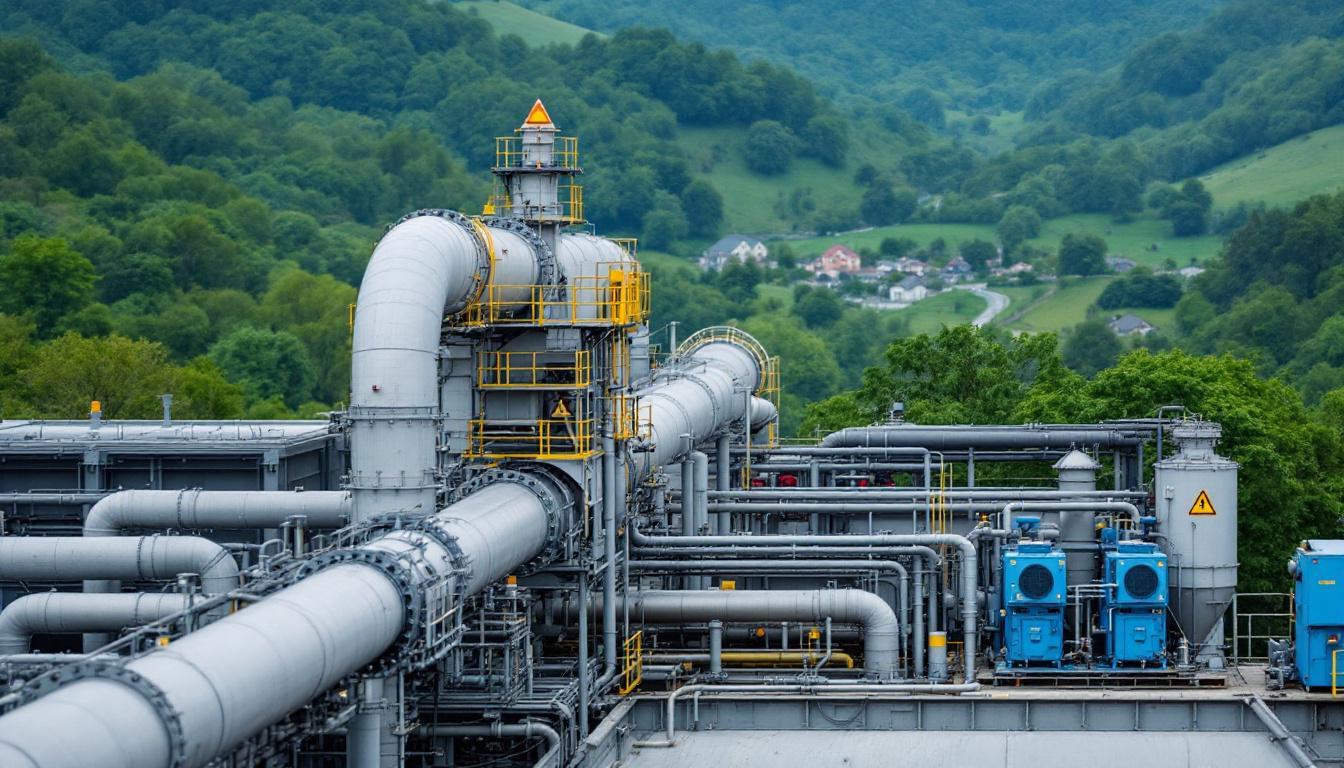
Saipem and Capsol Technologies have formed a non-exclusive partnership to promote large-scale deployment of hot potassium carbonate solvent-based carbon capture, aiming to advance decarbonisation efforts at hard-to-abate industrial sites.
Saipem and Norwegian capture specialist Capsol Technologies have agreed a non‑exclusive partnership to pursue industrial-scale carbon capture projects using hot potassium carbonate (HPC) solvent technology, a move intended to broaden market access for the two firms and speed deployment of capture at hard‑to‑abate sites.
Under the cooperation framework, Capsol will contribute its HPC capture process and modular technology packages while Saipem will provide project delivery, engineering, procurement and construction capabilities. According to Saipem, the arrangement is designed to offer industrial emitters an integrated, standardised route to implement HPC‑based CO2 capture, including optimised designs and execution services for large facilities.
The alliance builds on an existing working relationship: Capsol’s technology is already selected for the large Bioenergy with Carbon Capture and Storage (BECCS) plant Saipem is building for Stockholm Exergi in Sweden. Saipem says that project, for which it has received a full notice to proceed and a contract valued at about €600 million, will capture 800,000 tonnes of biogenic CO2 a year from the Värtaverket biomass cogeneration plant and includes CO2 storage and ship‑loading systems. Industry observers view the BECCS contract as a proving ground for scaling solvent‑based capture solutions for challenging industrial heat and steam profiles.
For Capsol, partnering with established engineering, procurement and construction (EPC) houses is central to a strategy of making carbon capture easier to procure and install; Saipem’s global project execution footprint is expected to help take the company’s offering to a wider set of emitters. The companies say the agreement allows them to pursue joint bids and tenders where mutually appropriate, signalling an intent to target not only power and waste‑to‑energy plants but also heavy industry applications where HPC chemistry can be attractive for cost and energy performance.
Saipem’s approach to post‑combustion capture already includes multiple technology routes. In 2023 Saipem agreed a general licence to deploy Mitsubishi Heavy Industries’ KM CDR absorption processes, reflecting a strategy of combining third‑party capture technologies with its EPC capabilities rather than relying on a single proprietary process. The new Capsol tie‑up therefore broadens Saipem’s technology toolkit at a time when large emitters are assessing capture options against differing flue gas compositions, thermal integration constraints and cost targets.
The partnership’s commercial impact will hinge on a number of market and technical factors. Industry data and project experience indicate that solvent choice, integration with plant steam and heat systems, modularisation to reduce on‑site construction time, and proven delivery track records are decisive in customer procurement. According to Capsol, its HPC route offers a competitive capital and operating cost profile, but commercial uptake will depend on project‑by‑project engineering, the availability of transport and storage solutions, and national policy support such as carbon pricing, subsidy schemes or contractual revenue guarantees for captured CO2.
For large industrial emitters and decarbonisation planners, the Saipem–Capsol agreement signals growing supply‑chain maturity for solvent‑based capture and reinforces the broader trend of EPCs knitting technology licences, modular suppliers and financing partners into turnkey offers. Whether the partnership accelerates deployment at scale will be revealed through forthcoming bid activity and the rollout of projects that follow the Stockholm Exergi example.
- https://www.chemengonline.com/saipem-and-capsol-join-forces-to-promote-carbon-capture-projects/ – Please view link – unable to able to access data
- https://www.saipem.com/en/media/news/Saipem-and-Capsol-partner-on-industrial-scale-CO2-capture-solutions – Saipem and Capsol Technologies ASA have entered into a non-exclusive cooperation agreement to jointly develop carbon capture projects, focusing on the Hot Potassium Carbonate (HPC) segment. This collaboration aims to combine Capsol’s efficient CO₂ capture technology with Saipem’s expertise in delivering complex energy projects, providing large industrial emitters with reliable, fully integrated, and easily implementable solutions, particularly in hard-to-abate and energy sectors.
- https://www.saipem.com/en/saipem-worldwide-projects/BECCS-Stockholm-Exergi – Saipem is executing a large-scale Bioenergy with Carbon Capture and Storage (BECCS) project for Stockholm Exergi in Sweden. The facility is designed to capture 800,000 tonnes of biogenic CO₂ annually from the Värtaverket power plant, enabling net removal of CO₂ from the atmosphere. Saipem is responsible for designing and building the carbon capture unit, CO₂ storage, and ship loading systems.
- https://www.saipem.com/en/media/press-releases/2025-03-31/saipem-full-notice-proceed-stockholm-exergi-execution-large-scale – Saipem has received a full notice to proceed from Stockholm Exergi for a large-scale CO₂ capture project at its existing bio-cogeneration plant in Sweden. The contract, valued at approximately €600 million, involves detailed engineering, procurement, construction, and commissioning of the carbon capture, CO₂ storage, and ship loading systems. Once operational, the plant will capture 800,000 tonnes of biogenic CO₂ annually from the biomass-fueled Värtaverket power plant in Stockholm.
- https://www.saipem.com/en/media/press-releases/2023-04-27/saipem-and-mitsubishi-heavy-industries-sign-agreement-post-0 – Saipem and Mitsubishi Heavy Industries have signed a General License Agreement enabling Saipem to deploy Mitsubishi’s advanced post-combustion CO₂ capture technologies in large-scale projects. These technologies, ‘KM CDR Process™’ and ‘Advanced KM CDR Process™’, are jointly developed with The Kansai Electric Power Co., Inc., and aim to reduce the CO₂ footprint of emitting industrial plants through absorption processes.
- https://www.marinelink.com/news/saipem-capsol-collaborate-co-capture-536573 – Saipem and Capsol Technologies ASA have entered into a non-exclusive cooperation agreement to jointly develop carbon capture projects, focusing on the Hot Potassium Carbonate (HPC) segment. This collaboration aims to combine Capsol’s CO₂ capture technology with Saipem’s expertise in delivering complex energy projects, providing large industrial emitters with reliable, fully integrated, and easily implementable solutions, particularly in hard-to-abate and energy sectors.
- https://www.stockholmexergi.se/en/building-beccs/vi-bygger-beccs-stockholm/ – Stockholm Exergi is constructing a large-scale Bioenergy with Carbon Capture and Storage (BECCS) facility at its existing biomass combined heat and power plant in Stockholm. The plant, being built in collaboration with Saipem, is designed to capture up to 800,000 tonnes of CO₂ annually, more than the total annual emissions from road traffic in Stockholm, marking a significant step towards net-zero emissions in the city’s energy supply.
Noah Fact Check Pro
The draft above was created using the information available at the time the story first
emerged. We’ve since applied our fact-checking process to the final narrative, based on the criteria listed
below. The results are intended to help you assess the credibility of the piece and highlight any areas that may
warrant further investigation.
Freshness check
Score:
10
Notes:
The article was published on March 10, 2026, and reports on a partnership announced on March 5, 2026. No earlier publications of this specific partnership were found, indicating high freshness. The content does not appear to be recycled from other sources.
Quotes check
Score:
10
Notes:
The article does not contain direct quotes. The information aligns with the official press release from Saipem dated March 5, 2026, confirming the accuracy and originality of the content.
Source reliability
Score:
8
Notes:
The article is published on Chemical Engineering Online, a reputable industry publication. However, it is important to note that the content is based on a press release from Saipem, which may present a company-centric perspective. Cross-referencing with independent sources is advisable for a more balanced view.
Plausibility check
Score:
9
Notes:
The partnership between Saipem and Capsol Technologies is plausible, given their respective expertise in engineering and carbon capture technologies. The collaboration builds on an existing project for Stockholm Exergi, adding credibility to the claims. However, the article does not provide detailed information on the specific terms of the agreement, which would be beneficial for a comprehensive assessment.
Overall assessment
Verdict (FAIL, OPEN, PASS): PASS
Confidence (LOW, MEDIUM, HIGH): MEDIUM
Summary:
The article provides timely and accurate information about the partnership between Saipem and Capsol Technologies, corroborated by official sources. However, the reliance on a company-issued press release without independent verification introduces potential bias. For a more comprehensive understanding, consulting additional independent sources is recommended.
