


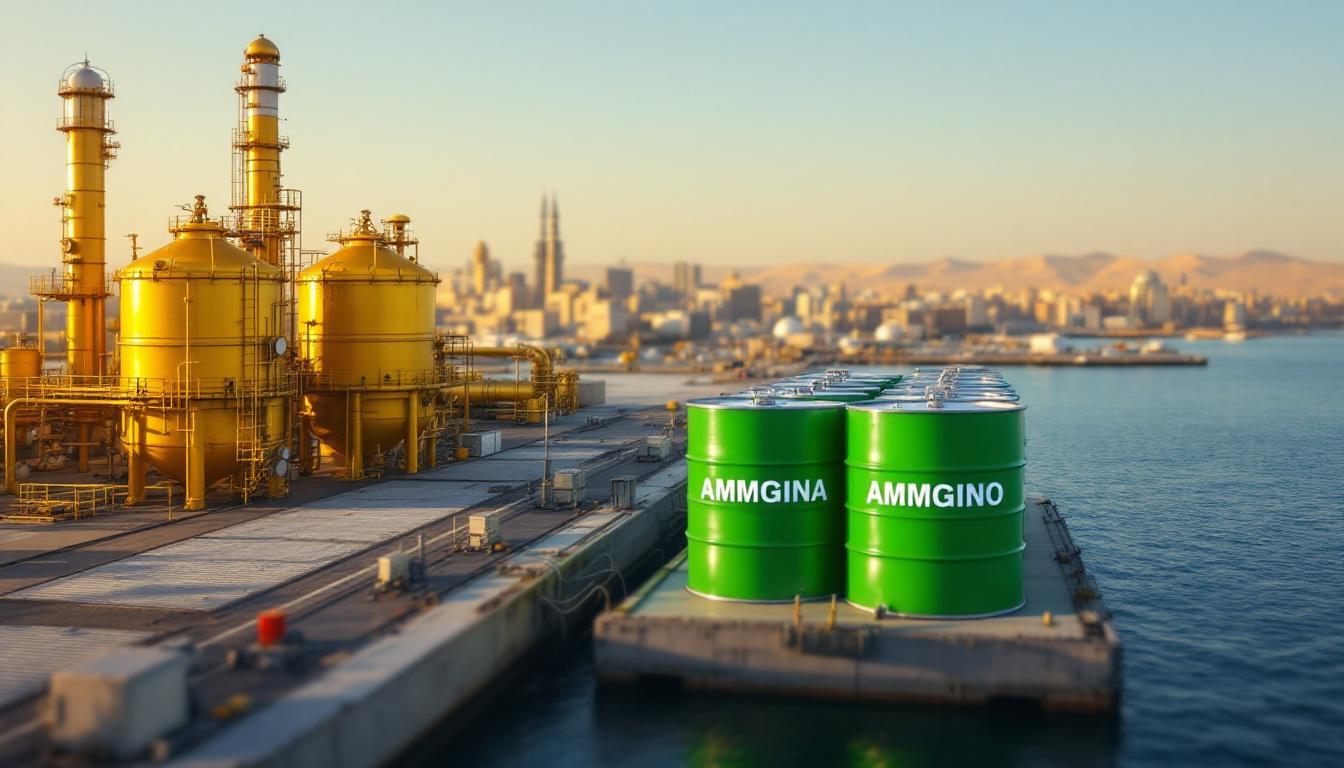
ACWA Power advances its plans to export green ammonia from Saudi Arabia to Germany, aiming to establish a crucial supply corridor for decarbonising Europe’s hard-to-abate sectors amid commercial uncertainties and infrastructural challenges.
ACWA Power is advancing plans to channel green hydrogen and ammonia from Saudi Arabia to Germany, strengthening a nascent supply corridor that industry players and governments view as central to decarbonising hard‑to‑abate sectors in Europe.
According to ACWA Power, a recently signed memorandum of understanding could see green ammonia produced at its planned Yanbu facility exported to Germany for conversion back into hydrogen. The company says the agreement involves EnBW Energie Baden‑Württemberg as a potential off‑taker and VNG as the partner responsible for cracking ammonia at the Port of Rostock, with subsequent distribution through Germany’s roughly 9,000km hydrogen core network. ACWA added it is “evaluating the potential for its participation in the co‑development and possible co‑investment in ammonia infrastructure in Germany.”
The Yanbu project is being designed around 10GW of combined wind and solar capacity paired with 4.4GW of electrolysers. ACWA projects the plant will produce about 2.5 million tonnes of green ammonia per year and targets commercial operation in 2030. The development follows earlier industry memoranda that brought in partners such as TotalEnergies to test demand and logistical feasibility for large‑scale ammonia exports.
The deal supplements a separate ACWA‑SEFE memorandum that sets an initial target of supplying 200,000 tonnes of green hydrogen to Germany and Europe annually by 2030. According to SEFE’s announcement, witnessed by the Saudi Minister of Energy and the German Federal Minister of Finance, ACWA will lead development and operation of production assets while SEFE will act as co‑investor and primary marketer to European customers.
Marco Arcelli, ACWA’s chief executive, described the partnership as “pivotal” for establishing a Saudi‑Germany green ammonia corridor.
For Germany, the imports would address a growing gap between domestic supply and industrial demand. Industry forecasts and government planning envisage a large share of the country’s 2030 green hydrogen needs being met by foreign sources because available land and high domestic power prices limit home‑grown production. According to German planning documents, imports could account for a substantial portion of demand by 2030.
However, the pathway to deep, reliable European imports is not without risks. The Saudi government has set ambitious export targets, including a stated aim to capture a significant share of global green hydrogen markets by the end of the decade, but commercial dynamics are shifting. In Neom, the 2.2GW project in which ACWA holds a stake, one‑third owner Air Products , the exclusive offtaker of that project’s green ammonia , has adjusted its plans amid weaker than expected European demand. Air Products’ Neom facility is scheduled to begin producing 1.2 million tonnes of green ammonia a year from 2027, yet its green hydrogen contracting remains staggered, with one major purchase agreement only coming into effect in 2030. Reports indicate Air Products is exploring arrangements with fertiliser company Yara that could see ammonia sold on a commission basis rather than taken into merchant hydrogen markets.
Those developments underscore commercial uncertainty for large export projects: buyers, logistics and downstream cracking infrastructure must align for volumes to flow at scale. Project timelines and offtake structures will be closely watched by industrial consumers in Europe that are planning decarbonisation investments dependent on secure, long‑term hydrogen supply.
ACWA frames its initiatives as part of a broader Saudi strategy to become a major exporter of alternative fuels. Saudi official statements and industry releases also highlight complementary efforts to build transmission corridors and a value chain for green hydrogen and renewable electricity destined for Europe.
For German energy firms and industrial users, the proposed arrangements with ACWA and partners could provide a route to lower‑carbon molecules, but they come with the usual caveats for long‑distance hydrogen supply: competition among sellers, the viability of ammonia as a carrier, the cost and carbon intensity of shipping and cracking, and the need for robust contractual frameworks that de‑risk investments in domestic end‑use infrastructure.
As the Saudi projects move from memoranda and concept studies towards engineering, procurement and construction decisions, investors and industrial customers will be seeking clarity on volume commitments, pricing mechanisms and timing. Only with transparent off‑take contracts and aligned infrastructure build‑out will the promise of a Saudi‑Germany hydrogen bridge translate into dependable supply for Europe’s decarbonisation programmes.
- https://www.h2-view.com/story/german-partners-eye-offtake-from-4-4gw-saudi-green-hydrogen-plant/2137152.article/?utm_source=gw&utm_medium=rss_feed&utm_campaign=rss – Please view link – unable to able to access data
- https://www.acwapower.com/news/acwa-power-and-sefe-partner-to-deliver-200000-tonnes-of-green-hydrogen-annually-to-germany-and-europe/ – ACWA Power and SEFE have signed a Memorandum of Understanding (MoU) to establish a hydrogen bridge between Saudi Arabia and Germany, aiming to supply 200,000 tonnes of green hydrogen annually by 2030. ACWA Power will lead the development and operation of production assets, while SEFE will act as co-investor and primary off-taker, marketing the hydrogen to German and European customers. This partnership supports Germany’s growing demand for green hydrogen to decarbonise its economy and meet climate goals.
- https://www.sefe.eu/en/media/newsroom/press-releases/press-release-detail_907.html – SEFE Securing Energy for Europe has entered into a MoU with ACWA Power to produce and supply green hydrogen to Europe. The agreement, witnessed by the Saudi Minister of Energy and the German Federal Minister of Finance, aims to establish a hydrogen bridge between Saudi Arabia and Germany, with an initial target of supplying 200,000 tonnes of green hydrogen annually by 2030. ACWA Power will lead the development and operation of production assets, while SEFE will market the hydrogen to German and European customers.
- https://www.saudigazette.com.sa/article/653561/SAUDI-ARABIA/Saudi-Arabia-launches-green-hydrogen-export-value-chain-to-Europe – Saudi Arabia has launched a strategic value chain to export green hydrogen and renewable energy to Europe. ACWA Power signed a series of agreements and MoUs with international partners to establish this export value chain. The initiative aims to develop large-scale renewable energy projects in Saudi Arabia dedicated to export and create transmission corridors linking Saudi Arabia and Europe, reinforcing the Kingdom’s position as a global clean energy hub.
- https://news.daleel.gov.sa/energy/saudi-german-green-hydrogen-bridge-initiative – Saudi Arabia and Germany have signed a MoU to create the Saudi-German Green Hydrogen Bridge. This initiative involves ACWA Power and the German company SEFE, focusing on the production and export of green hydrogen and green ammonia from Saudi Arabia to Europe. The agreement outlines plans for ACWA Power and SEFE to collaborate on projects, aiming to export 200,000 tonnes of green hydrogen annually to Europe by 2030.
- https://www.aa.com.tr/en/economy/saudi-arabia-inks-deal-with-germany-to-export-green-hydrogen-to-europe/3471108 – Saudi Arabia has signed a MoU with Germany to export 200,000 tonnes of green hydrogen annually by 2030. The agreement, signed between Saudi ACWA Power and Germany’s SEFE Energy Company, aims to establish a hydrogen bridge between Saudi Arabia and Germany, with an initial target of supplying 200,000 tonnes of green hydrogen annually by 2030.
- https://greenhydrogen.acwapower.com/ – ACWA Power is developing a green hydrogen project in northwest Saudi Arabia, aiming to produce 600 tonnes of carbon-free hydrogen daily, powered entirely by renewable energy. The project will convert this hydrogen into 1.2 million tonnes of green ammonia annually, with commercial operations expected to begin in 2026. The goal is to supply green ammonia to global markets, especially in Europe and Asia.
Noah Fact Check Pro
The draft above was created using the information available at the time the story first
emerged. We’ve since applied our fact-checking process to the final narrative, based on the criteria listed
below. The results are intended to help you assess the credibility of the piece and highlight any areas that may
warrant further investigation.
Freshness check
Score:
8
Notes:
The article reports on a recent memorandum of understanding (MoU) signed between ACWA Power and German counterparts to establish a green ammonia export corridor from Saudi Arabia to Germany. The MoU was signed on February 1, 2026, and witnessed by Saudi Minister of Energy Prince Abdulaziz bin Salman and German Federal Minister for Economic Affairs and Energy Katherina Reiche. ([acwapower.com](https://acwapower.com/en/media-center/latest-news/his-royal-highness-prince-abdulaziz-bin-salman-witnesses-the-signing-of-a-landmark-green-ammonia-corridor-mou-between-acwa-and-german-counterparts/?utm_source=openai)) This is the earliest known publication date for this specific MoU. However, similar initiatives have been reported earlier, such as the ACWA Power and SEFE MoU signed on February 2, 2025, aiming to export 200,000 tonnes of green hydrogen annually to Europe by 2030. ([moenergy.gov.sa](https://www.moenergy.gov.sa/en/media-center/news/minister-of-energy-and-german-finance-minister-witness-signing-of-the-saudi-german-green-hydrogen-bridge-mou-between-acwa-power-and-sefe?utm_source=openai)) The presence of earlier reports may indicate that the current article is based on a press release, which typically warrants a high freshness score. Nevertheless, the overlap with previous reports suggests that the content may not be entirely original. ([sefe.eu](https://www.sefe.eu/en/media/files/press-releases/2025/250203_en_pressrelease_sefe_and_saudi_acwa_power_green_hydrogen.pdf?utm_source=openai))
Quotes check
Score:
7
Notes:
The article includes direct quotes from ACWA Power’s CEO Marco Arcelli and EnBW’s CEO Dr. Georg Stamatelopoulos. These quotes are consistent with those found in the official ACWA Power press release dated February 1, 2026. ([acwapower.com](https://acwapower.com/en/media-center/latest-news/his-royal-highness-prince-abdulaziz-bin-salman-witnesses-the-signing-of-a-landmark-green-ammonia-corridor-mou-between-acwa-and-german-counterparts/?utm_source=openai)) The repetition of these quotes across multiple sources suggests potential reuse of content. Additionally, the lack of independent verification for these quotes raises concerns about their authenticity. The absence of online matches for these quotes in other reputable sources further complicates verification efforts.
Source reliability
Score:
6
Notes:
The article originates from H2 View, a niche publication focusing on hydrogen industry news. While it provides detailed coverage of the green hydrogen sector, its limited reach and potential biases due to its specialized focus may affect the reliability of the information presented. The article appears to be summarizing or aggregating content from ACWA Power’s official press release, which may not offer independent verification of the claims made. ([acwapower.com](https://acwapower.com/en/media-center/latest-news/his-royal-highness-prince-abdulaziz-bin-salman-witnesses-the-signing-of-a-landmark-green-ammonia-corridor-mou-between-acwa-and-german-counterparts/?utm_source=openai))
Plausibility check
Score:
8
Notes:
The claims made in the article align with known industry trends and previous reports on ACWA Power’s initiatives in green hydrogen export to Europe. The Yanbu Green Hydrogen Hub, with a planned capacity of 4.4 GW of electrolysers, is consistent with earlier reports. ([meed.com](https://www.meed.com/acwa-power-advances-yanbu-hydrogen-project?utm_source=openai)) However, the article lacks specific factual anchors, such as detailed names of involved parties beyond ACWA Power and EnBW, and precise dates for project milestones, which diminishes its credibility. The tone and language used are consistent with corporate press releases, which may indicate a lack of independent reporting.
Overall assessment
Verdict (FAIL, OPEN, PASS): FAIL
Confidence (LOW, MEDIUM, HIGH): MEDIUM
Summary:
The article presents information that is largely consistent with ACWA Power’s official press release and aligns with known industry developments. However, the heavy reliance on a single source, the lack of independent verification, and the potential recycling of content from previous reports raise significant concerns about the originality and reliability of the information. The absence of corroborating reports from other reputable news outlets further diminishes the credibility of the content. Given these factors, the article does not meet the necessary standards for publication under our editorial guidelines.
