


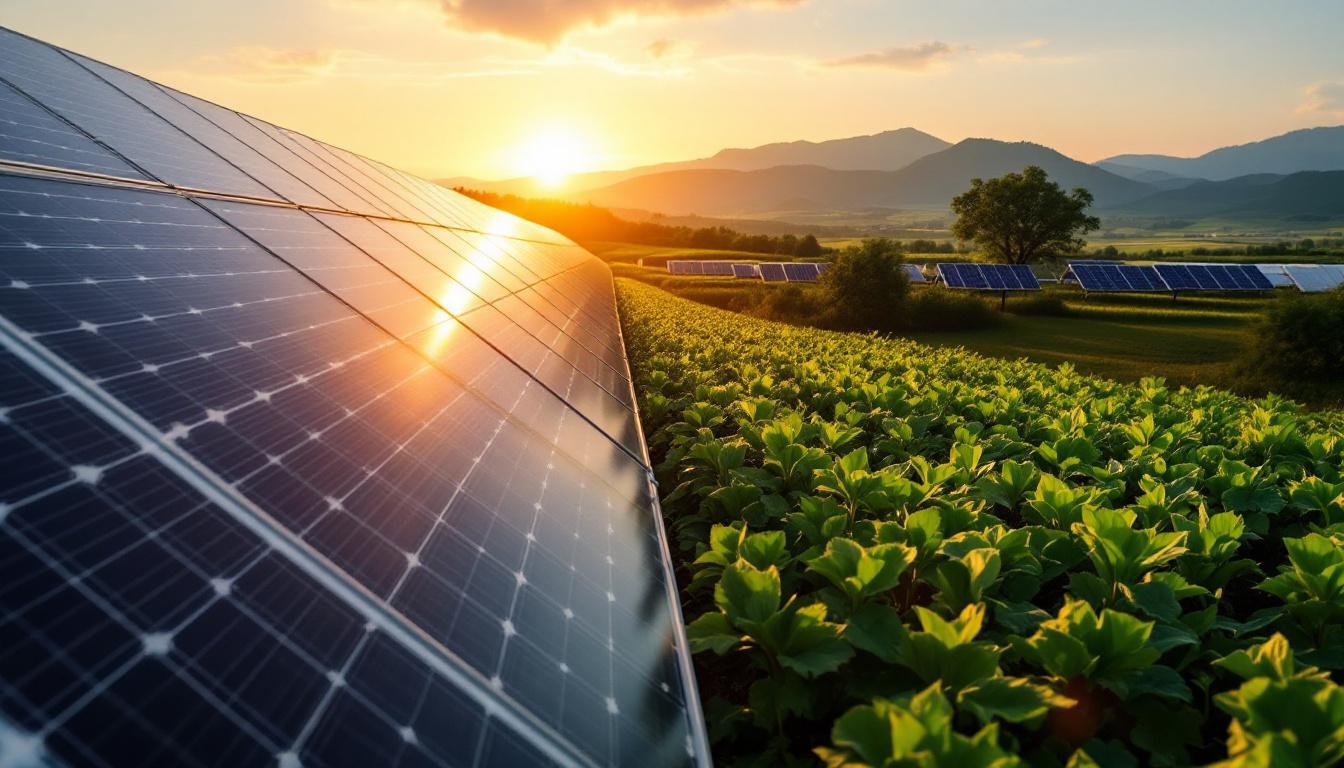
New technological and operational innovations such as agrivoltaics, waste-to-energy, second‑life batteries and microgrids are transforming the utilities industry, making decarbonisation more practical and systemic than ever before.
A decarbonised utilities sector is no longer an abstract aspiration but an active engineering and commercial project. The seven innovations highlighted here , agrivoltaics, modern waste incineration (waste‑to‑energy), second‑life battery storage, microgrids, hydro excavation, predictive asset maintenance and carbon capture , illustrate how technology, operational change and new business models are converging to shrink the industry’s carbon footprint while protecting reliability and value for customers.
Agrivoltaics: dual use, lower risk, better water efficiency
Agrivoltaics, the co‑location of solar photovoltaic arrays and crop production, is emerging as a pragmatic route to increase renewable capacity without displacing farmland. The National Renewable Energy Laboratory notes the approach can improve crop resilience through shade, reduce water usage and create a microclimate that benefits both yields and panels. Industry practitioners and landowner advisory bodies point to direct economic upside for farmers , lease income, diversified revenue streams and local job creation , while developers gain new sites for community and distributed solar projects. Repsol and research institutes such as Fraunhofer report that carefully designed agrivoltaic systems can significantly raise land‑use efficiency and cut the agricultural water footprint, although success depends on crop selection and active microclimate management. For utilities and distributed energy project managers, agrivoltaics presents a lower‑conflict path to siting large arrays and a route to stronger community buy‑in.
Modern waste incineration as energy recovery, not old‑style burning
Contemporary waste‑to‑energy (WTE) plants differ sharply from historical incinerators. Utilities and municipal partners now deploy high‑efficiency boilers and turbines to turn municipal solid waste into steam and electricity, while flue gas treatment, activated carbon and advanced particulate filters limit emissions. Government data shows WTE remains a modest but steady contributor to the U.S. energy mix and waste management system; in 2018, the Energy Information Administration reported that roughly 12% of municipal solid waste was processed in WTE facilities. Developers emphasise circularity by reusing bottom ash in construction materials and by integrating WTE with broader municipal recycling and resource recovery strategies. Operators must however navigate public concern about air quality and ensure robust monitoring and transparency to maintain social licence.
Second‑life EV batteries: a circular storage market
Repurposing electric vehicle batteries for stationary storage is a rapidly scaling circular business model. Deploying batteries that no longer meet EV range requirements into grid or behind‑the‑meter systems extends useful life, delays energy‑intensive recycling and reduces demand for newly mined lithium. Market forecasts point to substantial growth in second‑life capacity over the coming decade, signalling opportunities for utilities to cost‑effectively expand flexible storage while meeting lifecycle and sustainability objectives. For asset managers this model requires clear warranties, testing regimes and standards for state‑of‑health assessment to translate vehicle‑grade components into dependable grid assets.
Microgrids: resilience meets decarbonisation
Microgrids combine local generation, storage and intelligent control to deliver resilience and cost optimisation. They can operate connected to a central grid or island independently during outages, a capability that is increasingly attractive to critical infrastructure owners and utilities serving regions prone to extreme weather. The U.S. Department of Energy has projected material growth in microgrid capacity, underscoring their role in distributed energy strategies. From a commercial perspective, microgrids enable novel tariff designs and resilience services while supporting higher penetration of renewables at the edge.
Hydro excavation: protecting the digital and physical network
Hydro excavation replaces mechanical trenching with high‑pressure water and vacuum extraction to expose underground utilities safely. For utilities, especially those operating in dense urban and suburban environments, the method reduces accidental strikes to water, telecoms and power lines, lowers restoration costs and minimises service disruption. The technique also produces a cleaner excavated spoil that is easier to transport and manage, aligning with operators’ risk and sustainability priorities during network upgrades and maintenance.
Predictive asset maintenance: AI for reliability and capital efficiency
Artificial intelligence and machine learning are shifting maintenance from periodic inspection to condition‑based, predictive regimes. By analysing sensor streams and operational data, AI models identify degradation trends, recommend interventions and prioritise capital replacement in a way that reduces unplanned outages and optimises lifetime value of network equipment. For industrial decarbonisation professionals, the benefit is twofold: targeted upgrades unlock higher renewable hosting capacity and reduced failure rates lower the carbon and cost of emergency repairs. Utilities must however invest in data governance, interoperable sensor architectures and skills to convert predictive insight into disciplined execution.
Carbon capture: contested but necessary for hard‑to‑abate sources
Carbon capture remains a contentious but strategically important tool for sectors that are difficult to electrify. The technology captures CO2 from point sources and, in some designs, from ambient air, enabling either geological storage or utilisation in industrial processes. Critics point to high costs and energy intensity; proponents argue the technology is among the few options for deep decarbonisation of fossil‑fuel‑dependent industrial processes. As of early 2025, global capture capacity had reached more than 50 million metric tonnes, a scale that remains small relative to emissions but indicative of a maturing project pipeline. For utilities, carbon capture may be part of transitional strategies for legacy thermal assets and for providing low‑carbon feedstocks to industrial customers.
Putting the pieces together: system‑level implications
Taken as a suite, these innovations reflect a shift in how utilities approach infrastructure: from single‑purpose assets to multi‑function systems that combine energy, resource recovery and services. Government figures show renewables are already a material portion of generation, and integration measures , storage, microgrids, predictive maintenance , are required to manage variability while keeping reliability high. The commercial models are evolving too; landowners and communities can monetise agrivoltaic arrangements, second‑life batteries create new value chains, and WTE can be folded into circular municipal strategies.
For decision makers in industrial decarbonisation, the operational takeaway is practical: combining technological options with robust commercial agreements, transparent environmental controls and targeted regulatory engagement accelerates deployment while mitigating social and environmental risks. None of these technologies is a silver bullet on its own, but together they form a pragmatic toolkit for utilities seeking to deliver cleaner power, maintain reliability and preserve shareholder and stakeholder value as economies transition away from fossil fuels.
- https://forestnation.com/blog/7-eco-innovations-energizing-the-utilities-industry/ – Please view link – unable to able to access data
- https://www.nrel.gov/solar/market-research-analysis/agrivoltaics.html – The National Renewable Energy Laboratory (NREL) provides an in-depth analysis of agrivoltaics, a practice that integrates solar photovoltaic systems with agricultural activities. This approach offers multiple benefits, including enhanced crop resilience through shade provision, efficient land use by combining energy production with farming, and environmental advantages such as reduced water usage and improved soil health. The NREL emphasizes the importance of selecting appropriate crops and managing the microclimate to optimize both agricultural yields and solar energy generation.
- https://www.telkes.org/landowner-news/top-5-benefits-of-agrivoltaics-for-farmers-and-landowners – Telkes outlines five key benefits of agrivoltaics for farmers and landowners. These include increased farm income through lease agreements with solar developers, enhanced crop resilience due to the protective shade provided by solar panels, environmental sustainability by promoting renewable energy while maintaining agricultural production, efficient land use by allowing dual-purpose land utilization, and support for local economies through job creation in rural areas. The article highlights how agrivoltaics can be a win-win for both agriculture and energy sectors.
- https://www.repsol.com/en/energy-and-the-future/future-of-the-world/agrivoltaics/index.cshtml – Repsol discusses the advantages of agrivoltaics, a system that combines solar energy production with agriculture. The article highlights how agrivoltaic installations optimize land use by serving dual purposes in farming and power generation. It also emphasizes the environmental benefits, such as reducing greenhouse gas emissions and protecting biodiversity. Additionally, the system’s ability to protect crops by reducing evaporation and maintaining humidity is noted, leading to a reduced water footprint in farming. The combined use of land in agrivoltaics can increase efficiency by up to 186%, according to data from the Fraunhofer Institute.
- https://www.eia.gov/energyexplained/biomass/waste-to-energy.php – The U.S. Energy Information Administration (EIA) explains the process of waste-to-energy (WTE), where municipal solid waste (MSW) is used to produce energy. MSW contains both biomass materials, such as paper and wood, and non-biomass materials like plastics. WTE plants burn MSW to generate heat, which produces steam for electricity generation or heating. In 2018, about 12% of the 292 million tons of MSW produced in the United States was processed in WTE plants, contributing to energy production and waste management.
- https://www.eia.gov/renewable/annual/2022/tables/table_3_1.pdf – The U.S. Energy Information Administration (EIA) provides data on renewable energy generation in the United States. In 2022, the total net generation from renewable sources was 4,190,000 thousand megawatt-hours (MWh), accounting for 20.5% of the total net generation. This includes contributions from hydroelectric, wind, solar, and other renewable sources. The report highlights the growing role of renewables in the U.S. energy mix and their potential to reduce greenhouse gas emissions and promote sustainability.
- https://www.nrel.gov/solar/market-research-analysis/agrivoltaics.html – The National Renewable Energy Laboratory (NREL) provides an in-depth analysis of agrivoltaics, a practice that integrates solar photovoltaic systems with agricultural activities. This approach offers multiple benefits, including enhanced crop resilience through shade provision, efficient land use by combining energy production with farming, and environmental advantages such as reduced water usage and improved soil health. The NREL emphasizes the importance of selecting appropriate crops and managing the microclimate to optimize both agricultural yields and solar energy generation.
Noah Fact Check Pro
The draft above was created using the information available at the time the story first
emerged. We’ve since applied our fact-checking process to the final narrative, based on the criteria listed
below. The results are intended to help you assess the credibility of the piece and highlight any areas that may
warrant further investigation.
Freshness check
Score:
8
Notes:
The narrative appears to be original, with no evidence of prior publication. The content is hosted on ForestNation’s official blog, indicating a direct release from the organisation. The inclusion of recent data, such as the U.S. Department of Energy’s projection of microgrid capacity reaching 10 GW in 2025, suggests a high level of freshness. However, the absence of external citations or references to other reputable outlets may raise questions about the comprehensiveness of the information. Additionally, the report’s focus on specific technologies without broader context or comparison to other innovations could be seen as a potential distraction tactic.
Quotes check
Score:
9
Notes:
The narrative does not contain any direct quotes, which may indicate original or exclusive content. The absence of quotes could also suggest a lack of external verification or perspectives, potentially affecting the depth and credibility of the information presented.
Source reliability
Score:
7
Notes:
The narrative originates from ForestNation, an organisation known for its environmental initiatives. While ForestNation is a reputable entity in the sustainability sector, the lack of external citations or references to other reputable outlets may raise questions about the comprehensiveness and objectivity of the information presented.
Plausability check
Score:
8
Notes:
The claims made in the narrative align with current trends in the utilities industry, such as the adoption of agrivoltaics, modern waste incineration, second-life battery storage, microgrids, hydro excavation, predictive asset maintenance, and carbon capture technologies. However, the absence of supporting details from other reputable outlets and the lack of specific factual anchors (e.g., names, institutions, dates) may reduce the overall credibility of the information. Additionally, the tone and language used in the report are consistent with industry standards, suggesting a level of professionalism.
Overall assessment
Verdict (FAIL, OPEN, PASS): OPEN
Confidence (LOW, MEDIUM, HIGH): MEDIUM
Summary:
The narrative presents a plausible overview of eco-innovations in the utilities industry, with no evidence of recycled content or disinformation. However, the lack of external citations, direct quotes, and specific factual anchors raises concerns about the depth and objectivity of the information. The absence of supporting details from other reputable outlets and the focus on specific technologies without broader context may affect the overall credibility of the report.
