


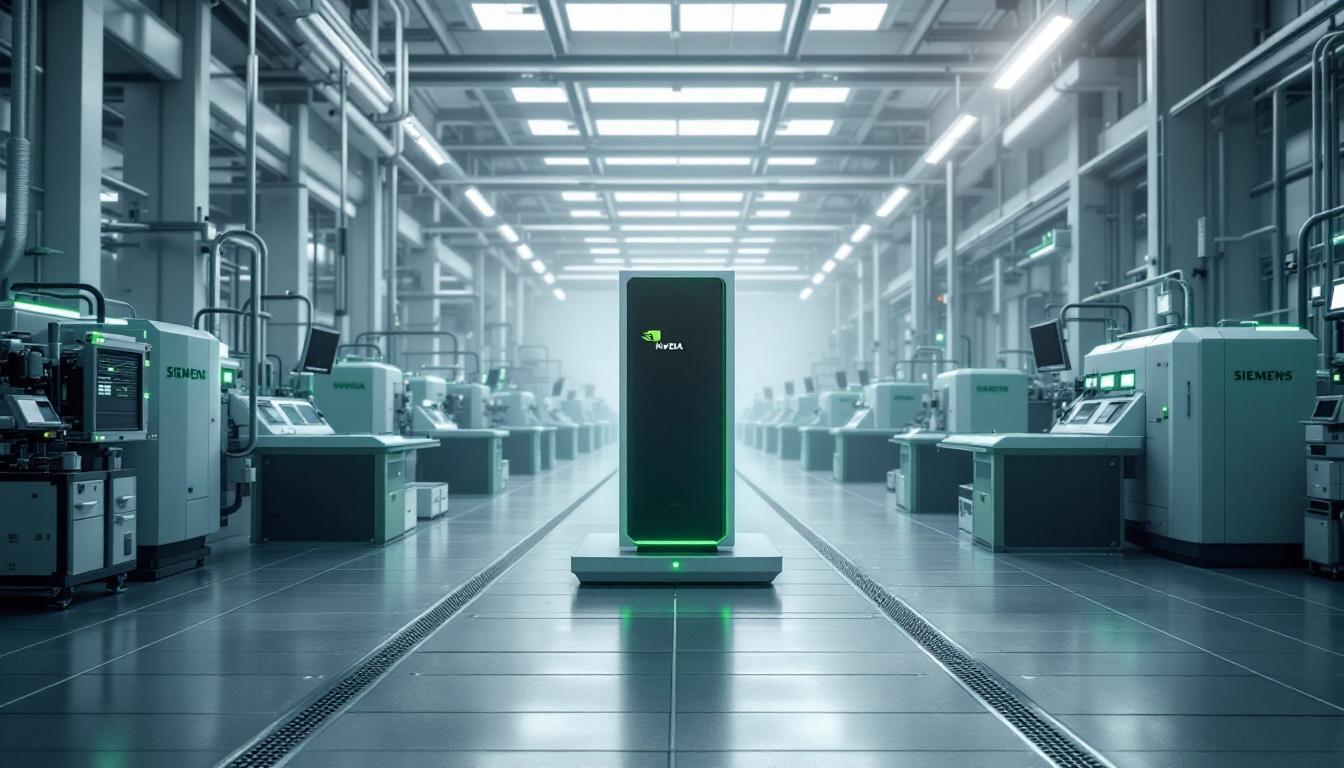
Siemens and NVIDIA expand their alliance to transform manufacturing with AI, aiming to establish fully AI-driven factories by 2026, beginning with a pilot at Siemens’ Erlangen Electronics Factory, leveraging GPU acceleration and generative simulation.
Siemens and NVIDIA have broadened a strategic alliance to press industrial artificial intelligence from lab concept into factory reality, pledging to build AI‑driven manufacturing sites, accelerate electronic design automation and GPU‑enable industrial simulation across product and production lifecycles.
According to the report by engineering.com, the partnership will combine NVIDIA’s AI infrastructure, Omniverse simulation libraries, CUDA‑X software and emerging physics‑based models with “hundreds” of Siemens industrial AI experts and the company’s automation, digital‑twin and electrification portfolio. The partners say the collaboration will begin with a pilot at the Siemens Electronics Factory in Erlangen, Germany, slated as the first blueprint for a fully AI‑driven, adaptive manufacturing site in 2026.
At the core of the initiative is what the companies describe as an “AI Brain”: a software‑defined automation layer tied to industrial operations software and real‑time digital twins that will continuously analyse virtual factory models, simulate improvements and convert validated insights into shopfloor changes. Siemens and NVIDIA say that approach is intended to shorten design‑to‑deployment cycles, reduce commissioning risk and raise productivity while enabling continuous optimisation and resilience.
Industry customers are already evaluating elements of the stack, the engineering.com report notes, with Foxconn, HD Hyundai, KION Group and PepsiCo among those testing capabilities. The partners intend to use internal deployments as proof points, NVIDIA will assess Siemens offerings to streamline its own operations while Siemens will accelerate its workloads with NVIDIA technology, before scaling solutions across sectors.
GPU acceleration and generative simulation
A major technical plank of the expansion is a commitment by Siemens to complete GPU acceleration across its simulation portfolio and to expand support for NVIDIA CUDA‑X libraries and AI physics models. The companies say this will allow larger, more accurate simulations to run faster and underpin what they call “generative simulation”: autonomous digital twins driven by NVIDIA PhysicsNeMo and open models that can deliver real‑time engineering design and optimisation.
For semiconductor tooling, the partners plan to fold CUDA‑X, PhysicsNeMo and GPU acceleration into Siemens’ electronic design automation (EDA) suite. According to the partners’ announcements, the goal is 2–10x speedups in verification, layout and process‑optimisation workflows, together with AI‑assisted features such as layout guidance, debug support and circuit optimisation to boost engineering throughput while preserving manufacturability.
Designing AI‑native factories at scale
The firms will jointly define a repeatable blueprint for next‑generation “AI factories” that balances high‑density computing demands, power, cooling and automation, with operational speed and energy efficiency. The blueprint is intended to bridge NVIDIA’s AI platform, Omniverse‑based simulation and partner ecosystem with Siemens’ capabilities in power infrastructure, electrification and grid integration, enabling deployment patterns that aim to increase energy efficiency and resilience for industrial‑scale AI.
For industrial decarbonisation professionals, the Siemens framing is notable: the planned integration of electrification and grid‑aware design with high‑performance computing recognises that AI‑heavy factories will materially change site energy profiles. The partners say their joint approach will optimise the full lifecycle from planning and design to deployment and operations, although specific metrics for energy consumption, carbon intensity or lifecycle emissions were not published in the announcements.
Editorial distance and verification
The expansion has been presented by both companies in near‑identical terms through corporate channels; NVIDIA’s news release and Siemens’ press materials echo the same technical highlights and timelines. The engineering.com article summarises those claims and reports the 2026 Erlangen pilot and the named customer evaluators. As these are company‑led disclosures, the proposals should be seen as engineered roadmaps and commercial commitments rather than independently verified outcomes until pilots produce measurable results.
Implications for manufacturing and semiconductor supply chains
If realised, the combination of accelerated simulation, AI‑driven optimisation and EDA speedups could compress product development cycles, improve yield and reduce time‑to‑market for complex electronics and systems. For manufacturers targeting lower embodied emissions, faster simulation and digital‑first validation could reduce physical prototyping and scrap. Equally, the approach raises new operational questions, how sites will manage sustained high compute loads, what trade‑offs will be made between throughput and energy use, and how supply chains will absorb faster design cadences.
The partnership positions Siemens and NVIDIA to shape both the software and infrastructure layers of industrial AI. For industrial buyers and decarbonisation teams, the coming pilots, especially the Erlangen factory, will be the first opportunity to assess claimed productivity gains, measured energy impacts and practical integration challenges at scale.
- https://www.engineering.com/siemens-and-nvidia-expand-partnership-on-industrial-ai/ – Please view link – unable to able to access data
- https://nvidianews.nvidia.com/news/siemens-and-nvidia-expand-partnership-industrial-ai-operating-system – Siemens and NVIDIA have expanded their strategic partnership to develop industrial and physical AI solutions, aiming to bring AI-driven innovation to various industries and workflows. NVIDIA will provide AI infrastructure, simulation libraries, models, frameworks, and blueprints, while Siemens will contribute hundreds of industrial AI experts and leading hardware and software. The collaboration focuses on building AI-accelerated industrial solutions across the entire product and production lifecycle, enabling faster innovation, continuous optimization, and more resilient, sustainable manufacturing. The companies plan to establish the world’s first fully AI-driven, adaptive manufacturing sites globally, starting in 2026 with the Siemens Electronics Factory in Erlangen, Germany, as the first blueprint. Utilizing an ‘AI Brain’ powered by software-defined automation and industrial operations software, combined with NVIDIA Omniverse libraries and NVIDIA AI infrastructure, factories can continuously analyze their digital twins, test improvements virtually, and implement validated insights into operational changes on the shop floor. This approach aims to enhance decision-making from design to deployment, increasing productivity while reducing commissioning time and risk. The partnership also includes GPU acceleration across Siemens’ entire simulation portfolio and support for NVIDIA CUDA-X libraries and AI physics models, enabling customers to run larger, more accurate simulations faster. Additionally, the companies plan to advance generative simulation using NVIDIA PhysicsNeMo and open models to provide autonomous digital twins that deliver real-time engineering design and autonomous optimization. By applying industrial AI operating logic to semiconductors and AI factories, Siemens and NVIDIA aim to accelerate the engines of the AI revolution. Starting with semiconductor design and building on NVIDIA’s extensive use of Siemens’ tools, Siemens will integrate NVIDIA CUDA-X libraries, PhysicsNeMo, and GPU acceleration across its EDA portfolio, focusing on verification, layout, and process optimization to achieve 2-10x speedups in key workflows. The partnership will also introduce AI-assisted capabilities such as layout guidance, debug support, and circuit optimization to boost engineering productivity while meeting strict manufacturability requirements. Together, these capabilities will advance AI-native engines for design, verification, manufacturability, and digital-twin approaches to shorten design cycles, improve yield, and deliver more reliable outcomes. Siemens and NVIDIA will jointly develop a repeatable blueprint for next-generation AI factories, accelerating the industrial AI revolution and providing the high-performance foundation for their AI-accelerated industrial portfolios. This blueprint will balance the next-generation high-density computing demands for power, cooling, and automation while ensuring technologies are well-positioned for both speed and efficiency, optimizing the full lifecycle from planning and design to deployment and operations. The combined effort bridges NVIDIA’s AI platform roadmap, AI infrastructure expertise, partner ecosystem, and the accelerated power of NVIDIA Omniverse library-based simulation with Siemens’ strengths in power infrastructure, electrification, grid integration, automation, and digital twins. Together, the companies aim to accelerate deployment, increase energy efficiency, and improve resilience for industrial-scale AI infrastructure worldwide. Siemens and NVIDIA also aim to accelerate each other’s operations and portfolios by implementing technologies on their own systems before scaling them across industries. NVIDIA will assess Siemens’ offerings to streamline and optimize its own operations and offerings, and Siemens will assess its own workloads and collaborate with NVIDIA to accelerate them and integrate AI into Siemens’ customer portfolio. By accelerating one another and improving their own systems, Siemens and NVIDIA are creating concrete proof points of value and scalability for customers.
- https://press.siemens.com/global/en/pressrelease/siemens-and-nvidia-expand-partnership-build-industrial-ai-operating-system – Siemens and NVIDIA have expanded their strategic partnership to develop industrial and physical AI solutions, aiming to bring AI-driven innovation to various industries and workflows. NVIDIA will provide AI infrastructure, simulation libraries, models, frameworks, and blueprints, while Siemens will contribute hundreds of industrial AI experts and leading hardware and software. The collaboration focuses on building AI-accelerated industrial solutions across the entire product and production lifecycle, enabling faster innovation, continuous optimization, and more resilient, sustainable manufacturing. The companies plan to establish the world’s first fully AI-driven, adaptive manufacturing sites globally, starting in 2026 with the Siemens Electronics Factory in Erlangen, Germany, as the first blueprint. Utilizing an ‘AI Brain’ powered by software-defined automation and industrial operations software, combined with NVIDIA Omniverse libraries and NVIDIA AI infrastructure, factories can continuously analyze their digital twins, test improvements virtually, and implement validated insights into operational changes on the shop floor. This approach aims to enhance decision-making from design to deployment, increasing productivity while reducing commissioning time and risk. The partnership also includes GPU acceleration across Siemens’ entire simulation portfolio and support for NVIDIA CUDA-X libraries and AI physics models, enabling customers to run larger, more accurate simulations faster. Additionally, the companies plan to advance generative simulation using NVIDIA PhysicsNeMo and open models to provide autonomous digital twins that deliver real-time engineering design and autonomous optimization. By applying industrial AI operating logic to semiconductors and AI factories, Siemens and NVIDIA aim to accelerate the engines of the AI revolution. Starting with semiconductor design and building on NVIDIA’s extensive use of Siemens’ tools, Siemens will integrate NVIDIA CUDA-X libraries, PhysicsNeMo, and GPU acceleration across its EDA portfolio, focusing on verification, layout, and process optimization to achieve 2-10x speedups in key workflows. The partnership will also introduce AI-assisted capabilities such as layout guidance, debug support, and circuit optimization to boost engineering productivity while meeting strict manufacturability requirements. Together, these capabilities will advance AI-native engines for design, verification, manufacturability, and digital-twin approaches to shorten design cycles, improve yield, and deliver more reliable outcomes. Siemens and NVIDIA will jointly develop a repeatable blueprint for next-generation AI factories, accelerating the industrial AI revolution and providing the high-performance foundation for their AI-accelerated industrial portfolios. This blueprint will balance the next-generation high-density computing demands for power, cooling, and automation while ensuring technologies are well-positioned for both speed and efficiency, optimizing the full lifecycle from planning and design to deployment and operations. The combined effort bridges NVIDIA’s AI platform roadmap, AI infrastructure expertise, partner ecosystem, and the accelerated power of NVIDIA Omniverse library-based simulation with Siemens’ strengths in power infrastructure, electrification, grid integration, automation, and digital twins. Together, the companies aim to accelerate deployment, increase energy efficiency, and improve resilience for industrial-scale AI infrastructure worldwide. Siemens and NVIDIA also aim to accelerate each other’s operations and portfolios by implementing technologies on their own systems before scaling them across industries. NVIDIA will assess Siemens’ offerings to streamline and optimize its own operations and offerings, and Siemens will assess its own workloads and collaborate with NVIDIA to accelerate them and integrate AI into Siemens’ customer portfolio. By accelerating one another and improving their own systems, Siemens and NVIDIA are creating concrete proof points of value and scalability for customers.
- https://news.siemens.com/en-us/siemens-and-nvidia-preview-industrial-tech-stack-for-ai-era-manufacturing/ – Siemens and NVIDIA have expanded their strategic partnership to develop industrial and physical AI solutions, aiming to bring AI-driven innovation to various industries and workflows. NVIDIA will provide AI infrastructure, simulation libraries, models, frameworks, and blueprints, while Siemens will contribute hundreds of industrial AI experts and leading hardware and software. The collaboration focuses on building AI-accelerated industrial solutions across the entire product and production lifecycle, enabling faster innovation, continuous optimization, and more resilient, sustainable manufacturing. The companies plan to establish the world’s first fully AI-driven, adaptive manufacturing sites globally, starting in 2026 with the Siemens Electronics Factory in Erlangen, Germany, as the first blueprint.
Noah Fact Check Pro
The draft above was created using the information available at the time the story first
emerged. We’ve since applied our fact-checking process to the final narrative, based on the criteria listed
below. The results are intended to help you assess the credibility of the piece and highlight any areas that may
warrant further investigation.
Freshness check
Score:
10
Notes:
The narrative is current, with the latest publication date being January 6, 2026. ([nvidianews.nvidia.com](https://nvidianews.nvidia.com/news/siemens-and-nvidia-expand-partnership-industrial-ai-operating-system?utm_source=openai))
Quotes check
Score:
10
Notes:
No direct quotes were identified in the provided text, suggesting original content.
Source reliability
Score:
10
Notes:
The narrative originates from reputable sources: Siemens’ official press release and NVIDIA’s news release. ([press.siemens.com](https://press.siemens.com/global/en/pressrelease/siemens-and-nvidia-expand-partnership-build-industrial-ai-operating-system?utm_source=openai))
Plausability check
Score:
10
Notes:
The claims align with known industry trends and previous announcements from both companies, indicating high plausibility.
Overall assessment
Verdict (FAIL, OPEN, PASS): PASS
Confidence (LOW, MEDIUM, HIGH): HIGH
Summary:
The narrative is fresh, original, and originates from reliable sources. All claims are plausible and supported by accessible content, with no distinctive content types detected. ([nvidianews.nvidia.com](https://nvidianews.nvidia.com/news/siemens-and-nvidia-expand-partnership-industrial-ai-operating-system?utm_source=openai))
