


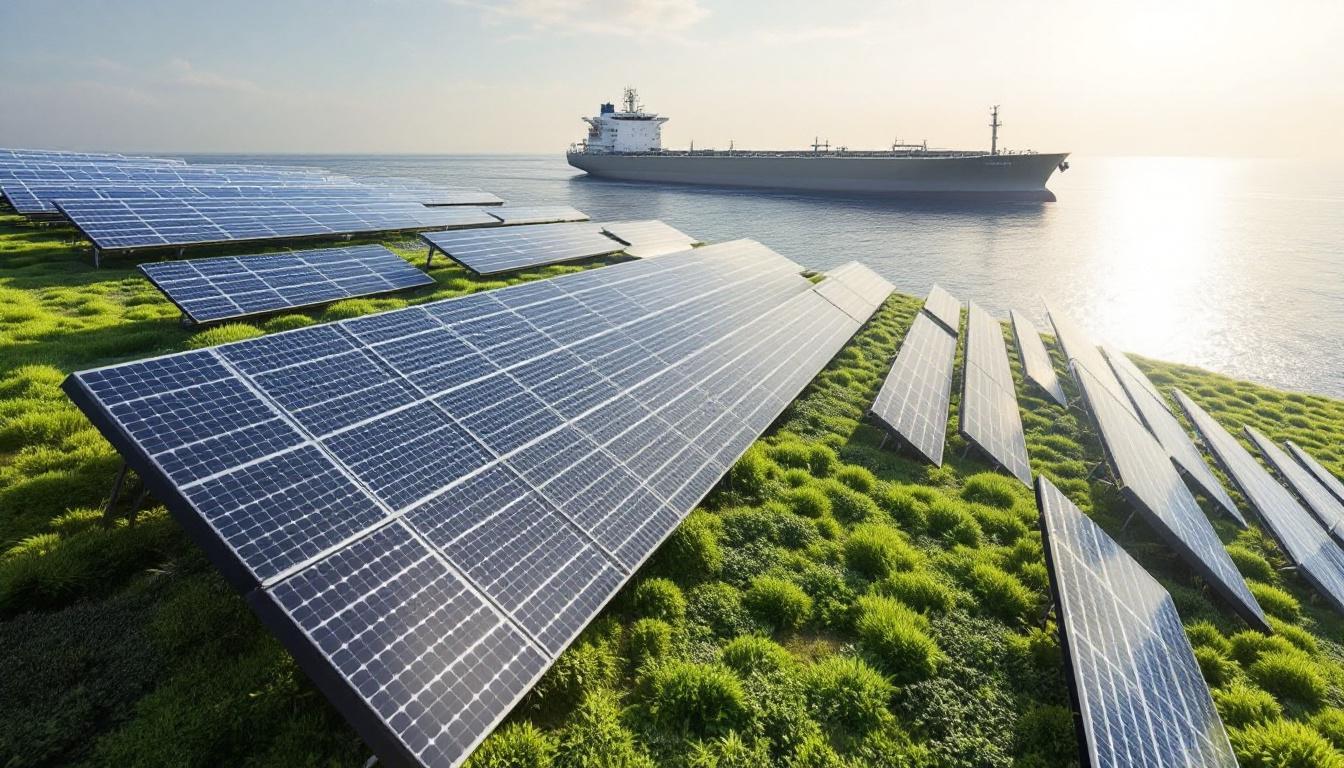
Sohar Port and Freezone is leveraging its logistics strengths to develop a low-carbon manufacturing and energy complex aligned with Oman’s 2050 net-zero goal, integrating renewables, hydrogen, and maritime clean-tech innovations.
Sohar Port and Freezone is converting its scale and logistics advantages into a deliberate industrial decarbonisation play, seeking to turn an existing trade hub into a low-carbon manufacturing and energy complex that supports Oman’s 2050 net-zero objective. The port’s vice president for sustainability, Dr Abdullah Al Abri, framed the effort as strategic rather than symbolic, tracing Sohar’s approach from national policy through to site-level projects during a recent Energy Talks interview with Lionel Rabin.
“The Vision serves as our compass,” Dr Al Abri said, describing how Oman’s Vision 2040 and the newly established Oman Net Zero Center have moved the country from aspirational targets to sectoral roadmaps with governance structures. Sohar, which handles roughly seven out of every ten imported items into Oman and has attracted more than US$30 billion of investment over two decades, is positioning its cluster of metals, petrochemicals, logistics and food businesses to be early beneficiaries of the transition.
Sohar’s decarbonisation strategy is multi-layered, centred on efficiency, electrification, renewables integration, biofuels, hydrogen pathways, and carbon capture, utilisation and storage. The port expects near-term energy-efficiency measures, such as demand-driven lighting, optimisation of cooling and wastewater systems, asset reuse and supply‑chain resource-efficiency programmes, to deliver material reductions in energy intensity and operating cost. “We’re not selling promises, we’re selling progress,” Dr Al Abri said.
Industry-scale renewables and novel site-specific resources underpin the hub’s plans. According to an OECD case study, Sohar has advanced projects coupling electrolysers with dedicated solar capacity, including an initial 35 MW electrolyser co‑located with a solar array and longer-term ambitions for gigawatt-scale PV to supply low‑cost electricity for hydrogen and green-steel production. Dr Al Abri also outlined a local opportunity unique in the Gulf: a cooling-water canal whose steady flow could support continuous hydropower, and mapped waste-heat streams that could feed a centralised recovery network serving heavy industrial tenants.
Maritime decarbonisation is a strategic focus. The port is already piloting biofuels for tugs, installing shore-power capability and developing LNG bunkering, moves that collectively aim to attract emissions‑conscious shipping lines and enable cleaner port calls. The Times of Oman reported that Sohar signed a shore-power agreement in September 2025 with MoonRock as lead investor and PowerCon Denmark as technical partner, a project pitched as supporting compliance with International Maritime Organization targets.
Hydrogen occupies a central role in Sohar’s industrial roadmap. Oman is an established producer of conventional hydrogen; Sohar seeks to host both blue and green pathways and to be ready for natural (so-called white) hydrogen should commercial deposits be confirmed. The port is linked to a CCUS consortium led by OQ and OQ Alternative Energy that has advanced conceptual work for a two‑million‑tonne-per-year CO2 capture facility aimed at enabling blue-hydrogen production and industrial decarbonisation by 2030. Industry partners and investors have also pursued green-hydrogen pilots: earlier collaborative agreements envisioned a 35 MW electrolyser paired with solar supply to decarbonise steelmaking at neighbouring facilities, with potential scale-up to several hundred megawatts. According to Oman News, Sohar signed a memorandum of understanding with Switzerland’s HYNAT SA in July 2025 to assess natural-hydrogen production sites and logistics, signalling growing interest in geological hydrogen options.
Sohar is simultaneously building a manufacturing ecosystem for low‑carbon hardware. Dr Al Abri described near‑term investments in polysilicon and PV component factories, a pipeline that the OECD study notes could extend into ingots, wafers, wind components and electrolyser assembly. That manufacturing thrust is intended to capture value along renewable-energy supply chains and to make the port an export node for cleantech equipment across Asia and Europe.
Partnerships and governance are central to the strategy. Sohar’s long-standing collaboration with the Port of Rotterdam has influenced institutional practices and investor outreach. The port joined the Alliance for Industry Decarbonization in November 2024 to align with global industrial decarbonisation standards, and it participates in ad hoc industry alliances to accelerate project delivery. Private‑sector financing has followed: Muscat Daily reported a US$220 million financing package signed in November 2025 to back expansion projects that include the Marsa LNG bunkering facility, a joint venture between TotalEnergies and OQ set to produce about one million tonnes per year and to run on a dedicated 300 MW solar plant aimed at zero‑carbon operations.
Sohar’s leaders stress the economic case for decarbonisation: lower energy and feedstock costs, industrial resilience, and new export opportunities for low‑carbon products. Dr Al Abri emphasised synergies across supply chains and transport links, noting that planned rail connectivity to the GCC by 2028 should strengthen logistics economics for manufactured low‑carbon goods and feedstocks. For industrial tenants, the appeal is plug‑and‑play access to low‑cost renewable power, CCUS infrastructure and hydrogen offtake options.
For policymakers and corporate decision‑makers tracking regional industrial decarbonisation, Sohar presents a pragmatic model that combines incremental operational improvements with strategic infrastructure investments and targeted manufacturing attraction. The combination of grid decarbonisation, dedicated solar capacity, CCUS readiness and maritime services positions the port as an anchor for Oman’s broader energy-transition ambitions, while partnerships with international technology and investment players aim to translate the country’s solar and wind endowments into competitive industrial propositions.
Sohar’s trajectory is not without risk: delivery hinges on large capital projects, timely grid expansion and the commercial viability of nascent hydrogen markets. Nonetheless, the accumulation of memoranda, pilot plants, alliance memberships and project financing indicates a deliberate move from aspiration to implementation. As Dr Al Abri invited in closing remarks, “Sunshine in Oman is not just a slogan; it’s a cost advantage,” and Sohar is seeking to convert that natural endowment into industrial competitiveness and exportable low‑carbon products.
- https://energyoman.net/sohar-port-and-freezone-charts-a-decarbonised-future?utm_source=rss&utm_medium=rss&utm_campaign=sohar-port-and-freezone-charts-a-decarbonised-future – Please view link – unable to able to access data
- https://www.oecd.org/content/dam/oecd/en/about/programmes/cefim/green-hydrogen/update-case-studies/Port-SOHAR-Case-Study-2024.pdf/_jcr_content/renditions/original./Port-SOHAR-Case-Study-2024.pdf – This OECD report provides a comprehensive case study on the Port of Sohar’s initiatives in green hydrogen, green ammonia, and green steel production. It details the port’s development of a 35-megawatt electrolyser capacity combined with a solar power plant, aiming to produce green hydrogen for industrial use. The study also outlines plans for a 3.5-gigawatt solar power plant to supply electricity to industrial companies, positioning Sohar as a hub for low-cost hydrogen and green steel production. The report discusses the port’s strategic location and its partnership with the Port of Rotterdam, emphasizing the integration of renewable electricity generation and green hydrogen production to support Oman’s clean energy transition.
- https://omannews.gov.om/topics/en/80/show/123546/dark – In July 2025, SOHAR Port and Freezone signed a Memorandum of Understanding (MoU) with Switzerland’s HYNAT SA to develop a comprehensive natural hydrogen value chain in Oman. The partnership focuses on identifying and evaluating production sites, developing logistical infrastructure, and studying demand across industrial, transport, and logistics sectors. This collaboration aims to establish a robust hydrogen ecosystem within SOHAR Port and Freezone, aligning with Oman’s national energy strategy priorities and supporting the country’s clean energy goals.
- https://timesofoman.com/article/162300-sohar-port-and-freezone-signs-agreement-to-develop-sustainable-shore-power-project – In September 2025, SOHAR Port and Freezone signed an agreement to develop a sustainable shore power project at its container terminal. Collaborating with MoonRock as the lead investor and PowerCon Denmark as the technical partner, the project enables vessels to connect to onshore power while berthed, reducing emissions and advancing carbon neutrality by 2050. This initiative strengthens Oman’s position in attracting global shipping lines seeking to meet International Maritime Organisation decarbonisation targets and supports the nation’s transition towards a greener logistics sector.
- https://m.timesofoman.com/article/152035-sohar-port-and-freezone-joins-alliance-for-industry-decarbonization-to-advance-sustainability-goals – In November 2024, SOHAR Port and Freezone joined the Alliance for Industry Decarbonization (AFID), a global initiative dedicated to accelerating the achievement of net-zero goals and promoting the decarbonisation of industrial value chains. This membership aligns with Oman’s Vision 2040 and the country’s commitment to achieving net-zero emissions by 2050. By collaborating with industry leaders and sharing expertise, SOHAR aims to empower stakeholders on their decarbonisation journeys and contribute to a global movement reshaping the future of the industry.
- https://www.majancouncil.org/17244/ – In August 2023, Hydrogen Rise, Jindal Shadeed Iron & Steel, and SOHAR Port and Freezone signed an agreement to evaluate the development of the first green hydrogen plant at Sohar. The project aims to decarbonise the steel production process at Jindal Shadeed’s manufacturing plant by producing steel sustainably, reducing emissions, and conserving gas supplies for other uses across the country. The first phase includes operating a 35-megawatt electrolyser capacity combined with a solar renewable energy plant by mid-2024, with plans to upscale to a potential 350-megawatt electrolysis capacity.
- https://www.muscatdaily.com/2025/11/24/sohar-port-and-freezone-signs-220mn-financing-deal-for-expansion-projects/ – In November 2025, SOHAR Port and Freezone signed a $220 million financing deal for expansion projects, including the Marsa LNG project. This joint venture between TotalEnergies and OQ is set to become the region’s first large-scale LNG bunkering and export facility, developed on a 44.5-hectare site with an annual production capacity of around one million tonnes. The project will be fully powered by a dedicated 300-megawatt solar plant, enabling zero-carbon operations and supporting Oman’s clean energy transition.
Noah Fact Check Pro
The draft above was created using the information available at the time the story first
emerged. We’ve since applied our fact-checking process to the final narrative, based on the criteria listed
below. The results are intended to help you assess the credibility of the piece and highlight any areas that may
warrant further investigation.
Freshness check
Score:
8
Notes:
The article was published on January 28, 2026. A search for similar narratives revealed that the earliest known publication date of substantially similar content is January 20, 2025, in the Times of Oman, reporting on Sohar Port’s cumulative investments reaching $30 billion. ([timesofoman.com](https://timesofoman.com/article/154230-cumulative-investments-at-sohar-port-and-freezone-touch-30bn?utm_source=openai)) The Energy Oman Magazine article provides updated information, including recent developments and quotes from Dr. Abdullah Al Abri, indicating freshness. However, the presence of similar content from a year prior suggests that the narrative has been in circulation for some time. The article appears to be based on a press release, which typically warrants a high freshness score. Nonetheless, the recycled nature of the content and the presence of similar narratives from the previous year raise concerns about originality. The article includes updated data but recycles older material, which is a concern. Given these factors, the freshness score is reduced to 8.
Quotes check
Score:
6
Notes:
The article includes direct quotes from Dr. Abdullah Al Abri, Vice President for Sustainability at Sohar Port and Freezone. A search for the earliest known usage of these quotes did not yield any matches, indicating that they may be original to this article. However, without independent verification of these quotes, their authenticity cannot be confirmed. The lack of online matches for these quotes raises concerns about their verifiability. Given these uncertainties, the quotes check score is reduced to 6.
Source reliability
Score:
7
Notes:
The article is published by Energy Oman Magazine, which appears to be a niche publication. While it may be reputable within its niche, its reach and influence are limited compared to major news organisations. The article appears to be based on a press release, which typically warrants a high source reliability score. However, the niche nature of the publication and the reliance on a press release raise concerns about the independence and reliability of the source. Given these factors, the source reliability score is reduced to 7.
Plausibility check
Score:
8
Notes:
The article discusses Sohar Port and Freezone’s decarbonisation efforts, including partnerships, infrastructure projects, and strategic initiatives. These claims align with previous reports, such as the Times of Oman article from January 20, 2025, which reported on Sohar Port’s cumulative investments reaching $30 billion. ([timesofoman.com](https://timesofoman.com/article/154230-cumulative-investments-at-sohar-port-and-freezone-touch-30bn?utm_source=openai)) The article also mentions recent developments, such as the shore power agreement signed in September 2025, which is corroborated by other sources. ([thearabianstories.com](https://www.thearabianstories.com/2025/09/02/omans-sohar-port-and-freezone-inks-deal-for-shore-power-infrastructure/?utm_source=openai)) However, the lack of independent verification for some claims and the reliance on a press release raise concerns about the overall plausibility of the narrative. Given these factors, the plausibility check score is reduced to 8.
Overall assessment
Verdict (FAIL, OPEN, PASS): FAIL
Confidence (LOW, MEDIUM, HIGH): MEDIUM
Summary:
The article presents a narrative on Sohar Port and Freezone’s decarbonisation efforts, but several concerns affect its credibility. The freshness score is reduced due to the recycled nature of the content and the presence of similar narratives from the previous year. The quotes lack independent verification, raising doubts about their authenticity. The source reliability score is reduced due to the niche nature of the publication and reliance on a press release. The plausibility check score is reduced due to the lack of independent verification for some claims. The verification independence score is reduced due to the reliance on a press release for verification. Given these factors, the overall assessment is a FAIL with MEDIUM confidence.
