


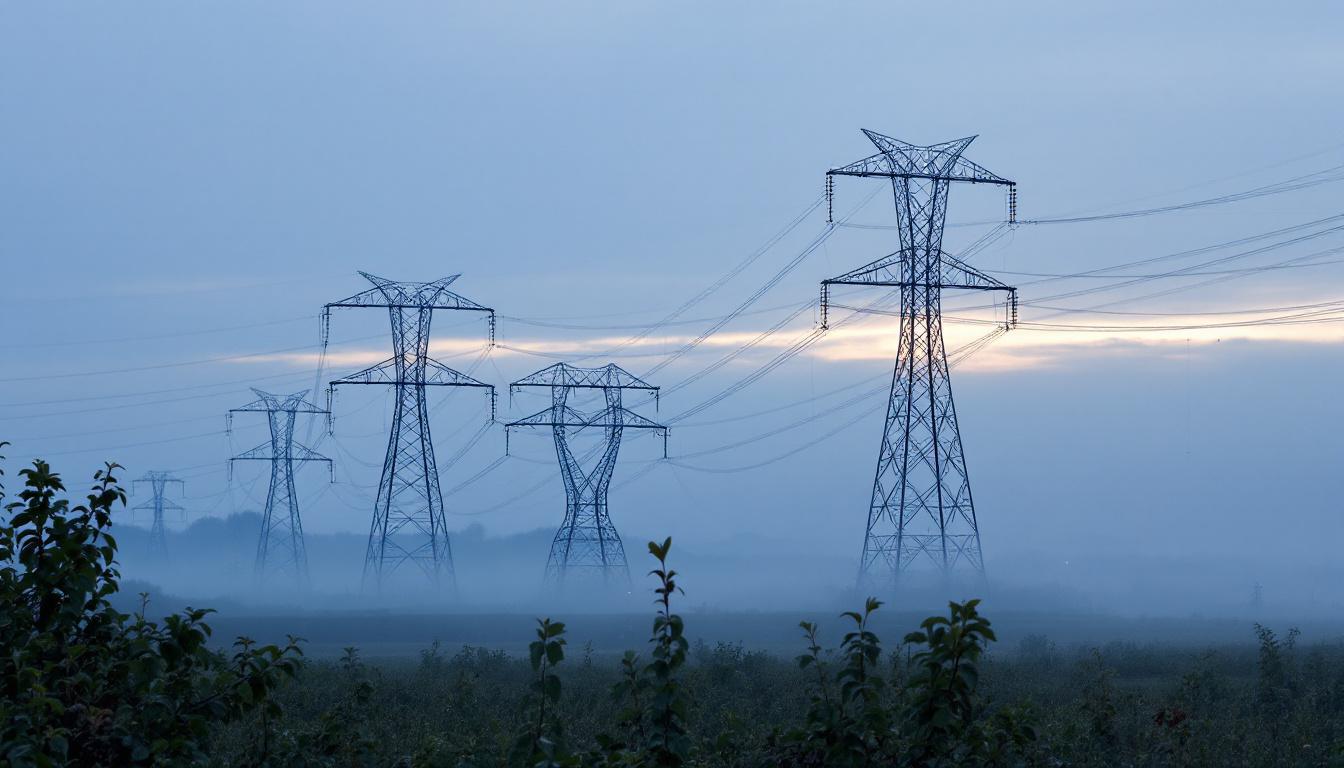
SSE’s ambitious five-year plan to invest £33 billion in renewable projects and transmission upgrades aims to transform the utility into a major growth contender, backed by recent strong financial results and strategic project milestones.
SSE is reshaping the profile of a traditional utilities group by leaning heavily into networks and large-scale renewables, betting that the UK’s transition to a low-carbon power system will deliver superior returns to investors prepared to accept execution risk.
According to MoneyWeek, the business, best known for delivering electricity across southern England and Scotland, has launched an ambitious five‑year investment programme valued at £33 billion. Company disclosures and interim commentary confirm that roughly two‑thirds of that capital is earmarked for upgrading and expanding transmission assets so renewable generators can be connected to the national grid. The remainder is being deployed to grow generation capacity, notably offshore wind projects. Industry coverage notes that this repositioning makes SSE less of a purely defensive utility and more of a growth play for those seeking dividends alongside capital appreciation.
Recent trading and results show tangible progress. In its Q3 trading statement for the period ending 31 December 2024, SSE reported a 26% year‑on‑year increase in renewables output and guided adjusted earnings per share for the 2024/25 year to between 154p and 163p, according to the company. Full-year results for 2024/25 recorded adjusted earnings per share of 160.9p and revealed a record £2.9 billion invested in energy infrastructure, the company said in its annual reporting. Those results followed a £2.5 billion investment clocked in 2023/24, when SSE also reported major project milestones such as full power at Seagreen and first power at Dogger Bank.
Operational progress includes reaching 50% turbine installation on Dogger Bank A and fully energising the Shetland HVDC link, moves the company highlights as central to unlocking north‑sea wind and distributing that output into Great Britain. SSE’s 2024 Annual Report emphasises a balance‑sheet positioned to meet its 2026/27 growth targets and describes a world‑class project pipeline underpinning the plan.
Market reaction has been favourable. MoneyWeek points to a share price uplift of about 26% over six months and 44% over 12 months, while investment‑bank commentary reported in financial press credited the capital plan with an immediate positive re‑rating. Jefferies is cited as viewing the strategy as a “clear positive,” and market reporting notes that SSE’s proposed capital allocation framework through 2029/30 has been described internally as c.£39 billion, which would cover dividends, tax and other cash requirements as well as the £33 billion investment envelope.
SSE has disclosed the intended funding mix for the programme: roughly £2 billion from a new equity placing, £2 billion from targeted asset disposals, about £21 billion from operational cash flow, and c.£14 billion from net debt and hybrid issuance. Analysts quoted in the coverage expect net debt to EBITDA to remain below 4.5 times during the period.
The financial case put forward by management rests on continued demand for renewable power and firm electricity prices. SSE’s reported revenue and earnings trajectory supports that view: group revenue and normalised earnings per share have grown substantially since 2020, and management projects mid‑single to high‑single digit EPS growth over coming years, with dividends capable of rising in line with earnings.
That opportunity is accompanied by clear execution and market risks. Delivering complex transmission projects and multi‑GW offshore wind farms on schedule and within budget is inherently challenging; large programmes are sensitive to permitting, consenting and construction risks, as well as to variable weather that can affect output. The company’s near‑term results have been influenced by weather variability, a point SSE acknowledged in its trading statement. The investment case also assumes electricity demand continues to increase, driven by data centres, electrification of transport and industrial decarbonisation, which may not materialise at the expected pace or could be offset by changes in market pricing dynamics.
Valuation metrics reported by MoneyWeek indicate that, despite the plan and recent upgrades in earnings, the stock trades at about 14 times projected 2027 earnings with a dividend yield near 2.8%, a profile that some investors may find attractive for a utility pursuing growth beyond the traditional defensive remit.
For corporate buyers and industrial decarbonisation professionals watching the UK grid evolve, SSE’s strategy is significant. If the company completes its major transmission links and offshore projects, it will materially increase the capacity to move renewable energy across regions and support electrification of industry. Conversely, delays or cost overruns on flagship projects would slow the pace at which grid reinforcement relieves local constraints and enable new low‑carbon loads.
The coming years will therefore be a test of delivery rather than ambition. According to the company’s communications, a combination of higher renewables output, completed transmission consents and energised links underpins management’s confidence. Independent market commentary acknowledges that the plan could deliver industry‑leading capital growth for SSE if the projects meet technical, regulatory and commercial milestones.
- https://moneyweek.com/investments/energy-stocks/trading-sse-shares – Please view link – unable to able to access data
- https://www.sse.com/news-and-views/2025/02/sse-has-published-its-q3-trading-statement/ – SSE’s Q3 Trading Statement for the period ending 31 December 2024 highlights a 26% year-on-year increase in renewables output, reflecting capacity additions and variable weather conditions. The company expects adjusted earnings per share for the 2024/25 full year to be between 154 and 163 pence, indicating strong operational performance despite mixed weather conditions. This performance underscores SSE’s commitment to its £33 billion investment programme, aiming to enhance electricity networks and renewable energy capacity. The statement also notes progress in securing transmission consents and advancing major transmission projects.
- https://www.sse.com/news-and-views/2025/05/sse-announces-full-year-202425-financial-results/ – SSE’s Full Year 2024/25 financial results reveal a record £2.9 billion investment in energy infrastructure. The company reported an adjusted operating profit of £2,419 million and adjusted earnings per share of 160.9 pence, aligning with guidance. Notable achievements include reaching 50% turbine installation on Dogger Bank A, progressing the 3.6GW offshore wind farm, and fully energising the Shetland HVDC link, connecting Shetland to the GB grid. These developments reflect SSE’s strategic focus on renewable energy and network enhancements.
- https://www.sse.com/news-and-views/2024/05/sse-announces-full-year-202324-financial-results/ – SSE’s Full Year 2023/24 financial results highlight a £2.5 billion investment in critical energy infrastructure. The company reported an adjusted operating profit of £2.4 billion and adjusted earnings per share of 158.5 pence. Key milestones include full power at Seagreen, the world’s deepest fixed-bottom offshore wind farm, and first power at Dogger Bank, the world’s largest wind farm. Additionally, the company commenced construction on the Eastern Green Link 2 subsea transmission cable, the largest in the UK, demonstrating SSE’s commitment to renewable energy and network development.
- https://www.sse.com/annual-report-2024/ – SSE’s Annual Report 2024 outlines the company’s financial and operational performance, meeting its financial objectives for 2023/24. The report details a £2.5 billion investment in infrastructure for net zero and emphasizes safety as the company’s top priority. It highlights a diversified business mix that mitigated the impact of weather and market conditions. The report also discusses the company’s world-class project pipeline and strong balance sheet, positioning SSE for its 2026/27 growth targets, reflecting a strategic focus on sustainable energy and infrastructure development.
- https://www.investing.com/news/earnings/sse-gains-11-on-33-bln-power-network-investment-and-expansion-drive-4350100 – SSE’s £33 billion investment plan has led to an 11% increase in share value, with Jefferies analysts viewing the move as a ‘clear positive.’ The plan is part of a broader £39 billion capital allocation framework through 2029-30, including £6 billion for dividends, tax, and other cash needs. The funding structure comprises £2 billion from a new equity placing, £2 billion from targeted asset disposals, £21 billion in operational cash flow, and £14 billion in net debt and hybrid capital, with net debt-to-EBITDA remaining below 4.5 times during the period.
- https://www.directorstalkinterviews.com/sse-plc-reports-interim-results-and-unveils-33bn-five-year-investment-plan/4121225669 – SSE plc has reported its interim results and unveiled a £33 billion five-year investment plan. The company reported an adjusted EBITDA of £1,152.2 million and an operating profit of £655 million. Earnings per share were 36.1 pence, with an interim dividend per share of 21.4 pence. The investment and capital expenditure stood at £1,570.1 million. The company also reported a net debt and hybrid capital of £11,437.6 million. The plan aims to deliver industry-leading capital growth across the group, with a focus on networks and renewables.
Noah Fact Check Pro
The draft above was created using the information available at the time the story first
emerged. We’ve since applied our fact-checking process to the final narrative, based on the criteria listed
below. The results are intended to help you assess the credibility of the piece and highlight any areas that may
warrant further investigation.
Freshness check
Score:
7
Notes:
The article references SSE’s £33bn investment plan announced in November 2025 and includes financial data up to May 2025. However, the article was published in March 2026, which raises concerns about the freshness of the information. The latest available data is from May 2025, making the content approximately 10 months old. This significant time gap reduces the relevance and timeliness of the information presented. Additionally, the article appears to be a summary of previously published reports, lacking new insights or updates. This recycling of content from earlier publications further diminishes its freshness.
Quotes check
Score:
5
Notes:
The article does not provide direct quotes from SSE’s official statements or other sources. Instead, it paraphrases information from SSE’s Q3 Trading Statement and Full-Year Results. The absence of direct quotes makes it challenging to verify the exact wording and context of the information presented. While the paraphrased content aligns with SSE’s publicly available reports, the lack of direct attribution raises concerns about the accuracy and reliability of the information.
Source reliability
Score:
6
Notes:
The article is published on MoneyWeek, a financial news outlet. While MoneyWeek is known for its financial coverage, it is not as widely recognized as major news organizations like the BBC or Reuters. This relative obscurity may affect the perceived reliability of the source. Additionally, the article appears to be a derivative work, summarizing information from SSE’s official reports without providing new analysis or insights. This lack of original reporting raises questions about the independence and depth of the content.
Plausibility check
Score:
8
Notes:
The claims regarding SSE’s £33bn investment plan and financial performance are consistent with previously reported information. SSE’s Q3 Trading Statement from February 2025 and Full-Year Results from May 2025 confirm the £33bn investment plan and the reported financial figures. However, the article does not provide new information or analysis beyond what is already publicly available, which limits its value in contributing to the current understanding of SSE’s activities.
Overall assessment
Verdict (FAIL, OPEN, PASS): FAIL
Confidence (LOW, MEDIUM, HIGH): HIGH
Summary:
The article fails to meet the necessary standards for factual reporting due to its reliance on outdated and recycled content, lack of direct quotes, and absence of independent verification sources. The significant time gap between the latest available data and the article’s publication date, combined with the lack of new analysis or insights, diminishes the article’s relevance and credibility. The absence of original reporting and analysis categorizes the content as a derivative work, which is not suitable for factual reporting.
