


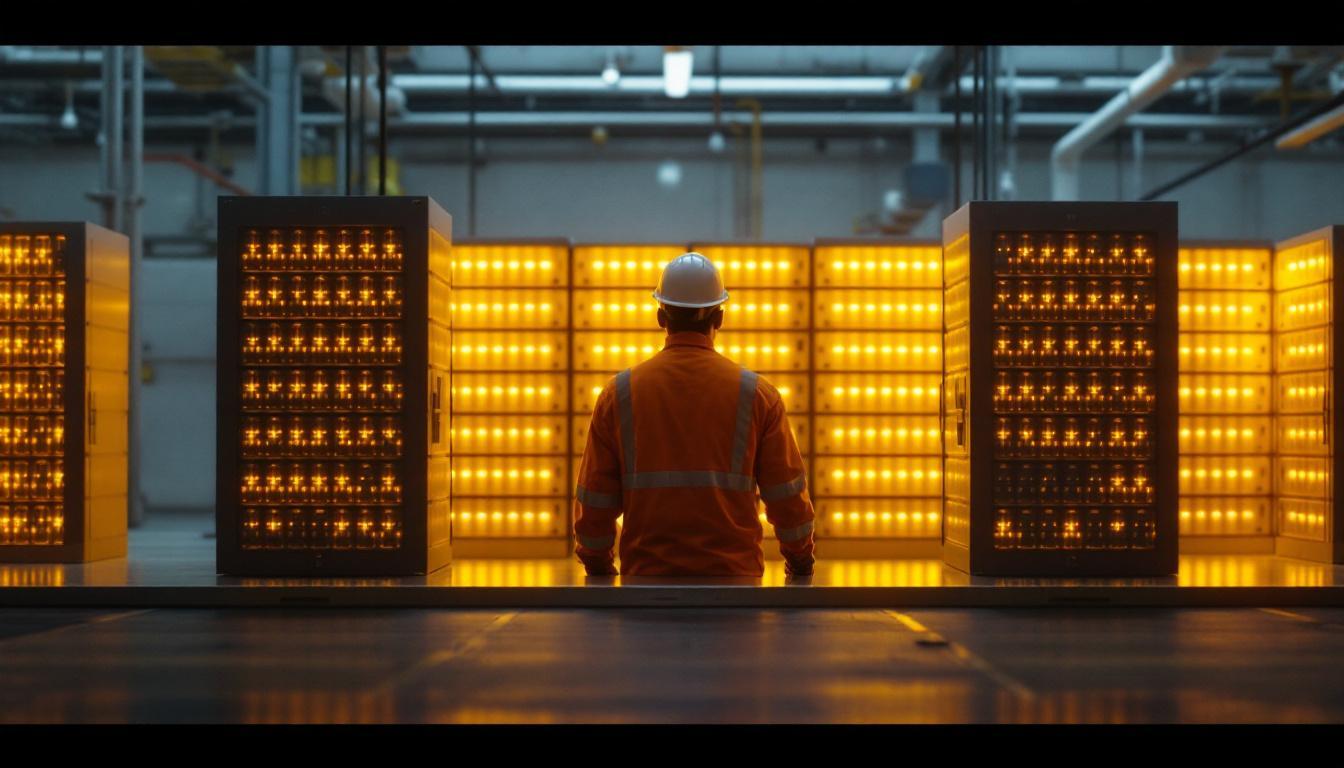
Tesla’s energy division saw record profits and increased deployment of stationary storage solutions despite a slowdown in vehicle deliveries, signalling a strategic pivot towards industrial decarbonisation and emerging supply chain shifts.
Tesla’s push into grid-scale batteries accelerated last quarter even as its core vehicle business cooled, underscoring a strategic tilt toward stationary storage that is reshaping supply dynamics for the U.S. market.
According to a Utility Dive report, Tesla deployed 14.2 GWh of energy storage in the fourth quarter of 2025 and 46.7 GWh for the year, increases of 29% and 49% respectively versus 2024. The company said its energy unit, covering stationary batteries and rooftop solar, delivered record profit margins for a fifth straight quarter and reported robust demand across Powerwall home systems and Megapack utility products, the latter of which Tesla intends to ramp up with a new production site near Houston targeting as much as 50 GWh annually. Chief Executive Elon Musk framed the expansion as a long-term bet: “We are building more manufacturing capacity and expect that energy will have very high growth for as far into the future as we can imagine.”
The storage surge came amid weakening vehicle deliveries for Tesla; fourth‑quarter car shipments fell year on year as North American EV sales cooled after U.S. consumer tax incentives for EV purchases and leases lapsed. Industry data cited by Utility Dive show EV volumes remain stronger outside North America, with global growth still positive in 2025.
Independent reporting offers a different view of Tesla Energy’s recent scale. PV‑Tech’s pv‑magazine reported a larger 12‑month deployment figure, 43.5 GWh, and an 84% year‑on‑year rise, alongside a notably higher margin for the energy arm (around 31.4%). That piece also described plans to produce a new Megablock product at the Houston site beginning in 2026 and projected combined grid‑storage manufacturing capacity of roughly 133 GWh per year once Houston, California and Shanghai facilities are fully operational. The discrepancies between the outlets’ figures illustrate how firms and trade publications can report divergent metrics depending on product classification, timing and accounting conventions.
The shifting mix, stronger storage, softer EVs, was echoed by major Korean cell makers. LG Energy Solution and Samsung SDI told investors that stationary storage demand helped cushion a North American EV slowdown. LG said it expects global energy storage growth to outpace EV battery growth by about four to one in 2026 and is targeting some 90 GWh of stationary storage orders and over 60 GWh of production capacity by year‑end, with roughly 80% of that capacity earmarked for North America. Both companies flagged U.S. production and deployment tax credits as near‑term demand drivers.
For project developers, data centres and utilities focused on industrial decarbonisation, these developments carry immediate procurement and planning implications. Policy incentives, including the clean energy investment tax credit and cell‑manufacturing support, are already altering where gigawatt‑scale capacity will be built and who will supply it. Yet analysts caution that headwinds remain: solar deployment projections have been revised down by some forecasters later this decade because of new sourcing rules, permitting delays and the accelerated phaseout of certain tax benefits, which could in turn influence the pairing of PV and batteries that underpins many grid‑scale offerings.
Tesla says it will continue to invest in solar as a complement to storage, Musk explicitly outlined ambitions to scale solar cell output toward 100 GW a year across an integrated supply chain, though some market analysts have questioned how rapidly the company can deliver that manufacturing expansion and whether it is reflected in its near‑term capital plans.
As corporate and policy levers redirect battery demand from mobility to stationary applications, suppliers and buyers in the industrial decarbonisation sector will need to monitor capacity ramps, product roadmaps and the evolving interpretation of reported deployment figures. Industry participants should also expect continued volatility while tax regimes, trade measures and permitting frameworks are settled across major markets.
- https://www.utilitydive.com/news/tesla-battery-storage-ev-samsung-lg/811266/ – Please view link – unable to able to access data
- https://www.utilitydive.com/news/tesla-battery-storage-ev-samsung-lg/811266/ – In the fourth quarter of 2025, Tesla’s energy storage deployments reached a record 14.2 GWh, contributing to a total of 46.7 GWh for the year, marking a 29% and 49% increase from the previous year, respectively. This growth occurred alongside a 16% decline in Tesla’s vehicle deliveries. The company plans to commence Megapack production at a new facility near Houston, aiming for an annual output of up to 50 GWh. Tesla’s energy business, encompassing stationary storage and solar PV systems, achieved record profit margins for the fifth consecutive quarter, with strong demand across all regions and product lines. CEO Elon Musk expressed confidence in the future growth of the energy sector, stating, “We are building more manufacturing capacity and expect that energy will have very high growth for as far into the future as we can imagine.”
- https://www.pv-magazine.com/2025/10/28/tesla-energy-output-rises-84-to-43-5-gwh-with-record-deployments/ – Tesla Energy reported an 84% year-over-year increase in deployed capacity, reaching 43.5 GWh over the past 12 months. In Q3 2025, the company deployed a record 12.5 GWh, surpassing the previous record of 11.4 GWh in Q4 2024. The energy division achieved a 31.4% profit margin, nearly doubling the non-energy generation profit margin of 16.1%. Tesla announced plans to manufacture its new “Megablock” product at a facility under construction in Houston, beginning in 2026, with a planned annual capacity of 50 GWh. Combined with existing facilities in California and Shanghai, Tesla’s total grid storage manufacturing capacity is expected to reach about 133 GWh per year once Houston comes online.
- https://www.pv-magazine.com/2025/10/28/tesla-energy-output-rises-84-to-43-5-gwh-with-record-deployments/ – Tesla Energy reported an 84% year-over-year increase in deployed capacity, reaching 43.5 GWh over the past 12 months. In Q3 2025, the company deployed a record 12.5 GWh, surpassing the previous record of 11.4 GWh in Q4 2024. The energy division achieved a 31.4% profit margin, nearly doubling the non-energy generation profit margin of 16.1%. Tesla announced plans to manufacture its new “Megablock” product at a facility under construction in Houston, beginning in 2026, with a planned annual capacity of 50 GWh. Combined with existing facilities in California and Shanghai, Tesla’s total grid storage manufacturing capacity is expected to reach about 133 GWh per year once Houston comes online.
- https://www.pv-magazine.com/2025/10/28/tesla-energy-output-rises-84-to-43-5-gwh-with-record-deployments/ – Tesla Energy reported an 84% year-over-year increase in deployed capacity, reaching 43.5 GWh over the past 12 months. In Q3 2025, the company deployed a record 12.5 GWh, surpassing the previous record of 11.4 GWh in Q4 2024. The energy division achieved a 31.4% profit margin, nearly doubling the non-energy generation profit margin of 16.1%. Tesla announced plans to manufacture its new “Megablock” product at a facility under construction in Houston, beginning in 2026, with a planned annual capacity of 50 GWh. Combined with existing facilities in California and Shanghai, Tesla’s total grid storage manufacturing capacity is expected to reach about 133 GWh per year once Houston comes online.
- https://www.pv-magazine.com/2025/10/28/tesla-energy-output-rises-84-to-43-5-gwh-with-record-deployments/ – Tesla Energy reported an 84% year-over-year increase in deployed capacity, reaching 43.5 GWh over the past 12 months. In Q3 2025, the company deployed a record 12.5 GWh, surpassing the previous record of 11.4 GWh in Q4 2024. The energy division achieved a 31.4% profit margin, nearly doubling the non-energy generation profit margin of 16.1%. Tesla announced plans to manufacture its new “Megablock” product at a facility under construction in Houston, beginning in 2026, with a planned annual capacity of 50 GWh. Combined with existing facilities in California and Shanghai, Tesla’s total grid storage manufacturing capacity is expected to reach about 133 GWh per year once Houston comes online.
Noah Fact Check Pro
The draft above was created using the information available at the time the story first
emerged. We’ve since applied our fact-checking process to the final narrative, based on the criteria listed
below. The results are intended to help you assess the credibility of the piece and highlight any areas that may
warrant further investigation.
Freshness check
Score:
8
Notes:
The article was published on February 3, 2026, reporting on Tesla’s Q4 2025 performance. The data on Tesla’s energy storage deployments in Q4 2025 and the full year 2025 were first reported by Utility Dive on January 28, 2026. The article appears to be based on this Utility Dive report, which is a reputable source. However, the article does not provide a direct link to the original Utility Dive report, which would have enhanced transparency. Additionally, the article includes information from other sources, such as the Houston Chronicle, but does not provide direct links to these sources either. This lack of direct sourcing raises concerns about the article’s freshness and originality.
Quotes check
Score:
7
Notes:
The article includes a direct quote from Tesla CEO Elon Musk: “We are building more manufacturing capacity and expect that energy will have very high growth for as far into the future as we can imagine.” This quote is attributed to a Utility Dive report, but no direct link is provided. Without access to the original source, it’s challenging to verify the accuracy and context of the quote. The absence of direct sourcing for the quote raises concerns about its authenticity.
Source reliability
Score:
6
Notes:
The article cites Utility Dive, a reputable source, but does not provide direct links to the original reports. This lack of direct sourcing makes it difficult to independently verify the information presented. The absence of direct links to the original sources raises concerns about the article’s source reliability.
Plausibility check
Score:
8
Notes:
The claims about Tesla’s record energy storage deployments in Q4 2025 and the full year 2025 are plausible and align with industry trends. However, the article does not provide direct links to the original sources, making it challenging to independently verify the information. The absence of direct sourcing raises concerns about the plausibility of the claims.
Overall assessment
Verdict (FAIL, OPEN, PASS): FAIL
Confidence (LOW, MEDIUM, HIGH): MEDIUM
Summary:
The article reports on Tesla’s record energy storage deployments in Q4 2025 and the full year 2025, citing Utility Dive as the source. However, it does not provide direct links to the original Utility Dive report or other cited sources, making it challenging to independently verify the information. The absence of direct sourcing raises concerns about the article’s freshness, originality, and source reliability. Given these issues, the article does not meet the necessary standards for publication.
