


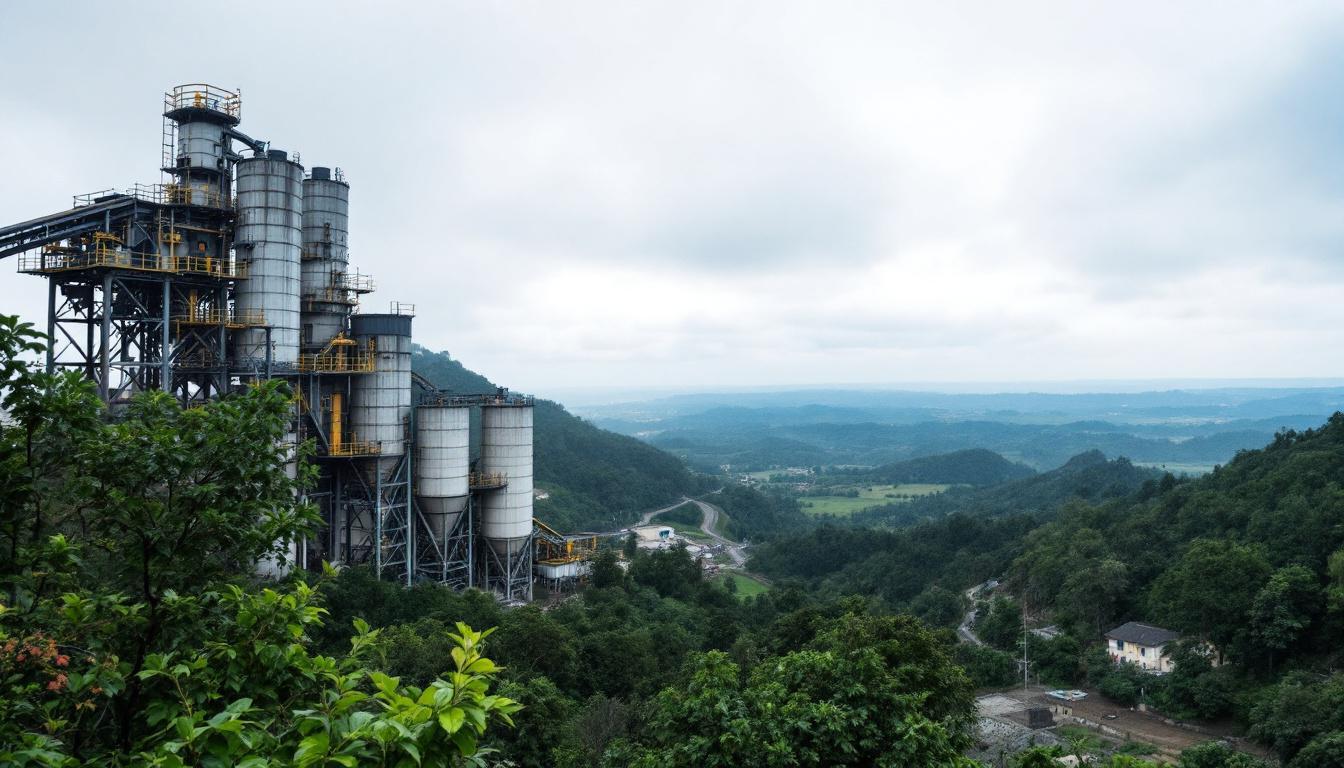
Titan Cement Egypt is leading the nation’s cement sector shift with a $3 billion expansion plan, focusing on greener energy, increased exports, and adapting to tighter environmental standards, positioning itself at the forefront of Egypt’s industry renaissance.
Titan Cement Egypt is positioning itself at the centre of Egypt’s cement industry transformation, marrying an aggressive expansion push with a concerted drive to decarbonise production and broaden export markets.
In an interview with Zawya, Amr Reda, CEO of Titan Cement Egypt, described the shift toward alternative fuels as no mere compliance exercise but “a gate to the future” for Egyptian heavy industry. The company’s broader strategy combines capacity investment, logistics optimisation and greener energy to protect domestic market share while keeping export channels open.
Investment and capacity
Titan is pursuing a multi-year investment programme that, by the company’s own account, amounts to roughly $3 billion aimed at expanding output and cutting emissions. According to Enterprise, that capital, largely earmarked for the 2025–2026 window, targets raising production capacity to roughly 5.5 million tonnes next year from around 4.5 million tonnes today. Titan’s management told industry media it expects to lift annual production ultimately toward the mid-5 million-tonne range.
Operationally, Titan plans incremental investments in fuel substitution and energy efficiency. Cemfuels reports the firm aims to produce 0.4 million tonnes per year of alternative fuels by the end of 2027, supported by a €7–8 million injection from the global parent. The same reporting notes the Beni Suef plant will source around 10,000 MW of solar-generated electricity, covering roughly 13% of that facility’s power needs, and that alternative fuels currently meet about 40% of Titan Egypt’s energy demand. The company has signalled intentions to expand that share, with public targets cited by Enterprise to reach 70% alternative-fuel utilisation by 2030.
Export strategy and market dynamics
Reda stressed that exports remain a complement rather than a substitute for robust domestic demand. Titan exported about 850,000 tonnes last year and is targeting roughly 1 million tonnes for 2026, he said in the Zawya interview. These figures sit alongside other published company targets and market reports indicating near‑term export ambitions of about 1 million tonnes with revenues approaching USD 50 million, as reported by Invest‑Gate.
Market observers note a volatile and shifting export landscape. Hydrocarbon Processing recorded a national record of 9.7 million tonnes of cement and clinker exported in 2024, nearly triple 2022 volumes, driven by regional reconstruction and state support. CementChina highlighted a spectacular rise in shipments to Israel between 2022 and 2024, while other reporting indicates Egypt’s exports have started to moderate as domestic demand rebounds, CementChina records a modest fall in export receipts in the first 11 months of 2025 amid surging local consumption.
Logistics, pricing and competitiveness
Reda underlined that a competitive production cost is only one element; logistics, packaging and receiving‑market infrastructure determine whether export opportunities convert into sales. He pointed to wide price differentials with rivals such as Vietnam, where reported ex‑works pricing can be materially lower, but noted Egypt enjoys freight cost advantages. These dynamics, together with potential competitors from Iran, Algeria and Saudi Arabia as their port capabilities evolve, make agility essential.
The domestic market remains the backbone. Industry figures cited by Zawya indicate Egypt’s 2025 domestic consumption reached roughly 54 million tonnes against production of some 85 million tonnes, leaving scope for both local absorption and surplus exports. Large infrastructure programmes such as Ras El Hekma and the Marassi Red Sea developments are expected to underpin demand into the late 2020s.
Decarbonisation and regulatory drivers
A central plank of Titan’s strategy is faster adoption of low‑carbon products and fuel mixes to meet incoming regulatory and buyer‑driven standards. Reda framed compliance with European environmental standards and mechanisms such as the EU’s Carbon Border Adjustment Mechanism as both an imperative and a market opportunity. He said Titan is expanding low‑clinker cement lines and scaling alternative fuel use, with its subsidiary GAEA set up to source and develop green fuel streams.
Independent reporting underscores the company’s commitments: Cemfuels details plans for third‑party alternative‑fuel supply and participation in a presidential construction‑waste recycling initiative with Beni Suef University. Invest‑Gate records Titan’s decision since 2024 to halt clinker exports to limit environmental impact and concentrate on cement exports, reflecting a strategic tilt toward lower‑carbon tradeable products.
Infrastructure substitution and product innovation
Beyond fuels and kilns, Titan is advocating for broader material substitution where appropriate. In the interview Reda highlighted studies showing concrete pavements can lower vehicle fuel consumption and reduce maintenance needs compared with asphalt, and suggested innovative cement‑sand mixes for rural roads to limit mud formation and extend service life, arguments that align with decarbonisation and lifecycle‑cost rationales relevant to public procurement.
Implications for industrial decarbonisation
For industrial decarbonisation professionals, Titan’s approach bundles familiar elements: capital investment in capacity and electrification, fuel switching to waste‑derived and biomass streams, on‑site solar generation, and product portfolio shifts toward low‑carbon cements. The company’s dual aim, securing domestic demand while keeping export options viable under tightening environmental rules, mirrors the wider sectoral challenge in emerging markets where trade competitiveness must be reconciled with decarbonisation costs.
Conclusion
Titan Cement Egypt is betting that scale, supply‑chain improvements and a rapid transition to alternative fuels will preserve its competitive position as both local construction activity rebounds and international buyers tighten environmental requirements. Whether that combination will fully offset price pressure from lower‑cost exporters and logistics constraints in target markets will depend on execution of the investment programme, the pace of alternative‑fuel deployment and how regional infrastructure and trade patterns evolve.
- https://www.zawya.com/en/economy/north-africa/titan-cement-egypt-pioneering-sustainability-through-alternative-fuels-bbfir8v7 – Please view link – unable to able to access data
- https://enterpriseam.com/egypt/2025/11/12/cement-player-titan-to-invest-egp-3-bn-to-boost-capacity/ – Titan Cement Egypt plans to invest EGP 3 billion by 2026 to expand its production capacity and increase the use of alternative fuels. The company aims to raise its total production capacity to 5.5 million tons next year, up from the current 4.5 million tons. Additionally, Titan intends to increase its alternative fuel usage to 70% of total consumption by 2030, up from the current 40%, to reduce costs and cut carbon emissions. The company is also targeting 1 million tons in exports by next year, nearly doubling last year’s 550,000 tons. ([enterpriseam.com](https://enterpriseam.com/egypt/2025/11/12/cement-player-titan-to-invest-egp-3-bn-to-boost-capacity/?utm_source=openai))
- https://www.cemfuels.com/news – Titan Egypt aims to reach production of 0.4 million tons per year of alternative fuel by the end of 2027, backed by €7-8 million in investment financed by its global parent company. Alternative fuels currently account for about 40% of total energy demand. The company’s Beni Suef plant signed an agreement to generate 10,000 MW of solar-powered electricity, covering around 13% of its energy needs. Titan plans to supply alternative fuels to third parties in the future and is participating in a presidential initiative to recycle construction waste in cooperation with Beni Suef University. The company has made significant progress in reducing its CO₂ emissions through improved energy efficiency and increasing reliance on alternative fuels. Titan Egypt plans to invest US$64 million by the end of 2029 through a mix of internal and bank financing. ([cemfuels.com](https://www.cemfuels.com/news?utm_source=openai))
- https://www.cementchina.net/news/content/56174788168075001.html – Egypt’s cement exports to Israel experienced a significant surge, increasing by 29 times in total and 45 times in quantity in 2024 compared to 2022. Specifically, Egypt’s cement exports to Israel soared from 52,300 tons in 2022 to 2.4 million tons in 2024, an increase of more than 45 times. The total export value rose from 16.43 million NIS (about 4.9 million U.S. dollars) in 2022 to 525.73 million NIS (about 142 million U.S. dollars) in 2024, a nearly 29-fold increase in dollar terms. This surge is attributed to increased demand following geopolitical events and Egypt’s ability to fill the supply gap left by other exporting countries. ([cementchina.net](https://www.cementchina.net/news/content/56174788168075001.html?utm_source=openai))
- https://www.hydrocarbonprocessing.com/news/2025/01/beware-egypts-smokestack-onshoring-as-cement-exports-surge/ – Egypt’s exports of cement and clinker reached a record 9.7 million tons in 2024, nearly tripling the amount shipped in 2022. This surge is attributed to increased demand from regional reconstruction projects and the Egyptian government’s support for the cement industry. The government has allocated fixed prices for natural gas supplies to cement producers, helping them control costs and boost exports. The cement industry is identified as a key driver of economic growth in Egypt. ([hydrocarbonprocessing.com](https://www.hydrocarbonprocessing.com/news/2025/01/beware-egypts-smokestack-onshoring-as-cement-exports-surge/?utm_source=openai))
- https://www.cementchina.net/news/content/68471890749815001.html – Egypt’s cement industry is experiencing a strong recovery in domestic demand, leading to a shift in export strategies. In the first 11 months of 2025, cement exports fell to $806 million, down 4% year-on-year, continuing the downward trend of the past six months. This change is attributed to explosive growth in domestic demand, driven by factors such as the implementation of massive national projects and the reinstatement of the 2008 building law, which stimulates private construction activity. The government is also providing support to the industry to meet this growing demand while ensuring local market stability. ([cementchina.net](https://www.cementchina.net/news/content/68471890749815001.html?utm_source=openai))
- https://invest-gate.me/news/titan-egypt-and-al-ahly-pharos-launch-a-workshop-to-enhance-economic-and-environmental-awareness-in-the-cement-industry/ – Titan Cement Egypt has increased its investments to EGP 3 billion during the period 2025–2029 to develop factories and support recycling operations and the green transition. On the export front, the company is targeting the export of one million tons this year with revenues approaching USD 50 million. Since 2024, Titan has made a strategic decision to completely halt clinker exports to protect the environment and limit exports to cement only. This aligns with the company’s commitment to supporting Egypt Vision 2030 and the National Climate Change Strategy 2050. Titan seeks to make sustainability a core element of competitiveness and innovation by expanding the production of green low-clinker cement and relying on alternative fuels through its subsidiary, GAEA. ([invest-gate.me](https://invest-gate.me/news/titan-egypt-and-al-ahly-pharos-launch-a-workshop-to-enhance-economic-and-environmental-awareness-in-the-cement-industry/?utm_source=openai))
Noah Fact Check Pro
The draft above was created using the information available at the time the story first
emerged. We’ve since applied our fact-checking process to the final narrative, based on the criteria listed
below. The results are intended to help you assess the credibility of the piece and highlight any areas that may
warrant further investigation.
Freshness check
Score:
7
Notes:
The article presents recent developments in Titan Cement Egypt’s sustainability efforts and expansion plans. However, some information overlaps with previously published press releases from July 2025 and June 2025, which may indicate recycled content. ([zawya.com](https://www.zawya.com/en/press-release/companies-news/titan-egypt-achieves-dual-sustainability-milestones-for-its-plants-gmx4ggvq?utm_source=openai))
Quotes check
Score:
6
Notes:
Direct quotes from CEO Amr Reda are used in the article. While these quotes are consistent with previous statements, their earliest known usage cannot be independently verified, raising concerns about their originality.
Source reliability
Score:
8
Notes:
The article is published on Zawya, a reputable news platform. However, the content appears to be based on press releases from Titan Cement Egypt, which may limit the independence of the information presented.
Plausibility check
Score:
7
Notes:
The claims about Titan Cement Egypt’s investment in alternative fuels and expansion plans are plausible and align with industry trends. However, the lack of independent verification sources raises concerns about the accuracy of these claims.
Overall assessment
Verdict (FAIL, OPEN, PASS): FAIL
Confidence (LOW, MEDIUM, HIGH): MEDIUM
Summary:
The article presents information on Titan Cement Egypt’s sustainability initiatives and expansion plans. However, the heavy reliance on press releases raises concerns about the originality and independence of the content. Additionally, the inability to independently verify direct quotes from CEO Amr Reda further diminishes the credibility of the article. Given these issues, the article does not meet the necessary standards for publication.
