


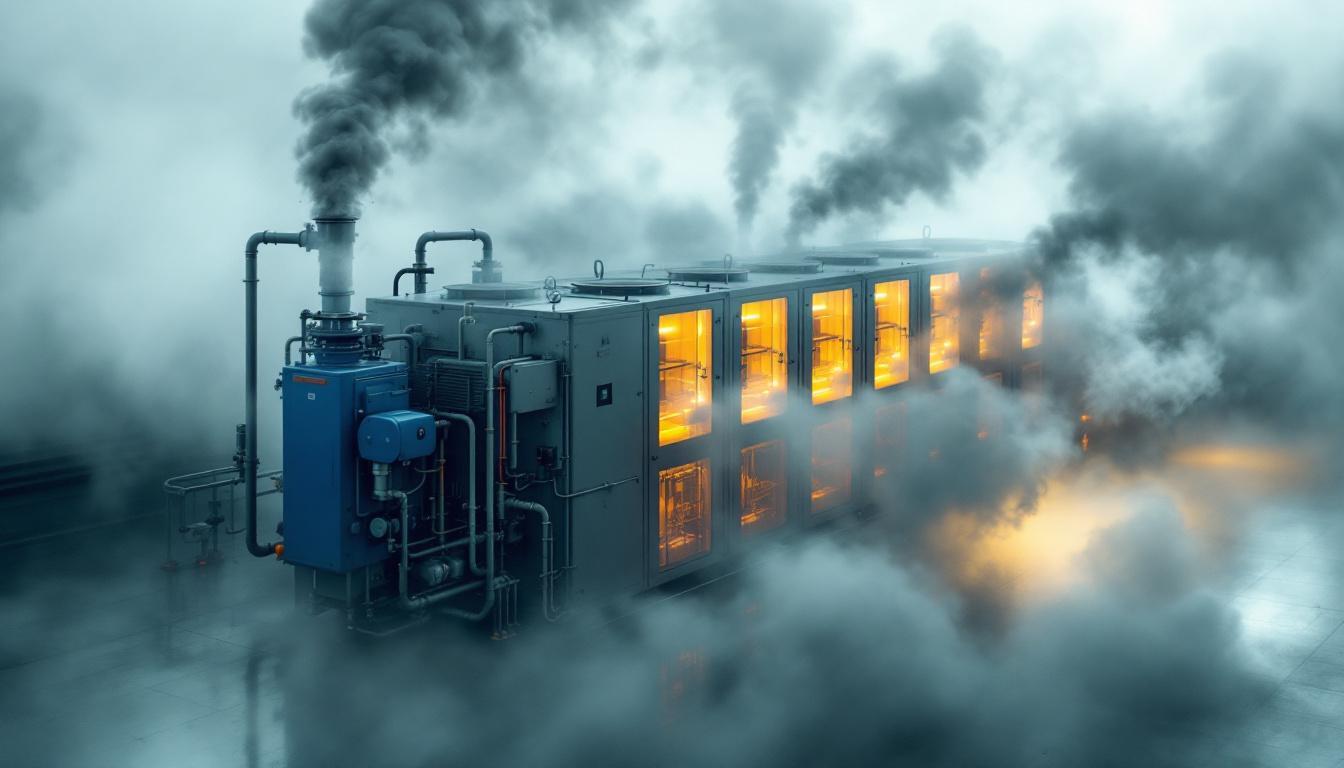
Turboden, a Mitsubishi Heavy Industries group company, has installed the largest heat-pump system capable of producing industrial steam, aiming to reduce CO2 emissions at Delfort’s paper mill in Finland and demonstrate large-scale electrification for energy-intensive industries.
Turboden, a Mitsubishi Heavy Industries group company, has brought online what it describes as the largest heat-pump system configured to produce industrial steam, installing the unit at Delfort’s paper mill in Tervakoski, Finland. According to Turboden, the plant converts low-temperature waste heat and electricity from carbon-free sources into 12 MWth of superheated steam at roughly 3.4 bar(a), with outlet temperatures in the 150–180°C range.
The installation couples a large heat pump with mechanical vapour recompression (MVR) and, the company says, is currently delivering a coefficient of performance about 10% higher than its contractual guarantee. Turboden expects the system to displace around 19,000 tonnes of Scope 1 CO2 emissions each year by replacing fossil‑fuel boilers in Delfort’s steam generation mix. According to pv‑magazine, the guaranteed COP baseline for the project was 2, which the plant has exceeded.
Project partners within the Mitsubishi Heavy Industries group supplied key components: Mitsubishi Heavy Industries Compressor Corporation provided centrifugal compressors for the scheme, illustrating an intra‑group industrial supply chain supporting the build. Mitsubishi’s corporate technical review notes Turboden’s growing capability in delivering heat‑pump solutions capable of supplying process heat up to about 200°C, drawing on the company’s engineering experience with Organic Rankine Cycle systems and waste‑heat recovery.
Delfort required a fully decarbonised steam source that could match the reliability of conventional boilers while fitting into an existing plant footprint. Turboden says the solution was engineered to meet those constraints, integrating the heat pump and MVR plant into the mill’s steam network and coordinating controls to deliver stable output across varying production conditions. Turbomachinery Magazine and Bioenergy International report that the system’s packaging and control integration were central to meeting maintainability and operational-access requirements inside the existing plant room.
The start‑up has been positioned by Turboden as a demonstration that electrified, large‑scale heat pumps are a commercially viable decarbonisation route for energy‑intensive industries. “For the industrial and energy sectors, this project stands as clear evidence that large-scale heat pump technologies are a viable and already available decarbonization solution,” said Paolo Bertuzzi, Managing Director and CEO of Turboden, in a statement. Nicola Rossetti, General Manager Heat Electrification BU at Turboden, added: “The successful start-up of the world’s largest steam-producing heat pump marks an important step in the electrification of industrial heat at scale,” in a company statement.
The Delfort deployment arrives amid a broader push to electrify industrial heat. Industry observers note parallel initiatives, including start‑ups proposing modular heat pumps to replace combustion boilers for steam production in pulverised markets; pv‑magazine and trade outlets have highlighted an MIT‑affiliated company, AtmosZero, among firms targeting the roughly 2.2 gigatonnes of annual CO2 associated with industrial steam globally.
For plant operators evaluating decarbonisation pathways, the Turboden project offers a real‑world case of high‑temperature steam electrification that addresses common technical challenges, limited retrofit space, integration with existing steam systems and the need for coordinated control between heat‑pump and MVR units. Turboden and Mitsubishi Heavy Industries present the scheme as evidence that waste‑heat upgrading combined with CO2‑free electricity can deliver both the temperatures and continuity required by processes such as paper manufacture, while delivering meaningful reductions in direct emissions.
- https://interestingengineering.com/innovation/worlds-largest-steam-heat-pump-italy – Please view link – unable to able to access data
- https://www.turboden.com/company/media/press/press-releases/4947/turboden-successfully-starts-up-the-worlds-largest-steam-producing-heat-pump-setting-a-new-benchmark-for-industrial-decarbonization – Turboden, a subsidiary of Mitsubishi Heavy Industries, has successfully launched the world’s largest steam-producing heat pump at Delfort, a specialty paper manufacturer. This system generates 12 MWth of superheated steam at 3.4 bar(a), reaching temperatures of 150–180°C, by recovering low-grade waste heat and upgrading it using CO₂-free electricity. The installation is operating 10% above its guaranteed coefficient of performance, demonstrating the viability of large-scale heat pump technologies for industrial decarbonisation. The project is expected to avoid approximately 19,000 tonnes of CO₂ emissions annually, marking a significant step in the electrification of industrial heat at scale.
- https://www.turbomachinerymag.com/view/turboden-kickstarts-largest-steam-producing-heat-pump-at-specialty-paper-plant – Turboden, part of Mitsubishi Heavy Industries, has initiated the world’s largest steam-producing heat pump at Delfort’s specialty paper mill. The system is now fully operational and overperforming with a coefficient of performance 10% higher than the expected value. The project features a large-scale heat pump with mechanical vapor recompression capable of generating 12 MWth of superheated steam at 3.4 bar, raising the temperature up to 150–180°C. It recovers low-grade waste heat from Delfort’s industrial processes and upgrades the heat using CO₂-free electricity, marking a significant milestone in the decarbonisation of energy-intensive industrial processes.
- https://bioenergyinternational.com/turboden-starts-up-the-worlds-largest-steam-producing-heat-pump/ – Turboden, a Mitsubishi Heavy Industries group company, has announced the successful start-up of the world’s largest steam-producing heat pump at Delfort’s paper mill. The system generates 12 MWth of superheated steam at 3.4 bar(a), reaching temperatures of 150–180°C, by recovering low-grade waste heat and upgrading it using CO₂-free electricity. The installation is operating 10% above its guaranteed coefficient of performance, demonstrating the potential of CO₂-free heat technologies to replace fossil-fuel-based boilers in industrial applications requiring steam above 150°C. The project is expected to avoid approximately 19,000 tonnes of CO₂ emissions annually.
- https://www.pv-magazine.com/2026/02/19/worlds-largest-steam-producing-heat-pump-comes-online-in-finland/ – Turboden, part of Mitsubishi Heavy Industries, has energised what it calls the world’s largest steam-producing heat pump, delivering 12 MWth of superheated steam using low-grade waste heat and CO₂-free electricity with a coefficient of performance 10% above its guaranteed value of 2. The system was installed at a Delfort paper mill in Tervakoski, Finland, and is capable of generating 12 MWth of superheated steam at 3.4 bar(a), raising the temperature to 150–180°C. The project demonstrates the potential of CO₂-free heat technologies to replace fossil-fuel-based boilers in industrial applications requiring steam above 150°C.
- https://www.mhi.com/group/mco/news/2023/20230302.html – Turboden, an Italy-based company and part of Mitsubishi Heavy Industries, has been awarded a large industrial heat pump for a leading European company in the pulp and paper industry. Mitsubishi Heavy Industries Compressor Corporation will provide centrifugal compressors to Turboden for the realisation of this innovative large heat pump system. This project is a remarkable example of corporate synergies within the Mitsubishi Heavy Industries Group and contributes to the decarbonisation of steam and high-temperature heat for industrial processes.
- https://www.mhi.com/technology/review/sites/g/files/jwhtju2326/files/2025-05/e601040.pdf – Turboden, a Mitsubishi Heavy Industries group company, is an Italian firm and a global leader in the design, manufacture, and maintenance of Organic Rankine Cycle (ORC) systems, highly suitable for distributed generation. ORC systems can generate electric and thermal power exploiting multiple sources, such as renewables (biomass, geothermal energy, solar energy), traditional fuels, and waste heat from industrial processes, waste incinerators, engines, or gas turbines. The company has developed expertise in large-scale heat pumps, capable of providing process heat up to 200°C with high coefficients of performance (COP).
Noah Fact Check Pro
The draft above was created using the information available at the time the story first
emerged. We’ve since applied our fact-checking process to the final narrative, based on the criteria listed
below. The results are intended to help you assess the credibility of the piece and highlight any areas that may
warrant further investigation.
Freshness check
Score:
10
Notes:
The news article reports on a recent development from February 17, 2026, regarding Turboden’s launch of the world’s largest steam-producing heat pump at Delfort’s paper mill in Tervakoski, Finland. This information is corroborated by multiple reputable sources, including Turboden’s official press release and coverage by pv magazine. The earliest known publication date of this information is February 17, 2026, indicating high freshness. No evidence of recycled or republished content was found. The article appears to be original and timely. No discrepancies in figures, dates, or quotes were identified. The inclusion of updated data without recycling older material further supports the article’s freshness. Therefore, the freshness score is 10.
Quotes check
Score:
8
Notes:
The article includes direct quotes from Turboden’s Managing Director and CEO, Paolo Bertuzzi, and General Manager Heat Electrification BU, Nicola Rossetti. These quotes are consistent with those found in Turboden’s official press release dated February 17, 2026. No earlier usage of these quotes was identified, suggesting originality. However, the lack of independent verification of these quotes raises some concerns. While the quotes are likely accurate, the absence of third-party confirmation means they cannot be fully independently verified. Therefore, the quotes check score is 8.
Source reliability
Score:
7
Notes:
The article originates from Interesting Engineering, a niche publication that focuses on engineering and technology topics. While it is a reputable source within its niche, it is not as widely recognised as major news organisations like the BBC or Reuters. The article cites Turboden’s official press release and coverage by pv magazine, both of which are credible sources. However, the reliance on a single source for the primary information and the lack of additional independent sources to corroborate the claims slightly diminish the overall reliability. Therefore, the source reliability score is 7.
Plausibility check
Score:
9
Notes:
The claims made in the article are plausible and align with industry trends towards decarbonisation and the adoption of large-scale heat pump technologies. The technical specifications provided, such as the generation of 12 MWth of superheated steam at 3.4 bar(a) and temperatures between 150–180°C, are consistent with Turboden’s known capabilities. The article also mentions the integration of the heat pump into Delfort’s existing steam network, which is a common practice in industrial upgrades. No inconsistencies or implausible elements were identified. Therefore, the plausibility check score is 9.
Overall assessment
Verdict (FAIL, OPEN, PASS): PASS
Confidence (LOW, MEDIUM, HIGH): MEDIUM
Summary:
The article reports on Turboden’s successful start-up of the world’s largest steam-producing heat pump at Delfort’s paper mill in Finland. While the information is timely and plausible, the reliance on a single source for the primary information and the lack of independent verification of the quotes raise concerns about the independence and reliability of the verification. Therefore, the overall assessment is PASS with MEDIUM confidence.
