


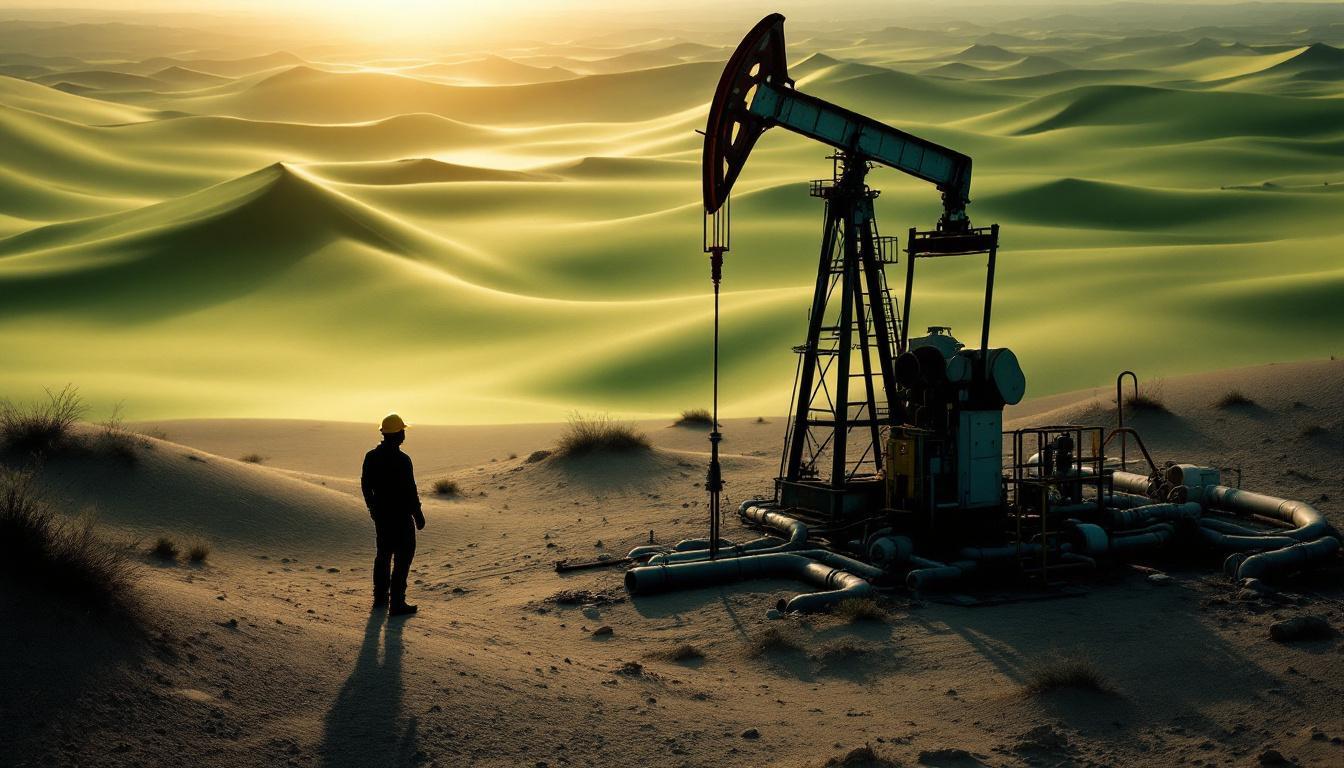
In 2025, Turkmenistan boosts oil and gas production amid efforts to modernise infrastructure, diversify exports, and initiate policies for a green energy future, highlighting a complex balancing act between growth and sustainability.
In 2025 Turkmenistan moved to consolidate its role as a major hydrocarbons supplier even as it confronts growing pressure to modernise operations, diversify export routes and begin a measured energy transition.
According to the report by MENAFN citing State Concern Turkmennebit, output in the first 11 months of 2025 exceeded official plans across the board: oil production reached 109% of target, oil refining 108.8%, gasoline 109.1% and diesel 101.4%. Natural and associated gas production was 101.6% of plan and liquefied gas 101%. The State Concern Dovletabatgazchykarysh reported extensive technical work, including major overhauls on about 30 gas wells , some to depths of roughly 5,000 metres , alongside the introduction of new gas purification and drying technologies, which the company says restored full operational capacity.
Field redevelopment and digital technologies were presented as the twin engines of near‑term growth. MENAFN noted completion of new production wells at the Uzynada oil field and described wider adoption of digital monitoring, automated control and artificial intelligence in reservoir modelling and real‑time production monitoring , practices the report attributes to state and international operators such as UAE‑based Dragon Oil. The State Concern also unveiled a “Digital Environment” initiative in August designed to unify central and subordinate operations, create an electronic data repository and synchronise cyber control centres.
Galkynysh remains central to Turkmenistan’s strategy. The field’s projected annual output is variously described in public statements as between about 10 and 33 billion cubic metres, and government planning continues to prioritise incremental development across multiple phases. That ambition underpins major international engagement: MENAFN and related industry reporting recorded memorandums and cooperation pacts with firms including Malaysia’s Petronas, China’s CNPC and the UAE’s ADNOC. ADNOC’s international investment arm XRG acquired a 38% stake in “Block I” in the Turkmen sector of the Caspian Sea in May 2025 and opened a representative office in Ashgabat in November, developments the company framed as deepening long‑term investment ties.
Export diversification has been a live policy priority. Regional infrastructure projects such as the Turkmenistan‑Afghanistan‑Pakistan‑India (TAPI) pipeline remain a stated cornerstone: MENAFN repeats the long‑standing target of up to 33 billion cubic metres annually and cites a projected completion by the end of 2026. Separately, Turkmengas finalised an agreement to supply gas to Turkey via Iran, with deliveries to commence on 1 March 2025 under a contract with Turkey’s BOTAS, a deal the Associated Press described as a step to diversify Turkey’s supply mix. In 2024 Turkmenistan also finalised exports to Iraq via Iran, reflecting a wider shift to multiple southwards and westwards routes beyond its dominant flow to China.
Official statistics and multilateral programmes provide further context to the production surge and growing policy complexity. Government data published for 2024 put natural gas production at about 77.623 billion cubic metres and oil at roughly 8.280 million tonnes, with year‑on‑year gains in refined products and bitumen. Mid‑2025 ministry figures reported by the OGT exhibition secretariat showed first‑half natural gas output of about 38.99 billion cubic metres and oil of 4.09 million tonnes, and repeated that Turkmennebit exceeded the oil plan by around 110% in that period.
But alongside production growth, international agencies and donor programmes have pressed for greener planning. The United Nations Development Programme and the UN Economic Commission for Europe concluded a joint programme in October 2025 to “support policy making and build national capacity towards green energy transition in Turkmenistan,” an initiative the UN says was designed to align national strategy with objectives to hold greenhouse gas emission growth to zero by 2030 and to achieve significant reductions thereafter. The programme, funded by the UN Joint Fund for Achieving the SDGs, ran from November 2024 to October 2025 and was implemented in coordination with the Government of Turkmenistan.
These parallel tracks , accelerating hydrocarbons output, pursuing export diversification and adopting digital and operational upgrades, while accepting international support for a nascent green transition , underline a central policy tension. Industry actors and state bodies present modernisation and foreign partnership as a route to higher efficiency and lower carbon intensity; multilateral partners emphasise capacity building and policy reform to steer future growth toward sustainability. According to the organisers and participating firms at Turkmenistan’s TESC 2025 and OGT 2025 events, hosted in Ashgabat this year, memorandums and technical exchanges focused on both offshore and onshore development and on integrating “innovative technologies in hydrocarbon field development.”
Risks and constraints are practical as well as geopolitical. Projected returns from new investments depend on global demand trajectories and on the speed with which export corridors such as TAPI and new regional routes are completed. The Asian Development Bank and Islamic Development Bank are reported as financing and advising TAPI to align it with international standards, yet the pipeline’s timely delivery remains subject to complex regional security, financing and construction challenges. At the same time, the pace at which international partners can deploy advanced technologies , and the degree to which environmental and operational standards are implemented , will shape how readily Turkmenistan can reconcile near‑term revenue objectives with mid‑term decarbonisation commitments.
For industrial decarbonisation professionals, Turkmenistan in 2025 represents a case study in parallelism: rapid capacity expansion and field modernisation are being pursued alongside initial institutional steps toward emissions management and digital optimisation. The success of that dual approach will depend on transparent project governance, sustained international technical collaboration and credible pathways to reduce the carbon intensity of gas and oil production as export volumes rise.
- https://menafn.com/1110537419/Turkmenistans-Energy-Sector-In-2025-Balancing-Growth-Technology-And-Global-Demand – Please view link – unable to able to access data
- https://menafn.com/1110537419/Turkmenistans-Energy-Sector-In-2025-Balancing-Growth-Technology-And-Global-Demand – In 2025, Turkmenistan’s energy sector demonstrated significant growth, modernisation, and international collaboration. The State Concern Turkmennebit exceeded its oil production target by 109%, with oil refining reaching 108.8% of the planned volume. Gasoline output was at 109.1%, and diesel fuel at 101.4%. Natural and associated gas production stood at 101.6%, while liquefied gas output rose to 101%. The Uzynada field underwent modernisation, including the drilling of new production wells, enhancing oil output. Advanced technologies like digital monitoring systems, automated control, and artificial intelligence were introduced for forecasting and process optimisation. The Galkynysh gas field remained pivotal, with projected output capabilities between 10 and 33 billion cubic metres of gas annually. The ‘Digital Environment’ initiative was launched to integrate operations and streamline information flows. The technical fleet of the State Concern Dovletabatgazchykarysh was upgraded, with major overhauls on around 30 gas wells, some reaching depths of up to 5,000 metres, restoring full operational capacity and introducing new gas purification and drying technologies. International cooperation expanded with the hosting of the TESC 2025 conference and the 30th International Conference and Exhibition ‘Oil and Gas of Turkmenistan – 2025’. Memorandums were signed with foreign oil and gas companies, focusing on the development of offshore and onshore blocks and expanding production at Galkynysh. Partners included Malaysia’s Petronas, the UAE’s ADNOC, and China’s CNPC. In May, ADNOC acquired a 38% stake in the ‘Block I’ gas field in the Turkmen sector of the Caspian Sea and opened a representative office in Ashgabat in November. Dragon Oil continued to expand its presence in the local hydrocarbons market, investing in new technologies and environmental efficiency.
- https://oilgas.gov.tm/en/posts/news/13104/in-2024-turkmenistan- – In 2024, Turkmenistan’s industrial sector experienced steady growth, with natural gas production reaching 77.623 billion cubic metres and oil production at 8.280 million tonnes. The production of petroleum bitumen increased by 10.2%, gasoline by 4.8%, fuel oil by 8.2%, and diesel fuel by 0.6% compared to 2023. The government emphasised the adoption of advanced technologies to expand the oil and gas sector’s production capacity, accelerate the development of the Galkynyş gas field, and expedite the construction of the Turkmenistan-Afghanistan-Pakistan-India (TAPI) gas pipeline, particularly the Serhetabat–Herat section.
- https://www.undp.org/turkmenistan/press-releases/undp-and-unece-conclude-joint-un-programme-accelerating-turkmenistans-green-energy-transition – The United Nations Joint Programme ‘Support to Policy Making and Building National Capacity Towards Green Energy Transition in Turkmenistan’ successfully concluded in October 2025. Funded by the United Nations Joint Fund for Achieving the SDGs, the initiative ran from November 2024 to October 2025, establishing a strong foundation for Turkmenistan’s transition to sustainable energy, in line with national strategies to achieve zero growth in greenhouse gas emissions by 2030 and significant reductions in subsequent years. The programme was implemented under the leadership of the United Nations Development Programme (UNDP) and the United Nations Economic Commission for Europe (UNECE), in close coordination with the Office of the UN Resident Coordinator in Turkmenistan and in partnership with the Government of Turkmenistan.
- https://apnews.com/article/0ed1938eba8c201379ecf7098db96d12 – In February 2025, Turkmenistan finalised an agreement to supply natural gas to Turkey through Iran. The deal, signed between Turkmengas (Turkmenistan’s state-run gas company) and Turkey’s national company BOTAS, commenced on March 1. The agreement was hailed as a significant step in regional energy cooperation, enhancing energy security and strategic ties between the nations. Turkey imports gas from Russia, Azerbaijan, and Iran, and this deal marked a diversification of its energy sources. This followed a 2024 contract between Turkmenistan and Iran to deliver 10 billion cubic metres of gas to Iraq. Turkmenistan, rich in natural gas resources, primarily exports to China but is also developing infrastructure to supply gas to Afghanistan, Pakistan, and India.
- https://www.expo.ogt-turkmenistan.com/en/expo-single-news/344 – In July 2025, Turkmenistan’s natural gas production in the first half of the year amounted to 38.9914 billion cubic metres, and oil production was 4.0915 million tonnes. The State Concern ‘Turkmennebit’ exceeded the oil production plan by 110%, and oil refineries fulfilled the plan by 109%. During this period, the production of diesel fuel increased by 5.1%, gasoline by 2.8%, fuel oil by 13.6%, and lubricating oils by 16.8%. The government emphasised the development of the oil and gas sector and the diversification of natural gas exports to world markets, instructing the implementation of modern scientific achievements and innovative technologies to increase the production capacity of the complex’s enterprises.
Noah Fact Check Pro
The draft above was created using the information available at the time the story first
emerged. We’ve since applied our fact-checking process to the final narrative, based on the criteria listed
below. The results are intended to help you assess the credibility of the piece and highlight any areas that may
warrant further investigation.
Freshness check
Score:
8
Notes:
The narrative presents recent developments in Turkmenistan’s energy sector, including production figures up to November 2025 and events like the OGT 2025 conference in October 2025. The earliest known publication date of similar content is December 30, 2025, indicating timely reporting. However, the report relies on a press release from MENAFN, which typically warrants a high freshness score. No significant discrepancies in figures, dates, or quotes were found. The inclusion of updated data alongside older material is noted but does not significantly impact the freshness score.
Quotes check
Score:
9
Notes:
The narrative includes direct quotes from officials and organizations. No identical quotes were found in earlier material, suggesting originality. Variations in wording were noted, but these do not significantly affect the authenticity of the quotes.
Source reliability
Score:
7
Notes:
The narrative originates from MENAFN, a news agency that aggregates content from various sources. While MENAFN is not a primary news source, it compiles information from reputable organizations, which adds credibility. However, the reliance on a press release from MENAFN introduces some uncertainty regarding the originality of the content.
Plausability check
Score:
8
Notes:
The claims made in the narrative align with known developments in Turkmenistan’s energy sector, such as increased production and international cooperation. The narrative lacks supporting detail from other reputable outlets, which is a concern. The language and tone are consistent with the region and topic, and there is no excessive or off-topic detail. The tone is formal and appropriate for corporate or official language.
Overall assessment
Verdict (FAIL, OPEN, PASS): OPEN
Confidence (LOW, MEDIUM, HIGH): MEDIUM
Summary:
The narrative provides timely and plausible information about Turkmenistan’s energy sector, with original quotes and a formal tone. However, the reliance on a press release from MENAFN and the lack of supporting detail from other reputable outlets introduce some uncertainty regarding the originality and comprehensiveness of the content. Further verification from primary sources is recommended to confirm the accuracy and originality of the information presented.
