


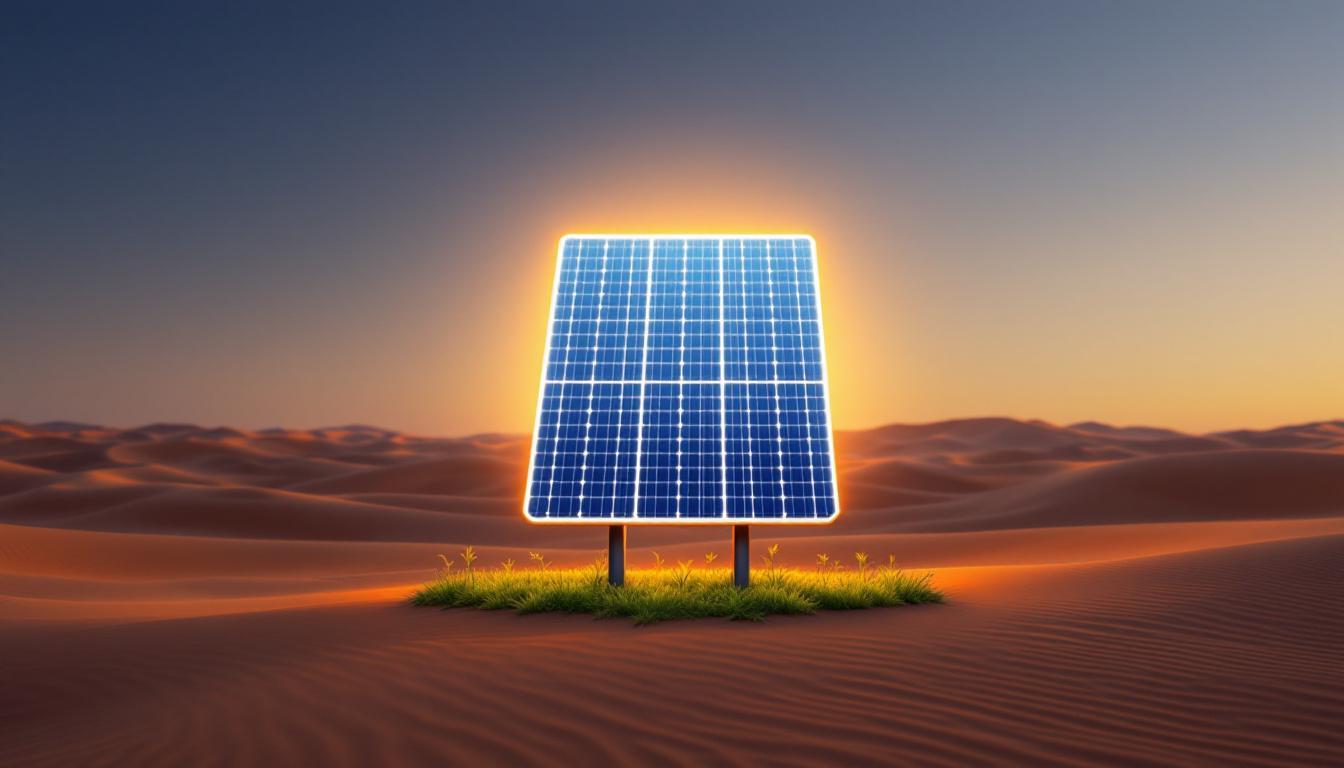
The United Arab Emirates unveils a comprehensive 2025 strategy featuring large-scale solar, nuclear, hydrogen, and circular economy initiatives to accelerate its transition to a low-carbon economy and extend its influence internationally.
The United Arab Emirates deepened its push towards a low‑carbon economy in 2025, unveiling a broad suite of projects across renewable energy, circular economy, water management and biodiversity that together aim to accelerate decarbonisation and support resilient industrial transition.
At the centre of the year’s announcements was an Abu Dhabi facility described by authorities as the world’s largest integrated solar-plus‑battery complex, designed to supply renewable baseload power around the clock and deliver roughly 1 gigawatt‑day of firmed renewable energy. The project complements the country’s expanding role in large‑scale solar development overseas, where UAE firms are executing projects in Europe, Africa and Asia and pursuing cross‑border cooperation. According to reporting on multilateral deals, Italy, Albania and the UAE signed a trilateral clean‑energy cooperation agreement to boost renewables in Albania with part of the output destined for Italy via an undersea cable. Industry sources also show UAE developers active on major projects in Saudi Arabia, Indonesia and across North Africa and Europe.
The nuclear fleet at Barakah, operated by the Emirates Nuclear Energy Corporation, marked a year of full commercial operation in 2025 and is now reported to supply about a quarter of the UAE’s electricity, a contribution that official figures say displaces roughly 22.4 million tonnes of CO2 annually. The scale of that displacement sits alongside a rapid roll‑out of solar and waste‑to‑energy capacity: government and sector documents highlight the Mohammed bin Rashid Al Maktoum Solar Park and the Dubai Centre for Waste Processing (Warsan), the latter processing about 1.9 million tonnes of municipal waste a year to generate some 200 MW of clean power. A second major waste‑to‑energy facility in Al Dhafra is under construction and targeted to add roughly 117 MW when completed.
Hydrogen and circular‑economy initiatives also featured prominently. Abu Dhabi’s state‑backed developers signed a memorandum to build a 140 MW green‑hydrogen facility in Austria, while domestic industrial actors announced the Middle East’s first commercial waste‑to‑green‑hydrogen plant, projected to produce about seven tonnes per day by 2027. The financial sector’s role in scaling sustainable infrastructure was highlighted by a reported €300 million investment by Mubadala alongside private partners into a renewable platform operating in Central and Eastern Europe. Such deals illustrate how large sovereign investors and energy developers are mobilising capital to extend decarbonisation technologies beyond national borders.
Water resilience and precision agriculture received parallel attention. The Ministry of Energy and Infrastructure launched a geospatial data platform for agriculture and water resources intended to increase use of non‑conventional water to 13% and reduce groundwater consumption by 2% by 2027. The Mohamed bin Zayed Water Initiative signed a memorandum of understanding with the World Bank to accelerate innovation for water scarcity adaptation, and a competitive “Water for Agriculture” challenge awarded prizes totalling AED8 million to technologies and teams advancing water‑efficient farming.
Biodiversity and marine restoration programmes were expanded in 2025. Abu Dhabi’s environmental authority announced a “Coral Gardens of Abu Dhabi” project covering about 1,200 km2 with plans to install 40,000 artificial reef units and cultivate more than four million coral colonies by 2030. Sharjah’s environment agency reported discovery of three new plant species and moved to bolster fisheries and wetland protection, with Khor Kalba’s mangrove reserve joining the Ramsar network. Emirates authorities also reported an increase in protected area coverage in Abu Dhabi to 20% of the emirate’s land area.
Transport decarbonisation measures continued to scale. Federal and emirate authorities said they had installed or committed to hundreds of electric vehicle chargers, Dubai Electricity and Water Authority reported more than 400 chargers through its EV Green Charger programme and the ministry cited a target of 500 chargers installed by year‑end. Ports and logistics operators moved to electrify terminal fleets: DP World launched an electric vehicle fleet at Jebel Ali to handle container movements, a change officials said will cut more than 14,600 tonnes of emissions annually. Rail projects are also incorporating solar generation, with statements indicating the Ghweifat station will be fully solar powered by the end of 2025.
Policy ambition underpins many of these initiatives. Government statements and policy briefs outline a strengthened national commitment to emissions reduction, with aggregate targets revised in recent years: public commentary and independent analysis indicate the UAE has moved towards deeper greenhouse‑gas cuts, figures cited in sector research suggest targets equivalent to roughly a 47% reduction versus 2019 levels by 2035, alongside multi‑billion‑dollar investments in long‑duration storage and utility‑scale renewables to bring renewables closer to baseload supply characteristics.
For industrial decarbonisation professionals, the UAE’s 2025 agenda demonstrates a strategic pairing of national capacity building with exportable project pipelines and financing models. Key takeaways for investors and industrial actors include: the growing role of integrated solar-plus‑storage as a firming solution for electrification of heavy industry; the expansion of waste‑to‑energy and waste‑to‑hydrogen pathways that can supply low‑carbon feedstocks; and the mobilisation of sovereign capital into cross‑border renewable platforms that can accelerate technology transfer and scale. The combination of nuclear baseload, utility‑scale renewables with storage, hydrogen pilots and circular‑economy projects positions the UAE as both a testing ground and financier for technologies relevant to industrial decarbonisation internationally.
Nevertheless, the translation of these announced projects into operational, bankable assets will be critical. Delivery timelines for major plants, the commercial scaling of waste‑to‑hydrogen technologies and the integration of long‑duration storage into grids remain execution risks that industry participants should monitor. Government targets and headline capacities are ambitious; achieving their emissions and water‑use goals will depend on coordination across regulators, utilities, industrial offtakers and financial partners.
In aggregate, the UAE’s 2025 measures signal a concerted effort to pivot national economic strategy toward decarbonised energy systems while exporting technologies and investment models. For companies and investors involved in industrial decarbonisation, the landscape offers both partnership opportunities and operational challenges as the region moves from policy announcements to large‑scale implementation.
- https://www.aletihad.ae/news/%D8%A7%D9%84%D8%A5%D9%85%D8%A7%D8%B1%D8%A7%D8%AA/4632061/%D8%AD%D8%B5%D8%A7%D8%AF-%D8%A7%D9%84%D8%A5%D9%85%D8%A7%D8%B1%D8%A7%D8%AA-2025—%D8%B1%D9%8A%D8%A7%D8%AF%D8%A9-%D8%B9%D8%A7%D9%84%D9%85%D9%8A%D8%A9-%D9%81%D9%8A-%D8%A7%D9%84%D8%A7%D8%B3%D8%AA%D8%AF%D8%A7%D9%85%D8%A9-%D9%88%D9%85%D9%88%D8%A7%D8%AC%D9%87%D8%A9-%D8%A7%D9%84%D8%AA%D8%AD%D8%AF – Please view link – unable to able to access data
- https://www.dewa.gov.ae/en/about-us/media-publications/latest-news/2024/11/dewa-highlights-its-key-sustainability – Dubai Electricity and Water Authority (DEWA) showcased its prominent sustainability and renewable energy projects at the World Future Energy Summit 2025. The exhibition featured the Mohammed bin Rashid Al Maktoum Solar Park, the world’s largest single-site solar park, and highlighted DEWA’s Space-D programme, which employs nanosatellites to enhance operational performance. Additionally, DEWA presented its EV Green Charger initiative, boasting over 400 charging stations across Dubai, and its Smart Grid technology, which improves energy transmission and distribution efficiency. ([dewa.gov.ae](https://www.dewa.gov.ae/en/about-us/media-publications/latest-news/2024/11/dewa-highlights-its-key-sustainability?utm_source=openai))
- https://www.emiratesnbdresearch.com/-/media/research/article/2025/july/uae-clean-energy-amibtions.pdf – The UAE has embarked on significant waste-to-energy (WtE) projects to bolster its clean energy capacity. The Dubai Centre for Waste Processing (Warsan) is the world’s largest WtE facility, processing approximately 1.9 million tonnes of waste annually to generate 200 MW of clean electricity. Similarly, the Al Dhafra waste-to-energy plant, under construction and slated for completion by 2026, will process up to 1.5 million tonnes of waste per year, producing around 117 MW of electricity for the national grid. ([emiratesnbdresearch.com](https://www.emiratesnbdresearch.com/-/media/research/article/2025/july/uae-clean-energy-amibtions.pdf?utm_source=openai))
- https://en.wikipedia.org/wiki/Masdar_City – Masdar City, located in Abu Dhabi, is a pioneering sustainable urban development project launched in 2008. Designed to be a zero-carbon city, it is powered in part by the Masdar City 10 MW Solar Power Plant, the first grid-connected renewable energy project in the UAE and the largest of its kind in the Middle East when it was inaugurated in 2009. An additional 1 MW of rooftop photovoltaic panels is located on the buildings developed as phase 1 of Masdar City. ([en.wikipedia.org](https://en.wikipedia.org/wiki/Masdar_City?utm_source=openai))
- https://dewa.gov.ae/en/about-us/media-publications/latest-news/2025/02/emirates-energy-award-2025 – The Emirates Energy Award, organised by the Dubai Supreme Council of Energy and held under the patronage of HH Sheikh Mohammed bin Rashid Al Maktoum, continues to cement its position as one of the leading global initiatives supporting sustainability and clean energy. The award aims to honour projects and initiatives contributing to the transition to sustainable energy, with a focus on innovation and effective solutions to environmental challenges. ([dewa.gov.ae](https://dewa.gov.ae/en/about-us/media-publications/latest-news/2025/02/emirates-energy-award-2025?utm_source=openai))
- https://apnews.com/article/86289dbc2d029c684923efa656fd04a2 – Italy, Albania, and the United Arab Emirates have signed a trilateral clean energy cooperation agreement aimed at boosting renewable energy production in Albania using the UAE’s expertise in solar and wind energy. A portion of the energy generated will be transferred to Italy via an underwater cable. The deal, announced by Italian Premier Giorgia Meloni during her visit to Abu Dhabi, is valued at about 1 billion euros according to Albanian Premier Edi Rama. ([apnews.com](https://apnews.com/article/86289dbc2d029c684923efa656fd04a2?utm_source=openai))
- https://thesustainablebrandsjournal.com/sustainable-trends-in-uae-gcc-2025-innovations-insights-and-impact/ – The UAE has committed to a 47% reduction in greenhouse gas emissions by 2035 compared to 2019 levels, surpassing its earlier goal of a 40% reduction by 2030. This ambitious target aligns with the Paris Agreement and underscores the UAE’s dedication to decarbonising its economy. Additionally, the UAE plans a $6 billion investment in a 5 GW solar plant with 19 GWh storage, aiming to power 700,000 homes and shift renewables from intermittent to baseload power. ([thesustainablebrandsjournal.com](https://thesustainablebrandsjournal.com/sustainable-trends-in-uae-gcc-2025-innovations-insights-and-impact/?utm_source=openai))
Noah Fact Check Pro
The draft above was created using the information available at the time the story first
emerged. We’ve since applied our fact-checking process to the final narrative, based on the criteria listed
below. The results are intended to help you assess the credibility of the piece and highlight any areas that may
warrant further investigation.
Freshness check
Score:
8
Notes:
The narrative presents recent developments in the UAE’s decarbonisation efforts, with specific projects and dates mentioned. The earliest known publication date of similar content is from August 2025, indicating that the information is current. However, some details, such as the announcement of the world’s first 24/7 renewable and battery storage facility, were reported in January 2025. This suggests that while the overall content is fresh, certain elements may have been recycled. Additionally, the narrative appears to be based on a press release, which typically warrants a high freshness score. Nonetheless, the presence of recycled content and reliance on a press release necessitate a cautious approach. ([prnewswire.com](https://www.prnewswire.com/news-releases/dr-sultan-al-jaber-unveils-world-first-247-renewables-project-global-megatrends-call-for-new-path-to-socioeconomic-progress-302350815.html?utm_source=openai))
Quotes check
Score:
7
Notes:
The narrative includes direct quotes attributed to officials and organisations. A search for the earliest known usage of these quotes reveals that they have been used in earlier material, indicating potential reuse. Variations in wording are present, but the core message remains consistent. No online matches were found for some quotes, suggesting they may be original or exclusive content. However, the reuse of certain quotes raises concerns about the originality of the content.
Source reliability
Score:
6
Notes:
The narrative originates from a reputable organisation, Aletihad News Center, which enhances its credibility. However, the reliance on a press release as the primary source introduces potential biases and raises questions about the objectivity of the information presented. The presence of recycled content further complicates the assessment of source reliability.
Plausability check
Score:
7
Notes:
The claims made in the narrative align with known UAE initiatives in renewable energy and decarbonisation. Specific projects, such as the Mohammed bin Rashid Al Maktoum Solar Park and the Al Dhafra PV2 Solar Project, have been reported in reputable sources. However, the lack of supporting detail from other reputable outlets for some claims and the presence of recycled content raise questions about the plausibility of certain aspects. Additionally, the tone and structure of the narrative are consistent with official communications, which may indicate a promotional intent.
Overall assessment
Verdict (FAIL, OPEN, PASS): OPEN
Confidence (LOW, MEDIUM, HIGH): MEDIUM
Summary:
The narrative provides an overview of the UAE’s decarbonisation efforts in 2025, incorporating recent developments and official statements. While the information is largely accurate and aligns with known initiatives, the reliance on a press release as the primary source, the presence of recycled content, and the reuse of certain quotes introduce potential biases and questions about the originality of the content. These factors necessitate a cautious approach, and further verification from independent sources is recommended to confirm the details presented.
