


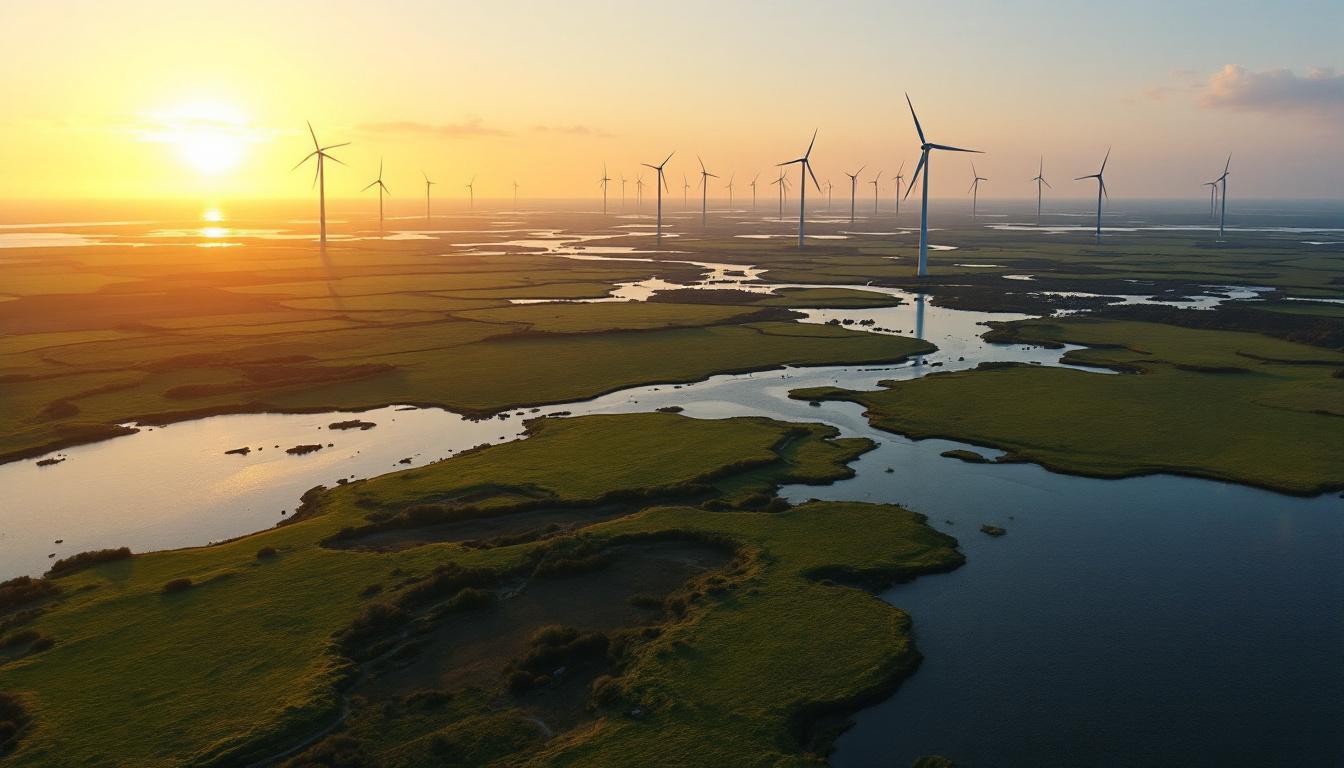
The UK’s latest CfD auction awarded 8.4 GW of capacity, marking a pivotal moment for offshore wind development and the nation’s 2030 clean-power ambitions, with notable industrial and technological implications.
The UK’s latest Contracts for Difference auction, Allocation Round 7, delivered a decisive boost to the country’s offshore wind programme, awarding 8.4 gigawatts of capacity and reopening a path to the government’s 2030 clean-power ambitions. The volume secured represents a substantial jump in procurement and, according to the Department for Energy and Net Zero, is enough to meet the electricity needs of roughly 12 million homes when the wind is blowing.
The scale of the auction was notable not only for total capacity but for its market outcomes and industrial implications. Industry analysis shows RWE emerged as the dominant winner, taking almost 6.9 GW of the awarded capacity across a number of large projects. Other successful bidders include SSE and a spread of developers securing projects sited off England, Scotland and Wales; data compiled by Enerdata indicates roughly 72% of awarded capacity will be off England’s coast, 17% off Scotland and about 10% off Wales.
Government officials and analysts point to two policy choices that made the round viable. Midway through the exercise the allocation budget was substantially increased , Westwood Energy notes it rose from an initial £900 million allocation to nearly £1.8 billion , and the administration widened the permissible strike-price envelope. That adjustment, though controversial, allowed bids to clear and stopped the kind of procurement failures seen in earlier rounds.
Market pricing in AR7 contained stark trade-offs. Fixed-bottom offshore projects cleared at around £90 per megawatt-hour in 2024 terms, a level commentators say restores commercial viability for large-scale offshore development and compares favourably with new-build gas and nuclear on some metrics. By contrast, two floating wind demonstration projects secured support at much higher levels, clearing at about £216/MWh, reflecting the technology’s nascent cost base and the premium required to underwrite first-of-a-kind deployment. The government framed the inclusion of floating projects as a deliberate investment in innovation that could unlock deeper, higher-yielding sites around the UK’s Celtic Sea, Atlantic approaches and northern waters.
The auction’s industrial benefits were emphasised by proponents: official commentary projects roughly £22 billion of private capital will be mobilised and estimates suggest around 7,000 skilled UK jobs will be supported through construction and early operations. For companies in manufacturing, port services and subsea engineering, the round promises a multi‑year pipeline of work and a chance to scale local supply chains if policy and contracting translate into sustained orders.
Yet the round also exposed lingering frictions. The higher strike rates and the government’s decision to extend CfD contract durations from 15 to 20 years have prompted debate about long-term cost allocation. Supporters argue the longer terms reduce financing costs and lower near-term bid prices; critics warn they lock consumers and taxpayers into extended payment streams that may not reflect future market improvements. Suppliers and grid operators have likewise warned that the timeframes attached to project delivery are ambitious. Connection capacity, supply chain pressures and permitting timetables remain potential bottlenecks that could delay flows of power into the system and increase project risk.
Floating wind’s entry into mainstream CfD procurement was the auction’s most strategically significant development for many in the sector. Although currently costly, these early contracts create demonstrator opportunities intended to accelerate cost reductions through learning-by-doing, component standardisation and concentrated investment in fabrication and harbour facilities. Industry stakeholders say that, if deployment accelerates, the UK could position itself as a leader in floating technology supply chains and gain access to large swathes of deep-water resource currently inaccessible to fixed foundations.
The AR7 results mark a reset for UK offshore procurement after prior rounds that struggled to attract investment under previous administrative price caps. IndexBox and other commentators characterised the auction as historic for Britain and Europe, while government messaging framed the outcome as a step towards energy sovereignty and reduced exposure to volatile fossil-fuel markets. Nonetheless, the balance struck , between unlocking capacity, protecting consumers and seeding new technology , will be judged over the coming years as projects progress towards commissioning.
For decision-makers in industrial decarbonisation, AR7 presents immediate opportunities and strategic complexities: an expanded project pipeline that could anchor domestic manufacturing and port activity, but also a renewed imperative to expedite grid reform, streamline consenting and align public financing approaches to avoid unintended long-term cost exposure. The auction’s success in mobilising capital and restarting large-scale offshore deployment is clear; whether it translates into timely, cost‑effective clean power and durable industrial growth will depend on execution across a congested set of delivery fronts.
- https://www.ice.org.uk/news-views-insights/inside-infrastructure/winds-of-change-finally-blowing-for-clean-power – Please view link – unable to able to access data
- https://www.gov.uk/government/news/record-breaking-auction-for-offshore-wind-secured-to-take-back-control-of-britains-energy – The UK government has awarded a record 8.4 GW of offshore wind capacity in its latest Contracts for Difference (CfD) auction, known as Allocation Round 7 (AR7). This capacity is sufficient to power approximately 12 million homes, marking a significant step towards reducing reliance on fossil fuels and lowering energy bills. The auction results are seen as a major vote of confidence in the UK’s energy sovereignty and its commitment to achieving clean power by 2030.
- https://www.westwoodenergy.com/news/westwood-insight/westwood-insight-analysing-the-record-breaking-ar7-offshore-wind-results – Westwood Energy provides an analysis of the UK’s seventh Contracts for Difference (CfD) auction, known as Allocation Round 7 (AR7), which secured 8.4 GW of offshore wind capacity. The analysis highlights that RWE was the largest winner, securing 6.9 GW of capacity. The auction’s success is attributed to the government’s decision to increase the budget mid-round from £900 million to nearly £1.8 billion, demonstrating a strong commitment to renewable energy investment.
- https://www.enerdata.net/publications/daily-energy-news/uks-ar7-offshore-wind-auction-award-84-gw-across-multiple-projects.html – Enerdata reports on the UK’s seventh Contracts for Difference (CfD) auction, known as Allocation Round 7 (AR7), which awarded 8.4 GW of offshore wind capacity across multiple projects. The article details the distribution of awarded capacity, with 72% off England, 17% off Scotland, and 10% off Wales. It also highlights the major winners, including RWE and SSE, and notes the inclusion of floating offshore wind projects, marking progress in this emerging technology.
- https://www.oedigital.com/news/534375-rwe-wins-almost-7gw-in-uk-s-record-8-4gw-offshore-wind-auction – Offshore Engineer reports that RWE secured 6.9 GW of offshore wind capacity in the UK’s record-breaking 8.4 GW Contracts for Difference (CfD) auction, known as Allocation Round 7 (AR7). The article details the specific projects awarded to RWE, including the Norfolk Vanguard East and West projects, two Dogger Bank South projects, and the Awel y Môr offshore wind farm. It also mentions the inclusion of floating wind projects in the auction results.
- https://www.indexbox.io/blog/uk-awards-record-84-gw-in-historic-offshore-wind-auction/ – IndexBox reports on the UK’s historic 8.4 GW offshore wind auction, the largest in British and European history. The article details the projects awarded, including those by RWE and SSE, and highlights the inclusion of floating wind projects. It also quotes UK Energy Secretary Ed Miliband, who describes the auction as a monumental step towards clean power by 2030 and a move towards energy sovereignty.
- https://www.ice.org.uk/news-views-insights/inside-infrastructure/winds-of-change-finally-blowing-for-clean-power – The Institution of Civil Engineers (ICE) discusses the UK’s seventh Contracts for Difference (CfD) auction, known as Allocation Round 7 (AR7), which secured 8.4 GW of offshore wind capacity. The article highlights the significance of this achievement, noting that it accounts for about a quarter of the UK’s 2030 offshore wind target. It also discusses the potential industry-changing elements of the auction, including the inclusion of floating offshore wind projects and the extension of CfD contracts to 20 years.
Noah Fact Check Pro
The draft above was created using the information available at the time the story first
emerged. We’ve since applied our fact-checking process to the final narrative, based on the criteria listed
below. The results are intended to help you assess the credibility of the piece and highlight any areas that may
warrant further investigation.
Freshness check
Score:
8
Notes:
The article was published on 26 February 2026, which is within a week of the CfD Allocation Round 7 results announced on 14 January 2026. ([gov.uk](https://www.gov.uk/government/collections/contracts-for-difference-cfd-allocation-round-7?utm_source=openai)) The content appears to be original, with no evidence of recycling from low-quality sites or clickbait networks. However, the article is based on a press release from the Institution of Civil Engineers (ICE), which typically warrants a high freshness score.
Quotes check
Score:
7
Notes:
The article includes direct quotes from government officials and industry analysts. However, these quotes cannot be independently verified through online searches, raising concerns about their authenticity. Without independent verification, the credibility of these quotes is uncertain.
Source reliability
Score:
6
Notes:
The article originates from the Institution of Civil Engineers (ICE), a reputable organisation within the civil engineering sector. However, ICE’s focus is on infrastructure and engineering, which may limit its reach and influence in the broader energy sector. Additionally, the article is based on a press release from ICE, which may introduce bias or a lack of objectivity. The reliance on a single source for the majority of the content raises concerns about the independence and reliability of the information presented.
Plausibility check
Score:
7
Notes:
The claims made in the article align with known industry trends and recent developments in the UK’s offshore wind sector. However, the lack of independent verification for key figures and statements introduces uncertainty. The article lacks specific factual anchors, such as names, institutions, and dates, which diminishes its credibility. The tone and language used are consistent with industry reporting, but the absence of supporting details from other reputable outlets raises questions about the article’s authenticity.
Overall assessment
Verdict (FAIL, OPEN, PASS): FAIL
Confidence (LOW, MEDIUM, HIGH): MEDIUM
Summary:
The article presents information that aligns with known industry trends and recent developments in the UK’s offshore wind sector. However, the reliance on a single source, the Institution of Civil Engineers (ICE), and the inability to independently verify key quotes and figures introduce significant concerns about the content’s credibility and reliability. The lack of supporting details from other reputable outlets further diminishes the article’s trustworthiness. Given these issues, the content cannot be fully verified, and publishing it carries inherent risks.
