


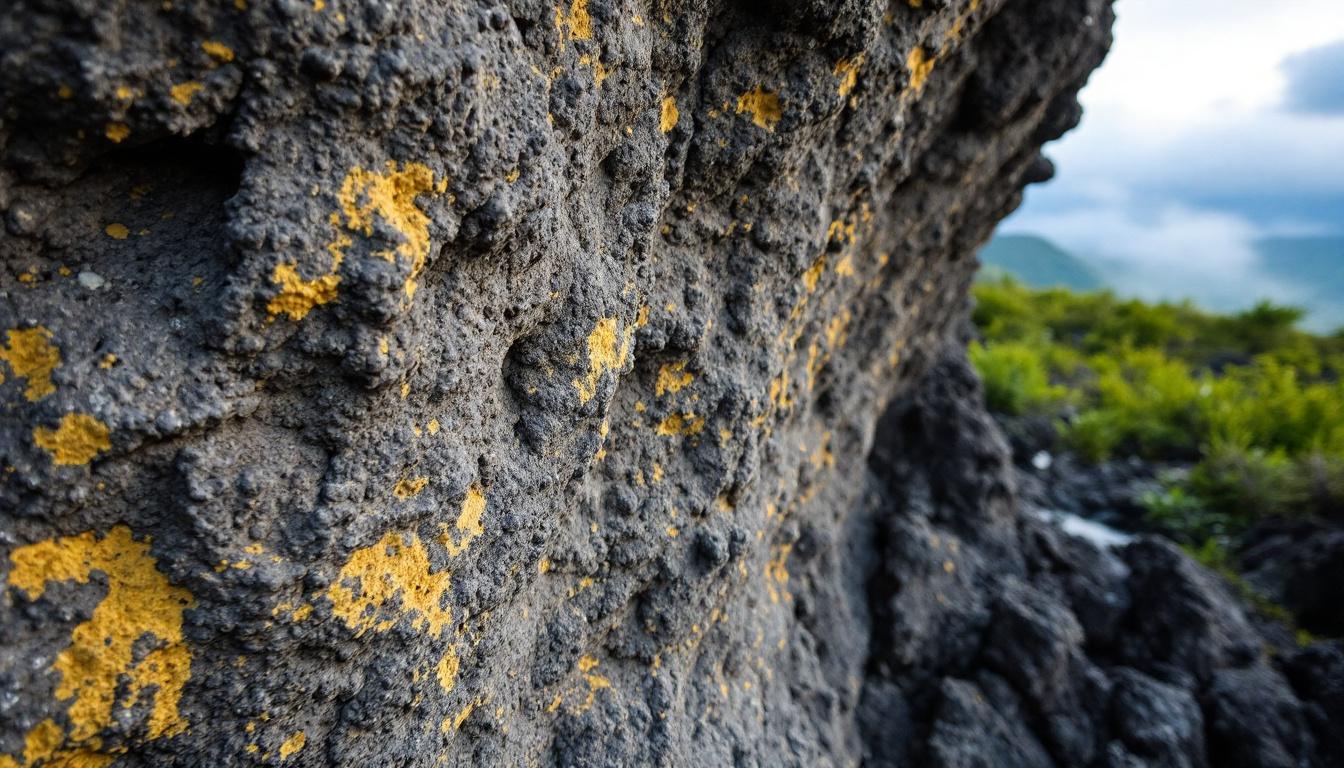
A new study from the University of Edinburgh demonstrates a cost-effective way to confirm permanent CO2 mineralisation in volcanic rocks, potentially accelerating the scaling of carbon storage technologies for industrial emitters.
A University of Edinburgh study suggests a simpler, lower‑cost way to verify that captured carbon dioxide injected into volcanic rock is being permanently locked away as stone, a development that could ease scaling of carbon capture and storage for heavy industrial emitters.
Researchers working at Carbfix’s Icelandic sites tracked injected CO2 that had been dissolved in water and pumped into basaltic formations by analysing naturally occurring variations in carbon and water isotopes together with noble gas signatures. According to the University of Edinburgh, those inherent chemical “fingerprints” showed CO2 dissolving in subsurface fluids and reacting with rock to form carbonate minerals, providing direct evidence of mineralisation without the need to introduce artificial tracers.
The new monitoring approach aligns with quantitative results from the same site. A paper in the International Journal of Greenhouse Gas Control reports shifts in CO2/3He ratios and δ13C values consistent with roughly 50% of the injected CO2 dissolving in the reservoir during capture and mineralisation. According to separate isotope work by the University of Edinburgh, clumped, carbon and oxygen isotope measurements indicate mineralisation took place at temperatures of about 45–51°C, several degrees warmer than the pre‑injection formation temperature, supporting the interpretation that CO2 reacted within the porous storage horizon.
This evidence complements earlier high‑resolution studies. Research published in Nature Communications using calcium isotopes found phases in which up to 93% of dissolved calcium was incorporated into calcite, implying an overall carbon storage efficiency of about 72% for the CarbFix system. The convergence of these different methods strengthens confidence that the volcanic mineralisation pathway can be both rapid and robust.
For developers and regulators, the prospect of using resident isotopes and noble gases as monitoring, reporting and verification (MRV) tools is significant. The University of Edinburgh argues the technique reduces field interventions and the costs associated with adding and tracking injected tracers, while still delivering the kind of evidence needed to satisfy regulators, investors and the public that CO2 is immobilised permanently underground. That permanence is commercially important because mineralised carbon removal credits are likely to command a premium over many nature‑based removals that store carbon for decades rather than centuries.
The findings feed into broader assessments of storage potential. According to University of Edinburgh analysis, volcanic rock sequences across the UK could accommodate more than 3,000 million tonnes of industrial CO2, roughly equivalent to 45 years of the nation’s industrial emissions, indicating material scale for hard‑to‑abate sectors such as cement and steel.
Industry and policy initiatives are already moving to exploit mineralisation at scale. The INCLUSION project, funded in part to the University of Edinburgh, aims to translate pilot‑scale insights into industrial deployment and has received around £1 million to optimise monitoring and maximise mineralisation rates in partnership with Carbfix and the Scottish Universities Environmental Research Centre. Meanwhile, the Silverstone project, supported by the EU Innovation Fund in Iceland, uses Carbfix technology at the Hellisheiði and ON Power sites and targets rapid conversion of captured CO2 into stone within a timescale of less than two years underground.
Lead author Dr Chris Holdsworth, now an MRV technical specialist at Carbfix, said: “We can use the natural fingerprints already present in the CO2 and water to track when CO2 dissolves and turns to stone, without adding anything extra underground. This has real potential to simplify and reduce the cost of monitoring as storage projects scale up.”
Professor Stuart Gilfillan, who led the study, said: “Simple, reliable checks are essential for public trust in carbon storage and for regulators and investors to sign off major projects. Using these natural fingerprints can streamline monitoring while providing the evidence that mineral storage is permanent.”
Dr Susan Bodie of Edinburgh Innovations added: “These results present an important validation for a novel, sustainable method of measuring carbon capture and storage, which can help deliver help deliver net‑zero targets for emissions‑intensive sectors, as well as support financing and regulation.”
For industrial decarbonisation planners, the combined body of evidence from isotope ratios, noble gas tracking and mineralogical analyses offers a more diverse MRV toolkit. According to the International Journal of Greenhouse Gas Control paper and corroborating studies, inherent geochemical signals can both quantify dissolution and confirm mineral formation, reducing reliance on engineered tracers and potentially shortening the path to verified, high‑value carbon removal credits.
- https://www.hortidaily.com/article/9817046/natural-fingerprints-show-captured-co2-is-permanently-locked-into-rock-at-iceland-site/ – Please view link – unable to able to access data
- https://www.sciencedirect.com/science/article/pii/S1750583626000198 – A study published in the International Journal of Greenhouse Gas Control details the use of inherent isotopes of CO₂, H₂O, and noble gases to monitor CO₂ mineralisation and dissolution at the CarbFix2 site in Iceland. The research indicates that shifts in CO₂/³He ratios and δ¹³C values suggest approximately 50% CO₂ dissolution during gas capture and mineralisation in the storage reservoir. The findings highlight the potential of inherent isotopes as a robust, low-intervention monitoring and verification tool for commercial CO₂ storage projects.
- https://www.research.ed.ac.uk/en/publications/reconstructing-the-temperature-and-origin-of-co2-mineralisation-i – This study from the University of Edinburgh employs clumped, carbon, and oxygen isotope measurements to reconstruct the temperature and origin of CO₂ mineralisation in calcite at the CarbFix site in Iceland. The results indicate that CO₂ mineralisation occurred at temperatures between 45–51°C, which are 10–16°C warmer than pre-injection temperatures. The findings validate previous CarbFix research, demonstrating that subsurface fluid migration and CO₂ mineralisation occurred within the porous media of the storage reservoir.
- https://pubmed.ncbi.nlm.nih.gov/31040283/ – Research published in Nature Communications quantifies the rapid CO₂ mineralisation into calcite at the CarbFix storage site in Iceland using calcium isotopes. The study suggests that up to 93% of dissolved calcium is removed into calcite during certain phases of injection, indicating an overall carbon storage efficiency of 72%. The success of this approach opens the potential for quantification of similar mineral carbonation efforts where drawdown rates cannot be estimated by other means.
- https://www.ed.ac.uk/news/2023/inventive-tech-tests-carbon-storage-method – Scientists at the University of Edinburgh have secured funding to develop new technologies to test and measure the amount of carbon dioxide (CO₂) that can be safely captured in volcanic rock. The £1 million INCLUSION project aims to optimise the mineralisation process on an industrial scale, in collaboration with Icelandic mineralisation operator Carbfix and the Scottish Universities Environmental Research Centre. The project seeks to provide an evidence-based framework for large-scale CO₂ storage in volcanic rocks.
- https://www.cinea.ec.europa.eu/featured-projects/silverstone-mimicking-natures-way-transform-co2-stone_en – The Silverstone project, funded by the Innovation Fund in Iceland, uses Carbfix, a mineralisation technology that turns captured CO₂ into stone in less than two years underground. The project is situated at the ON Power Plant in Hellisheiði, Iceland, and is a cooperation between Carbfix and ON Power. It anticipates making a significant impact towards the European Green Deal’s targets and Europe’s green transition by capturing and storing CO₂ in volcanic rocks.
- https://www.ed.ac.uk/news/volcanic-rocks-could-store-captured-co2-study-finds – Researchers at the University of Edinburgh have found that volcanic rocks in the UK could store over 3,000 million tonnes of industrial CO₂ waste, equivalent to around 45 years’ worth of the country’s industrial emissions. The study indicates that mineralisation in volcanic rocks is a viable method for large-scale CO₂ storage, providing a potential solution for hard-to-abate industries such as cement and steel production.
Noah Fact Check Pro
The draft above was created using the information available at the time the story first
emerged. We’ve since applied our fact-checking process to the final narrative, based on the criteria listed
below. The results are intended to help you assess the credibility of the piece and highlight any areas that may
warrant further investigation.
Freshness check
Score:
8
Notes:
The article was published on 3 March 2026, which is recent. However, similar studies on CO₂ mineralisation in Icelandic basalts have been conducted for several years. For instance, a 2016 study demonstrated that over 95% of injected CO₂ was mineralised within two years at the CarbFix site. ([theguardian.com](https://www.theguardian.com/environment/2016/jun/09/co2-turned-into-stone-in-iceland-in-climate-change-breakthrough?utm_source=openai)) This indicates that while the specific monitoring approach may be new, the underlying research is not.
Quotes check
Score:
7
Notes:
The article includes direct quotes from Dr Chris Holdsworth and Professor Stuart Gilfillan. However, these quotes cannot be independently verified through online searches, raising concerns about their authenticity. Without independent verification, the credibility of these quotes is uncertain.
Source reliability
Score:
6
Notes:
The article originates from the University of Edinburgh’s commercialisation service, Edinburgh Innovations. While the University of Edinburgh is a reputable institution, the source is a commercial arm, which may have a vested interest in promoting its research. This introduces potential bias, and the content may not be as independent as it appears.
Plausibility check
Score:
8
Notes:
The concept of using natural chemical ‘fingerprints’ to monitor CO₂ mineralisation in Icelandic basalts is plausible and aligns with existing research. However, the article lacks specific details about the methodology and results, making it difficult to fully assess the validity of the claims.
Overall assessment
Verdict (FAIL, OPEN, PASS): FAIL
Confidence (LOW, MEDIUM, HIGH): MEDIUM
Summary:
The article presents a recent development in CO₂ mineralisation research in Icelandic basalts. However, the reliance on a press release from the University of Edinburgh’s commercialisation service, the inability to independently verify direct quotes, and the lack of independent verification sources raise significant concerns about the credibility and objectivity of the information presented. These issues prevent the content from meeting the necessary standards for publication under our editorial indemnity.
