


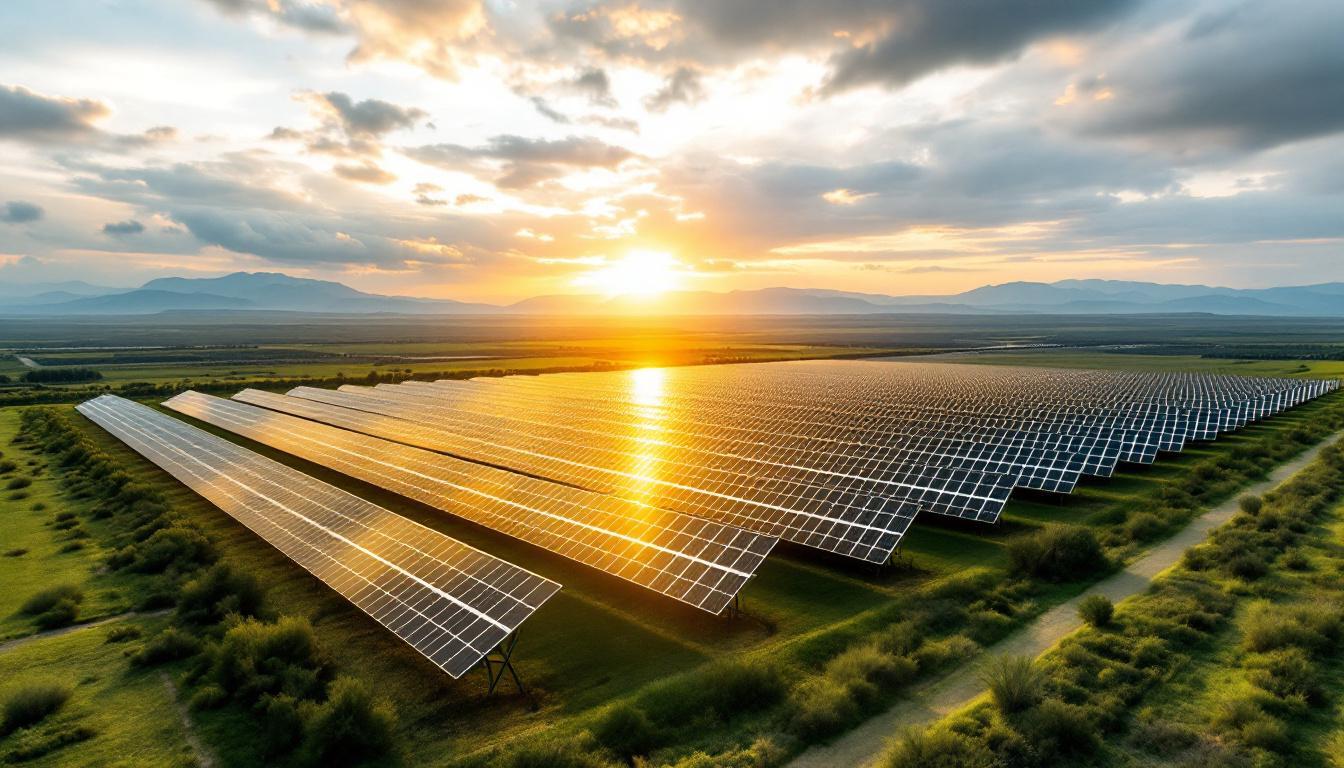
Uzbekistan shifts from planning to large-scale implementation in its power sector, rapidly expanding renewables, developing nuclear, and modernising its grid to meet rising industrial demand and ambitious decarbonisation targets by 2030.
In 2025 Uzbekistan moved decisively from planning to large‑scale delivery across its power sector, accelerating capacity additions, diversifying generation sources and pairing renewables with grid and storage investments to tackle growing industrial demand and system stability.
Official tallies presented during the year point to more than $35 billion of foreign investment drawn into the sector since 2017 and roughly 9,000 MW of new capacity commissioned, with annual electricity output rising from about 60 billion kWh in 2017 to roughly 85 billion kWh in 2025. According to the Uzbek government, green technologies now account for roughly 30% of installed generation capacity following the commissioning of nearly 5,000 MW of solar and wind and roughly 400 MW of hydropower by late 2025.
Scale and scope: utility renewables, hydropower and storage
Utility‑scale renewables were the spine of the year’s activity. Major corporate and international players signed and executed multi‑gigawatt wind and solar deals: AMEA Power agreed a 1 GW wind development in Karakalpakstan alongside a 300 MWh standalone battery energy storage system (BESS), and ACWA Power brought a 1 GW wind portfolio into full commercial operation ahead of schedule. Industry reporting noted that by November 2025 nearly 5,000 MW of solar and wind capacity, plus about 400 MW of hydropower, had entered service, underpinning the government’s ambition to reach 54% renewable generation by 2030.
Storage moved from demonstration toward programme scale. The European Bank for Reconstruction and Development provided a senior loan of up to $75 million for a combined 500 MW solar / 500 MWh BESS package in Samarkand and Bukhara, while Masdar and Uzenergosotish signed a Battery Storage Service Agreement for the Zarafshan BESS, planned in phases totalling 600 MW / 1,200 MWh, as part of a national rollout. These initiatives reflect a deliberate effort to pair intermittent generation with dispatchable capacity to strengthen frequency control and reduce reliance on peaking gas plants.
Hydropower was advanced on multiple fronts, from community micro‑projects to large cascades. Uzbekhydroenergo launched construction of the Norin cascade (six plants, 228 MW) and progressed preparations for the Upper Pskem and Khojakent projects with Chinese partners. The World Bank approved a $150 million concessional credit to scale Uzbekistan’s small hydropower sector, aiming to build nearly 3,000 small stations and lift installed small‑hydro capacity to about 160 MW by 2026, expanding access for some 280,000 people and cutting annual CO₂ emissions by as much as 430,000 tonnes, the World Bank said.
Nuclear and system planning: SMRs and a large‑plant feasibility track
Uzbekistan pursued a two‑track nuclear strategy. Work advanced on a small modular nuclear power plant (SMR) sited in Jizzakh, with earthworks and preparation reported during the year, and Rosatom and Uzatom agreed a feasibility process for a larger VVER‑1000 project with options to expand. Government statements indicated excavation has begun at an integrated nuclear complex in Jizzakh combining VVER‑1000 and RITM‑200N units, and officials presented localisation, workforce and community planning alongside the construction programme. International coverage and prior agreements with Russia were widely reported as underpinning this nuclear push.
Grid, distribution and efficiency: enabling the green build‑out
Uzbekistan coupled generation expansion with aggressive grid modernisation and demand‑side measures. Projects launched in 2025 included multiple 220 kV substations with GIS technology, 420 km of new high‑voltage transmission lines and the modernisation of low‑voltage distribution networks under a World Bank $100 million concessional credit to reduce technical losses (estimated at roughly 13% in 2024) and enhance renewable integration. The government also created a National Energy Efficiency Agency and announced subsidies for energy audits, rooftop solar and heat pumps from July 2025 to stimulate end‑use savings.
Operational flexibility remained part of the mix: new combined‑cycle and gas‑piston plants progressed to provide firming capacity for regions with fast rising load, while municipal waste‑to‑energy, biomass and industrial captive renewables were promoted to decarbonise energy‑intensive sectors. A December package of inaugurations and starts, labelled by officials as “Powering the Future”, included 16 plants across technologies totalling 3,500 MW, ten utility‑scale storage systems (1,245 MW) and major substation and line work, with government estimates that the programme would save nearly 7 billion cubic metres of gas and avoid some 11 million tonnes of emissions.
Regional exports and cross‑border coordination
Uzbekistan pursued an export and regional‑system integrator role. Contracts with Afghanistan envisaged high‑voltage corridors to deliver up to 1,000 MW, and trilateral cooperation with Azerbaijan and Kazakhstan set out green‑energy development and cross‑border transmission frameworks. Officials framed these moves as mutually reinforcing energy security, water management and seasonal balancing across Central Asia.
Financing, localisation and industrial decarbonisation
Financing instruments and private‑sector risk mitigants increased in prominence. Partial risk guarantees from the Asian Development Bank and deals with international financiers aimed to unlock private participation in large PPP renewables‑plus‑storage projects. Separately, UNG Overseas and Cargill agreed a long‑term financing framework potentially worth up to $8 billion to support energy security, infrastructure modernisation and renewables deployment, according to government announcements. Uzbekistan emphasised local content: meetings with Chinese and Korean firms repeatedly centred on domestic manufacturing of cables, turbines, batteries and storage components, and several projects carry explicit localisation targets. Industrial decarbonisation examples include a 60 MW renewables package for Namangan Cement Company designed to supply up to 80% of its needs.
Assessment for industrial decarbonisation practitioners
For professionals engaged in industrial decarbonisation the Uzbek case in 2025 is instructive on several fronts:
- Rapid capacity expansion is being synchronised with grid reinforcements and storage procurement to preserve system reliability while enabling high variable renewable penetration.
- Storage procurement is being structured at scale and with commercial service agreements, signalling a transition to marketable grid services beyond mere back‑up.
- Hydropower development is being pursued across the asset scale spectrum, micro, small and large cascades, providing flexible, renewable baseload and ancillary services that are valuable for deep decarbonisation of industry.
- Nuclear investments are treated as part of a diversified low‑carbon baseload strategy, with parallel SMR and large‑reactor pathways under development.
- Financing innovation, concessional credit lines, partial risk guarantees and large bilateral commercial packages, has been critical to mobilise foreign capital while attempting to drive domestic industrial participation.
Risks and trade‑offs
The scale and speed of Uzbekistan’s programme carry familiar implementation and policy risks for buyers, financiers and industrial off‑takers: grid integration challenges as variable renewables reach higher penetrations; supply‑chain and contractor concentration risk given large volumes awarded to a limited number of international groups; and social‑environmental management of large hydropower and nuclear works. Moreover, reliance on large external actors for nuclear and some renewables elements means geopolitical and contractual risk must be actively managed by counterparties and lenders.
Outlook
By year‑end 2025 Uzbekistan had demonstrably shifted from target setting to large‑scale delivery, with an integrated agenda spanning utility renewables, storage, hydropower cascades, nuclear initiation, grid modernisation and measures to decarbonise industry. If the government and its partners can sustain project execution, local industrial participation and the parallel build‑out of transmission and storage, Uzbekistan’s pathway offers a replicable model for emerging economies seeking rapid decarbonisation while preserving supply security and supporting industrial growth. According to reporting and multilateral announcements during 2025, the country’s policy objective is now to raise renewable generation to as much as 54% by 2030, an outcome that will depend as much on financing, localisation and grid readiness as on the headline capacity figures.
- https://www.trend.az/business/4142870.html – Please view link – unable to able to access data
- https://www.worldbank.org/en/news/press-release/2025/06/25/uzbekistan-to-enhance-energy-production-through-hydropower-with-world-bank-support.print – In June 2025, the World Bank approved a $150 million concessional credit to support Uzbekistan in developing its small hydropower sector. The project aims to construct nearly 3,000 small hydropower plants by 2026, increasing installed capacity to 160 MW and providing electricity to an additional 280,000 people. This initiative is part of Uzbekistan’s strategy to meet its growing electricity demand and reduce greenhouse gas emissions by up to 430,000 tons of CO₂ annually.
- https://www.euronews.com/business/2025/11/25/uzbekistan-powers-ahead-making-good-on-commitments-to-expand-renewable-energy – As of November 2025, Uzbekistan has commissioned nearly 5,000 MW of solar and wind capacity, along with around 400 MW of hydropower, marking a significant milestone in its green transition. The country aims to increase the share of renewable energy in electricity generation to 54% by 2030, with hydropower remaining central to this development. The Naryn Hydropower Cascade, comprising six stations, was fully operational by September 2025, generating 171 million kWh annually and saving approximately 290 million cubic metres of natural gas.
- https://www.kun.uz/en/news/2025/04/19/uzbekistan-aims-to-generate-54-of-electricity-from-renewable-sources-by-2030 – In April 2025, Uzbekistan announced its goal to generate 54% of its electricity from renewable sources by 2030. This ambitious target includes plans to construct 2,983 micro hydropower stations with a combined capacity of 167 MW during 2025–2026. These projects are expected to generate 500 million kWh of clean electricity, save 151 million cubic metres of natural gas, and create employment opportunities during both construction and operation phases.
- https://www.euronews.com/business/2025/12/05/uzbekistan-launches-946-billion-green-energy-push-covering-nations-power-needs – In December 2025, Uzbekistan launched 42 new renewable energy and grid projects valued at €9.46 billion, aiming to meet the nation’s power needs with clean electricity. These projects include 16 solar, wind, thermal, and hydropower plants with a combined capacity of 3,500 MW, 10 utility-scale energy storage systems providing 1,245 MW, and 11 substations with 420 km of high-voltage transmission lines. The initiative is part of Uzbekistan’s strategy to increase the share of green energy in total generation to 54% by 2030.
- https://apnews.com/article/6b29cec95b9f5be8d1b408063f1d0065 – In May 2024, Russia and Uzbekistan signed an agreement for Russia to construct Central Asia’s first nuclear power plant in Uzbekistan. The project, led by Russia’s state-owned energy corporation Rosatom, involves building six reactors with a total capacity of 330 MW. This development is significant for Uzbekistan, which has substantial uranium reserves, and marks a strategic expansion of Russia’s influence in Central Asia amid ongoing geopolitical tensions with the West.
- https://www.worldbank.org/en/news/press-release/2025/05/15/uzbekistan-to-invest-in-modernizing-electricity-distribution-networks-with-world-bank-support – In May 2025, the World Bank approved a $100 million concessional credit to support Uzbekistan’s efforts to modernize its electricity distribution networks. The program aims to enhance the integration of renewable energy, improve supply reliability, and reduce technical distribution losses, which were estimated at around 13% as of 2024. The initiative includes constructing and modernizing 6,000 km of low-voltage distribution lines and installing 1,200 distribution transformers, with a total capacity of 250 MVA.
Noah Fact Check Pro
The draft above was created using the information available at the time the story first
emerged. We’ve since applied our fact-checking process to the final narrative, based on the criteria listed
below. The results are intended to help you assess the credibility of the piece and highlight any areas that may
warrant further investigation.
Freshness check
Score:
8
Notes:
The article provides a comprehensive overview of Uzbekistan’s energy sector developments in 2025, with specific dates and events. However, the publication date of the article is January 18, 2026, which is over seven days after the events described, potentially affecting the freshness score.
Quotes check
Score:
7
Notes:
The article includes direct quotes from officials and organizations. However, without access to the original sources, it’s challenging to verify the authenticity of these quotes, which raises concerns about their accuracy.
Source reliability
Score:
6
Notes:
The article is published on Trend.az, a news outlet based in Azerbaijan. While it provides detailed information, the lack of clear sourcing and potential biases associated with the publication may affect the reliability of the information presented.
Plausability check
Score:
8
Notes:
The claims about Uzbekistan’s energy sector developments align with known trends and reports from reputable sources. However, without independent verification, it’s difficult to fully assess the accuracy of the information.
Overall assessment
Verdict (FAIL, OPEN, PASS): FAIL
Confidence (LOW, MEDIUM, HIGH): MEDIUM
Summary:
The article provides a detailed overview of Uzbekistan’s energy sector developments in 2025. However, concerns about the freshness of the content, the authenticity of quotes, the reliability of the source, and the independence of verification sources lead to a ‘FAIL’ assessment. Editors should exercise caution and seek additional independent verification before considering publication.
