


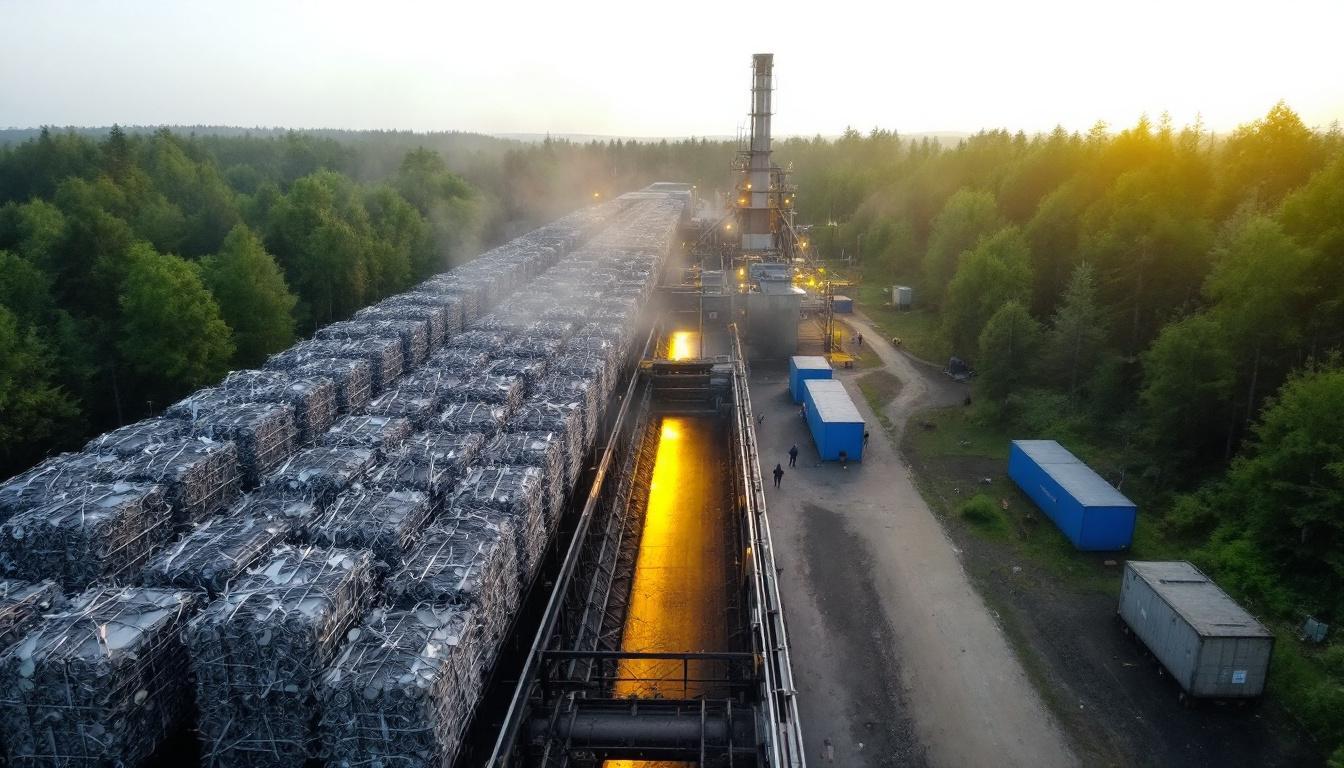
The US government is shifting from policy to action in critical minerals, deploying over $10 billion across multiple agencies to fund domestic processing, reserve mechanisms, and strategic projects, shaping a new industrial decarbonisation landscape.
Washington has moved from diagnosis to deployment in the critical minerals arena, shifting sizeable public capital into financing, processing and reserve mechanisms that could materially accelerate projects needed for electrification and industrial decarbonisation.
At the centre of the shift is a cluster of large, targeted commitments that treat mineral security as a financing problem rather than a purely policy one. The Export-Import Bank has pledged loan capacity that industry sources describe as roughly $10 billion to support stockpiling and associated offtake arrangements, while a newly authorised Strategic Resilience Reserve carries a $2.5 billion authorisation designed to buy minerals above market prices during shortages and recycle proceeds into future purchases. According to reporting and government summaries, letters of interest for graphite-specific facilities total about $2.07 billion, split between Graphite Creek in Alaska and advanced graphite materials manufacturing in Ohio, signalling a federal bet on closing midstream bottlenecks that currently hand China dominant control of natural and spherical graphite processing.
This capital push is being amplified by a broader set of federal programmes. The Department of Energy has announced nearly $1 billion in planned notices of funding opportunities aimed at scaling mining, processing and manufacturing technologies, and separately unveiled a $355 million package to accelerate domestic production of critical materials through industrial byproduct recovery and Mine of the Future demonstration sites. The White House Office of Science and Technology Policy reports a $400 million equity investment in MP Materials, making the federal government a significant shareholder to expand domestic magnet manufacturing capacity, while the Department of Commerce awarded $210 million to Crucible Metals to develop a large-scale smelter and critical minerals processing complex in Tennessee.
The combined effect is a multi‑agency financing architecture that reduces single‑path reliance and lets projects match funding sources to their stage and geography. Industry participants can pursue capital through the DOE Loan Programs Office, Department of Defense Title III authorities, the Commerce Department, USDA Rural Development, the International Development Finance Corporation and EXIM. That diversity means a midstream separation plant might fit DOE technology-focused channels, a mining development in an allied country could seek DFC support, and export-credit mechanisms can underwrite strategic stockpiles without new legislation.
Uranium policy illustrates how regulatory and financing moves are being synchronised. Federal reclassification of uranium as a critical mineral has opened eligibility for Loan Programs Office lending, fast-tracked NEPA review in some cases and unlocked Defense Production Act Title III options. The result is compressed procurement cycles: utilities that under-contracted for 2025–26 requirements are rushing into long-term agreements, creating immediate demand for producers and lifting the economics for near-term expansions.
The tilt in programme design is clear: Washington is prioritising midstream processing and separation capacity because those are chokepoints that can be closed more quickly than new mine development. DOE and Commerce investments explicitly target separation, smelting and advanced materials manufacturing so the United States can convert concentrate into battery‑grade and defence‑spec products domestically rather than shipping feedstock overseas.
Near-term winners are therefore advanced-stage, shovel‑ready projects in stable jurisdictions that have completed feasibility work and permitting. Those developers now face a deeper pool of patient, below-market capital from government-backed lenders and agencies, which can shorten traditional financing timetables by a year or more. Uranium producers with immediate capacity or near-term expansion plans are capturing contracting activity from utilities seeking security of supply. Domestic facilities that can take concentrates and produce separated oxides, coated graphite or refined lithium are also positioned to attract both commercial and government buyers.
By contrast, very early-stage explorers without defined resources remain largely excluded. Federal capital is being targeted at deployable capacity rather than speculative exploration. Projects located in countries outside a narrowing definition of “allied” risk being shut out of export-credit and DFC support, pushing them back to fully private markets. Conventional lenders and private equity face intensified competition from subsidised public capital, which may crowd out mid-return opportunities and force those investors into higher‑risk or early‑stage niches.
The federal push is not a single administration’s initiative alone. According to reporting, a separate proposal labelled Project Vault would establish a multi‑billion-dollar strategic stockpile financed in part through EXIM, reflecting bipartisan concern about supply disruptions and an appetite to set Western price benchmarks independent of Chinese spot markets. At the same time the U.S. Trade and Development Agency is expanding scoping missions and technical assistance to identify high‑impact projects in emerging markets, extending the financing architecture beyond domestic borders.
What to watch next for industrial decarbonisation stakeholders
- Implementation details for the Strategic Resilience Reserve, including which commodities qualify and how purchase price floors will be set, because those parameters will determine whether marginal North American projects become bankable.
- The Section 232 review on uranium imports expected in Q2 2026, which could provoke tariffs or restrictions and further accelerate allied procurement and domestic contracting.
- The Bureau of Land Management decision on Graphite Creek before March 2026; an approval paired with federal backing would create the first commercial‑scale natural graphite mine in the United States and materially shorten timelines for domestic anode supply.
- Site selections and offtake deals for rare earth separation projects supported by DOE funding; any credible path to domestic separated oxides by 2028 will attract defence and industrial offtake.
- Announcements from developers with Letters of Intent or non‑binding agreements with federal agencies, such as a reported $1.6 billion LOI for a heavy rare‑earth value chain project in Texas, which will be a test of delivery timelines and the government’s appetite for large project risk.
For firms engaged in industrial decarbonisation, the implications are practical. Projects that remove midstream reliance on adversarial supply chains and offer hard delivery timelines will be favoured by public capital and strategic buyers. Companies that can demonstrate permitting progress, bankable offtake and processing capabilities will find cheaper, patient finance; those still at the exploration stage will need to sustain private backing or accelerate technical work to reach eligibility.
The federal strategy marks a substantive pivot: from producing analyses and hearings to deploying balance sheet tools and reshaping project economics. For corporate strategists and project developers, the window for first‑mover advantage is narrowing as government funding begins to flow into the parts of the supply chain that matter most for decarbonisation , refining, separation and material conversion.
- https://skillings.net/u-s-doubles-down-on-critical-minerals-new-funding-bills-that-could-move-projects-faster-in-2026/ – Please view link – unable to able to access data
- https://www.whitehouse.gov/wp-content/uploads/2026/01/WHOSTP-2025-Wins.pdf – In January 2026, the White House Office of Science and Technology Policy released a report detailing the administration’s achievements in science and technology. The report highlights significant investments in critical minerals processing, including a $400 million equity investment in MP Materials, making the federal government the company’s largest shareholder at 15%. This investment aims to support the rapid expansion of domestic magnet manufacturing capacity to meet U.S. demand. Additionally, the Department of Commerce awarded $210 million in funding to Crucible Metals for the development of an advanced smelter and critical minerals processing facility in Tennessee, with expected capital expenditures of $6.6 billion. The facility is set to process 13 critical and strategic minerals vital to semiconductors and other technologies, ensuring a secure supply chain for domestic industries.
- https://www.energy.gov/articles/energy-department-announces-actions-secure-american-critical-minerals-and-materials-supply – In August 2025, the U.S. Department of Energy (DOE) announced its intent to issue notices of funding opportunities totaling nearly $1 billion to advance and scale mining, processing, and manufacturing technologies across key stages of the critical minerals and materials supply chains. This initiative aims to ensure a more secure, predictable, and affordable supply of critical minerals and materials essential for American energy dominance, national security, and industrial competitiveness. The proposed funding will accelerate the growth of the U.S. critical minerals and materials sector, reducing reliance on foreign suppliers and bolstering domestic production capabilities.
- https://www.energy.gov/articles/energy-department-announces-355-million-expand-domestic-production-critical-minerals-and – In November 2025, the U.S. Department of Energy announced $355 million in funding to expand domestic production of critical materials essential for advancing U.S. energy production, manufacturing, transportation, and national defense. The funding includes up to $275 million for American industrial facilities capable of producing valuable minerals from existing industrial and coal byproducts, and up to $80 million to establish Mine of the Future proving grounds for real-world testing of next-generation mining technologies. These initiatives aim to demonstrate the feasibility of recovering critical minerals from existing American infrastructure and industrial activity, reducing waste while building new domestic supply chains for high-value materials.
- https://www.ustda.gov/ustda-expands-efforts-to-secure-americas-critical-mineral-supply-chains/ – In February 2026, the U.S. Trade and Development Agency (USTDA) announced new steps to increase America’s access to critical minerals and rare earth elements vital to American commercial and defense interests. USTDA committed to funding a scoping mission that contracts with a U.S. company to identify and structure high-impact projects in emerging markets, aiming to secure U.S. access to critical minerals. Additionally, USTDA is soliciting proposals for Critical Minerals Project Scoping Missions to elevate promising opportunities to accelerate mineral exploration, extraction, processing, and ancillary infrastructure projects in emerging markets, thereby strengthening America’s critical mineral supply chains.
- https://www.globenewswire.com/news-release/2026/01/26/3225497/0/en/USA-Rare-Earth-Announces-Letter-of-Intent-with-the-U-S-Government-for-Access-to-1-6-Billion-in-Funding-to-Accelerate-the-Domestic-Heavy-Rare-Earth-Value-Chain.html – In January 2026, USA Rare Earth, Inc. announced a non-binding Letter of Intent (LOI) with the U.S. Department of Commerce and a collaboration with the U.S. Department of Energy (DOE). The LOI covers a total of $1.6 billion, including $277 million in proposed federal funding and $1.3 billion in a proposed senior secured loan under the CHIPS Act. This initiative aims to reduce U.S. dependence on China for rare earth materials crucial to defense and industrial sectors. USA Rare Earth plans to extract 40,000 metric tons per day of rare earth minerals from a Texas site, targeting commercial production by 2028, thereby bolstering domestic supply chains for critical minerals.
- https://www.tomshardware.com/tech-industry/trump-administration-plans-12bn-critical-minerals-stockpile-to-offset-china-supply-risk – In February 2026, the Trump administration initiated a $12 billion plan, known as Project Vault, to establish a strategic 60-day stockpile of critical minerals. This initiative aims to shield U.S. electronics, automotive, aerospace, and energy sectors from potential supply disruptions related to China’s dominance in mineral refining. The project includes a $10 billion, 15-year loan from the U.S. Export-Import Bank, along with $1.67 billion in private investments. The stockpile will be accessible during supply disruptions, with an obligation to replenish once normal supply resumes, ensuring a stable supply of essential minerals for domestic industries.
Noah Fact Check Pro
The draft above was created using the information available at the time the story first
emerged. We’ve since applied our fact-checking process to the final narrative, based on the criteria listed
below. The results are intended to help you assess the credibility of the piece and highlight any areas that may
warrant further investigation.
Freshness check
Score:
7
Notes:
The article discusses recent U.S. legislative efforts to enhance critical mineral supply chains, including the introduction of the SECURE Minerals Act in January 2026. This aligns with other recent legislative activities, such as the Critical Mineral Mining Education Act introduced in January 2026. However, the article does not provide specific publication dates for these legislative actions, making it challenging to assess the freshness of the content. The lack of precise dates raises concerns about the timeliness of the information presented. Additionally, the article’s focus on recent legislative developments suggests a high degree of originality, but without specific dates, this cannot be confirmed with certainty. The absence of clear publication dates necessitates a cautious approach to the freshness and originality of the content.
Quotes check
Score:
5
Notes:
The article includes direct quotes from various U.S. senators and representatives regarding the introduction of the SECURE Minerals Act. However, these quotes are not accompanied by specific dates or sources, making it difficult to verify their authenticity and context. The lack of verifiable sources for these quotes raises concerns about their accuracy and reliability. Without the ability to cross-reference these statements with original sources, the credibility of the quotes is uncertain. This lack of verifiability significantly impacts the overall trustworthiness of the article.
Source reliability
Score:
4
Notes:
The article does not specify its source, making it challenging to assess the reliability and credibility of the information presented. The absence of a clear source raises questions about the independence and objectivity of the content. Without knowing the origin of the article, it is difficult to determine whether the information has been independently verified or if it originates from a reputable news organisation. This lack of transparency about the source significantly undermines the trustworthiness of the article.
Plausibility check
Score:
6
Notes:
The article discusses recent U.S. legislative efforts to enhance critical mineral supply chains, including the introduction of the SECURE Minerals Act in January 2026. While these developments are plausible and align with known policy trends, the lack of specific dates and verifiable sources makes it difficult to fully assess the accuracy and completeness of the information. The absence of concrete details raises concerns about the depth and reliability of the reporting. Without the ability to cross-reference the claims with independent sources, the plausibility of the article remains uncertain.
Overall assessment
Verdict (FAIL, OPEN, PASS): FAIL
Confidence (LOW, MEDIUM, HIGH): LOW
Summary:
The article presents information on recent U.S. legislative efforts to enhance critical mineral supply chains, including the introduction of the SECURE Minerals Act in January 2026. However, the lack of specific publication dates, verifiable sources, and independent verification raises significant concerns about the freshness, originality, and reliability of the content. The absence of concrete details and the inability to cross-reference claims with reputable sources further diminish the article’s trustworthiness. Given these issues, the article fails to meet the necessary standards for publication.
