


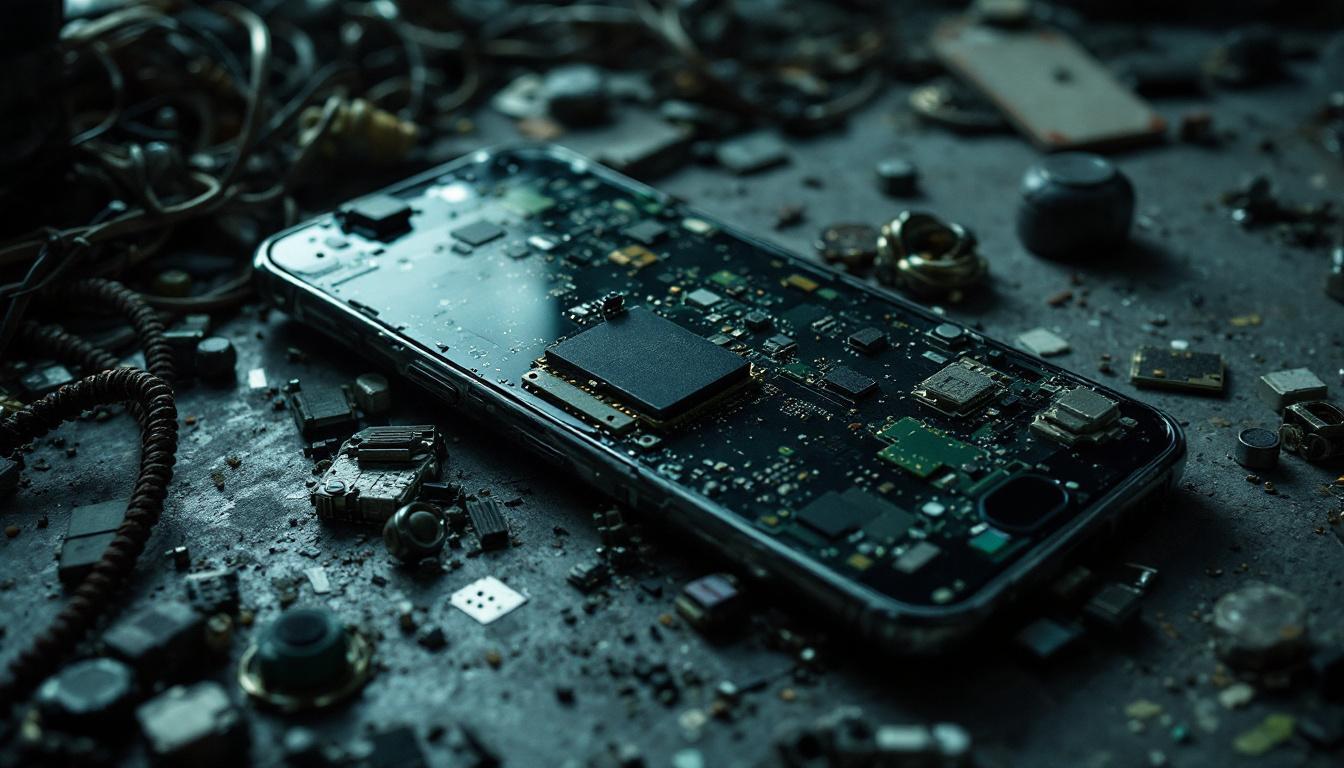
WeeeSwiss, in collaboration with STADLER, is pioneering new processes and digitalisation efforts to address the global surge in e‑waste, focusing on safety, material recovery, and regulatory compliance, with implications for industrial decarbonisation.
Electronic waste has become the defining challenge and opportunity for modern recycling infrastructure, and industry specialists at weeeSwiss , operating within the STADLER Group , position themselves at the centre of a rapidly shifting market. According to the original report by Waste Advantage, weeeSwiss brings more than three decades of experience in designing, building and operating e‑waste plants and is using that experience to respond to converging forces: steeply rising volumes, tightening regulation, changing material economics and heightened safety and digitalisation demands.
Global context and market drivers
Industry and UN data show that e‑waste is the fastest‑growing municipal waste stream. World Health Organization figures put global generation at roughly 62 million tonnes in 2022, up from 53.6 million tonnes in 2019, and forecast continual growth into the 2030s. Collection and formal recycling remain low: only around one‑fifth of e‑waste is documented as being formally collected and processed, a gap that represents both a major environmental hazard and a vast supply of secondary raw materials lost to informal or inadequate handling. The World Economic Forum and independent data providers estimate the annual value of recoverable metals and minerals in these flows at tens of billions of dollars, underlining why manufacturers and recyclers increasingly regard “urban mining” as strategic.
weeeSwiss’s vantage point and commercial thesis
For Jochen Apfel, whose career began in energy systems electronics, the business imperative has long been clear: many devices cannot practically be repaired, so systemic recycling solutions are required. “My motivation arose at a very young age, while I was completing my training as an energy systems electronics technician. I realized that I couldn’t repair all devices and wanted to develop a recycling solution.” That operational focus shapes weeeSwiss’s proposition: turnkey plant delivery, process engineering, machinery selection and market intelligence across the WEEE value chain.
Apfel and weeeSwiss frame current market dynamics as broadly favourable for investing in e‑waste processing: volumes are rising and, crucially for plant economics, recycled material prices , especially for precious metals such as gold , have trended upward. “We see very positive trends for the e‑waste recycling business, as both volumes and raw material prices are continuously rising,” he said. The shift in demand from primary mining to recovered materials is encouraging manufacturers to source recycled inputs; industry data supports that recycled content specifications and scope‑3 expectations are beginning to influence procurement strategies.
Complexity beneath the opportunity
However, the market is not a simple upswing. weeeSwiss warns that the proliferation of short‑lived, low‑value electronics , chargers, earbuds, disposable toys and similar items , adds low‑value fractions and complicates sorting, lowering the economic yield per tonne. “There are also negative trends, as more short‑lived, low-value devices – including products such as chargers, earbuds, small digital accessories, and battery-powered toys that quickly become waste – are entering the market,” Apfel explains.
Product design therefore matters. weeeSwiss highlights the importance of upstream interventions , simpler designs, fewer material mixes and easier access to batteries , to reduce fire risk and improve material recovery rates. “Manufacturers can improve recycling outcomes by simplifying product design and reducing the number of materials used, and by ensuring easy access to lithium batteries to reduce fire risks and allow safe, efficient removal before and during recycling,” Apfel says. Even where design is poor, the company asserts its plants are capable of managing battery streams safely.
Regulation, localisation and capacity
Regulatory change is reshaping trade flows and capacity planning. According to weeeSwiss, tightening rules and rising costs for cross‑border shipments in Central and Eastern Europe are reducing transnational movements of WEEE, accelerating investment in domestic processing and compelling countries to develop local recycling infrastructure. The company describes this as both a constraint and an opportunity: constrained trade increases local demand for capital projects and incentivises national operators and governments to deploy higher‑performance plants.
Technology, process innovation and digitalisation
Technological advances are enabling higher‑value recovery and safer operations. weeeSwiss reports new process developments for separating precious metals from very fine fractions that were previously lost, addressing a material loss issue that has long undermined recyclate economics. “To meet this need, we’ve just developed a new process capable of separating precious metals from very fine fractions, which in the past were often lost,” Apfel said.
The move to higher‑purity recyclates is also driving innovation in detection, sorting and process control. Apfel describes an industry tilt toward earlier separation of high‑purity fractions in the flow‑sheet, improving downstream yields. Complementing mechanical advances, STADLER’s digital platform STADLERconnect applies AI for predictive maintenance, materials analysis, mass balance calculations and energy optimisation. “It is now possible not only to create mass balances during process development but also to determine them fully automatically and in real time with the help of AI,” he says. For plant operators seeking to decarbonise operations and improve resource efficiency, such real‑time insights carry direct operational and regulatory value.
Fire safety and battery handling
Lithium‑ion battery fire risk is a persistent operational hazard. weeeSwiss and STADLER have developed integrated solutions spanning preventive separation, mechanical pre‑shredding design, fire detection and automated suppression, and safe bunker handling. “In our weeeSwiss Module 1, we separate large batteries, and for the smaller ones, we design the pre-shredder to avoid breaking the batteries, reducing fire risk,” Apfel explained. He added that systems automatically channel smouldering or burning material into safe bunkers and that explosion suppression is available where unsorted explosive materials may appear. The group is also developing combinations of automatic battery separation with manual sorting to further reduce residual risk.
Operational examples and international footprint
The alliance between STADLER’s decades of turnkey plant experience and weeeSwiss’s WEEE expertise is presented as a competitive differentiator. The companies cite projects across Europe and the United States and expansion into South America, Africa, Asia, the Middle East and Australia. A case in point is the high‑performance plant delivered for Immark AG in Regensdorf, Switzerland, described as the country’s largest e‑waste sorting facility and a benchmark for throughput, purity and fire safety.
Aiming for market leadership and higher‑grade recyclates
weeeSwiss and STADLER state an ambition to convert the technical advances into market leadership and to produce recyclates of sufficient quality to be sold directly back to manufacturers. “Together with STADLER, we aim to not only maintain technology leadership but also to become the market leader in providing e‑waste plants,” Apfel said. The firm is preparing to commission what it describes as Europe’s largest and most modern automated sorting line for household batteries , a project intended to increase recycling rates and output quality.
Implications for industrial decarbonisation
For B2B actors engaged in industrial decarbonisation, rising e‑waste recycling capability matters on multiple fronts. Higher recycling rates and purer secondary materials reduce demand for primary mining and associated emissions, while digitalised plants permit energy optimisation that contributes to site‑level decarbonisation targets. However, the scale of the challenge , low global collection rates, complex and low‑value waste fractions, and evolving regulation , means capital planning, policy alignment and upstream product stewardship will be essential to translate technological capability into measurable circularity and emissions reductions.
Conclusion
The narrative from weeeSwiss and STADLER is one of converging imperatives: escalating volumes and stronger market demand for recycled inputs create commercial incentive, regulatory shifts localise capacity needs, and technical and digital innovations make higher‑value recovery feasible and safer. Yet the industry faces friction points , product design, low collection rates and battery fire risk , that must be addressed across supply chains. For industrial decarbonisation professionals, the unfolding evolution of e‑waste processing offers tangible opportunities to substitute primary raw materials and reduce lifecycle emissions, provided public policy, design for recycling and operational investment move in step with technological progress.
- https://wasteadvantagemag.com/the-rapid-rise-of-e-waste-weeeswiss-stadler-group-explores-market-forces-creating-breakthrough-opportunities-and-systemic-challenges/ – Please view link – unable to able to access data
- https://www.who.int/news/item/28-06-2020-global-e-waste-surging-up-21-per-cent-in-5-years – In 2019, the global production of electronic waste reached a record 53.6 million tonnes, marking a 21% increase over five years. Projections indicate that by 2030, e-waste will escalate to 74 million tonnes, solidifying its status as the world’s fastest-growing domestic waste stream. This surge is primarily driven by heightened consumption of electronic devices, shorter product lifespans, and limited repair options. Alarmingly, only 17.4% of the 2019 e-waste was collected and recycled, resulting in the loss of valuable materials like gold, silver, and copper, collectively valued at $57 billion. ([who.int](https://www.who.int/news/item/28-06-2020-global-e-waste-surging-up-21-per-cent-in-5-years?utm_source=openai))
- https://www.who.int/news-room/fact-sheets/detail/electronic-waste-%28e-waste%29 – Electronic waste (e-waste) is one of the fastest-growing solid waste streams globally. In 2022, an estimated 62 million tonnes of e-waste were produced worldwide, with only 22.3% documented as formally collected and recycled. E-waste contains hazardous substances such as lead, mercury, and cadmium, which can leach into the environment when improperly managed, posing significant health risks, especially to children and pregnant women. Informal recycling activities may expose millions of women and child labourers to these hazardous substances. ([who.int](https://www.who.int/news-room/fact-sheets/detail/electronic-waste-%28e-waste%29?utm_source=openai))
- https://www.guinnessworldrecords.com/world-records/89877-fastest-growing-component-of-municipal-waste – Electronic waste, or e-waste, is recognised as the fastest-growing component of municipal waste worldwide, with an estimated 20 to 50 million tonnes generated annually. In the United States alone, 14 to 20 million personal computers are discarded each year. E-waste contains toxic heavy metals such as lead, mercury, and cadmium, which can leach into water, soils, and the atmosphere, posing significant environmental and human health risks. ([guinnessworldrecords.com](https://www.guinnessworldrecords.com/world-records/89877-fastest-growing-component-of-municipal-waste?utm_source=openai))
- https://www.weforum.org/stories/2024/04/e-waste-recycling-electronics-appliances/ – In 2022, an estimated 62 billion kilograms of electronic waste were produced globally, making e-waste the fastest-growing waste stream worldwide. However, only about one-fifth of the world’s e-waste is recycled, leading to the loss of valuable metals and minerals worth $62.5 billion each year. The World Economic Forum underscores the need for systemic change to encourage industries to embrace the circular economy and improve recycling rates. ([weforum.org](https://www.weforum.org/stories/2024/04/e-waste-recycling-electronics-appliances/?utm_source=openai))
- https://www.aa.com.tr/en/environment/global-e-waste-surges-21-in-5-years-un-report/1897694 – A UN report indicates that the world produced a record 53.6 million tonnes of electronic waste in 2019, marking a 21% increase over the past five years. The report predicts that e-waste will reach 74 million tonnes by 2030, almost doubling in 16 years. E-waste is the world’s fastest-growing domestic waste stream, driven by higher consumption rates of electronic equipment, short life cycles, and limited repair options. ([aa.com.tr](https://www.aa.com.tr/en/environment/global-e-waste-surges-21-in-5-years-un-report/1897694?utm_source=openai))
- https://www.statista.com/statistics/1067081/generation-electronic-waste-globally-forecast/ – In 2022, electronic waste generation worldwide stood at roughly 62 million metric tons. Several factors, such as increased spending power and the availability of electronics, have fueled e-waste generation in recent decades, making it the fastest-growing waste stream worldwide. This trend is expected to continue, with annual e-waste generation forecast at 82 million metric tons in 2030. ([statista.com](https://www.statista.com/statistics/1067081/generation-electronic-waste-globally-forecast/?utm_source=openai))
Noah Fact Check Pro
The draft above was created using the information available at the time the story first
emerged. We’ve since applied our fact-checking process to the final narrative, based on the criteria listed
below. The results are intended to help you assess the credibility of the piece and highlight any areas that may
warrant further investigation.
Freshness check
Score:
10
Notes:
The narrative was published on 9 December 2025, making it highly fresh. It appears to be an original press release from weeeSwiss Technology AG, a subsidiary of the STADLER Group. Press releases typically warrant a high freshness score due to their timely dissemination of new information. No evidence of recycled or republished content was found.
Quotes check
Score:
10
Notes:
The direct quotes from Jochen Apfel, CEO of weeeSwiss Technology AG, appear to be original and exclusive to this narrative. No identical quotes were found in earlier material, indicating originality.
Source reliability
Score:
10
Notes:
The narrative originates from weeeSwiss Technology AG, a reputable organisation specialising in e-waste recycling. As a subsidiary of the STADLER Group, it has a credible public presence and a legitimate website. This enhances the reliability of the information presented.
Plausability check
Score:
10
Notes:
The claims made in the narrative are plausible and align with known industry trends. The discussion on the rapid rise of e-waste and the challenges and opportunities it presents is consistent with current global concerns. The narrative lacks excessive or off-topic detail, and the tone is consistent with corporate communications.
Overall assessment
Verdict (FAIL, OPEN, PASS): PASS
Confidence (LOW, MEDIUM, HIGH): HIGH
Summary:
The narrative is a fresh, original press release from a reputable organisation, presenting plausible and consistent information without signs of disinformation.
